Ralph Jones mauls a bleeding Charles Humez against the ropes in 1956. Man, Tiger Jones was a punishing fighter, just constantly in your chest, banging away.
Ralph Jones lands a shot to the chest of Chico Vejar in 1957. It's insane how many legendary fighters Tiger Jones fought in the 50's, and he beat or held his own with all of them. Names like Rocky Castellani, Sal DiMartino, Johnny Saxton, Johnny Bratton, Danny Womber, Kid Gavilan, Bobby Dykes, Joey Giardello, Peter Mueller, Sugar Ray Robinson, Bobo Olson, Eduardo Lausse, Johnny Saxton, Gene Fullmer, Chico Vejar, Rory Calhoun, Paul Pender, and Laszlo Papp. Absolutely crazy.
Jones vs Johnny Saxton in 1955, Saxton was a good fighter but he was controlled by the mob, the Philadelphia gangster Frank "Blinky" Palermo was Saxton's manager so it's hard to know how many of his fights were fixed.
That's the thing about Ralph "Tiger" Jones, you can't go by his record, he was a strong, powerful, bruising fighter. On any given night he could give any Middleweight in history hell.
Highlights from Ralph "Tiger" Jones vs Sugar Ray Robinson in 1955, one of my favorite performances in a boxing ring on the part of Tiger Jones. He applies relentless pressure on Robinson and just walks through everything Ray hits him with. Robinson had six bags of groceries in each hand trying to carry them uphill to the front door. That's what it was facing Tiger Jones.
One final word about Ralph "Tiger" Jones, aka "Mt. Television", the guy was a beast, plain and simple, he could hang with any Middleweight in history. Too tough to knock out, in your chest, any victory against him was going to be hard-earned.
''l was described as 'pound for pound, the greatest fighter of all time.' That phrase has been like part of my name whenever l'm introduced anywhere. My ego enjoys it, but it wasn't my accompIishment. God gave me the gift. l'm a bIessed man, a chosen man. As a boy, l wanted to be a doctor, but that dream ended when l quit schooI in the ninth grade. Another dream began: to be a gIadiator.''
June 28, 1997, Christy Martin, aka "The Coal Miners Daughter", in the ring with a bloody nose during a Middleweight fight against Andrea DeShong at MGM Grand Garden Arena, Las Vegas, Nevada.
The story of Johnny "Honey Boy" Bratton. He was a very game boxer-puncher, who could go toe-to-toe and fight like a tiger, as well as box beautifully. Bratton became well-known for his incredible fighting heart, that saw him in many crowd-pleasing wars, and made him one of the favourites of the fight crowds back in the 1940s and 50s. Another one of my personal favorites.
VICE
Honey Boy Bratton: The Boxer Who Inspired Miles Davis and Muhammad Ali
By: Corey Erdman
March 29, 2017
The look and sound of Chicago in the 1940s and 1950s was strikingly different from the rest of America. During that time period, it was estimated at one point that more than 3000 African Americans per week were moving to the Windy City from various Southern states. Outside of New York, it housed the largest black population in the northern states.
Workers from the fields of Mississippi and Arkansas now were employed in Chicago packinghouses, and brought with them the sound of southern blues—the songs of labor. That familiar 12-bar riff was their soundtrack, but a welterweight slugger named Johnny Bratton was their action hero. For black children now living in Chicago, the sight of Bratton being chauffeured around in a white Cadillac, dressed in a $400 all-red suit gave hope that the dream their families had chased migrating north could become reality.
The Brattons had come to Chicago from Little Rock for the same reason. Robert S. Abbott’s Chicago Defender was widely read in the South, championing full racial equality and encouraging migration north. To many, Chicago seemed like the one place where they and their fellow African Americans could have a voice.
As Johnny was coming of age in the South Side of the Chicago—then termed the Black Belt—he struggled to find his identity. He was arrogant, prone to trouble, but had a spindly frame. Like so many others throughout history who carried those same attributes, he discovered that the boxing gym was where that combination could be moulded into something positive. And although he had tiny fists, he quickly found out they still packed a wallop.
Within a year, he’d won the Chicago Golden Gloves, and had dropped out of DuSable High School to focus entirely on fighting. DuSable’s school motto, one that is inscripted in its auditorium, is “peace if possible, but justice at any rate,” a famous quote from 19th century abolitionist Wendell Phillips. Phillips was described as “an agitator by profession”—a description Bratton would go on to hold in the eyes of fight fans outside of Chicago.
As the son of a preacher-turned-taxi driver, he had inherited his father’s charisma, but not his willingness to either study, or settle down and get a menial job. He dreamed of opulence, of stardom like the soul singers, jazz musicians and bluesmen whose records he collected. He was in a hurry to grow up, and nothing can turn you into an adult—or at that time, offer you a fortune faster—than becoming a professional fighter.
At the age of 15, Bratton signed a managerial contract with Howard Frazier, a seedy gambler with a penchant for moving his fighters quickly. It wouldn’t be long before he was a main event fighter in Chicago. According to the Detroit Free Press, less than two years into his career, he had already made more than $60,000.
Bratton spent a great deal of that money in the same time period. He had the white Cadillac, with his ring moniker “Honey Boy” on it, and a Jaguar that said “Johnny B.” By the time he was 17, he already had a child, and was divorced. Perhaps influenced by his manager, he took a liking to gambling himself, particularly dice, and developed a massive entourage which he loved to wine and dine.
It would be easy to say that Bratton blew all of his money, but the reality is that as reckless as he was at times, a great deal of his early earnings were squandered by Frazier. In 1949, Bratton noticed that money wasn’t coming in on certain nights in the dressing room, and took to the Illinois State Athletic Commission to prove what he’d suspected: Frazier had been gambling and losing many of his purses.
The deception wouldn’t undo him professionally, or turn him to a life of frugality. He had an image to maintain. Honey Boy was the idol of the black Chicago youth, the most famous black athlete in the entire city, and one that was becoming a household name throughout the country. It’s important to remember that the Gillete Cavalcade of Sports, the Friday night televised boxing program, was watched by 20 percent of the United States at its peak. By comparison, Modern Family, ABC’s top rated program today, is watched by 2.2 percent of the country.
“It’s hard for people who are young now to get a sense of how famous and how admired and how much of a command of the culture a Johnny Bratton would have had,” said author and historian Bijan Bayne. “(Chicagoans) could identify with him because his life pattern was similar. I would imagine that a lot of boys went into the Police Athletic League and the Golden Gloves hoping to become the next Bratton. Because they would have seen him. They would have actually seen him in the streets where their parents lived. There was an accessibility to him because he was so young.”
One of Bratton’s biggest admirers was Miles Davis, who spent time in Chicago in the early 1950s for two principal reasons: To study pianist Ahmad Jamal, and to meet Bratton. The two became friends, riding around in a convertible throughout town, and Davis was enamoured not only with his hero’s style, but with his fame. He was amazed when people from the streets would shout “Honey Boy!” as they were driving up and down the block.
More than that however, he loved Bratton’s style of fighting, and wanted to emulate it himself. Bratton was a sinewy, frail looking welterweight who had a flashy style unlike the brawlers that mostly populated the rankings of the day. The pizzazz was just window-dressing however, because his means of victory almost always came through devastating power punching. As he found out early in his teenage years, his little hands which were once described as “looking like they’d crumble like a potato chip,” could put any 147-pounder in the world to sleep.
Later, when he would return to New York City, Davis asked Bobby McQuillen, trainer at the legendary Gleason’s Gym, to show him “the swivel,” a fancy name for the amount of torque Bratton would put into his punches.
“Bobby was teaching me Johnny Bratton’s style, because that was the style I wanted to know. Boxing’s got style like music’s got style,” wrote Davis in his 1989 autobiography Miles.
The admiration was mutual. Like his contemporary—one he’s often compared to and overshadowed by—Sugar Ray Robinson, in the 1950s Bratton planned to begin singing in Chicago clubs. The plan never really materialized, though his love of music would be a lifelong romance. Instead, Bratton spent his nights in the club simply as a patron, or more often, simply out on the town where he could be seen.
As destructive as the behavior might have been, it also aided in bolstering Bratton’s popularity. Magazines such as Jet, founded in Chicago, took a particular fascination with his personal life. But you didn’t have to read the magazines to find out what Johnny was doing—he was everywhere. Particularly for the younger black audience in Chicago, Bratton was an accessible, visible figure, while their parents might have been in the clubs listening to Muddy Waters and Howlin’ Wolf.
“What you had was the cultural shift, from the laid back atmosphere of the rural south versus the more aggressive urban culture. And the kind of labor people were doing. You’re getting music being made by and for people who are doing backbreaking work. And when they were done with their day they would go to the neighborhood blues cafe or jazz club and wind down,” said Stereo Williams, editor-in-chief of The Boombox.
Carlo Rotella penned a 2002 book titled “Good With Their Hands,” drawing the parallel between boxers, bluesmen and laborors. In it, he wrote, “the makers of (Chicago blues) commanded the attention of an expanding black audience with music singularly expressive of the encounter with industrial urbanism: expressive in lyrics, theme, and the juxtaposition of strong, southern-accented feeling with mechanized, routinized, mass-produced—that is, industrialized—sound and experience.”
Bratton, then, bridged the gap between younger and older black audiences, and embodied the same juxtaposition as the city’s blues sound. He was a southern man living in the North, unafraid of hard work in the ring in the form of enduring punishment, but dressed with a commercial flare.
Unfortunately, Bratton often gets forgotten in boxing history because of his proximity to arguably the two greatest welterweights to ever lace up a pair of gloves: Robinson, and Kid Gavilan.
In 1951, after Robinson vacated the title to move up to middleweight, Bratton became the welterweight champion of the world, delivering a masterclass against Charley Fusari at Chicago Stadium. It would be both his biggest professional triumph, and the beginning of his demise. That night, he took home a purse of $39,000, plus 27 per cent of the gate, and an extra $1500 in television and radio rights fees. The entirety of his purse would be garnished by the government in order to pay delinquent income taxes, and an additional $5000 was withheld from him by the National Boxing Association to ensure that he made his mandatory defense against Gavilan, the number one contender.
The two would meet two months later at Madison Square Garden. Bratton’s weaknesses were well-known outside of the ring—gambling, booze, cigarettes, women, clothing—but the ones he had inside of it were exposed on this night, May 18 of 1951. The weaknesses, however, were structural. His jaw was broken at some point during the first five rounds, and his right hand was broken in two places. Later, is was discovered that he had an impacted wisdom tooth that led to the weakening of his jaw, and as the legendary Willie Pep once said of him, “a baby could have broken that jaw.”
That’s not to say that the losses were simply misfortune. Gavilan was the superior fighter—a faster, more powerful version of Bratton, and every bit the showman—and the unanimous decision on the scorecards proved it. In the locker room after the fight, Bratton couldn’t open his eyes to speak to reporters due to intense swelling.
Bratton had hit his ceiling. He couldn’t beat Gavilan, but he refused to admit it. Once, he invaded a press conference featuring Gavilan and offered to give $10,000 of his own money to charity if he’d give him a rematch—a poor allocation of funds, knowing Bratton’s deteriorating financial state. He’d get his wish later that year, battling The Cuban Hawk to a draw at home in Chicago Stadium.
It was their third and final meeting that would spell the end of Bratton’s career though. Undoubtedly weakened by hard living, and by interim bouts with hard-charging, murderous punching middleweights like Rocky Castellani and Ralph Tiger Jones, Bratton was a mere zombie in the ring that night in 1953 at Chicago Stadium. Gavilan would pound him for 15 uncomfortably one-sided rounds.
“Johnny was in a prone position on the table and his face was completely covered by towels. For the first time in my life I heard him cry. I left the dressing room to try to compose myself. When Johnny finally came out he had on dark glasses, but they did not cover the horrible sight of his completely disfigured face. At the hotel the outer room of the suite was filled to capacity with people. When I went into the bedroom I wanted to turn and run but most of all I wished that I would soon awaken from what I hoped was a nightmare. Johnny’s face was indistinguishable. His eyes were so swollen that he couldn’t open them at all. I walked up to the bed and he said, “Jo, is that you?” He then reached out his swollen hand to touch me,” Bratton’s then-wife Joanne once recalled. “I was resigned to the fact that Johnny would not quit until he made the decision himself.”
Unfortunately, Bratton knew no other way to live, much less satisfy the tax man and the mounting bill collectors. He remained in bed for two days, once again unable to upon his eyes due to the thrashing he sustained from Gavilan, at one point taking what ringside observers counted as 60 unanswered punches. His wife read him the telegrams and letters that poured in from adoring and concerned fans, and his parents visited to beg him to retire.
Bratton lost to future welterweight champion Johnny Saxton three months later, and was so lethargic that the Pennsylvania commission suspended his license and kept more than $4000 of his purse.
His body could no longer perform what his massive heart wanted to, and he was no longer good enough to make money fighting, even when he actually fought. After two more bouts, Bratton declared he was retiring, in his words, “while he still had all his buttons.” That day, his mother would see him cry once more, as he told her, “ma, I’m never again going to keep bad company.” He walked away from the sport with none of the $400,000 he had been paid out during his career.
In the grand scheme of things, only a select few boxing careers end as anything other than a tragedy. But even in the realm of tragedy, Bratton’s fate was particularly heartwrenching. Most fighters eventually lose the ability to perform their job, or any other job, having spent their lives learning an otherwise useless skill. Bratton not only lost that, he lost all of his money, and according to people at the time, his mind. His tragedy only really begins when his career ends.
In May of 1956, little more than a year after his retirement, Bratton was admitted to Manteno State Mental Hospital. The idea that Bratton was mentally ill is something that has been accepted as fact without consideration of the times. This was a time that predated comprehension of both the effects of repeated brain trauma and seemingly anything pertaining to mental illness. It’s quite possible that his admission was due to nothing more than what we would today categorize as typical concussed behavior. His retention in facilities for almost a decade likely had a lot to do with the fact that he continued to escape—once to loot a store in Atlantic City—lending credence to the institution’s theory that he was indeed “crazy.”
If his last hurrah as a boxer came the night he won the welterweight title, then the last night he was truly “Honey Boy” came in April of 1959. Bratton escaped the Chicago State Hospital with nothing other than the scrubs he was wearing, and the five records he owned: Billie Holiday, Milt Jackson, Nat King Cole, Charlie Parker, and of course, his old friend Miles Davis.
Generous street merchants purchased him a $103 suit and gave him spending cash, and his old boxing pals, former lightweight contender Luther Rawlings and Hall of Famer Bob Satterfield took him out on the town where he sipped ginger ale and smoked cigarettes. He stopped at several boxing clubs to see the young fighters, still in awe of him whether he was 60 pounds heavier or not. Before the night was over, he paid a visit to the local radio station, where he joined the nighttime broadcast and fielded more than 50 calls in 15 minutes from fans and well-wishers. Somebody else must have been listening though, namely someone with a badge, as the police scooped him up at 4:15 AM and returned him to his room.
“You know, they didn’t forget me out there on the South Side,” Bratton told Jet magazine after the incident. A local cab driver was effusive in his praise for Bratton when approached by the publication as well: “Gavilan made his face look like a hamburger, but Johnny wouldn’t go out. He wouldn’t let the South Side down.”
Bratton would make a few more escape attempts. Once, he stole the key ring and shimmied down a coal chute before borrowing money to fly to New York, where he was found and returned. Coverage of him dwindled, and by the time he was officially released in 1962, even Jet, which had committed space almost weekly to updates on Bratton in years past, spared only a few paragraphs when he came home.
By the time he was finally a free man, it was his ex-wife Joanne the tabloids cared about. No longer a call center agent struggling to get by, Joanne remarried and became Joanne Jackson, and was one of the co-founders of Golden World Records in Detroit. Golden World ran parallel with Motown Records for a time, notably producing the first Parliament record, and launching the careers of Carl Carlton and Edwin Starr, both of whom went on to have major pop hits. Ultimately, Berry Gordy would purchase the company and its headquarters at 3246 West Davison Avenue would become Motown’s “B studios” for years to come.
Before long, Johnny would be sleeping in the lobby of the Hotel del Prado in Chicago, where reporter John Schulian of the Chicago Sun-Times found him in 1979. The hotel had since been converted to apartments, but was once a hot spot for entertainers and athletes—none more popular in their day than the one crumpled up in the corner of the decaying structure.
In 1991 it was discovered that a homeless man in the New York Port Authority bus terminal had been impersonating Bratton for years, soliciting meals from compassionate old fight fans, and snatching free fight tickets from oblivious promoters. The real Bratton would get his last taste of the spotlight, if only to reveal that he was the real Honey Boy.
The episode became a laughing matter for press and readers who wondered why anyone would want to impersonate Johnny Bratton, of all people.
The reality was lost on them, as it is today, that generations of fighters, musicians and South Side Chicagoans are in some ways Bratton imposters.
“I adopted all I could from those who made the trade, bloody, vicious and savage as it might be, an art. As Sugar Ray, Kid Gavilan and Johnny Bratton had done. They were the Picassos among fighters, and they made it all seem a thing of pride, poise, courage, strength and class,” wrote Muhammad Ali in his autobiography The Greatest: My Own Story. Prior to his bout against Oscar Bonavena at Madison Square Garden, Ali had thoughts of having a sign made, dedicating the fight to Bratton, whom he’d heard had fallen on hard times. It’s a good thing he didn’t, as it likely would have been the man from the bus station who showed up to be honored, rather than the real man.
In his final interview before his death in 1993, Bratton was asked if he thought he paved the way for the generation of big-money fighters at the time.
“Yeah, I did my part. I think I did my part,” said Bratton, before offering his final words of wisdom. “Save your money, and buy good whiskey.”
I'll start off by saying that Johnny Bratton is a legend and one of my favorite fighters to watch on film, the nickname "Honey Boy" fits him well because his style, the way he operates in the ring is indeed sweet as honey, very aesthetically pleasing to the eye. He had serious knockout power, but he was also a brilliant, slick boxer and counter puncher, here's an excellent breakdown of Bratton's style.
Like most of the fights and photos I talk about and post, I'm not going to lay them out in chronological order, I'm just going to drop them and enjoy them. So without further ado. One thing about Johnny Bratton, he was in some real knock-down-drag-outs. In 1951, Bratton captured the vacant National Boxing Association World welterweight title with a split decision win over Charley Fusari, Fusari was a good fighter, he was nicknamed "The Irvington Milkman" because early in his career he bought a milk delivery business for his family with his ring earnings. It was a cracking fight, both guys were busted open, they really went to war on each other. Fusari was down for a four-count in the 4th round and a nine-count in the 10th, it was a razor close fight, but the knockdowns made the difference and Bratton earned the split decision and the NBA welterweight crown. Some great shots from that fight.
Another great fight, Johnny Bratton vs Joe Miceli in 1952. Miceli was another good fighter back in that era, very popular, he fought from lightweight all the way to middleweight, fought everyone across those three weight divisions. Miceli was one of those fighters that could beat anyone on any given night, had a murderous combination left hook/uppercut. This was a nice little donnybrook, Miceli hurt Bratton a few times but Bratton proved he could come back from being hurt and he just overwhelmed Miceli with power punches until it was stopped. One thing about Bratton, he could box, but he could be explosive and carried brutal power.
Credit: Associated Press
Johnny Bratton was hurling challenges at both welterweight champion Kid Gavilan and middleweight champion Ray Robinson Saturday after his exciting TKO win over Joe Miceli. Bratton, former NBA welter ruler, forced referee Harry Kessler to intervene in 18 seconds of the 8th round Friday night at MSG to score a TKO over Miceli. Bratton got off to a fast start and Miceli came back strong in the middle rounds to cut Bratton's right eye. Then Bratton opened the throttle wide in a vicious punching exhibition to end it. Miceli, home on an army furlough, was down for an automatic eight-count in the 1st and took a seven-count in the 7th when the bell ended the round. Bratton simply rained punishment on him in the 8th as he was driven around the ring, dazed and weary, when the referee stopped it."
Unofficial AP scorecard through seven completed rounds - 3-3-1 Even
The highlights from Bratton-Miceli, check out the right hook that Bratton catches Miceli with that drops him near the end, brutal stuff, I couldn't believe Miceli got up from it. The voice you hear doing commentary is the legendary Rocky Marciano.
Johnny Bratton and Kid Gavilán fought three times between 1951 and 1953, with Gavilán winning the first and third encounters (the latter for the World Welterweight Title) and their second bout ending in a draw, establishing a significant rivalry in the welterweight division. Their second meeting was the best of the trilogy, a hellacious life-or-death struggle that ended in a draw, Bratton's jaw was broken in the fifth round and he still finished the fight and went the distance.
Johnny Bratton (left) and Kid Gavilan face-off before their first bout
Boxing Over Broadway
Johnny Bratton vs Kid Gavilan II
No Rope A Dope In This Fight
By: Bobby Franklin
Recently, I received an email from my friend boxing historian Mike Silver, the author of The Arc Of Boxing. Mike included a link to a Youtube video of the second Kid Gavilan vs Johnny Bratton fight. He described the bout as one of the best he has seen and commented emphatically, “This is BOXING.” After that ringing endorsement I had to take a look for myself. Mike certainly was right. The fight was indeed entertaining as well as a textbook example of how much boxing has devolved over the years.
Kid Gavilan and Johnny Bratton fought three times during the period from 1951 to 1953. In their first fight Gavilan won the NBA World Welterweight Championship from Bratton. In their third fight the Kid defended the title against Johnny. Their second fight was a ten round non-title affair.
Rare today, non-title fights were not unusual years ago. They would take place when the fighters would come in over the weight limit of the division the title holder was in. This was prearranged and the fans knew they were not going to see the champion risk his belt. It was a way for a title holder to stay busy without risking his title. It was also an opportunity for someone not rated high enough to get a chance at fighting a champ and, even in losing, be able to enhance his reputation by showing he could stay in there with the best.
The second Gavilan/Bratton fight was a bit unusual as the two had fought for the title just six months earlier. In that fight, held on May 18, 1951, Bratton fought with a broken jaw from the fifth round on but lasted the full distance while losing a decision. Just six months later on November 11, 1951 the two would meet again, this time in a non-title fight. And what a fight it was.
Bratton Lands A Left On Gavilan
You might think Bratton would have been a bit gun shy after having taken such a licking in their first encounter, but at the opening bell he came out with guns blazing. Of course, Gavilan was their to meet fire with fire, and this led to a very “entertaining” fight. It also was a display of two ring wise boxing veterans plying their craft.
For the first three rounds Johnny tried matching Gavilan’s speedy combinations. This led to some great exchanges but The Kid was getting the best of them. In the 4th round Bratton changed tactics and started looking to counterpunch. He had more success with this strategy. Gavilan was a very rhythmic fighter and Johnny was trying to break that rhythm by making moves to throw the Champ off his game. Bratton even mimicked Gavilan’s trademark bolo punch in an effort to rattle him. In the seventh round the two tried to outdo one another while digging into their bags of tricks. Gavilan used head feints and a shuffle (yes, this move was around long before Ali trademarked it), and Bratton at one point pointed to the crowd in order to distract the Kid. Neither fell for the tactics but it is fun to watch them trying to one up each other.
Gavilan Lands A Right Counter On Bratton
There a few things that really stand out in this fight. Things that you will not see today or for that matter ever again in boxing. In the entire 10 rounds the fighters only clinched two times, and neither of these was a hug fest. They also went to the ropes on just one occasion. This fight, like so many from the age of boxing when it was an art form, took place almost entirely in mid-ring.
It was in the eighth round when Bratton was stepping back from Gavilan that he went against the ropes. He immediately responded by neutralizing a left hook the Champ was throwing by placing his right hand on the inside of Gavilan’s elbow as he stepped away from the ropes. This was one of two times that the referee intervened, and even that action by the third man was not needed as the two were breaking on their own.
Gavilan Beats Bratton To The Punch
It is also a pleasure to watch how these two artists used their left jabs. Today, most fighters hold their hands up against their faces in what makes them look like they are wearing ear muffs. It is impossible to throw a decent jab from that position, not that any of them seem interested in throwing jabs anyway. Both Johnny and the Kid used a classic stance where the left hand is held low and out in front of them while the right hand is kept open and held high in order to parry the opponent’s punches, their chins stay tucked into the shoulder. Having the left in this position allows for the punch to travel a shorter distance while also leaving the option of turning it into a hook or an uppercut, and for the real masters, a hook off the jab. It is also a great defensive position as Bratton showed in the 8th round when he was able to disarm Gavilan by grabbing the inside of his elbow and walking him away from the ropes. The left can also be raised in a stiff arm fashion to deflect a punch. They both employed feints in an effort to get the other to lead, knowing that a fighter is most vulnerable when he is throwing a punch.
It’s funny, but at one point the referee took a round away from Gavilan for holding and hitting. This was odd as I wasn’t able to see anything close to holding and hitting. I think the ref was feeling unneeded and wanted to justify being paid.
At the end of the ten rounds the decision was announced as a draw. If not for the referee taking away the round from Gavilan, the champ would have won the fight.
The two would meet one more time in November of 1953, this time for the title. Gavilan won a one-sided decision over fifteen rounds. The press reported that Bratton was thoroughly beaten by the 12th round but he held on until the final bell.
I highly recommend viewing the second fight between these two excellent fighters. You can watch it a number of times, and as with any great work of art you will notice new things each time you see it. And Mike was right, it is a very entertaining fight.
Johnny Bratton was one tough SOB, I'll tell you that, he had an iron chin and will. In their third fight, Bratton was pretty much past his prime, he took a beating from Gavilan but just would not quit. He went out on his shield, a gladiator if there ever was one.
Johnny Bratton and Kid Gavilan weigh in before their third meeting
Kid Gavilán made a ruthless seventh defense of the welterweight title with a 15 round unanimous decision over Johnny "Honey Boy" Bratton at Chicago Stadium in Chicago, Illinois on November 13th in 1953.
The two met twice before, with Gavilán winning the NBA title from Bratton the first time, whereas the second, a non-title bout, ended in a draw. There may have been unfinished business in that sense, but it was a younger champion being handed the torch from a faded one.
Gavilán was aggressive throughout the fight, but the early going was competitive. Then the middle rounds became hell for Bratton as he absorbed dozens of punches in the corner during the 8th round and he never appeared to recover. It was a slow beatdown from that point forward, with multiple reports suggesting the fight could have been stopped any time.
Bratton lost the decision and never won another fight before retiring in 1955.
"My best punch [was] my left hook, but he [is] very clever," Gavilán said. "He don't have glass chin, he have a rubber one."
Johnny Bratton and Kid Gavilan during their third fight, this photo of Bratton landing a brutal uppercut that distorts Gavilan's face is an epic image.
Johnny Bratton in his dressing room after the third fight with Kid Gavilan, a warrior nearing the end of a legendary career. The three Bratton-Gavilan fights were absolutely hellacious ring wars, they went 40 rounds with eachother with both fighters hearing the final bell in each fight. Bratton and Gavilan were made of material not of this earth.
I posted this photo already, but it's worth another look. This is one of the greatest boxing photos ever taken and I would give my left pinky finger to own the original type 1 copy of it. Johnny Bratton sending Robert Early lateral before scoring a 3rd round TKO at Chicago Stadium in 1945. This photo really shows the brutal power of a prime Johnny Bratton. I mean just look at this image, what a beast of a photo.
Rocky Castellani winces after Bratton's right cross explodes off his chin in the 5th round in 1952. There was no knockdowns and little bloodshed. This bout marked Bratton's invasion of the middleweight division for first time.
Johnny Bratton and Tuzo Portuguez in 1953. Bratton knocked Portuguez out in the 5th round. Bratton was nearly stopped in the 4th when he was hurt along the ropes, but he rallied to floor Portuguez for the count with two right hands.
Comments
Ralph Jones mauls a bleeding Charles Humez against the ropes in 1956. Man, Tiger Jones was a punishing fighter, just constantly in your chest, banging away.
Jones unloads a brutal uppercut on Jimmy Herring and knocking him into the ropes in 1953.
Ralph "Tiger" Jones takes a break from training to pose.
Ralph Jones lands a shot to the chest of Chico Vejar in 1957. It's insane how many legendary fighters Tiger Jones fought in the 50's, and he beat or held his own with all of them. Names like Rocky Castellani, Sal DiMartino, Johnny Saxton, Johnny Bratton, Danny Womber, Kid Gavilan, Bobby Dykes, Joey Giardello, Peter Mueller, Sugar Ray Robinson, Bobo Olson, Eduardo Lausse, Johnny Saxton, Gene Fullmer, Chico Vejar, Rory Calhoun, Paul Pender, and Laszlo Papp. Absolutely crazy.
Tiger Jones hitting the speed bag.
Jones vs Johnny Saxton in 1955, Saxton was a good fighter but he was controlled by the mob, the Philadelphia gangster Frank "Blinky" Palermo was Saxton's manager so it's hard to know how many of his fights were fixed.
Tiger Jones throws a right which connects with the right glove of Hector Constance during their featured ten rounder in 1954 at Madison Square Garden.
Tiger Jones floors Bobby Dykes in 1954.
That's the thing about Ralph "Tiger" Jones, you can't go by his record, he was a strong, powerful, bruising fighter. On any given night he could give any Middleweight in history hell.
Highlights from Ralph "Tiger" Jones vs Sugar Ray Robinson in 1955, one of my favorite performances in a boxing ring on the part of Tiger Jones. He applies relentless pressure on Robinson and just walks through everything Ray hits him with. Robinson had six bags of groceries in each hand trying to carry them uphill to the front door. That's what it was facing Tiger Jones.
Tiger Jones was slick on defense as well, slipping punches and rolling to avoid them.
A couple more good shots of Tiger Jones.
Tiger Jones wearing the beret, chatting with Jacques Royer before their fight in 1954.
Tiger Jones in an old school type fight pose.
One final word about Ralph "Tiger" Jones, aka "Mt. Television", the guy was a beast, plain and simple, he could hang with any Middleweight in history. Too tough to knock out, in your chest, any victory against him was going to be hard-earned.
''l was described as 'pound for pound, the greatest fighter of all time.' That phrase has been like part of my name whenever l'm introduced anywhere. My ego enjoys it, but it wasn't my accompIishment. God gave me the gift. l'm a bIessed man, a chosen man. As a boy, l wanted to be a doctor, but that dream ended when l quit schooI in the ninth grade. Another dream began: to be a gIadiator.''
The legendary Ray "Boom Boom" Mancini.
One of my favorite photos of "The Brown Bomber."
June 28, 1997, Christy Martin, aka "The Coal Miners Daughter", in the ring with a bloody nose during a Middleweight fight against Andrea DeShong at MGM Grand Garden Arena, Las Vegas, Nevada.
The story of Johnny "Honey Boy" Bratton. He was a very game boxer-puncher, who could go toe-to-toe and fight like a tiger, as well as box beautifully. Bratton became well-known for his incredible fighting heart, that saw him in many crowd-pleasing wars, and made him one of the favourites of the fight crowds back in the 1940s and 50s. Another one of my personal favorites.
VICE
Honey Boy Bratton: The Boxer Who Inspired Miles Davis and Muhammad Ali
By: Corey Erdman
March 29, 2017
The look and sound of Chicago in the 1940s and 1950s was strikingly different from the rest of America. During that time period, it was estimated at one point that more than 3000 African Americans per week were moving to the Windy City from various Southern states. Outside of New York, it housed the largest black population in the northern states.
Workers from the fields of Mississippi and Arkansas now were employed in Chicago packinghouses, and brought with them the sound of southern blues—the songs of labor. That familiar 12-bar riff was their soundtrack, but a welterweight slugger named Johnny Bratton was their action hero. For black children now living in Chicago, the sight of Bratton being chauffeured around in a white Cadillac, dressed in a $400 all-red suit gave hope that the dream their families had chased migrating north could become reality.
The Brattons had come to Chicago from Little Rock for the same reason. Robert S. Abbott’s Chicago Defender was widely read in the South, championing full racial equality and encouraging migration north. To many, Chicago seemed like the one place where they and their fellow African Americans could have a voice.
As Johnny was coming of age in the South Side of the Chicago—then termed the Black Belt—he struggled to find his identity. He was arrogant, prone to trouble, but had a spindly frame. Like so many others throughout history who carried those same attributes, he discovered that the boxing gym was where that combination could be moulded into something positive. And although he had tiny fists, he quickly found out they still packed a wallop.
Within a year, he’d won the Chicago Golden Gloves, and had dropped out of DuSable High School to focus entirely on fighting. DuSable’s school motto, one that is inscripted in its auditorium, is “peace if possible, but justice at any rate,” a famous quote from 19th century abolitionist Wendell Phillips. Phillips was described as “an agitator by profession”—a description Bratton would go on to hold in the eyes of fight fans outside of Chicago.
As the son of a preacher-turned-taxi driver, he had inherited his father’s charisma, but not his willingness to either study, or settle down and get a menial job. He dreamed of opulence, of stardom like the soul singers, jazz musicians and bluesmen whose records he collected. He was in a hurry to grow up, and nothing can turn you into an adult—or at that time, offer you a fortune faster—than becoming a professional fighter.
At the age of 15, Bratton signed a managerial contract with Howard Frazier, a seedy gambler with a penchant for moving his fighters quickly. It wouldn’t be long before he was a main event fighter in Chicago. According to the Detroit Free Press, less than two years into his career, he had already made more than $60,000.
Bratton spent a great deal of that money in the same time period. He had the white Cadillac, with his ring moniker “Honey Boy” on it, and a Jaguar that said “Johnny B.” By the time he was 17, he already had a child, and was divorced. Perhaps influenced by his manager, he took a liking to gambling himself, particularly dice, and developed a massive entourage which he loved to wine and dine.
It would be easy to say that Bratton blew all of his money, but the reality is that as reckless as he was at times, a great deal of his early earnings were squandered by Frazier. In 1949, Bratton noticed that money wasn’t coming in on certain nights in the dressing room, and took to the Illinois State Athletic Commission to prove what he’d suspected: Frazier had been gambling and losing many of his purses.
The deception wouldn’t undo him professionally, or turn him to a life of frugality. He had an image to maintain. Honey Boy was the idol of the black Chicago youth, the most famous black athlete in the entire city, and one that was becoming a household name throughout the country. It’s important to remember that the Gillete Cavalcade of Sports, the Friday night televised boxing program, was watched by 20 percent of the United States at its peak. By comparison, Modern Family, ABC’s top rated program today, is watched by 2.2 percent of the country.
“It’s hard for people who are young now to get a sense of how famous and how admired and how much of a command of the culture a Johnny Bratton would have had,” said author and historian Bijan Bayne. “(Chicagoans) could identify with him because his life pattern was similar. I would imagine that a lot of boys went into the Police Athletic League and the Golden Gloves hoping to become the next Bratton. Because they would have seen him. They would have actually seen him in the streets where their parents lived. There was an accessibility to him because he was so young.”
One of Bratton’s biggest admirers was Miles Davis, who spent time in Chicago in the early 1950s for two principal reasons: To study pianist Ahmad Jamal, and to meet Bratton. The two became friends, riding around in a convertible throughout town, and Davis was enamoured not only with his hero’s style, but with his fame. He was amazed when people from the streets would shout “Honey Boy!” as they were driving up and down the block.
More than that however, he loved Bratton’s style of fighting, and wanted to emulate it himself. Bratton was a sinewy, frail looking welterweight who had a flashy style unlike the brawlers that mostly populated the rankings of the day. The pizzazz was just window-dressing however, because his means of victory almost always came through devastating power punching. As he found out early in his teenage years, his little hands which were once described as “looking like they’d crumble like a potato chip,” could put any 147-pounder in the world to sleep.
Later, when he would return to New York City, Davis asked Bobby McQuillen, trainer at the legendary Gleason’s Gym, to show him “the swivel,” a fancy name for the amount of torque Bratton would put into his punches.
“Bobby was teaching me Johnny Bratton’s style, because that was the style I wanted to know. Boxing’s got style like music’s got style,” wrote Davis in his 1989 autobiography Miles.
The admiration was mutual. Like his contemporary—one he’s often compared to and overshadowed by—Sugar Ray Robinson, in the 1950s Bratton planned to begin singing in Chicago clubs. The plan never really materialized, though his love of music would be a lifelong romance. Instead, Bratton spent his nights in the club simply as a patron, or more often, simply out on the town where he could be seen.
As destructive as the behavior might have been, it also aided in bolstering Bratton’s popularity. Magazines such as Jet, founded in Chicago, took a particular fascination with his personal life. But you didn’t have to read the magazines to find out what Johnny was doing—he was everywhere. Particularly for the younger black audience in Chicago, Bratton was an accessible, visible figure, while their parents might have been in the clubs listening to Muddy Waters and Howlin’ Wolf.
“What you had was the cultural shift, from the laid back atmosphere of the rural south versus the more aggressive urban culture. And the kind of labor people were doing. You’re getting music being made by and for people who are doing backbreaking work. And when they were done with their day they would go to the neighborhood blues cafe or jazz club and wind down,” said Stereo Williams, editor-in-chief of The Boombox.
Carlo Rotella penned a 2002 book titled “Good With Their Hands,” drawing the parallel between boxers, bluesmen and laborors. In it, he wrote, “the makers of (Chicago blues) commanded the attention of an expanding black audience with music singularly expressive of the encounter with industrial urbanism: expressive in lyrics, theme, and the juxtaposition of strong, southern-accented feeling with mechanized, routinized, mass-produced—that is, industrialized—sound and experience.”
Bratton, then, bridged the gap between younger and older black audiences, and embodied the same juxtaposition as the city’s blues sound. He was a southern man living in the North, unafraid of hard work in the ring in the form of enduring punishment, but dressed with a commercial flare.
Unfortunately, Bratton often gets forgotten in boxing history because of his proximity to arguably the two greatest welterweights to ever lace up a pair of gloves: Robinson, and Kid Gavilan.
In 1951, after Robinson vacated the title to move up to middleweight, Bratton became the welterweight champion of the world, delivering a masterclass against Charley Fusari at Chicago Stadium. It would be both his biggest professional triumph, and the beginning of his demise. That night, he took home a purse of $39,000, plus 27 per cent of the gate, and an extra $1500 in television and radio rights fees. The entirety of his purse would be garnished by the government in order to pay delinquent income taxes, and an additional $5000 was withheld from him by the National Boxing Association to ensure that he made his mandatory defense against Gavilan, the number one contender.
The two would meet two months later at Madison Square Garden. Bratton’s weaknesses were well-known outside of the ring—gambling, booze, cigarettes, women, clothing—but the ones he had inside of it were exposed on this night, May 18 of 1951. The weaknesses, however, were structural. His jaw was broken at some point during the first five rounds, and his right hand was broken in two places. Later, is was discovered that he had an impacted wisdom tooth that led to the weakening of his jaw, and as the legendary Willie Pep once said of him, “a baby could have broken that jaw.”
That’s not to say that the losses were simply misfortune. Gavilan was the superior fighter—a faster, more powerful version of Bratton, and every bit the showman—and the unanimous decision on the scorecards proved it. In the locker room after the fight, Bratton couldn’t open his eyes to speak to reporters due to intense swelling.
Bratton had hit his ceiling. He couldn’t beat Gavilan, but he refused to admit it. Once, he invaded a press conference featuring Gavilan and offered to give $10,000 of his own money to charity if he’d give him a rematch—a poor allocation of funds, knowing Bratton’s deteriorating financial state. He’d get his wish later that year, battling The Cuban Hawk to a draw at home in Chicago Stadium.
It was their third and final meeting that would spell the end of Bratton’s career though. Undoubtedly weakened by hard living, and by interim bouts with hard-charging, murderous punching middleweights like Rocky Castellani and Ralph Tiger Jones, Bratton was a mere zombie in the ring that night in 1953 at Chicago Stadium. Gavilan would pound him for 15 uncomfortably one-sided rounds.
“Johnny was in a prone position on the table and his face was completely covered by towels. For the first time in my life I heard him cry. I left the dressing room to try to compose myself. When Johnny finally came out he had on dark glasses, but they did not cover the horrible sight of his completely disfigured face. At the hotel the outer room of the suite was filled to capacity with people. When I went into the bedroom I wanted to turn and run but most of all I wished that I would soon awaken from what I hoped was a nightmare. Johnny’s face was indistinguishable. His eyes were so swollen that he couldn’t open them at all. I walked up to the bed and he said, “Jo, is that you?” He then reached out his swollen hand to touch me,” Bratton’s then-wife Joanne once recalled. “I was resigned to the fact that Johnny would not quit until he made the decision himself.”
Unfortunately, Bratton knew no other way to live, much less satisfy the tax man and the mounting bill collectors. He remained in bed for two days, once again unable to upon his eyes due to the thrashing he sustained from Gavilan, at one point taking what ringside observers counted as 60 unanswered punches. His wife read him the telegrams and letters that poured in from adoring and concerned fans, and his parents visited to beg him to retire.
Bratton lost to future welterweight champion Johnny Saxton three months later, and was so lethargic that the Pennsylvania commission suspended his license and kept more than $4000 of his purse.
His body could no longer perform what his massive heart wanted to, and he was no longer good enough to make money fighting, even when he actually fought. After two more bouts, Bratton declared he was retiring, in his words, “while he still had all his buttons.” That day, his mother would see him cry once more, as he told her, “ma, I’m never again going to keep bad company.” He walked away from the sport with none of the $400,000 he had been paid out during his career.
In the grand scheme of things, only a select few boxing careers end as anything other than a tragedy. But even in the realm of tragedy, Bratton’s fate was particularly heartwrenching. Most fighters eventually lose the ability to perform their job, or any other job, having spent their lives learning an otherwise useless skill. Bratton not only lost that, he lost all of his money, and according to people at the time, his mind. His tragedy only really begins when his career ends.
In May of 1956, little more than a year after his retirement, Bratton was admitted to Manteno State Mental Hospital. The idea that Bratton was mentally ill is something that has been accepted as fact without consideration of the times. This was a time that predated comprehension of both the effects of repeated brain trauma and seemingly anything pertaining to mental illness. It’s quite possible that his admission was due to nothing more than what we would today categorize as typical concussed behavior. His retention in facilities for almost a decade likely had a lot to do with the fact that he continued to escape—once to loot a store in Atlantic City—lending credence to the institution’s theory that he was indeed “crazy.”
If his last hurrah as a boxer came the night he won the welterweight title, then the last night he was truly “Honey Boy” came in April of 1959. Bratton escaped the Chicago State Hospital with nothing other than the scrubs he was wearing, and the five records he owned: Billie Holiday, Milt Jackson, Nat King Cole, Charlie Parker, and of course, his old friend Miles Davis.
Generous street merchants purchased him a $103 suit and gave him spending cash, and his old boxing pals, former lightweight contender Luther Rawlings and Hall of Famer Bob Satterfield took him out on the town where he sipped ginger ale and smoked cigarettes. He stopped at several boxing clubs to see the young fighters, still in awe of him whether he was 60 pounds heavier or not. Before the night was over, he paid a visit to the local radio station, where he joined the nighttime broadcast and fielded more than 50 calls in 15 minutes from fans and well-wishers. Somebody else must have been listening though, namely someone with a badge, as the police scooped him up at 4:15 AM and returned him to his room.
“You know, they didn’t forget me out there on the South Side,” Bratton told Jet magazine after the incident. A local cab driver was effusive in his praise for Bratton when approached by the publication as well: “Gavilan made his face look like a hamburger, but Johnny wouldn’t go out. He wouldn’t let the South Side down.”
Bratton would make a few more escape attempts. Once, he stole the key ring and shimmied down a coal chute before borrowing money to fly to New York, where he was found and returned. Coverage of him dwindled, and by the time he was officially released in 1962, even Jet, which had committed space almost weekly to updates on Bratton in years past, spared only a few paragraphs when he came home.
By the time he was finally a free man, it was his ex-wife Joanne the tabloids cared about. No longer a call center agent struggling to get by, Joanne remarried and became Joanne Jackson, and was one of the co-founders of Golden World Records in Detroit. Golden World ran parallel with Motown Records for a time, notably producing the first Parliament record, and launching the careers of Carl Carlton and Edwin Starr, both of whom went on to have major pop hits. Ultimately, Berry Gordy would purchase the company and its headquarters at 3246 West Davison Avenue would become Motown’s “B studios” for years to come.
Before long, Johnny would be sleeping in the lobby of the Hotel del Prado in Chicago, where reporter John Schulian of the Chicago Sun-Times found him in 1979. The hotel had since been converted to apartments, but was once a hot spot for entertainers and athletes—none more popular in their day than the one crumpled up in the corner of the decaying structure.
In 1991 it was discovered that a homeless man in the New York Port Authority bus terminal had been impersonating Bratton for years, soliciting meals from compassionate old fight fans, and snatching free fight tickets from oblivious promoters. The real Bratton would get his last taste of the spotlight, if only to reveal that he was the real Honey Boy.
The episode became a laughing matter for press and readers who wondered why anyone would want to impersonate Johnny Bratton, of all people.
The reality was lost on them, as it is today, that generations of fighters, musicians and South Side Chicagoans are in some ways Bratton imposters.
“I adopted all I could from those who made the trade, bloody, vicious and savage as it might be, an art. As Sugar Ray, Kid Gavilan and Johnny Bratton had done. They were the Picassos among fighters, and they made it all seem a thing of pride, poise, courage, strength and class,” wrote Muhammad Ali in his autobiography The Greatest: My Own Story. Prior to his bout against Oscar Bonavena at Madison Square Garden, Ali had thoughts of having a sign made, dedicating the fight to Bratton, whom he’d heard had fallen on hard times. It’s a good thing he didn’t, as it likely would have been the man from the bus station who showed up to be honored, rather than the real man.
In his final interview before his death in 1993, Bratton was asked if he thought he paved the way for the generation of big-money fighters at the time.
“Yeah, I did my part. I think I did my part,” said Bratton, before offering his final words of wisdom. “Save your money, and buy good whiskey.”
I'll start off by saying that Johnny Bratton is a legend and one of my favorite fighters to watch on film, the nickname "Honey Boy" fits him well because his style, the way he operates in the ring is indeed sweet as honey, very aesthetically pleasing to the eye. He had serious knockout power, but he was also a brilliant, slick boxer and counter puncher, here's an excellent breakdown of Bratton's style.
The counter punching of Johnny Bratton.
Like most of the fights and photos I talk about and post, I'm not going to lay them out in chronological order, I'm just going to drop them and enjoy them. So without further ado. One thing about Johnny Bratton, he was in some real knock-down-drag-outs. In 1951, Bratton captured the vacant National Boxing Association World welterweight title with a split decision win over Charley Fusari, Fusari was a good fighter, he was nicknamed "The Irvington Milkman" because early in his career he bought a milk delivery business for his family with his ring earnings. It was a cracking fight, both guys were busted open, they really went to war on each other. Fusari was down for a four-count in the 4th round and a nine-count in the 10th, it was a razor close fight, but the knockdowns made the difference and Bratton earned the split decision and the NBA welterweight crown. Some great shots from that fight.
Here are the highlights from Johnny Bratton-Charley Fusari, what a war, it earned 1951 Fight of the Year honors.
just an epic thread
well done sir 🤙
I> @galaxy27 said:
Thank you kindly, I'm having a blast, an absolute blast, it's like a good book that you just can't put down!
Another great fight, Johnny Bratton vs Joe Miceli in 1952. Miceli was another good fighter back in that era, very popular, he fought from lightweight all the way to middleweight, fought everyone across those three weight divisions. Miceli was one of those fighters that could beat anyone on any given night, had a murderous combination left hook/uppercut. This was a nice little donnybrook, Miceli hurt Bratton a few times but Bratton proved he could come back from being hurt and he just overwhelmed Miceli with power punches until it was stopped. One thing about Bratton, he could box, but he could be explosive and carried brutal power.
Credit: Associated Press
Johnny Bratton was hurling challenges at both welterweight champion Kid Gavilan and middleweight champion Ray Robinson Saturday after his exciting TKO win over Joe Miceli. Bratton, former NBA welter ruler, forced referee Harry Kessler to intervene in 18 seconds of the 8th round Friday night at MSG to score a TKO over Miceli. Bratton got off to a fast start and Miceli came back strong in the middle rounds to cut Bratton's right eye. Then Bratton opened the throttle wide in a vicious punching exhibition to end it. Miceli, home on an army furlough, was down for an automatic eight-count in the 1st and took a seven-count in the 7th when the bell ended the round. Bratton simply rained punishment on him in the 8th as he was driven around the ring, dazed and weary, when the referee stopped it."
Unofficial AP scorecard through seven completed rounds - 3-3-1 Even
The highlights from Bratton-Miceli, check out the right hook that Bratton catches Miceli with that drops him near the end, brutal stuff, I couldn't believe Miceli got up from it. The voice you hear doing commentary is the legendary Rocky Marciano.
Johnny Bratton and Kid Gavilán fought three times between 1951 and 1953, with Gavilán winning the first and third encounters (the latter for the World Welterweight Title) and their second bout ending in a draw, establishing a significant rivalry in the welterweight division. Their second meeting was the best of the trilogy, a hellacious life-or-death struggle that ended in a draw, Bratton's jaw was broken in the fifth round and he still finished the fight and went the distance.
Johnny Bratton (left) and Kid Gavilan face-off before their first bout
Boxing Over Broadway
Johnny Bratton vs Kid Gavilan II
No Rope A Dope In This Fight
By: Bobby Franklin
Recently, I received an email from my friend boxing historian Mike Silver, the author of The Arc Of Boxing. Mike included a link to a Youtube video of the second Kid Gavilan vs Johnny Bratton fight. He described the bout as one of the best he has seen and commented emphatically, “This is BOXING.” After that ringing endorsement I had to take a look for myself. Mike certainly was right. The fight was indeed entertaining as well as a textbook example of how much boxing has devolved over the years.
Kid Gavilan and Johnny Bratton fought three times during the period from 1951 to 1953. In their first fight Gavilan won the NBA World Welterweight Championship from Bratton. In their third fight the Kid defended the title against Johnny. Their second fight was a ten round non-title affair.
Rare today, non-title fights were not unusual years ago. They would take place when the fighters would come in over the weight limit of the division the title holder was in. This was prearranged and the fans knew they were not going to see the champion risk his belt. It was a way for a title holder to stay busy without risking his title. It was also an opportunity for someone not rated high enough to get a chance at fighting a champ and, even in losing, be able to enhance his reputation by showing he could stay in there with the best.
The second Gavilan/Bratton fight was a bit unusual as the two had fought for the title just six months earlier. In that fight, held on May 18, 1951, Bratton fought with a broken jaw from the fifth round on but lasted the full distance while losing a decision. Just six months later on November 11, 1951 the two would meet again, this time in a non-title fight. And what a fight it was.
Bratton Lands A Left On Gavilan
You might think Bratton would have been a bit gun shy after having taken such a licking in their first encounter, but at the opening bell he came out with guns blazing. Of course, Gavilan was their to meet fire with fire, and this led to a very “entertaining” fight. It also was a display of two ring wise boxing veterans plying their craft.
For the first three rounds Johnny tried matching Gavilan’s speedy combinations. This led to some great exchanges but The Kid was getting the best of them. In the 4th round Bratton changed tactics and started looking to counterpunch. He had more success with this strategy. Gavilan was a very rhythmic fighter and Johnny was trying to break that rhythm by making moves to throw the Champ off his game. Bratton even mimicked Gavilan’s trademark bolo punch in an effort to rattle him. In the seventh round the two tried to outdo one another while digging into their bags of tricks. Gavilan used head feints and a shuffle (yes, this move was around long before Ali trademarked it), and Bratton at one point pointed to the crowd in order to distract the Kid. Neither fell for the tactics but it is fun to watch them trying to one up each other.
Gavilan Lands A Right Counter On Bratton
There a few things that really stand out in this fight. Things that you will not see today or for that matter ever again in boxing. In the entire 10 rounds the fighters only clinched two times, and neither of these was a hug fest. They also went to the ropes on just one occasion. This fight, like so many from the age of boxing when it was an art form, took place almost entirely in mid-ring.
It was in the eighth round when Bratton was stepping back from Gavilan that he went against the ropes. He immediately responded by neutralizing a left hook the Champ was throwing by placing his right hand on the inside of Gavilan’s elbow as he stepped away from the ropes. This was one of two times that the referee intervened, and even that action by the third man was not needed as the two were breaking on their own.
Gavilan Beats Bratton To The Punch
It is also a pleasure to watch how these two artists used their left jabs. Today, most fighters hold their hands up against their faces in what makes them look like they are wearing ear muffs. It is impossible to throw a decent jab from that position, not that any of them seem interested in throwing jabs anyway. Both Johnny and the Kid used a classic stance where the left hand is held low and out in front of them while the right hand is kept open and held high in order to parry the opponent’s punches, their chins stay tucked into the shoulder. Having the left in this position allows for the punch to travel a shorter distance while also leaving the option of turning it into a hook or an uppercut, and for the real masters, a hook off the jab. It is also a great defensive position as Bratton showed in the 8th round when he was able to disarm Gavilan by grabbing the inside of his elbow and walking him away from the ropes. The left can also be raised in a stiff arm fashion to deflect a punch. They both employed feints in an effort to get the other to lead, knowing that a fighter is most vulnerable when he is throwing a punch.
It’s funny, but at one point the referee took a round away from Gavilan for holding and hitting. This was odd as I wasn’t able to see anything close to holding and hitting. I think the ref was feeling unneeded and wanted to justify being paid.
At the end of the ten rounds the decision was announced as a draw. If not for the referee taking away the round from Gavilan, the champ would have won the fight.
The two would meet one more time in November of 1953, this time for the title. Gavilan won a one-sided decision over fifteen rounds. The press reported that Bratton was thoroughly beaten by the 12th round but he held on until the final bell.
I highly recommend viewing the second fight between these two excellent fighters. You can watch it a number of times, and as with any great work of art you will notice new things each time you see it. And Mike was right, it is a very entertaining fight.
Johnny Bratton was one tough SOB, I'll tell you that, he had an iron chin and will. In their third fight, Bratton was pretty much past his prime, he took a beating from Gavilan but just would not quit. He went out on his shield, a gladiator if there ever was one.
Johnny Bratton and Kid Gavilan weigh in before their third meeting
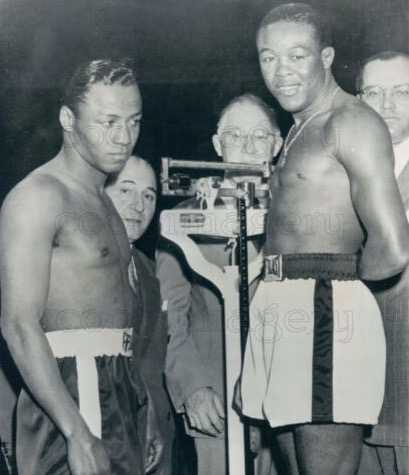
Kid Gavilán made a ruthless seventh defense of the welterweight title with a 15 round unanimous decision over Johnny "Honey Boy" Bratton at Chicago Stadium in Chicago, Illinois on November 13th in 1953.
The two met twice before, with Gavilán winning the NBA title from Bratton the first time, whereas the second, a non-title bout, ended in a draw. There may have been unfinished business in that sense, but it was a younger champion being handed the torch from a faded one.
Gavilán was aggressive throughout the fight, but the early going was competitive. Then the middle rounds became hell for Bratton as he absorbed dozens of punches in the corner during the 8th round and he never appeared to recover. It was a slow beatdown from that point forward, with multiple reports suggesting the fight could have been stopped any time.
Bratton lost the decision and never won another fight before retiring in 1955.
"My best punch [was] my left hook, but he [is] very clever," Gavilán said. "He don't have glass chin, he have a rubber one."
Johnny Bratton and Kid Gavilan during their third fight, this photo of Bratton landing a brutal uppercut that distorts Gavilan's face is an epic image.
Johnny Bratton in his dressing room after the third fight with Kid Gavilan, a warrior nearing the end of a legendary career. The three Bratton-Gavilan fights were absolutely hellacious ring wars, they went 40 rounds with eachother with both fighters hearing the final bell in each fight. Bratton and Gavilan were made of material not of this earth.
I posted this photo already, but it's worth another look. This is one of the greatest boxing photos ever taken and I would give my left pinky finger to own the original type 1 copy of it. Johnny Bratton sending Robert Early lateral before scoring a 3rd round TKO at Chicago Stadium in 1945. This photo really shows the brutal power of a prime Johnny Bratton. I mean just look at this image, what a beast of a photo.
Let's get a few more Johnny Bratton photos in here, sick photo of Bratton dodging a right hand from Kid Gavilan in their first fight in 1951.
Johnny Bratton laying in Charley Fusari in 1951.
Rocky Castellani winces after Bratton's right cross explodes off his chin in the 5th round in 1952. There was no knockdowns and little bloodshed. This bout marked Bratton's invasion of the middleweight division for first time.
Bratton on the speed bag.
Johnny Bratton lands a brutal right hand on Bobby Jones in 1953, Bratton dominated and knocked Jones out in the 5th.
Johnny Bratton and Tuzo Portuguez in 1953. Bratton knocked Portuguez out in the 5th round. Bratton was nearly stopped in the 4th when he was hurt along the ropes, but he rallied to floor Portuguez for the count with two right hands.
Johnny Bratton standing beside his white Jaguar.
Johnny Bratton dukes it out with a 5-year-old at Sheil House on South Michigan Avenue in 1946.
Bratton on the cover of TV Boxing.
A series of photos that Johnny Bratton autographed.
Johnny Bratton raises his fist for the camera.
Great up close shot of Bratton.