Hey look, it's time for a word from our sponsors. This thread is being brought to you by Pillsbury Cinnamon Rolls, they're the undisputed champion of cinnamon rolls, try some today!
Kid Chocolate sends Bushy Graham to the canvas in their wild 1929 fight at the New York Colosseum. Kid Chocolate won when Graham was disqualified in the 7th round.
April 13, 1929
18,000 SEE GRAHAM LOSE TO CHOCOLATE; Cuban Featherweight Declared Winner on Foul in 7th in Inaugural at Coliseum. GRAHAM IN LEAD AT TIME Utica Boy, Warned on Several Occasions, Had Slight Edge --Brady Victor. THOUSANDS TURNED AWAY Police Disperse Ticket Seekers-- Ringside Fans Yield Seats to Mayor Walker and His Party. Judge Joh Calls Foul. Graham Sent to One Knee. Crowd Noisy Gathering.
Credit...The New York Times
The New York Coliseum in the Bronx opened last night with a spectacular featherweight battle, but an unsatisfactory finish brought the inaugural feature to an untimely close. Kid Chocolate, Cuban negro fighter, won from Bushey Graham, Utica veteran, on a foul in the seventh round of their scheduled fifteen-round encounter. There followed a great roar from : 18,000 fight fans, men and women, some shouting in rebuke for the disqualified lad, some in rebuttal of the disqualification. Referee Jack Dorman disqualified Graham after 2 minutes and 4 seconds of the seventh round, giving Chocolate the fight at a time when Graham was ahead on points. There could be no dissent with the disqualification, because Graham had violated the rules of warfare and was deserving of punishment. Chocolate was down twice, once tinder a foul blow and Graham was down as many times from punches which were clean and upset him. In the first round Graham floored his foe for a count of one. In the second Chocolate sent Graham to his knee with a smashing right to the jaw. Later in the round Chocolate hobbled off to a neutral corner to fall on his knees, claiming an illegal left which was palpably foul. Judge Joh Calls Foul. In the sixth Judge Billy Joh at the ringside called a flagrant foul - which escaped the eye of Referee Dorman because he was out of position, and then Graham was told that another offense would mean his disqualification. The offense came in the next round. Graham protested the disqualification, explaining that his foot slipped as he leaped in on the attack, but the explanation fell on deaf ears. Though he was ahead at the time the bout ended, Graham was weakening under the pace. Great exertion was entailed in his own peculiar style and there was considerable punishment in the punches Chocolate rained upon his head and body at close quarters. The first five rounds held more action than is ordinarily crowded into the average ten-round battle and excitement was proportionate. Graham pumped left hooks into Chocolate's body and face to start the fight and then suddenly electrified the crowd by upsetting Chocolate with a right to the jaw. Chocolate took only a count of one and rose to weather a gale of blows. Graham Sent to One Knee. At the start of the second, Chocolate crashed over a right to the jaw which caught Graham off balance and sent Bushey to one knee. Chocolate tried desperately to press his advantage, and won the round. In one exchange Graham shot over a left which looked low, and Chocolate was hurt by the blow. The Cuban dragged himself to a neutral corner, where he went to one knee in pain, but neither judge could verify the punch and the bout proceeded. Later Graham again was warned for striking low with the left. Graham's dancing style and accurate hitting with left hooks gave him the third round. In this session Chocolate won the crowd when he smilingly assisted his foe back to the ring as Graham almost dove through the ropes after missing a right for the jaw. A late rally won Chocolate the fourth round and found him drilling rights to Graham's jaw in a frenzied outburst of offensive fighting which had the crowd yelling wildly. Chocolate once fell to his knees from the impact of his own blow and his position while delivering it. Graham was warned again in this round for fouling. Through the fifth and sixth sessions Graham's dancing, slapping. hooking style gave the up-State lad these sessions beyond question. Chocolate tried every trick at his command, but was unable at times even to land a jab. The seventh found Graham running into a rally by Chocolate and fighting off the Cuban until suddenly Graham slipped a left to the body, which was erratic and ended the fight. Chocolate weighed 120 pounds and Graham 121½ pounds.
On July 15th, 1931, Kid Chocolate became junior lightweight champion with a 7th round TKO of Benny Bass in Philadelphia, making Kid Chocolate Cuba's first ever world champion. Benny Bass eas nicknamed "Little Fish", he was an all-time great, tough as nails fighter, he's a Hall of Famer. Strongly built with muscular shoulders, Bass's signature punch was a powerful left hook to the midsection, and he enjoyed fighting on the inside, a frequent requirement from his relative lack of reach. Tough, great fighter was Benny Bass.
The Fight City
Boxiana
July 15, 1931: Chocolate vs Bass
By: Patrick Connor
Throughout boxing history, world titles have assumed various levels of worth, some about as valuable as your proverbial wooden nickel. It’s a process unlikely to ever stop, as different sanctioning bodies and incarnations of championships are always being created and destroyed, but if naught else the belts do signify some kind of achievement and often function as a means to an end. And indeed a world title belt not universally recognized triggered a wave of patriotism and euphoria in Cuba on behalf of Eligio Sardiñas, aka the great “Kid Chocolate,” the island nation’s first world champion.
A 160-0 amateur record, as reported by Chocolate’s manager Luis “Pincho” Gutierrez, was likely fudged, but no one could deny “The Keed” seemed destined for stardom. The former newsboy brought his entertaining ring style to New York in 1928, along with his stablemate Black Bill, and after only ten fights, Kid Chocolate caught on as a major attraction. He stayed that way as he went on a 61-3-1 tear, putting himself in line for a chance to face Benny Bass, holder of the National Boxing Association’s super featherweight title, a championship acknowledged by some, but not all.
Benny Bass
The losses on Chocolate’s ledger came at the hands of Jack “Kid” Berg, Fidel LaBarba and Bat Battalino, and were all forgivable, if not disputed. Still, the Cuban’s popularity caught up with him, as noted by Kansas City editor Edward Cochrane: “About a year ago [Chocolate] was rated by the leading fistic experts of two continents as the best featherweight in the world despite the fact that he did not hold the title. Then he went the way of all boxers. He decided he could do Broadway at night and retain his fighting form but he found that he could not.”
A title shot loss against New York’s featherweight champion Battalino perhaps reflected the cost of such high living. The Kid then moved up to super featherweight, a division still struggling for legitimacy a decade after its semi-formal inception.
Bass was no unknown himself, though despite his history of being warned and even disqualified for low blows, Bass was more soft spoken than The Kid. But his record of 105-15-3 proved his toughness and experience, even if he had trouble winning the important ones. Losing to Tony Canzoneri was understandable, but Pete Nebo, Eddie Shea and Mike Dundee were all beatable opponents. Unfortunately, Bass often underperformed, starting with losing a spot on the 1920 U.S. Olympic team in the semi-finals of the Amateur Athletic Union games. (He was sent packing by William Cohan, who would then be defeated by Frankie Genaro, the eventual gold medalist.)
After having picked up a vacant featherweight belt, which he then lost to Canzoneri, Bass won the NBA junior lightweight title with a two round destruction of Tod Morgan in 1929. But then the New York State Athletic Commission moved to abolish all junior or supplemental weight classes and ceased to recognize Bass as a champion at 130. It was another hit to a division largely considered superfluous.
All through 1930 and the first half of 1931, Bass could not consistently prevail over good fighters, but due to the screwy rule in some jurisdictions stating that champions needed to be stopped to lose a belt, he managed to hold on to his NBA title and his defense against the Cuban was set for Shibe Park in Philadelphia.
In training, Bass pitched hay at his Berlin, N.J. farm between gym sessions, while Chocolate worked at the headquarters of George Godfrey just outside of Philadelphia. The Kid even wrestled with Godfrey, who outweighed him by 100 pounds or more, after sessions with his usual sparring partner, Nick Florio. The irony of Kid Chocolate grappling with a fighter named after George “Old Chocolate” Godfrey aside, the exercise probably did little to enhance his boxing skills. It did, however, keep The Kid in great shape, as he came into the match weighing well below the super featherweight limit.
Bass and Chocolate weigh in
Following an intense opening round, Bass returned to his corner complaining that the vision in his left eye was quickly diminishing. He would later state he had been thumbed, and in round two the same eye opened up, spilling copious amounts of blood. From then on, The Kid set himself to annex the belt on cuts, as he mercilessly pecked away at the bad eye. A United News report out of Pittsburgh read, “Bass was bewildered by Chocolate’s boxing skill and frequently swung all the way around in attempts to hit his opponent. On other occasions he wound up with his back to the Cuban.”
The champion’s usually trusty left hook was easily dodged or taken on Chocolate’s gloves, though Bass sometimes found The Kid’s body, where he was said to be weak. But the difference in speed and sharpness was a killer, and through rounds five and six the challenger dished out welts and whips galore. Bass was fading quickly and The Kid sensed a world title within his grasp. The end came in round seven.
Kid Chocolate celebrates his big win
“[Bass] was in a battered condition when Referee Leo Houck ordered the bout stopped,” reported The New York Times. “His left eye was closed and bleeding badly, while he also had a split under his chin. On the other hand, Chocolate appeared virtually unharmed as the battle ended. To celebrate winning the title the Cuban danced for joy in his corner as the crowd set up a roar of acclaim.”
The Kid had every right to celebrate. After all, blindness had already retired Black Bill, Cuba’s other championship hope, and with the victory Kid Chocolate became Cuba’s first world titlist and an overnight national hero.
Kid Chocolate floors Fidel LaBarba at Madison Square Garden in 1932, The Keed defeated LaBarba by majority decision, defending both the featherweight and junior lightweight titles. Fidel LaBarba is another all-time great fighter in the Hall of Fame, LaBarba won the gold medal in the flyweight division at the 1924 Summer Olympics in Paris. Love this image of Kid Chocolate, awesome pose with the arms out.
In 1932 Kid Chocolate defended his junior lightweight championship with a 10-round unanimous decision over Eddie Shea in Chicago. This image captures Chocolate sending Shea to the canvas in round 3.
1933, Kid Chocolate defended his featherweight and junior lightweight titles with a 15-round unanimous decision over Seaman Tommy Watson at Madison Square Garden. Love that bottom image of Kid Chocolate leaping forward with everything he's got about to hit Watson with a right hook to the body, what an electrifying fighter.
Great shot of Kid Chocolate in the ring against Jack "Kid" Berg, Berg was an all-time great, he was nicknamed "The Whitechapel Whirlwind" because of his non-stop, relentless punching style that originated from his time fighting in London's Whitechapel district. The nickname highlighted his perpetual motion and ability to overwhelm opponents with a constant barrage of punches, earning him a reputation for being both powerful and tireless. Berg would hand Chocolate his first professional loss and defeat him again in their rematch.
Great shot of Kid Chocolate after knocking out Lew Feldman and winning the New York State Featherweight championship in 1932 at MSG. They fought eachother four times in the early 1930s, Kid Chocolate won all four fights.
Love this image of Kid Chocolate standing on a scale at a weigh-in, staring at Al Singer. They fought at the Polo Grounds in 1929 and Chocolate won a 12-round decision. Kid Chocolate had a freakishly intimidating look about him.
There's a cool type 1 original photo of Kid Chocolate on ebay right now, authenticated and slabbed by PSA. I managed to find another image of Chocolate that obviously was taken at the same shoot, it forms a neat little sequence.
One of the greatest boxing photos ever taken, a photo of Eligio Sardiñas Montalvo, aka the legendary "Kid Chocolate," the first ever world boxing champion from Cuba, enjoying some ice cream during training camp in 1931. I would absolutely love to own the original type 1 photo of this image.
This is an absolutely fascinating story, quite a few legendary boxers ended up working odd jobs years after their careers ended, and people would track them down and interview them about their careers and chat with them. Well, back in the 1960s, this guy got a tip that Kid Chocolate was working in a nightclub in Chicago and he decided to find out for himself it was true.
SPORTS OF THE TIMES; The Riddle of Kid Chocolate
Share full article
By Ira Berkow
Aug. 21, 1988
A brief obituary in this newspaper recently noted that Kid Chocolate, the former boxing champion, died in Havana under, if not mysterious circumstances, then certainly unrevealed circumstances.
The news came by way of the Cuban state radio and no details were given concerning survivors or cause of death.
The item sketched some background of the Kid, who was 78 years old when he died on Aug. 8.
He was born Eligio Sardinias in Cerro, Cuba, and came to America in the late 1920's and shortly emerged as one of the finest boxers of his era. He won the New York featherweight title, then considered a major championship, in 1932, and the world junior-lightweight title the following year. He retired in 1938 with a professional record of 132-10 with 50 knockouts. He was elected to the Boxing Hall of Fame in 1959.
Now we go back 20 years, to the winter of 1968. I was visiting in Chicago when someone told me he heard that Kid Chocolate was working as a handyman in a nightspot on the near North Side.
I didn't know much about the Kid, other than that he was a champion, and a kind of flashy and highly skilled boxer - he was also called the Cuban Bon Bon. And I knew that he had supposedly returned to Cuba when he retired, received a Government pension, but had slipped from public view. Some thought Chocolate was dead. It was worth a trip to the nightclub to find out.
It's not uncommon for old boxers to wind up in humble positions. Joe Louis was a so-called greeter in a Las Vegas casino. Beau Jack, the former lightweight champion, was a bootblack in Miami Beach. Johnny Bratton, the former welterweight champion, slept on park benches in Chicago.
I phoned the club and asked for Kid Chocolate. The man who answered was the boss. He told me that a few years before a guy had tried to break into the club. ''The Kid flattened him with one punch,'' said the boss. ''Yep, he's still got the goods. And what a fine, warm, gentle guy he is. Does a great job here, too.''
The afternoon that I visited the club, it rained darkly outside, but inside in the muted red-velvet tawdriness, it was quiet, the doors not yet open. The only sounds were the plinking of rain on the window and the clinking of glasses and bottles being sorted behind the mirrored bar by a rather slight black man. He wore a hat with a narrow upturned brim and introduced himself as Kid Chocolate.
''I'm feelin' great, like I could get back in the ring tomorrow,'' he said. ''But I'm not sure my legs would agree. I'm 60 years old now. But every morning you can still see me doing the roadwork in Washington Park. I takes real good care of myself. Eat the right foods. Don't take the weed. Don't drink, neither. I just run the stuff you see here.''
''You gotta stay sharp,'' he continued. ''I mean, it's a critical world we livin' in. When I was champ I was like a rattlesnake. Still am, too. If I'm rattlin', you better be movin'. Take the guy who tried to get in here awhile back. He didn't heed the warning. You do not take no chances with this cat.'' He stuck his thumb in his chest. ''So I popped him through the alley. That's how a rattlesnake do. He rattles. Woof, he hits you!'' He wiped a long-stemmed glass and placed it upside down on the bar. He was asked about his days as champion.
''I forgets about it now,'' he said. ''Don't like to talk much about it. You start seein' it in your mind, and that's all you thinking about. Drive you crazy, like it done Johnny Bratton.
''I was a big man then, but I didn't get no swell head. Use to like to do the cabaretin' and good timin', though. My home was New Orleans and them days I was always 'round Bourbon Street. You hear about that place? I was friends with ol' Chick Webb and Fatha Hines and Louie Armstrong and Count Basie. 'Member them?
''I made money the hard way, didn't graft it like some others done. Now I only associate with the poor class, 'cause I'm from the poor class. But some who makes it big forgets the little man. Some peoples don't look back at the poor folk. That's what is wrong with the world today. When I sees the scum I toss 'em a few bucks and say, 'Enjoy it, boys.' Then I leave. They'll respect you and maybe later they'll listen to you when you tell 'em about the good life.
''I got a little green saved up. Know what I'd like to do with it? Open a boys camp. Yessir. Lecture the young 'uns on clean livin'. Wouldn't that be somethin'?''
When I returned to New York with my notes, I called Nat Fleischer, the boxing expert, then 82 years old. I asked about Kid Chocolate.
Fleischer said that the last time he saw him was at a fight in Havana in 1959, shortly before Batista's regime collapsed.
''He was sickly,'' said Fleischer, ''bent over and he walked with a cane. It's like he disappeared when Castro came. If the Kid was in America, we surely would know about it. He was extremely popular. It would be big news.''
I called the nightspot and spoke to the man who said he was Kid Chocolate. I told him what I had learned.
He admitted that he wasn't Kid Chocolate, though he said he had once been a boxer and used that name. Kid Chocolate was his idol. ''People call me 'champ,' '' he said, ''and I only goes by what they call me.''
Now the real Kid Chocolate, the Cuban Bon Bon, is dead. I don't know what happened to the other fellow, but he was a lovely guy, and a capable imposter, with one recorded knockout to his credit.
This is one of my favorite boxing photos of all-time. I'm a big history buff, I'm always watching documentaries about the evolution of humans, the life that came before us, and in this photo Kid Chocolate looks like an ancient species of primitive human, he just looks really cool. Another photo I would love to own.
Mike Tyson discusses Kid Chocolate. For those who don't know, Mike Tyson could be a college professor on boxing history, he's watched film and studied every fighter there is to study, his legendary trainer Cus D'Amato used to show him a lot of film and teach him about the rich history of the sport.
26-year-old Londoner John H. Stracey got up from a first-round knockdown in Mexico City to halt the six-year reign of Mexican-based Cuban Jose Napoles in the welterweight division on this day in 1975 stopping the 31-year-old champion in the sixth round for the WBC title.
"It was my proudest moment. I had 51 fights, won 45, lost five and drew one. But once you have won a world title, it never gets better," said Stracey.
It was to be the last fight of Napoles' glittering career.
James J. Jeffries, aka "The Boilermaker." He was a beast, prime Jeffries was no joke.
''Well, I'm a peaceful sort of person, but I could always fight a bit, and when they offered a few dollars to fight Dan Long in San Francisco some thirteen years ago, I just fell for it. I was 'no pumpkins,' as they say, in those days, but I beat Long so easily that I thought there might be something in it, and I decided to investigate. Delaney took me down to Shaw's Springs, where Corbett was training for Fritz. I found Corbett dead easy, and I acquired the idea that I might some day or another become the champion myself. I won the championship eventually, as I dare say you know.
I think my first fight with Sharkey was about the roughest passage I ever had. Sharkey was the roughest 'tough' that ever drew breath, and when we clashed he started in to play his little games with me. Well, I don't want to brag, but when Tom tried to 'rough' me I just tore him off like a rat.
The hardest puncher I ever run up against was Bob Fitzsimmons, my goodness! How that man couId punch! I caught one waIIop in our second match that made me think of home and mother! If Fitz had onIy been a IittIe bigger he wouId have achieved even greater fame than he has aIready done. But at that, I don't think he wouId ever have beaten me, for to teII you the truth, it was practicaIIy impossibIe to reaIIy hurt me when I was in my prime.''
Yeah, no kidding, James J. Jeffries was a beast all right. He never lost in his prime. The only loss on his record came from a ill-fated comeback against Jack Johnson in 1909, and Jeffries had been out of the ring for six years at the time he challenged Johnson. There's a reason Jeffries never lost in his prime.
Credit: Tracy G. Callis, boxing historian, IBRO
James J. Jeffries won the Heavyweight Championship of the World the same way he accomplished most things in his life – he made up his mind he wanted it and battered down anyone who got in his way. Jeffries, along with Rocky Marciano, are two of the most highly criticized Heavyweight Champions, due to their crude styles of fighting, but they were also the only two men to retire unbeaten during their active careers. Unfortunately, Jeffries was talked into a comeback - after being out of the ring for six years - and experienced the only loss of his career. For this fight, he shed 70 pounds, had no warm up fights prior to the contest – only sparring sessions and a few exhibitions, and fought in 110 degree weather against a great fighter, Jack Johnson. Johnson was at his peak and had fought 42 bouts since Jeffries had retired. Jeffries was rusty and "over-the-hill". Yet, today, many analysts rate him on the basis of this fight. As a fighter, Jeffries traded on strength, power hitting, a tough chin, wonderful stamina, and an indomitable will. He was a heavy hitter with both fists and caved in the ribs of many opponents with his sledge-hammer left hook – Bob Fitzsimmons, Jim Corbett, Tom Sharkey, Gus Ruhlin, and Pete Everett to name five. He also sent Joe Goddard to the hospital after a heavy battering. Keith (in his book, Games and Sports, 1969 p 127) said "Jeffries probably owned the deadliest left hook the prize ring has ever known". Tex Rickard said "he’s the hardest hitter I ever saw and that includes Dempsey". Jeffries, himself, once said he never hit a man as hard as he could for fear of killing him. Some writers portray Jeffries as slow-moving and ponderous. This is not true. He was able to move very fast. He tracked down and knocked out clever Peter Jackson, the all-time great boxer-puncher. He cornered and hammered Bob Armstrong, the 6’4", fast-moving, sharp-jabbing African American. He outran the speedy Jim Corbett, Bob Fitzsimmons, and Joe Choynski in footraces and all of these men were fast runners. In addition, Jeffries could jump high into the air – over six feet. Some critics call Jeffries a "one-armed" fighter. This is not true either. He threw short, straight, jolting blows with each fist when fighting in close. He also used a thundering right uppercut. From a distance, he utilized a punishing left jab and a bashing left hook. Further, he used a crouch which made it difficult to hit him cleanly. When an opponent moved in to hit him, he ran the risk of getting hammered with that left hook or having Jeffries spring forward quickly and pound away with those short, bludgeoning left-right blasts. Sometimes heads collided but that never phased Jeffries. If a skirmish became distasteful, Jeffries would take hold of his man and shove him backward 5-6 feet with his enormous strength and resume the battle from there – stalking his man, resembling a bear as he moved forward. Interestingly enough, Jeffries reminds one of a bulldog when seen in his crouch. The Jeffries chin was a phenomenal structure and it would certainly hold up against most of the "best ever" hitters. The dynamite puncher Tom Sharkey punched at it in two contests and could not hurt it. Bob Fitzsimmons and a number of others broke their hands and injured their wrists hitting it. The Jeffries stamina was awesome too - if he could not outbox an opponent, he could certainly outlast him. He fought two grueling fights with Tom Sharkey, endured two punishing battles with Bob Fitzsimmons, and chased down shifty Jim Corbett in two long contests.
James J. Jeffries was an absolute unit of a man, his nickname "The Boilermaker" was very fitting. They also called him "The California Grizzly" because of his immense size, strength, and rugged fighting style, which observers compared to a bear. Jeffries was a large and powerful man for his era, standing 6'2" and and weighing over 220 pounds during his fighting prime.
James J. Jeffries on the right, you can see how big he was in his prime. He just battered the hell of guys, overwhelmed them with sheer strength and power. On top of that he had a granite chin. This is a photo of his fight against "Gentleman Jim" Corbett in 1898, Corbett is an all-time great, he's called the "father of modern boxing" because he was the first fighter to really apply science to boxing, thinking and strategy. He outboxed Jeffries for 23 rounds in this fight before Jeffries finally caught up to him and knocked him out.
You know, it's interesting, I poke around on eBay a lot, I collect boxing photos and cards, and I run into pictures of James J. Jeffries and "Sailor" Tom Sharkey together, they obviously were good friends and it's understandable why, they took eachother to hell, to the edge of death. They went a total of 45 rounds with eachother in two of the most punishing fights in boxing history. I can see how going through something like that would form a bond. Both were monsters, two of the toughest men to ever enter a boxing ring, able to take ungodly amounts of punishment. Two men with hellish mindsets.
The Fight City
Nov. 3, 1899: Jeffries vs Sharkey II
By: Kenneth Bridgham
James J. Jeffries, a former boilermaker from Los Angeles, California, was the hulking, square-jawed heavyweight champion of the world, the third to win the title with gloves on. His predecessors were the bare-knuckle icon John L. Sullivan, the crafty and scientific James J. Corbett, and the hard-hitting Bob Fitzsimmons, the man from whom he won the crown via knockout on June 9th, 1899, at Coney Island. Known for his ability to deliver and endure punishment, Jeffries was a muscular slugger who fought out of a unique crouch, his left hand extended out before him.
James J. Jeffries, aka “The Boilermaker.”
Less than five months after securing the most prized title in sports, Jeffries was back at Coney Island to make his first defense against Ireland’s Tom Sharkey. The tattooed “Sailor Tom” had learned to box while serving in the U.S. Navy. A stockier version of the much larger champion, Sharkey stood less than 5’9″ tall (Jeffries was almost 6’3″), but he was a rugged warrior. He had shared a ring with both Corbett and Fitzsimmons and took Jeffries through twenty hard-fought rounds in San Francisco in 1898, losing by decision. After “Jeff,” as Jeffries’s fans called him, won the championship, a rematch was only logical.
The second Jeffries vs Sharkey battle was scheduled for twenty-five rounds and would supersede even the original for brutality. four hundred newly installed arc lights hung too low above the ring to illuminate the action for the primitive movie camera that would be rolling for posterity. They were so low, Jeffries later said that he could reach up and touch them. An electrician insisted they were the most powerful assemblage of lights yet assembled in one place by man, equaling the power of eighty thousand candles. When they were turned on, they temporarily blinded the audience. The writer for The Brooklyn Daily Eagle felt the temperature at ringside was possibly over one hundred degrees. For the fighters, the result was scalding heat that literally blistered their skin over the course of the match.
“Sailor” Tom Sharkey
Challenger Sharkey was the aggressor from the start, swinging away at the jabbing champion, who landed the more precise blows in the early going. Enjoying a six-inch height advantage and a reach advantage of the same amount, the normally slugging Jeffries showed more boxing ability than ever before in keeping his opponent at a distance and using head movement to avoid incoming blows. He had been training of late with the skilled middleweight champion Tommy Ryan. Sharkey’s weapon of choice was the left hook, and he connected several of these to Jeffries’s head in the opening frame. When the smaller man got inside, Jeffries leaned all of his 210 pounds upon the challenger’s neck and back. He outweighed Sharkey by 27 pounds.
In round two, Jeffries scored a knockdown near a corner. The Irish fighter made it to his feet and rushed right back in, only to hit the deck a second time. But he made it up yet again and, showing great resilience, landed a right to the champion’s ribs that was “enough to knock a hole in a stone wall.” But it was also during this round that Jeffries’ left arm gave out, the result of a previous injury. For the rest of the fight, he would have to rely almost exclusively on his right.
Sharkey down in round two.
Rounds three through seven bore witness to the most thrilling ring action since the bare-knuckle age. Fans would afterward continuously argue over who won these rounds, with Sharkey as the unrelenting aggressor and the one-armed Jeffries laying back and landing the more telling single shots. A succession of hard rights from Jeff in the eighth round had Sharkey nearly out. A bad cut over his left eye multiplied Sharkey’s troubles in the tenth and made a scarlet target for Jeffries through the rest of the fight.
Both combatants showed signs of fatigue by the middle rounds, but Jeffries caught a second wind in the later stages and switched his punishment to Sharkey’s ribs, resolving to finish the fight and get out from underneath the punishing lights. With a single blow (sources differ as to the round in which it occurred), he cracked one of Sharkey’s ribs. “I felt the rib go,” Sharkey said later. “It jumped in, and then I thought it would jump out of my skin.” Amazingly, the challenger refused to relent. As the fighters mauled away at center ring, a headbutt opened a gash on the champion’s forehead; another chipped a tooth. Sharkey’s right ear had swollen to grotesque proportions; “a big wet sponge,” was how Jeffries later described it. Both fighters were bloodied, blistered, and bruised. The heat under the lights was so intense that multiple people ringside lost consciousness. Jeffries, the ex-boilermaker, later compared it to standing before a blast furnace for more than an hour. Yet both warriors fought on.
In round twenty-four, Sharkey repeatedly uncorked his left hook in a desperate bid to secure a knockout over the bigger man. But he left himself wide open, and the champ countered with punishing rights to the jaw that repeatedly staggered the challenger, forcing him to hold to stay on his feet. To start the final frame, Sharkey charged across the ring like a horned ram. He walked through stiff jabs and snapping uppercuts to unleash his own furious assault on Jeffries’s skull, but he left his damaged ribs exposed and Jeffries sent home right-hand blows to Sharkey’s side. Decades later, writer Alexander Johnston, who was at the fight, remembered the report of those punches echoing through the arena. Another well-timed uppercut to Sharkey’s jaw nearly finished him, but “Sailor Tom” held on long enough to stay on his feet. Both were exhausted and the fight devolved into pure caveman-like brawling, Jeffries clearly getting the better of it.
As the final bell approached, Jeffries shoved Sharkey to the floor. Turning “a complete somersault” in his fall, Sharkey clutched Jeffries’s left glove and pulled it off. Sharkey then stood up and, as referee George Siler was lacing up the champion’s glove, lunged around the ref to attack. Though there are different versions of the story, many contend that Jeffries retaliated with a powerful bare-handed blow. Siler pushed Sharkey away, and the bell rang. Ignoring it, Sharkey lashed out with a right hand that struck Jeffries on the shoulder before he could be dragged away.
The final bell: Sharkey in his corner as Jeffries is toweled off at ring center.
Siler awarded the fight to Jeffries, and the crowd boisterously agreed, though Johnston later reported that Sharkey had his loyalists, who favored the challenger’s unrelenting aggression. The fight had lasted an hour and forty minutes under the torturous blaze of the electric lights. Afterward, both fighters admitted that the heat fatigued and dehydrated them. Jeffries claimed to have lost twenty pounds in his effort to save his title and he would never again fight underneath such lights, lucrative film proceeds be damned.
James J. Jeffries won the world heavyweight title in 1899 against the legendary, all-time great pound-for-pound fighter Bob Fitzsimmons. I kid you not when I say Fitzsimmons was one of the greatest pound-for-pound fighters in boxing history, he was undisputed middleweight, light heavyweight, and heavyweight champion in his career, he was the original weight division jumper. He was pound-for-pound before the term was a thing. Fitzsimmons was also one of the hardest punchers in boxing history, Fitzsimmons is a legend.
Bob Fitzsimmons (left) and James J. Jeffries face-off in a turn of the century studio photograph.
"'When I retired back in 1904 a lot of experts claimed I was unbeatable - that I was just naturally so big and fast and tough and strong that there was no use expecting any other fighter to beat me. I never did agree with that.
I was not a 'natural'. I was a 'made' fighter.
The night I fought [Bob] Fitzsimmons for the title I was 24 years old, weighed better than 200lb, could run the hundred in under 11 seconds, and could do the standing high jump to the height of my shoulders.
I fought from a crouch that made it hard to hit me where it hurt. Fitz was the greatest body puncher there was, but he wrecked his hands on me that night. I fought with my left hand extended, and I had a knockout in it that never travelled more than a few inches. But how much of that could you call natural?
It was no more natural for me to run the hundred barefoot in 11 seconds than it was for any other 200-pounder. I'd worked for years to build up that speed.
The crouch and that left hand weren't natural: I'd spent hundreds of hours of drilling, trying out this idea and that, sweating my head off and taking plenty of punches before I had them readied up for a man like Fitzsimmons.
I trained like a horse. When I didn't train - well, I went in untrained against Jim Corbett once, and he boxed the ears off me for 23 rounds before I finally got to him. It wasn't just natural for me to lick the other boy.
If I'd been a natural-born fighter I might have been a kiIIer in the ring - I had the strength of it. But thank God I didn't have that temperament. I only once went in the ring angry, wanting to hurt the other fellow. I only once tried to hit the other boy as hard as I could - and that time I missed.
I worked out in training with the roughest fighters I could hire, but I never in my life knocked out a sparring partner, and never tried to.
I fought only one preliminary in my career, and I got to the top in ten starts after that. The record book makes it look quick and easy - like I was some kind of ring wonder.
But the work I did doesn't show in the book. I fought my first pro fight when I was 16 years old, and I put in eight years of the toughest kind of plugging before I got my shot at the title. The plugging don't show in the record book, but I did it.''
James J. Jeffries used a 40-pound advantage to win the heavyweight championship with a bruising 11th round KO of Bob Fitzsimmons at the Coney Island Athletic Club in Brooklyn, New York on June 9th in 1899.
Not only did Fitzsimmons have a serious experience advantage over Jeffries, but he was recognized as the more polished fighter and would have been on a long KO streak if not for old lawman Wyatt Earp unfairly disqualifying him against Tom Sharkey. Fitzsimmons, the former middleweight champion, was also one of the greatest punchers of all time. But he was still middleweight-sized.
Jeffries had a few struggles that showed he could be out-boxed and out-sped, and he didn't have a ton of fights under his belt. But he was strong as an ox and incredibly durable, and he was willing to walk through anything to win.
The opening round was simple sparring, but round 2 was telling: near the end of the round, Jeffries sent Fitzsimmons down hard with a jab. Fitzsimmons got up wobbly and fell toward Jeffries as the bell sounded and saved him. Fitzsimmons fought hard in round 3, evidently feeling the urgency of the situation. And in round 5, Fitzsimmons landed a punch that cut Jeffries over his left eye before bulling the bigger man to the ropes.
Fitzsimmons showed his class in rounds 6 and 7, as he maneuvered around Jeffries and outworked him with both hands. But the 8th round was where it went wrong for the champion.
Jeffries once more hurt Fitzsimmons with a jab and the champion's corner screamed for him to avoid punishment. Fitzsimmons retaliated and stunned Jeffries at the end of the round, but damage was done.
"Fitzsimmons looked like a beaten man" at the start of round 9, one report said. Jeffries softened him up with body punches and hard jabs in the 9th, and in round 10 Jeffries got aggressive and sent Fitz down with a left hand. Fitzsimmons' manager Martin Julian sprinted to his fallen fighter and dumped water on him as he was getting up. Then Jeffries sent him down again in short order, right before the bell.
Fitzsimmons was all but done, but he answered the bell for round 11. Jeffries knocked him clean out with a combination and the crowd of 9,000 went berserk.
"Fitz fought a good and game battle and hit me harder than any man whom I have been up against," Jeffries said. "I am satisfied that I have well earned the right to be called champion by beating Fitzsimmons, who was undoubtedly the greatest fighter of the age."
"Jeffries is a corker, and there is not a man on earth that can beat him," Fitzsimmons said. "He's a wonder, and no mistake."
James J. Jeffries vs Bob Fitzsimmons II, two Goliaths collide for the second time.
James J. Jeffries and Bob Fitzsimmons shake hands before their second fight
The Fight City
July 25, 1902: Jeffries vs Fitzsimmons II
By: Robert Portis
It is difficult to say how heavyweight champion James J. Jeffries would have matched up against more contemporary boxers, but there’s no doubt he was an extraordinary fighter. He lost only one match in his entire career and that bout, against the great Jack Johnson, happened long after his prime had passed. Unfortunately, it is one of only two of Jeffries’ twenty-four pro matches to ever be filmed, the other being his rematch in 1899 with legendary brawler “Sailor” Tom Sharkey. But the video quality of the latter, and the fact the former is of a fight taking place after almost six years of inactivity, mean neither gives us a chance to make a fair evaluation.
Jeffries had won the world title in 1899 from the great Bob Fitzsimmons at Coney Island, New York in just his fourteenth bout. The bigger and heavier challenger had bulled his way inside the smaller champion’s guard and inflicted a vicious body attack, scoring four knockdowns and forcing a stoppage in eleven rounds. The rematch took place three years later, after Fitzsimmons had put together a nice streak of wins capped by a dramatic second round knockout of the same tough Sharkey who had lasted 25 brutal rounds with Jeffries. That win set the stage for a rematch between “The Boilermaker” and “The Fighting Blacksmith,” and fight fans eagerly awaited Jeffries vs Fitzsimmons II.
Bob Fitzsimmons. Drawing by Damien Burton.
But Jeffries made his rival wait a couple more years and by the time the return finally happened, many wondered if the 39-year-old Cornishman’s advancing age might be too much to overcome. Besides, Jeffries figured to outweigh the challenger by thirty pounds or more. But those who backed the man who many today still regard as one of the greatest power punchers in the history of the sport, cited the former champion’s eagerness for revenge. Simply put, no fight had ever mattered more to “Ruby” and rumour had it he was so hell-bent on winning he planned to load his gloves with Plaster of Paris.
“Let him do it,” said Jeffries when told of these reports. “I’ll flatten him anyway.”
“The Boilermaker” in his prime.
No plaster was to be found inside the challenger’s gloves, but those watching in The Arena in San Francisco could be forgiven for thinking there was, as from the opening bell the smaller man inflicted a cruel beating on the champion. As early as the second round Jeffries was shedding blood as Fitzsimmons applied tremendous pressure, beating Jeffries to the punch over and over again. Rudy’s hard shots opened up deep cuts around both of Jeffries’ eyes and broke the champion’s nose. It was later revealed the challenger had in fact wrapped his hands with electrical tape instead of gauze, with no one from Jeffries’ camp objecting.
Newspaper cartoon depicts the one-sided nature of the match.
But the champion was nothing if not tough and durable and despite the carnage, he refused to concede. Instead he waited for his chance to strike back and it came in round eight. After a series of exchanges, Jeffries cornered his man. Fitzsimmons then inexplicably paused, lowered his guard, and spoke to Jeffries. The champion’s response was to move in and land a hard right to the belly followed by a thunderous left hook to the jaw that put Fitzsimmons down and out.
When the challenger approached the champion a few minutes later to congratulate him, Jeffries, seated on his stool, peered up at Fitzsimmons through swollen, bleeding eyes and declared, “You’re the most dangerous man alive.”
Jeffries and Fitzsimmons: a pair of all-time greats.
The bout’s conclusion struck some observers as suspicious and talk of a “fix” began to circulate in the days following, though both boxers dismissed the speculation. “The fight was won fairly and to the best man belongs the laurels,” stated Fitzsimmons.
No one knows what the Cornishman paused to say to Jeffries just before the fatal punches found their mark. Was it a taunt which provoked a violent response from the champion? Or, as some later asserted, a kind of surrender? One version of the odd ending has it that after seven torrid rounds during which Fitzsimmons had repeatedly landed his best shots, the challenger was exhausted. Instead of absorbing a beating as the match went on, “Ruby,” knowing he had nothing left, simply paused, dropped his hands, and told Jeffries, “Hit me.” “The Boilermaker” obliged and the fight was over.
Another Jeffries fight I want to mention is his fight against Joe Choynski in 1897, Choynski held Jeffries to a draw, the closest anyone came to beating Jeffries in his prime, although some thought Jeffries did enough to earn the win. Choynski was nicknamed "Chrysanthemum Joe", and "The California Terror", he was a murderous puncher, James J. Jeffries actually said the hardest punch he was hit with in his career was by Choynski, in fact Choynski landed a punch that broke Jeffries nose and drove his lip between his teeth, Jeffries corner had to pry them out with a knife. In fact, Choynski was the reason why Jeffries started fighting from a crouch position. Jeffries, who was rushed along quite quickly at the beginning of his career, took on the experienced ring genius in Joe Choynski. Granted, Choynski was giving up almost fifty pounds in weight, but Choyinski used his quicker feet and wiser mind to his advantage as he stayed away from Jeffries's power and was able to score on his own. Although Jeffries claims he dropped Choynski with a left hook to the neck, he also claims that Joe scored once with a right that knocked his lower lip between his front two teeth, an injury which required a lip incision to relieve Jeffries of the pain. Jeffries states that was the hardest punch he'd ever taken. Some disagreed with the decision, believing that Jeffries did enough forcing to earn the nod, but Joe was so impressive in the science he displayed in the ring that the referee gave him part of the honors in ruling the affair a draw. I would love to have seen this fight, two brutal punchers locking horns. This is a photo of James J. Jeffries and Joe Choynski (right) facing off.
Ok, let's get to the nastiness of that era of boxing. James J. Jeffries retired as the unbeaten heavyweight champion in 1905, but in 1910 he was coaxed out of retirement by the racists of white America. By 1910, Jack Johnson had become the heavyweight champion and white America just couldn't live with the fact that a black man was the heavyweight champion, so they talked Jeffries out of retirement and he accepted the challenge of trying to bring the heavyweight title back to the white race. It was a shameful time, and a shameful thing to do, but sadly it was the way things were back then. I must say this, Jack Johnson was one of the bravest men to ever live, he faced all kinds of death threats throughout his career, the man literally was a walking target everyday of his life, but he didn't give a crap, he earned that heavyweight title and he wasn't going to give it up because of a bunch of racist low lives. I don't think people fully appreciate how brave Jack Johnson was and the danger he faced everyday for years and years. So, Jeffries came out of retirement and he was deemed "The Great White Hope" by the white people who hoped Jeffries would be their savior and bring the heavyweight title back to the so called superior race, it was labeled "The Fight of The Century." It didn't work out like they planned.
The Fight City
July 4, 1910: Johnson vs Jeffries
By: Eliott McCormick
In 1910, Jack Johnson and James J. Jeffries clashed in Reno, Nevada to contest the world heavyweight crown in what was then billed as “The Fight of the Century.” At stake was far more than a mere boxing championship, as the black Johnson, having taken the belt from Canadian Tommy Burns in 1908, was thought by the white public in America to be wholly unfit to hold the title. Jeffries, an undefeated former champion and the most legitimate “Great White Hope,” had been repeatedly summoned to return to boxing so he could defeat the brash Johnson and reinstate the white man’s rightful place atop the athletic hierarchy. His quest would prove fruitless, but the legendary Johnson vs Jeffries match, with its buildup and aftermath, was a genuine sensation and social phenomenon, an event which galvanized the public while reflecting the hateful ideologies of the age.
Jack Johnson
While one recognizes the obvious racism of a society which regarded white people as inherently superior, for a present day boxing fan to actually understand the climate of fear and hatred attending this racial tinderbox of a fight is inherently difficult. In acknowledging this disconnect, it is still remarkable to contemplate Jack Johnson’s determination to defeat Jeffries despite the danger involved. Violence, after all, was the nasty appendage to an event whose ramifications went far beyond boxing. Consider the grandiloquence of Christian Socialist Reverdy Ransom, who stated that “the greatest marathon race of the ages is about to begin between the white race and the darkest races of mankind. What Jack Johnson seeks to do to Jeffries in the roped arena will be the ambition of negroes in every domain of human endeavor.”
Jeffries (centre) training with Choynski (left) and Corbett.
Because Jeffries had retired undefeated, many felt he remained the true champion. Almost 35-years-old, and having not stepped through the ropes in six years, he now weighed close to three hundred pounds. Despite this, Jeffries was besieged by media and fans to leave his California alfalfa farm and take the title away from its black holder. Initially hesitant, the fighter they called “The Boilermaker” was persuaded to come back by Tex Rickard, who guaranteed the winner two thirds of a colossal $101,000 purse. There were, of course, other social pressures encouraging Jeffries’ return, which the former champion articulated unambiguously: “That portion of the white race that has been looking at me to defend its athletic supremacy may feel assured that I am fit to do my very best.”
Johnson is introduced to the hostile crowd.
The Manichean racial narrative seized on by the press—in which Johnson and Jeffries were pitted against one another as representatives of incongruous civilizations—ensured a previously unseen degree of interest in a boxing match. Over five hundred media members traveled to Reno to report on both camps, leading famed author Jack London to proclaim that “there has never been anything like it in the history of the ring.” Johnson projected an air of supreme confidence, often spending his afternoons joking with the many hands in his camp. Jeffries, whose training was bolstered by visits from boxing dignitaries John L. Sullivan, Joe Choynski and ‘Gentleman’ Jim Corbett, was equally self-assured, at least publicly. Private concerns about his inactivity and weight loss troubled him, particularly when news arrived regarding Johnson and his excellent physical condition.
Regardless of this, few dared to wager on the champion. Jim Corbett believed Jeffries would win, as did George Little, Johnson’s former manager. At the Reno betting parlour operated by Corbett’s brother, Tom, there was not a single person willing to place a bet on a Jack Johnson victory. Gambling with their hearts, few, if any, members of the white public were willing to place their financial faith in a black man’s claim to athletic supremacy.
Johnson vs Jeffries was held on Independence Day, a cruel irony given the repressive wishes of those in attendance. Johnson entered the ring first as per his superstitious custom, appearing cool and outwardly confident as he acknowledged his friends at ringside. A huge roar from the crowd signaled Jeffries’ entrance, his fellow Caucasians elated to see their champion returning to restore collective racial prestige. Back at his original boxing weight, the svelte Jeffries wore a look of complete seriousness, and he refused to shake Johnson’s hand before the opening bell.
Johnson smiles as Jeffries attacks.
Jeffries began the fight aggressively, but Johnson’s brilliant, unsolvable defense thwarted the former champion’s swarming style. Every time Jeffries attempted to brawl, Johnson tied him up and pinned his arms, and when granted an opening, Johnson stung Jeffries with quick, precise blows. Despairing at the obvious difference in ability between the two combatants, an ungentlemanly Corbett taunted Johnson with a series of vicious racial insults, but the champion smiled back at Corbett and then returned his own barbs, while at the same time coolly keeping Jeffries at bay.
As the rounds passed, Jeffries’ face became increasingly marked, and it was obvious he was no longer a championship-caliber boxer, or at least not of a standard to challenge Johnson. Impressively game, but too fatigued to be effective, Jeffries might have met his end far sooner had Johnson not feared the ugly consequences of an early knockout. The tiring Jeffries could mount no competitive push, and in round fifteen Johnson scored the first ever knockdown against Jeffries, only to do it again, and then again.
Jeffries tries in vain to overpower “The Galveston Giant.”
Amid cries of “Don’t let the n..... knock him out!” Jeffries’ corner stopped the fight to prevent further damage, both physical and figurative. White fans rushed the ring, but Johnson’s crew formed a protective barrier around the champion. No one questioned the outcome or the fact that Johnson had proven himself the better man. Tellingly, Jeffries himself famously admitted he could never have beaten Johnson, even in his prime. “I could never have whipped Johnson at my best,” he said. “I couldn’t have hit him. No, I couldn’t have reached him in a thousand years.”
Johnson vs Jeffries front page
Immediately after, race riots broke out all over America. The dead were overwhelmingly black, and the violence precipitated calls to ban boxing in the United States. It would stand as the single worst day for race riots in American history until the unrest and violence of the late 1960’s. Johnson vs Jeffries, like later culturally significant matches such as Louis vs Schmeling II, Ali vs Frazier I and Holmes vs Cooney, proved to be a revealing social barometer as it attracted and laid bare America’s most dangerous prejudices. Given the ensuing, racially-charged calamities of the decades to come, this was one “Fight of the Century” truly deserving of its moniker.
Comments
Hey look, it's time for a word from our sponsors. This thread is being brought to you by Pillsbury Cinnamon Rolls, they're the undisputed champion of cinnamon rolls, try some today!
Kid Chocolate sends Bushy Graham to the canvas in their wild 1929 fight at the New York Colosseum. Kid Chocolate won when Graham was disqualified in the 7th round.
April 13, 1929
18,000 SEE GRAHAM LOSE TO CHOCOLATE; Cuban Featherweight Declared Winner on Foul in 7th in Inaugural at Coliseum. GRAHAM IN LEAD AT TIME Utica Boy, Warned on Several Occasions, Had Slight Edge --Brady Victor. THOUSANDS TURNED AWAY Police Disperse Ticket Seekers-- Ringside Fans Yield Seats to Mayor Walker and His Party. Judge Joh Calls Foul. Graham Sent to One Knee. Crowd Noisy Gathering.
Credit...The New York Times
The New York Coliseum in the Bronx opened last night with a spectacular featherweight battle, but an unsatisfactory finish brought the inaugural feature to an untimely close. Kid Chocolate, Cuban negro fighter, won from Bushey Graham, Utica veteran, on a foul in the seventh round of their scheduled fifteen-round encounter. There followed a great roar from : 18,000 fight fans, men and women, some shouting in rebuke for the disqualified lad, some in rebuttal of the disqualification. Referee Jack Dorman disqualified Graham after 2 minutes and 4 seconds of the seventh round, giving Chocolate the fight at a time when Graham was ahead on points. There could be no dissent with the disqualification, because Graham had violated the rules of warfare and was deserving of punishment. Chocolate was down twice, once tinder a foul blow and Graham was down as many times from punches which were clean and upset him. In the first round Graham floored his foe for a count of one. In the second Chocolate sent Graham to his knee with a smashing right to the jaw. Later in the round Chocolate hobbled off to a neutral corner to fall on his knees, claiming an illegal left which was palpably foul. Judge Joh Calls Foul. In the sixth Judge Billy Joh at the ringside called a flagrant foul - which escaped the eye of Referee Dorman because he was out of position, and then Graham was told that another offense would mean his disqualification. The offense came in the next round. Graham protested the disqualification, explaining that his foot slipped as he leaped in on the attack, but the explanation fell on deaf ears. Though he was ahead at the time the bout ended, Graham was weakening under the pace. Great exertion was entailed in his own peculiar style and there was considerable punishment in the punches Chocolate rained upon his head and body at close quarters. The first five rounds held more action than is ordinarily crowded into the average ten-round battle and excitement was proportionate. Graham pumped left hooks into Chocolate's body and face to start the fight and then suddenly electrified the crowd by upsetting Chocolate with a right to the jaw. Chocolate took only a count of one and rose to weather a gale of blows. Graham Sent to One Knee. At the start of the second, Chocolate crashed over a right to the jaw which caught Graham off balance and sent Bushey to one knee. Chocolate tried desperately to press his advantage, and won the round. In one exchange Graham shot over a left which looked low, and Chocolate was hurt by the blow. The Cuban dragged himself to a neutral corner, where he went to one knee in pain, but neither judge could verify the punch and the bout proceeded. Later Graham again was warned for striking low with the left. Graham's dancing style and accurate hitting with left hooks gave him the third round. In this session Chocolate won the crowd when he smilingly assisted his foe back to the ring as Graham almost dove through the ropes after missing a right for the jaw. A late rally won Chocolate the fourth round and found him drilling rights to Graham's jaw in a frenzied outburst of offensive fighting which had the crowd yelling wildly. Chocolate once fell to his knees from the impact of his own blow and his position while delivering it. Graham was warned again in this round for fouling. Through the fifth and sixth sessions Graham's dancing, slapping. hooking style gave the up-State lad these sessions beyond question. Chocolate tried every trick at his command, but was unable at times even to land a jab. The seventh found Graham running into a rally by Chocolate and fighting off the Cuban until suddenly Graham slipped a left to the body, which was erratic and ended the fight. Chocolate weighed 120 pounds and Graham 121½ pounds.
On July 15th, 1931, Kid Chocolate became junior lightweight champion with a 7th round TKO of Benny Bass in Philadelphia, making Kid Chocolate Cuba's first ever world champion. Benny Bass eas nicknamed "Little Fish", he was an all-time great, tough as nails fighter, he's a Hall of Famer. Strongly built with muscular shoulders, Bass's signature punch was a powerful left hook to the midsection, and he enjoyed fighting on the inside, a frequent requirement from his relative lack of reach. Tough, great fighter was Benny Bass.
The Fight City
Boxiana
July 15, 1931: Chocolate vs Bass
By: Patrick Connor
Throughout boxing history, world titles have assumed various levels of worth, some about as valuable as your proverbial wooden nickel. It’s a process unlikely to ever stop, as different sanctioning bodies and incarnations of championships are always being created and destroyed, but if naught else the belts do signify some kind of achievement and often function as a means to an end. And indeed a world title belt not universally recognized triggered a wave of patriotism and euphoria in Cuba on behalf of Eligio Sardiñas, aka the great “Kid Chocolate,” the island nation’s first world champion.
A 160-0 amateur record, as reported by Chocolate’s manager Luis “Pincho” Gutierrez, was likely fudged, but no one could deny “The Keed” seemed destined for stardom. The former newsboy brought his entertaining ring style to New York in 1928, along with his stablemate Black Bill, and after only ten fights, Kid Chocolate caught on as a major attraction. He stayed that way as he went on a 61-3-1 tear, putting himself in line for a chance to face Benny Bass, holder of the National Boxing Association’s super featherweight title, a championship acknowledged by some, but not all.
Benny Bass
The losses on Chocolate’s ledger came at the hands of Jack “Kid” Berg, Fidel LaBarba and Bat Battalino, and were all forgivable, if not disputed. Still, the Cuban’s popularity caught up with him, as noted by Kansas City editor Edward Cochrane: “About a year ago [Chocolate] was rated by the leading fistic experts of two continents as the best featherweight in the world despite the fact that he did not hold the title. Then he went the way of all boxers. He decided he could do Broadway at night and retain his fighting form but he found that he could not.”
A title shot loss against New York’s featherweight champion Battalino perhaps reflected the cost of such high living. The Kid then moved up to super featherweight, a division still struggling for legitimacy a decade after its semi-formal inception.
Bass was no unknown himself, though despite his history of being warned and even disqualified for low blows, Bass was more soft spoken than The Kid. But his record of 105-15-3 proved his toughness and experience, even if he had trouble winning the important ones. Losing to Tony Canzoneri was understandable, but Pete Nebo, Eddie Shea and Mike Dundee were all beatable opponents. Unfortunately, Bass often underperformed, starting with losing a spot on the 1920 U.S. Olympic team in the semi-finals of the Amateur Athletic Union games. (He was sent packing by William Cohan, who would then be defeated by Frankie Genaro, the eventual gold medalist.)
After having picked up a vacant featherweight belt, which he then lost to Canzoneri, Bass won the NBA junior lightweight title with a two round destruction of Tod Morgan in 1929. But then the New York State Athletic Commission moved to abolish all junior or supplemental weight classes and ceased to recognize Bass as a champion at 130. It was another hit to a division largely considered superfluous.
All through 1930 and the first half of 1931, Bass could not consistently prevail over good fighters, but due to the screwy rule in some jurisdictions stating that champions needed to be stopped to lose a belt, he managed to hold on to his NBA title and his defense against the Cuban was set for Shibe Park in Philadelphia.
In training, Bass pitched hay at his Berlin, N.J. farm between gym sessions, while Chocolate worked at the headquarters of George Godfrey just outside of Philadelphia. The Kid even wrestled with Godfrey, who outweighed him by 100 pounds or more, after sessions with his usual sparring partner, Nick Florio. The irony of Kid Chocolate grappling with a fighter named after George “Old Chocolate” Godfrey aside, the exercise probably did little to enhance his boxing skills. It did, however, keep The Kid in great shape, as he came into the match weighing well below the super featherweight limit.
Bass and Chocolate weigh in
Following an intense opening round, Bass returned to his corner complaining that the vision in his left eye was quickly diminishing. He would later state he had been thumbed, and in round two the same eye opened up, spilling copious amounts of blood. From then on, The Kid set himself to annex the belt on cuts, as he mercilessly pecked away at the bad eye. A United News report out of Pittsburgh read, “Bass was bewildered by Chocolate’s boxing skill and frequently swung all the way around in attempts to hit his opponent. On other occasions he wound up with his back to the Cuban.”
The champion’s usually trusty left hook was easily dodged or taken on Chocolate’s gloves, though Bass sometimes found The Kid’s body, where he was said to be weak. But the difference in speed and sharpness was a killer, and through rounds five and six the challenger dished out welts and whips galore. Bass was fading quickly and The Kid sensed a world title within his grasp. The end came in round seven.
Kid Chocolate celebrates his big win
“[Bass] was in a battered condition when Referee Leo Houck ordered the bout stopped,” reported The New York Times. “His left eye was closed and bleeding badly, while he also had a split under his chin. On the other hand, Chocolate appeared virtually unharmed as the battle ended. To celebrate winning the title the Cuban danced for joy in his corner as the crowd set up a roar of acclaim.”
The Kid had every right to celebrate. After all, blindness had already retired Black Bill, Cuba’s other championship hope, and with the victory Kid Chocolate became Cuba’s first world titlist and an overnight national hero.
Kid Chocolate floors Fidel LaBarba at Madison Square Garden in 1932, The Keed defeated LaBarba by majority decision, defending both the featherweight and junior lightweight titles. Fidel LaBarba is another all-time great fighter in the Hall of Fame, LaBarba won the gold medal in the flyweight division at the 1924 Summer Olympics in Paris. Love this image of Kid Chocolate, awesome pose with the arms out.
In 1932 Kid Chocolate defended his junior lightweight championship with a 10-round unanimous decision over Eddie Shea in Chicago. This image captures Chocolate sending Shea to the canvas in round 3.
1933, Kid Chocolate defended his featherweight and junior lightweight titles with a 15-round unanimous decision over Seaman Tommy Watson at Madison Square Garden. Love that bottom image of Kid Chocolate leaping forward with everything he's got about to hit Watson with a right hook to the body, what an electrifying fighter.
Great shot of Kid Chocolate in the ring against Jack "Kid" Berg, Berg was an all-time great, he was nicknamed "The Whitechapel Whirlwind" because of his non-stop, relentless punching style that originated from his time fighting in London's Whitechapel district. The nickname highlighted his perpetual motion and ability to overwhelm opponents with a constant barrage of punches, earning him a reputation for being both powerful and tireless. Berg would hand Chocolate his first professional loss and defeat him again in their rematch.
Great shot of Kid Chocolate after knocking out Lew Feldman and winning the New York State Featherweight championship in 1932 at MSG. They fought eachother four times in the early 1930s, Kid Chocolate won all four fights.
Love this image of Kid Chocolate standing on a scale at a weigh-in, staring at Al Singer. They fought at the Polo Grounds in 1929 and Chocolate won a 12-round decision. Kid Chocolate had a freakishly intimidating look about him.
There's a cool type 1 original photo of Kid Chocolate on ebay right now, authenticated and slabbed by PSA. I managed to find another image of Chocolate that obviously was taken at the same shoot, it forms a neat little sequence.
Kid Chocolate leans through the ropes to greet Nat Fleischer, the founder of "The Ring" magazine.
One of the greatest boxing photos ever taken, a photo of Eligio Sardiñas Montalvo, aka the legendary "Kid Chocolate," the first ever world boxing champion from Cuba, enjoying some ice cream during training camp in 1931. I would absolutely love to own the original type 1 photo of this image.
This is an absolutely fascinating story, quite a few legendary boxers ended up working odd jobs years after their careers ended, and people would track them down and interview them about their careers and chat with them. Well, back in the 1960s, this guy got a tip that Kid Chocolate was working in a nightclub in Chicago and he decided to find out for himself it was true.
SPORTS OF THE TIMES; The Riddle of Kid Chocolate
Share full article
By Ira Berkow
Aug. 21, 1988
A brief obituary in this newspaper recently noted that Kid Chocolate, the former boxing champion, died in Havana under, if not mysterious circumstances, then certainly unrevealed circumstances.
The news came by way of the Cuban state radio and no details were given concerning survivors or cause of death.
The item sketched some background of the Kid, who was 78 years old when he died on Aug. 8.
He was born Eligio Sardinias in Cerro, Cuba, and came to America in the late 1920's and shortly emerged as one of the finest boxers of his era. He won the New York featherweight title, then considered a major championship, in 1932, and the world junior-lightweight title the following year. He retired in 1938 with a professional record of 132-10 with 50 knockouts. He was elected to the Boxing Hall of Fame in 1959.
Now we go back 20 years, to the winter of 1968. I was visiting in Chicago when someone told me he heard that Kid Chocolate was working as a handyman in a nightspot on the near North Side.
I didn't know much about the Kid, other than that he was a champion, and a kind of flashy and highly skilled boxer - he was also called the Cuban Bon Bon. And I knew that he had supposedly returned to Cuba when he retired, received a Government pension, but had slipped from public view. Some thought Chocolate was dead. It was worth a trip to the nightclub to find out.
It's not uncommon for old boxers to wind up in humble positions. Joe Louis was a so-called greeter in a Las Vegas casino. Beau Jack, the former lightweight champion, was a bootblack in Miami Beach. Johnny Bratton, the former welterweight champion, slept on park benches in Chicago.
I phoned the club and asked for Kid Chocolate. The man who answered was the boss. He told me that a few years before a guy had tried to break into the club. ''The Kid flattened him with one punch,'' said the boss. ''Yep, he's still got the goods. And what a fine, warm, gentle guy he is. Does a great job here, too.''
The afternoon that I visited the club, it rained darkly outside, but inside in the muted red-velvet tawdriness, it was quiet, the doors not yet open. The only sounds were the plinking of rain on the window and the clinking of glasses and bottles being sorted behind the mirrored bar by a rather slight black man. He wore a hat with a narrow upturned brim and introduced himself as Kid Chocolate.
''I'm feelin' great, like I could get back in the ring tomorrow,'' he said. ''But I'm not sure my legs would agree. I'm 60 years old now. But every morning you can still see me doing the roadwork in Washington Park. I takes real good care of myself. Eat the right foods. Don't take the weed. Don't drink, neither. I just run the stuff you see here.''
''You gotta stay sharp,'' he continued. ''I mean, it's a critical world we livin' in. When I was champ I was like a rattlesnake. Still am, too. If I'm rattlin', you better be movin'. Take the guy who tried to get in here awhile back. He didn't heed the warning. You do not take no chances with this cat.'' He stuck his thumb in his chest. ''So I popped him through the alley. That's how a rattlesnake do. He rattles. Woof, he hits you!'' He wiped a long-stemmed glass and placed it upside down on the bar. He was asked about his days as champion.
''I forgets about it now,'' he said. ''Don't like to talk much about it. You start seein' it in your mind, and that's all you thinking about. Drive you crazy, like it done Johnny Bratton.
''I was a big man then, but I didn't get no swell head. Use to like to do the cabaretin' and good timin', though. My home was New Orleans and them days I was always 'round Bourbon Street. You hear about that place? I was friends with ol' Chick Webb and Fatha Hines and Louie Armstrong and Count Basie. 'Member them?
''I made money the hard way, didn't graft it like some others done. Now I only associate with the poor class, 'cause I'm from the poor class. But some who makes it big forgets the little man. Some peoples don't look back at the poor folk. That's what is wrong with the world today. When I sees the scum I toss 'em a few bucks and say, 'Enjoy it, boys.' Then I leave. They'll respect you and maybe later they'll listen to you when you tell 'em about the good life.
''I got a little green saved up. Know what I'd like to do with it? Open a boys camp. Yessir. Lecture the young 'uns on clean livin'. Wouldn't that be somethin'?''
When I returned to New York with my notes, I called Nat Fleischer, the boxing expert, then 82 years old. I asked about Kid Chocolate.
Fleischer said that the last time he saw him was at a fight in Havana in 1959, shortly before Batista's regime collapsed.
''He was sickly,'' said Fleischer, ''bent over and he walked with a cane. It's like he disappeared when Castro came. If the Kid was in America, we surely would know about it. He was extremely popular. It would be big news.''
I called the nightspot and spoke to the man who said he was Kid Chocolate. I told him what I had learned.
He admitted that he wasn't Kid Chocolate, though he said he had once been a boxer and used that name. Kid Chocolate was his idol. ''People call me 'champ,' '' he said, ''and I only goes by what they call me.''
Now the real Kid Chocolate, the Cuban Bon Bon, is dead. I don't know what happened to the other fellow, but he was a lovely guy, and a capable imposter, with one recorded knockout to his credit.
This is the real Kid Chocolate in his old age, living in Cuba, as photographed in 1987.
Kid Chocolate looking through Jack "Kid" Berg's autobiography.
Kid Chocolate strikes a fight pose in 1987.
Kid Chocolate sits beside a photo of himself in his fighting days.
Jack Dempsey with Kid Chocolate.
This is one of my favorite boxing photos of all-time. I'm a big history buff, I'm always watching documentaries about the evolution of humans, the life that came before us, and in this photo Kid Chocolate looks like an ancient species of primitive human, he just looks really cool. Another photo I would love to own.
Great fight pose shot of Kid Chocolate.
Kid Chocolate in his later years showing his junior lightweight championship belt.
Kid Chocolate (middle) in Central Park in New York City during his fighting days.
Ok, I'll wrap it up on Kid Chocolate, didn't mean to go on so long but he is a legend and a fascinating fighter. Just a few more photos.
Kid Chocolate chopping wood in Havana Cuba.
Kid Chocolate trading with a medicine ball.
Two Cuban legends, Kid Chocolate and Kid Gavilan.
Chocolate shaking hands with Phil Baker in 1937.
Kid Chocolate (second from left) putting in the road work.
Kid Chocolate facing off with Ignacio "Young" Fernandez, Fernandez was a very hard puncher from the Philippines.
I'll leave off with this photo, epic shot of the legendary Kid Chocolate.
Mike Tyson discusses Kid Chocolate. For those who don't know, Mike Tyson could be a college professor on boxing history, he's watched film and studied every fighter there is to study, his legendary trainer Cus D'Amato used to show him a lot of film and teach him about the rich history of the sport.
By the way, the character "Chocolate Drop" in the 1939 film Golden Boy is based on Kid Chocolate.
26-year-old Londoner John H. Stracey got up from a first-round knockdown in Mexico City to halt the six-year reign of Mexican-based Cuban Jose Napoles in the welterweight division on this day in 1975 stopping the 31-year-old champion in the sixth round for the WBC title.
"It was my proudest moment. I had 51 fights, won 45, lost five and drew one. But once you have won a world title, it never gets better," said Stracey.
It was to be the last fight of Napoles' glittering career.
James J. Jeffries, aka "The Boilermaker." He was a beast, prime Jeffries was no joke.
''Well, I'm a peaceful sort of person, but I could always fight a bit, and when they offered a few dollars to fight Dan Long in San Francisco some thirteen years ago, I just fell for it. I was 'no pumpkins,' as they say, in those days, but I beat Long so easily that I thought there might be something in it, and I decided to investigate. Delaney took me down to Shaw's Springs, where Corbett was training for Fritz. I found Corbett dead easy, and I acquired the idea that I might some day or another become the champion myself. I won the championship eventually, as I dare say you know.
I think my first fight with Sharkey was about the roughest passage I ever had. Sharkey was the roughest 'tough' that ever drew breath, and when we clashed he started in to play his little games with me. Well, I don't want to brag, but when Tom tried to 'rough' me I just tore him off like a rat.
The hardest puncher I ever run up against was Bob Fitzsimmons, my goodness! How that man couId punch! I caught one waIIop in our second match that made me think of home and mother! If Fitz had onIy been a IittIe bigger he wouId have achieved even greater fame than he has aIready done. But at that, I don't think he wouId ever have beaten me, for to teII you the truth, it was practicaIIy impossibIe to reaIIy hurt me when I was in my prime.''
Yeah, no kidding, James J. Jeffries was a beast all right. He never lost in his prime. The only loss on his record came from a ill-fated comeback against Jack Johnson in 1909, and Jeffries had been out of the ring for six years at the time he challenged Johnson. There's a reason Jeffries never lost in his prime.
Credit: Tracy G. Callis, boxing historian, IBRO
James J. Jeffries won the Heavyweight Championship of the World the same way he accomplished most things in his life – he made up his mind he wanted it and battered down anyone who got in his way. Jeffries, along with Rocky Marciano, are two of the most highly criticized Heavyweight Champions, due to their crude styles of fighting, but they were also the only two men to retire unbeaten during their active careers. Unfortunately, Jeffries was talked into a comeback - after being out of the ring for six years - and experienced the only loss of his career. For this fight, he shed 70 pounds, had no warm up fights prior to the contest – only sparring sessions and a few exhibitions, and fought in 110 degree weather against a great fighter, Jack Johnson. Johnson was at his peak and had fought 42 bouts since Jeffries had retired. Jeffries was rusty and "over-the-hill". Yet, today, many analysts rate him on the basis of this fight. As a fighter, Jeffries traded on strength, power hitting, a tough chin, wonderful stamina, and an indomitable will. He was a heavy hitter with both fists and caved in the ribs of many opponents with his sledge-hammer left hook – Bob Fitzsimmons, Jim Corbett, Tom Sharkey, Gus Ruhlin, and Pete Everett to name five. He also sent Joe Goddard to the hospital after a heavy battering. Keith (in his book, Games and Sports, 1969 p 127) said "Jeffries probably owned the deadliest left hook the prize ring has ever known". Tex Rickard said "he’s the hardest hitter I ever saw and that includes Dempsey". Jeffries, himself, once said he never hit a man as hard as he could for fear of killing him. Some writers portray Jeffries as slow-moving and ponderous. This is not true. He was able to move very fast. He tracked down and knocked out clever Peter Jackson, the all-time great boxer-puncher. He cornered and hammered Bob Armstrong, the 6’4", fast-moving, sharp-jabbing African American. He outran the speedy Jim Corbett, Bob Fitzsimmons, and Joe Choynski in footraces and all of these men were fast runners. In addition, Jeffries could jump high into the air – over six feet. Some critics call Jeffries a "one-armed" fighter. This is not true either. He threw short, straight, jolting blows with each fist when fighting in close. He also used a thundering right uppercut. From a distance, he utilized a punishing left jab and a bashing left hook. Further, he used a crouch which made it difficult to hit him cleanly. When an opponent moved in to hit him, he ran the risk of getting hammered with that left hook or having Jeffries spring forward quickly and pound away with those short, bludgeoning left-right blasts. Sometimes heads collided but that never phased Jeffries. If a skirmish became distasteful, Jeffries would take hold of his man and shove him backward 5-6 feet with his enormous strength and resume the battle from there – stalking his man, resembling a bear as he moved forward. Interestingly enough, Jeffries reminds one of a bulldog when seen in his crouch. The Jeffries chin was a phenomenal structure and it would certainly hold up against most of the "best ever" hitters. The dynamite puncher Tom Sharkey punched at it in two contests and could not hurt it. Bob Fitzsimmons and a number of others broke their hands and injured their wrists hitting it. The Jeffries stamina was awesome too - if he could not outbox an opponent, he could certainly outlast him. He fought two grueling fights with Tom Sharkey, endured two punishing battles with Bob Fitzsimmons, and chased down shifty Jim Corbett in two long contests.
James J. Jeffries was an absolute unit of a man, his nickname "The Boilermaker" was very fitting. They also called him "The California Grizzly" because of his immense size, strength, and rugged fighting style, which observers compared to a bear. Jeffries was a large and powerful man for his era, standing 6'2" and and weighing over 220 pounds during his fighting prime.
James J. Jeffries on the right, you can see how big he was in his prime. He just battered the hell of guys, overwhelmed them with sheer strength and power. On top of that he had a granite chin. This is a photo of his fight against "Gentleman Jim" Corbett in 1898, Corbett is an all-time great, he's called the "father of modern boxing" because he was the first fighter to really apply science to boxing, thinking and strategy. He outboxed Jeffries for 23 rounds in this fight before Jeffries finally caught up to him and knocked him out.
Onlookers watch James J. Jeffries training.
You know, it's interesting, I poke around on eBay a lot, I collect boxing photos and cards, and I run into pictures of James J. Jeffries and "Sailor" Tom Sharkey together, they obviously were good friends and it's understandable why, they took eachother to hell, to the edge of death. They went a total of 45 rounds with eachother in two of the most punishing fights in boxing history. I can see how going through something like that would form a bond. Both were monsters, two of the toughest men to ever enter a boxing ring, able to take ungodly amounts of punishment. Two men with hellish mindsets.
The Fight City
Nov. 3, 1899: Jeffries vs Sharkey II
By: Kenneth Bridgham
James J. Jeffries, a former boilermaker from Los Angeles, California, was the hulking, square-jawed heavyweight champion of the world, the third to win the title with gloves on. His predecessors were the bare-knuckle icon John L. Sullivan, the crafty and scientific James J. Corbett, and the hard-hitting Bob Fitzsimmons, the man from whom he won the crown via knockout on June 9th, 1899, at Coney Island. Known for his ability to deliver and endure punishment, Jeffries was a muscular slugger who fought out of a unique crouch, his left hand extended out before him.
James J. Jeffries, aka “The Boilermaker.”
Less than five months after securing the most prized title in sports, Jeffries was back at Coney Island to make his first defense against Ireland’s Tom Sharkey. The tattooed “Sailor Tom” had learned to box while serving in the U.S. Navy. A stockier version of the much larger champion, Sharkey stood less than 5’9″ tall (Jeffries was almost 6’3″), but he was a rugged warrior. He had shared a ring with both Corbett and Fitzsimmons and took Jeffries through twenty hard-fought rounds in San Francisco in 1898, losing by decision. After “Jeff,” as Jeffries’s fans called him, won the championship, a rematch was only logical.
The second Jeffries vs Sharkey battle was scheduled for twenty-five rounds and would supersede even the original for brutality. four hundred newly installed arc lights hung too low above the ring to illuminate the action for the primitive movie camera that would be rolling for posterity. They were so low, Jeffries later said that he could reach up and touch them. An electrician insisted they were the most powerful assemblage of lights yet assembled in one place by man, equaling the power of eighty thousand candles. When they were turned on, they temporarily blinded the audience. The writer for The Brooklyn Daily Eagle felt the temperature at ringside was possibly over one hundred degrees. For the fighters, the result was scalding heat that literally blistered their skin over the course of the match.
“Sailor” Tom Sharkey
Challenger Sharkey was the aggressor from the start, swinging away at the jabbing champion, who landed the more precise blows in the early going. Enjoying a six-inch height advantage and a reach advantage of the same amount, the normally slugging Jeffries showed more boxing ability than ever before in keeping his opponent at a distance and using head movement to avoid incoming blows. He had been training of late with the skilled middleweight champion Tommy Ryan. Sharkey’s weapon of choice was the left hook, and he connected several of these to Jeffries’s head in the opening frame. When the smaller man got inside, Jeffries leaned all of his 210 pounds upon the challenger’s neck and back. He outweighed Sharkey by 27 pounds.
In round two, Jeffries scored a knockdown near a corner. The Irish fighter made it to his feet and rushed right back in, only to hit the deck a second time. But he made it up yet again and, showing great resilience, landed a right to the champion’s ribs that was “enough to knock a hole in a stone wall.” But it was also during this round that Jeffries’ left arm gave out, the result of a previous injury. For the rest of the fight, he would have to rely almost exclusively on his right.
Sharkey down in round two.
Rounds three through seven bore witness to the most thrilling ring action since the bare-knuckle age. Fans would afterward continuously argue over who won these rounds, with Sharkey as the unrelenting aggressor and the one-armed Jeffries laying back and landing the more telling single shots. A succession of hard rights from Jeff in the eighth round had Sharkey nearly out. A bad cut over his left eye multiplied Sharkey’s troubles in the tenth and made a scarlet target for Jeffries through the rest of the fight.
Both combatants showed signs of fatigue by the middle rounds, but Jeffries caught a second wind in the later stages and switched his punishment to Sharkey’s ribs, resolving to finish the fight and get out from underneath the punishing lights. With a single blow (sources differ as to the round in which it occurred), he cracked one of Sharkey’s ribs. “I felt the rib go,” Sharkey said later. “It jumped in, and then I thought it would jump out of my skin.” Amazingly, the challenger refused to relent. As the fighters mauled away at center ring, a headbutt opened a gash on the champion’s forehead; another chipped a tooth. Sharkey’s right ear had swollen to grotesque proportions; “a big wet sponge,” was how Jeffries later described it. Both fighters were bloodied, blistered, and bruised. The heat under the lights was so intense that multiple people ringside lost consciousness. Jeffries, the ex-boilermaker, later compared it to standing before a blast furnace for more than an hour. Yet both warriors fought on.
In round twenty-four, Sharkey repeatedly uncorked his left hook in a desperate bid to secure a knockout over the bigger man. But he left himself wide open, and the champ countered with punishing rights to the jaw that repeatedly staggered the challenger, forcing him to hold to stay on his feet. To start the final frame, Sharkey charged across the ring like a horned ram. He walked through stiff jabs and snapping uppercuts to unleash his own furious assault on Jeffries’s skull, but he left his damaged ribs exposed and Jeffries sent home right-hand blows to Sharkey’s side. Decades later, writer Alexander Johnston, who was at the fight, remembered the report of those punches echoing through the arena. Another well-timed uppercut to Sharkey’s jaw nearly finished him, but “Sailor Tom” held on long enough to stay on his feet. Both were exhausted and the fight devolved into pure caveman-like brawling, Jeffries clearly getting the better of it.
As the final bell approached, Jeffries shoved Sharkey to the floor. Turning “a complete somersault” in his fall, Sharkey clutched Jeffries’s left glove and pulled it off. Sharkey then stood up and, as referee George Siler was lacing up the champion’s glove, lunged around the ref to attack. Though there are different versions of the story, many contend that Jeffries retaliated with a powerful bare-handed blow. Siler pushed Sharkey away, and the bell rang. Ignoring it, Sharkey lashed out with a right hand that struck Jeffries on the shoulder before he could be dragged away.
The final bell: Sharkey in his corner as Jeffries is toweled off at ring center.
Siler awarded the fight to Jeffries, and the crowd boisterously agreed, though Johnston later reported that Sharkey had his loyalists, who favored the challenger’s unrelenting aggression. The fight had lasted an hour and forty minutes under the torturous blaze of the electric lights. Afterward, both fighters admitted that the heat fatigued and dehydrated them. Jeffries claimed to have lost twenty pounds in his effort to save his title and he would never again fight underneath such lights, lucrative film proceeds be damned.
James J. Jeffries and "Sailor" Tom Sharkey became good friends for years after their two wars in the ring.
Jeffries and Sharkey sitting at a table doing some paperwork.
Jeffries and Sharkey posing with Babe Ruth.
Jeffries and Sharkey smiling for the camera.
James J. Jeffries won the world heavyweight title in 1899 against the legendary, all-time great pound-for-pound fighter Bob Fitzsimmons. I kid you not when I say Fitzsimmons was one of the greatest pound-for-pound fighters in boxing history, he was undisputed middleweight, light heavyweight, and heavyweight champion in his career, he was the original weight division jumper. He was pound-for-pound before the term was a thing. Fitzsimmons was also one of the hardest punchers in boxing history, Fitzsimmons is a legend.
Bob Fitzsimmons (left) and James J. Jeffries face-off in a turn of the century studio photograph.
"'When I retired back in 1904 a lot of experts claimed I was unbeatable - that I was just naturally so big and fast and tough and strong that there was no use expecting any other fighter to beat me. I never did agree with that.
I was not a 'natural'. I was a 'made' fighter.
The night I fought [Bob] Fitzsimmons for the title I was 24 years old, weighed better than 200lb, could run the hundred in under 11 seconds, and could do the standing high jump to the height of my shoulders.
I fought from a crouch that made it hard to hit me where it hurt. Fitz was the greatest body puncher there was, but he wrecked his hands on me that night. I fought with my left hand extended, and I had a knockout in it that never travelled more than a few inches. But how much of that could you call natural?
It was no more natural for me to run the hundred barefoot in 11 seconds than it was for any other 200-pounder. I'd worked for years to build up that speed.
The crouch and that left hand weren't natural: I'd spent hundreds of hours of drilling, trying out this idea and that, sweating my head off and taking plenty of punches before I had them readied up for a man like Fitzsimmons.
I trained like a horse. When I didn't train - well, I went in untrained against Jim Corbett once, and he boxed the ears off me for 23 rounds before I finally got to him. It wasn't just natural for me to lick the other boy.
If I'd been a natural-born fighter I might have been a kiIIer in the ring - I had the strength of it. But thank God I didn't have that temperament. I only once went in the ring angry, wanting to hurt the other fellow. I only once tried to hit the other boy as hard as I could - and that time I missed.
I worked out in training with the roughest fighters I could hire, but I never in my life knocked out a sparring partner, and never tried to.
I fought only one preliminary in my career, and I got to the top in ten starts after that. The record book makes it look quick and easy - like I was some kind of ring wonder.
But the work I did doesn't show in the book. I fought my first pro fight when I was 16 years old, and I put in eight years of the toughest kind of plugging before I got my shot at the title. The plugging don't show in the record book, but I did it.''
Jeffries vs Fitzsimmons I, two Goliaths collide.
James J. Jeffries used a 40-pound advantage to win the heavyweight championship with a bruising 11th round KO of Bob Fitzsimmons at the Coney Island Athletic Club in Brooklyn, New York on June 9th in 1899.
Not only did Fitzsimmons have a serious experience advantage over Jeffries, but he was recognized as the more polished fighter and would have been on a long KO streak if not for old lawman Wyatt Earp unfairly disqualifying him against Tom Sharkey. Fitzsimmons, the former middleweight champion, was also one of the greatest punchers of all time. But he was still middleweight-sized.
Jeffries had a few struggles that showed he could be out-boxed and out-sped, and he didn't have a ton of fights under his belt. But he was strong as an ox and incredibly durable, and he was willing to walk through anything to win.
The opening round was simple sparring, but round 2 was telling: near the end of the round, Jeffries sent Fitzsimmons down hard with a jab. Fitzsimmons got up wobbly and fell toward Jeffries as the bell sounded and saved him. Fitzsimmons fought hard in round 3, evidently feeling the urgency of the situation. And in round 5, Fitzsimmons landed a punch that cut Jeffries over his left eye before bulling the bigger man to the ropes.
Fitzsimmons showed his class in rounds 6 and 7, as he maneuvered around Jeffries and outworked him with both hands. But the 8th round was where it went wrong for the champion.
Jeffries once more hurt Fitzsimmons with a jab and the champion's corner screamed for him to avoid punishment. Fitzsimmons retaliated and stunned Jeffries at the end of the round, but damage was done.
"Fitzsimmons looked like a beaten man" at the start of round 9, one report said. Jeffries softened him up with body punches and hard jabs in the 9th, and in round 10 Jeffries got aggressive and sent Fitz down with a left hand. Fitzsimmons' manager Martin Julian sprinted to his fallen fighter and dumped water on him as he was getting up. Then Jeffries sent him down again in short order, right before the bell.
Fitzsimmons was all but done, but he answered the bell for round 11. Jeffries knocked him clean out with a combination and the crowd of 9,000 went berserk.
"Fitz fought a good and game battle and hit me harder than any man whom I have been up against," Jeffries said. "I am satisfied that I have well earned the right to be called champion by beating Fitzsimmons, who was undoubtedly the greatest fighter of the age."
"Jeffries is a corker, and there is not a man on earth that can beat him," Fitzsimmons said. "He's a wonder, and no mistake."
James J. Jeffries vs Bob Fitzsimmons II, two Goliaths collide for the second time.
James J. Jeffries and Bob Fitzsimmons shake hands before their second fight
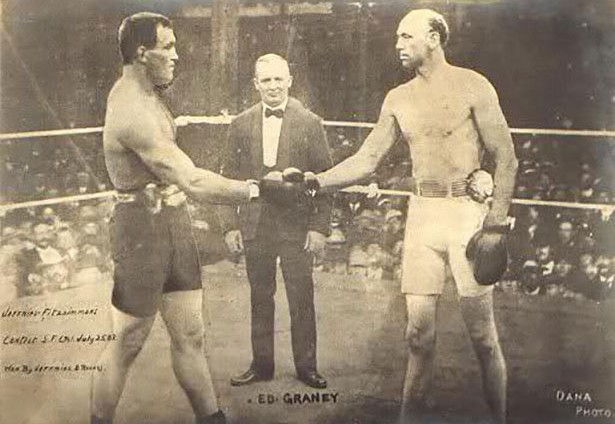
The Fight City
July 25, 1902: Jeffries vs Fitzsimmons II
By: Robert Portis
It is difficult to say how heavyweight champion James J. Jeffries would have matched up against more contemporary boxers, but there’s no doubt he was an extraordinary fighter. He lost only one match in his entire career and that bout, against the great Jack Johnson, happened long after his prime had passed. Unfortunately, it is one of only two of Jeffries’ twenty-four pro matches to ever be filmed, the other being his rematch in 1899 with legendary brawler “Sailor” Tom Sharkey. But the video quality of the latter, and the fact the former is of a fight taking place after almost six years of inactivity, mean neither gives us a chance to make a fair evaluation.
Jeffries had won the world title in 1899 from the great Bob Fitzsimmons at Coney Island, New York in just his fourteenth bout. The bigger and heavier challenger had bulled his way inside the smaller champion’s guard and inflicted a vicious body attack, scoring four knockdowns and forcing a stoppage in eleven rounds. The rematch took place three years later, after Fitzsimmons had put together a nice streak of wins capped by a dramatic second round knockout of the same tough Sharkey who had lasted 25 brutal rounds with Jeffries. That win set the stage for a rematch between “The Boilermaker” and “The Fighting Blacksmith,” and fight fans eagerly awaited Jeffries vs Fitzsimmons II.
Bob Fitzsimmons. Drawing by Damien Burton.
But Jeffries made his rival wait a couple more years and by the time the return finally happened, many wondered if the 39-year-old Cornishman’s advancing age might be too much to overcome. Besides, Jeffries figured to outweigh the challenger by thirty pounds or more. But those who backed the man who many today still regard as one of the greatest power punchers in the history of the sport, cited the former champion’s eagerness for revenge. Simply put, no fight had ever mattered more to “Ruby” and rumour had it he was so hell-bent on winning he planned to load his gloves with Plaster of Paris.
“Let him do it,” said Jeffries when told of these reports. “I’ll flatten him anyway.”
“The Boilermaker” in his prime.
No plaster was to be found inside the challenger’s gloves, but those watching in The Arena in San Francisco could be forgiven for thinking there was, as from the opening bell the smaller man inflicted a cruel beating on the champion. As early as the second round Jeffries was shedding blood as Fitzsimmons applied tremendous pressure, beating Jeffries to the punch over and over again. Rudy’s hard shots opened up deep cuts around both of Jeffries’ eyes and broke the champion’s nose. It was later revealed the challenger had in fact wrapped his hands with electrical tape instead of gauze, with no one from Jeffries’ camp objecting.
Newspaper cartoon depicts the one-sided nature of the match.
But the champion was nothing if not tough and durable and despite the carnage, he refused to concede. Instead he waited for his chance to strike back and it came in round eight. After a series of exchanges, Jeffries cornered his man. Fitzsimmons then inexplicably paused, lowered his guard, and spoke to Jeffries. The champion’s response was to move in and land a hard right to the belly followed by a thunderous left hook to the jaw that put Fitzsimmons down and out.
When the challenger approached the champion a few minutes later to congratulate him, Jeffries, seated on his stool, peered up at Fitzsimmons through swollen, bleeding eyes and declared, “You’re the most dangerous man alive.”
Jeffries and Fitzsimmons: a pair of all-time greats.
The bout’s conclusion struck some observers as suspicious and talk of a “fix” began to circulate in the days following, though both boxers dismissed the speculation. “The fight was won fairly and to the best man belongs the laurels,” stated Fitzsimmons.
No one knows what the Cornishman paused to say to Jeffries just before the fatal punches found their mark. Was it a taunt which provoked a violent response from the champion? Or, as some later asserted, a kind of surrender? One version of the odd ending has it that after seven torrid rounds during which Fitzsimmons had repeatedly landed his best shots, the challenger was exhausted. Instead of absorbing a beating as the match went on, “Ruby,” knowing he had nothing left, simply paused, dropped his hands, and told Jeffries, “Hit me.” “The Boilermaker” obliged and the fight was over.
Another Jeffries fight I want to mention is his fight against Joe Choynski in 1897, Choynski held Jeffries to a draw, the closest anyone came to beating Jeffries in his prime, although some thought Jeffries did enough to earn the win. Choynski was nicknamed "Chrysanthemum Joe", and "The California Terror", he was a murderous puncher, James J. Jeffries actually said the hardest punch he was hit with in his career was by Choynski, in fact Choynski landed a punch that broke Jeffries nose and drove his lip between his teeth, Jeffries corner had to pry them out with a knife. In fact, Choynski was the reason why Jeffries started fighting from a crouch position. Jeffries, who was rushed along quite quickly at the beginning of his career, took on the experienced ring genius in Joe Choynski. Granted, Choynski was giving up almost fifty pounds in weight, but Choyinski used his quicker feet and wiser mind to his advantage as he stayed away from Jeffries's power and was able to score on his own. Although Jeffries claims he dropped Choynski with a left hook to the neck, he also claims that Joe scored once with a right that knocked his lower lip between his front two teeth, an injury which required a lip incision to relieve Jeffries of the pain. Jeffries states that was the hardest punch he'd ever taken. Some disagreed with the decision, believing that Jeffries did enough forcing to earn the nod, but Joe was so impressive in the science he displayed in the ring that the referee gave him part of the honors in ruling the affair a draw. I would love to have seen this fight, two brutal punchers locking horns. This is a photo of James J. Jeffries and Joe Choynski (right) facing off.
Ok, let's get to the nastiness of that era of boxing. James J. Jeffries retired as the unbeaten heavyweight champion in 1905, but in 1910 he was coaxed out of retirement by the racists of white America. By 1910, Jack Johnson had become the heavyweight champion and white America just couldn't live with the fact that a black man was the heavyweight champion, so they talked Jeffries out of retirement and he accepted the challenge of trying to bring the heavyweight title back to the white race. It was a shameful time, and a shameful thing to do, but sadly it was the way things were back then. I must say this, Jack Johnson was one of the bravest men to ever live, he faced all kinds of death threats throughout his career, the man literally was a walking target everyday of his life, but he didn't give a crap, he earned that heavyweight title and he wasn't going to give it up because of a bunch of racist low lives. I don't think people fully appreciate how brave Jack Johnson was and the danger he faced everyday for years and years. So, Jeffries came out of retirement and he was deemed "The Great White Hope" by the white people who hoped Jeffries would be their savior and bring the heavyweight title back to the so called superior race, it was labeled "The Fight of The Century." It didn't work out like they planned.
The Fight City
July 4, 1910: Johnson vs Jeffries
By: Eliott McCormick
In 1910, Jack Johnson and James J. Jeffries clashed in Reno, Nevada to contest the world heavyweight crown in what was then billed as “The Fight of the Century.” At stake was far more than a mere boxing championship, as the black Johnson, having taken the belt from Canadian Tommy Burns in 1908, was thought by the white public in America to be wholly unfit to hold the title. Jeffries, an undefeated former champion and the most legitimate “Great White Hope,” had been repeatedly summoned to return to boxing so he could defeat the brash Johnson and reinstate the white man’s rightful place atop the athletic hierarchy. His quest would prove fruitless, but the legendary Johnson vs Jeffries match, with its buildup and aftermath, was a genuine sensation and social phenomenon, an event which galvanized the public while reflecting the hateful ideologies of the age.
Jack Johnson
While one recognizes the obvious racism of a society which regarded white people as inherently superior, for a present day boxing fan to actually understand the climate of fear and hatred attending this racial tinderbox of a fight is inherently difficult. In acknowledging this disconnect, it is still remarkable to contemplate Jack Johnson’s determination to defeat Jeffries despite the danger involved. Violence, after all, was the nasty appendage to an event whose ramifications went far beyond boxing. Consider the grandiloquence of Christian Socialist Reverdy Ransom, who stated that “the greatest marathon race of the ages is about to begin between the white race and the darkest races of mankind. What Jack Johnson seeks to do to Jeffries in the roped arena will be the ambition of negroes in every domain of human endeavor.”
Jeffries (centre) training with Choynski (left) and Corbett.
Because Jeffries had retired undefeated, many felt he remained the true champion. Almost 35-years-old, and having not stepped through the ropes in six years, he now weighed close to three hundred pounds. Despite this, Jeffries was besieged by media and fans to leave his California alfalfa farm and take the title away from its black holder. Initially hesitant, the fighter they called “The Boilermaker” was persuaded to come back by Tex Rickard, who guaranteed the winner two thirds of a colossal $101,000 purse. There were, of course, other social pressures encouraging Jeffries’ return, which the former champion articulated unambiguously: “That portion of the white race that has been looking at me to defend its athletic supremacy may feel assured that I am fit to do my very best.”
Johnson is introduced to the hostile crowd.
The Manichean racial narrative seized on by the press—in which Johnson and Jeffries were pitted against one another as representatives of incongruous civilizations—ensured a previously unseen degree of interest in a boxing match. Over five hundred media members traveled to Reno to report on both camps, leading famed author Jack London to proclaim that “there has never been anything like it in the history of the ring.” Johnson projected an air of supreme confidence, often spending his afternoons joking with the many hands in his camp. Jeffries, whose training was bolstered by visits from boxing dignitaries John L. Sullivan, Joe Choynski and ‘Gentleman’ Jim Corbett, was equally self-assured, at least publicly. Private concerns about his inactivity and weight loss troubled him, particularly when news arrived regarding Johnson and his excellent physical condition.
Regardless of this, few dared to wager on the champion. Jim Corbett believed Jeffries would win, as did George Little, Johnson’s former manager. At the Reno betting parlour operated by Corbett’s brother, Tom, there was not a single person willing to place a bet on a Jack Johnson victory. Gambling with their hearts, few, if any, members of the white public were willing to place their financial faith in a black man’s claim to athletic supremacy.
Johnson vs Jeffries was held on Independence Day, a cruel irony given the repressive wishes of those in attendance. Johnson entered the ring first as per his superstitious custom, appearing cool and outwardly confident as he acknowledged his friends at ringside. A huge roar from the crowd signaled Jeffries’ entrance, his fellow Caucasians elated to see their champion returning to restore collective racial prestige. Back at his original boxing weight, the svelte Jeffries wore a look of complete seriousness, and he refused to shake Johnson’s hand before the opening bell.
Johnson smiles as Jeffries attacks.
Jeffries began the fight aggressively, but Johnson’s brilliant, unsolvable defense thwarted the former champion’s swarming style. Every time Jeffries attempted to brawl, Johnson tied him up and pinned his arms, and when granted an opening, Johnson stung Jeffries with quick, precise blows. Despairing at the obvious difference in ability between the two combatants, an ungentlemanly Corbett taunted Johnson with a series of vicious racial insults, but the champion smiled back at Corbett and then returned his own barbs, while at the same time coolly keeping Jeffries at bay.
As the rounds passed, Jeffries’ face became increasingly marked, and it was obvious he was no longer a championship-caliber boxer, or at least not of a standard to challenge Johnson. Impressively game, but too fatigued to be effective, Jeffries might have met his end far sooner had Johnson not feared the ugly consequences of an early knockout. The tiring Jeffries could mount no competitive push, and in round fifteen Johnson scored the first ever knockdown against Jeffries, only to do it again, and then again.
Jeffries tries in vain to overpower “The Galveston Giant.”
Amid cries of “Don’t let the n..... knock him out!” Jeffries’ corner stopped the fight to prevent further damage, both physical and figurative. White fans rushed the ring, but Johnson’s crew formed a protective barrier around the champion. No one questioned the outcome or the fact that Johnson had proven himself the better man. Tellingly, Jeffries himself famously admitted he could never have beaten Johnson, even in his prime. “I could never have whipped Johnson at my best,” he said. “I couldn’t have hit him. No, I couldn’t have reached him in a thousand years.”
Johnson vs Jeffries front page
Immediately after, race riots broke out all over America. The dead were overwhelmingly black, and the violence precipitated calls to ban boxing in the United States. It would stand as the single worst day for race riots in American history until the unrest and violence of the late 1960’s. Johnson vs Jeffries, like later culturally significant matches such as Louis vs Schmeling II, Ali vs Frazier I and Holmes vs Cooney, proved to be a revealing social barometer as it attracted and laid bare America’s most dangerous prejudices. Given the ensuing, racially-charged calamities of the decades to come, this was one “Fight of the Century” truly deserving of its moniker.
A few more shots from the Jeffries-Johnson fight.