Saúl "Canelo" Álvarez scored a crushing 3rd round KO of James Kirkland at Minute Maid Park in Houston, Texas in 2015.
Canelo entered the fight with struggles in three of his last four bouts: Floyd Mayweather handed Canelo his first pro loss, and the budding Mexican star (understandably) had trouble with the styles of Austin Trout and Erislandy Lara. He sought a big performance a week after Mayweather and Manny Pacquiao delivered boxing's biggest event.
Kirkland had faced plenty of outside the ring issues for years, which included prison time and in-ring inactivity, but he'd only lost once as a pro. Still, Kirkland was being brought in as an opponent and was about a 6-to-1 underdog.
Prectably, Kirkland attacked and consistently out-threw Canelo. But he was wild and missed many of his shots while Canelo was far more precise with his own. In round 1, a right hand made Kirkland go to the deck. He wasn't that hurt and got up, but he was bleeding from the nose.
Round 2 was exciting as fought at a faster pace, but featured but no knockdowns. Then a counter right uppercut put Kirkland down again in round 3, and it unraveled for him from there. A right hand after the action resumed turned Kirkland about halfway around and ended the fight.
“Once I dropped him the first time I knew I had him,” Canelo said. “I’m ready for any rival. I don’t run away from anyone. I’m ready for anyone."
That Canelo Alvarez-James Kirkland knockout was legit scary, watch the impact from this punch in slow motion, it looked like Kirkland's soul was trying to leave his body.
''I was a poor boy who craved an education. Because of hard work and my aII-around athIetic abiIity, I got in a year at the CaIifornia AgricuIturaI CoIIege in Davis, CaIifornia. Then I won the nationaI and internationaI amateur heavyweight boxing championship. That was in 1935, just 10 years ago. In spite of my success as an amateur boxer, I certainIy never wouId have become a professionaI if I were not desperate for money then.
AIready I knew that boxing was the toughest of aII sports - the most punishing and tiring - even worse than rowing with a coIIege crew. You have to foIIow a persistent training grind to keep in shape at aII times. And you have to go aII-out every second that you're in the ring - aII-out with efforts in which there can be no rhythm because aII your movements are broken - on offense or defense.
When you taIk about a 'hungry' fighter, that was me during my first three years as a professionaI. If I hadn't been hungry and broke I never wouId have stuck with it. RareIy do you find a coIIege boxer who is as financiaIIy desperate as I was. Most of them find some way of ending the financiaI pressure - reIatives, friends or a sideIine Iike music, campus work, etc.
And those who are desperate enough to try to cash in on unusuaI athIetic abiIity in the ring seIdom get far because they start thinking about the gambIe they are taking with their features and their brain. They think about the risk they run of getting disfigured or of becoming punchy during the training grind or in bouts. Then they are throught - too nervous and cautious to fight effectiveIy.
Because of my desperation for money, I became tough mentaIIy as weII as physicaIIy. I eIiminated such thoughts.''
Interesting story about Lou Nova, he was nicknamed "The Alameda Assassin", but he had another nickname, "The Cosmic Puncher", and it's fascinating how he earned that second nickname.
Lou Nova was a 1930s and 40s heavyweight contender who defeated Max Baer and Tommy Farr, but lost to heavyweight champion Joe Louis. For a time, Nova was advised by "Oom the Omnipotent," a scam artist yogi who said his real name was Pierre Bernard, and who convinced Nova that the fighter had a "cosmic punch." But trainer Ray Arcel saw right through Oom's nonsense from the beginning.
Oom reportedly studied yoga in the 1800s and incorporated the art into demonstrations. For instance, Oom would go into "trances" that allowed him to withstand various painful pokes and prods. He also later studied hypnotism and the occult. More importantly, observant reporters noted Oom was a businessman who owned a bank, a realty company, a baseball park, a private zoo and chunks of land.
Through his travels, Oom was accused of essentially using his knowledge of yoga and mysticism to take advantage of younger people, and especially women. For example, a teenage woman accused Oom of keeping her younger sister at his New York apartment, which Oom called his "Sanskrit College."
In the lead-up to Lou Nova's 1939 fight against former heavyweight champion Max Baer, Nova got in contact with Oom, who called himself, "the reincarnation of the Supreme Being, Oom, the Omnipotent." Nova was taught several actual yoga poses and techniques that seemed to help his overall condition, and he benefited from Oom's private zoo, like riding Oom's elephants and having toucans and leopards around for photographers during fight promotions.
However, along with the benefits came Oom's wacky ideas. First, Oom convinced Nova he could harness otherworldly power and deliver a "cosmic punch." Second, Nova could flex his abdominal muscles in such a way that he would be impervious to body punches. Third, a "dynamic stance," which looked more like an old-timey bare knuckle fighter stance, would help Nova gain enough power to smash his hand through a wall.
"I told him he couldn't even knock over an old man like me with that stance," said Ray Arcel, "and to get busy with his gym work."
Prior to working with Nova, Arcel either trained or helped train fighters like Jack "Kid" Berg, Benny Leonard, Abe Goldstein, Ceferino Garcia and Henry Armstrong. But in the 1930s and 40s, Arcel gained even more fame as the trainer of several Joe Louis victims. As a trainer, Arcel wound up carting off so many of his fighters who got knocked out by Joe Louis—from Jack Sharkey, Paulino Uzcudun and James Braddock, to Johnny Paychek and Nathan Mann—that newspaper writers began calling Arcel "the meat wagon." And Arcel knew better than to trust Oom.
Nova defeated Max Baer in their first fight, but had a tough time with the aging former champion. Nova was then roughed up by "Two Ton" Tony Galento before sending Baer into retirement and earning a shot at champion Joe Louis. That was around when Arcel joined Nova's camp.
"The first day I joined Nova I walked into the gym and there he was in a John L. Sullivan stance," joked Arcel. I asked him what the hell he thought he was doing. He informed me that he was in the dynamic stance. Nova got to believing all this stuff before he was through and a lot of other people were half convinced."
Unfortunately for Nova, Joe Louis didn't buy into the magic stuff either and jolted Nova with a right hand that knocked him down, and then stopped him moments later in round 6 at the Polo Grounds in New York, 1941.
"I saw Joe [Louis] kind of squinting out of the corner of his eyes at Lou and waiting to see if that cosmic punch would materialize," laughed Arcel. "Nova was still winding up for that cosmic punch when Louis let him have it."
Nova regained enough form to have a good year in 1944, but never quite reached top contender status again. Arcel would lament that he felt Nova was easily taken advantage of and perhaps too eager to believe Oom at a critical time during his career, though Nova basically moved on and quickly forgot the parlor tricks.
In 1946, Oom picked up a wad of money to finance his international travels and shenanigans by returning to an old trick of his: a big divorce settlement. In stark contrast to his high profile life as an all-knowing swinger, Pierre Bernard the businessman and trickery artist died quietly in French hospital in 1955.
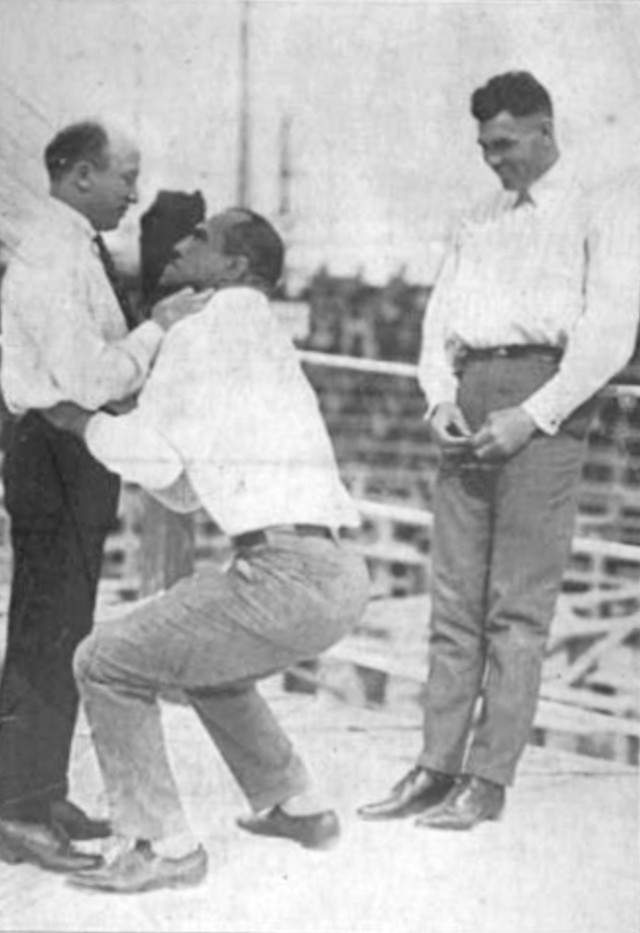
Pierre Bernard aka "Oom the Omnipotent."
Lou Nova trains using the methods of "Oom the Omnipotent."
Lou Nova really did have a good punch, he iced Max Baer twice, he was a great fighter up until the point he met "Two Ton" Tony Galento, that fight changed Nova forever. Galento was known to be a dirty fighter, he would use thumbs, elbows, you name it, and Galento is alleged to have fought dirty against Nova, thumbing him in the eyes, almost blinding him, and really roughing Nova up. This is an interview conducted with Lou Nova by the Los Angeles Times in 1988.
Jab From the Past : With New Fight Facing Him, Lou Nova Focuses On the Many Memories of a Memorable Boxing Career
By EARL GUSTKEY
July 24, 1988 12 AM PT
LAS VEGAS — The old heavyweight pointed to the photographs on the wall, to the framed black-and-white of his 1941 bout against Joe Louis, and to another showing his knockout of Max Baer.
“Max Baer . . . ,” Lou Nova said quietly. “Max Baer could hit harder than anyone. Harder than Sonny Liston. . . . Harder than Tyson? Oh, my yes. Listen, Mike Tyson isn’t a great fighter yet. He will be, but he isn’t yet.”
In the late 1930s, the 6-foot 2-inch, 200-pound Nova came out of Alameda, Calif., with a crackling left jab, a knockout right hand and a dream that he would be the man to take Louis’ heavyweight championship.
Lou Nova thinks a lot about the old days. Though a fit-looking 75, he is battling cancer.
James J. Corbett, like Nova, was a heavyweight from the Bay Area. In 1892, Corbett dethroned John L. Sullivan for the heavyweight championship.
“I can’t get over the coincidence between Corbett and me,” Nova said. “We’re both from the same area, we both represented the San Francisco Olympic Club, we were both world amateur boxing champions, we were both prominent pro heavyweights, we both became Broadway actors, we were the only two boxers ever admitted to the Lamb’s Club (for actors) in New York, and he died of cancer.
“Now I’ve got it. How do you like that? Makes you wonder . . . “
The morning sun was warming the sun porch in Nova’s Las Vegas mobile home. The memories came tumbling down.
Of the 20 men Louis defeated during his championship years, Nova is one of the more interesting ones.
Born in Hollywood, Nova was the son of a symphony pianist. In the mid-1930s, he was a standout football player and javelin thrower at Alameda High School. He was recruited to play football at UC Davis, where he was, for one season, a single-wing tailback.
“If pro football players made any money in those days, I probably would have wound up playing pro ball,” he said.
Of course, no one made much money in those days. Nova recalled a visit to a downtown Oakland boxing gym.
“Amateur boxing was very big in those days,” he said. “Every big city in the country had thousands of amateur boxers. So I was a good high school athlete, and I figured I could box, too. So one day I walked into Duffy’s Gym, around 1935. I was wearing cardboard soles in my shoes.
“Duffy’s Gym was in the seedy part of town. The trainer there, Harold Broom, also owned a bar in the neighborhood, and the boxers who used the gym could always get a free bowl of hot stew at the bar. I lived on that stew.
“Well, I learned pretty quickly. I was the national (and world) amateur heavyweight champion in 1935. Max Baer’s first manager, Ham Lorimar, was around the gym a lot, and he became my first manager, until he sold my contract for $10,000 to Ray Carlin.”
Nova turned pro in 1936 and won his first 20 bouts, until losing a decision to Maxie Rosenbloom at Hollywood Legion Stadium in 1938. Nova then easily decisioned Britain’s Tommy Farr before achieving his breakthrough victory, an 11th-round knockout of Baer in 1939.
“After that, I knew I’d eventually get my shot at Louis,” Nova recalled. “So I signed for a fight with Tony Galento, with the winner guaranteed a shot at Louis. The Galento fight ruined me.”
Nova fought Galento in Philadelphia. As The Times’ Jim Murray described it decades later, “Galento should have been arrested that night for practicing surgery without a license.”
The referee finally stopped it, in the 14th, and declared Galento the winner. The Associated Press reporter described the referee’s shirt as blood-soaked “from collar to waist.”
The reporter also called it “the most brutal bout of modern times.”
“I was never the same after that fight,” Nova said.
“See, my trainer then was Ray Arcel. Ray’s still around. People think he’s some kind of boxing genius. Let me tell you something. Ray Arcel didn’t know anything about boxing. He’d never been a fighter. I never forgave him for letting that fight go that long.
“I’d never taken a beating before. I always assumed when you’re taking a bad beating, your corner stops it. Mine didn’t.
“They put me in the hospital for three days. To this day, I have no memory of anything in that fight after the third round, including the three days in the hospital.
“Physically, I bounced back. But mentally, never. I subconsciously promised myself never to let myself take that kind of beating again. I finally got my chance with Louis. But I wasn’t the same fighter. I was cautious, very conservative. I really believe I’d have beaten him had I never fought Galento.
“Years later, people who knew Louis told me that Louis was afraid of me. He knew I’d beaten Tommy Farr worse than he did, but that it really bothered him that I’d knocked out Baer twice. And he knew that I had the best left jab in boxing in those days.
“Looking back on it all, I really believe I was the worst-managed fighter in history. I had ability, I’d shown that. All my life, I’ve wondered how far I’d have gone if my corner had stopped that Galento fight early.”
Arcel, who turns 89 next month, seemed surprised when told Nova blamed him for the length of his beating by Galento.
“I’m sorry Lou feels that way,” Arcel said. “I was his trainer, but I had no authority to stop the fight. Ray Carlin was his manager, he was in the corner, and he was in complete charge.
“Lou Nova was a courageous and talented heavyweight. He had talent. At his best, he would’ve given any heavyweight in any era a lot of trouble.”
Louis-Nova, on Sept. 29, 1941, was witnessed by 56,549 at New York’s Polo Grounds. It isn’t on anyone’s best-remembered list. Nova, boxing cautiously, largely avoided contact with the stalking Louis, until Louis knocked him out with one right hand in the sixth round.
After expenses, the 27 year old returned to Southern California with a check for $125,000, wondering how best to invest it.
“This banker was recommended to me, a guy named Davis,” Nova recalled, starting to laugh. “I’d found this piece of property in the farm country of the San Fernando Valley, near Van Nuys. It was a four-bedroom, three-bath house on 6 acres, with fruit orchards. It also had a guest house and stables. Remember, this is 1941.
“It was on the market for $25,000. So I asked this Davis guy for advice, and he said: ‘Nova, you go ahead and buy that place if you really want it, but don’t sink a lot of money into it, because that farmland out there (in the San Fernando Valley) will never be worth anything. If you’ll take my advice, you’ll put that money in long-term, 3% bonds.’
“I bought the place anyway. And when my wife divorced me in 1954, she wound up with the whole thing anyway.”
Nova broke up, laughing heartily at the story.
Nova and Louis later became friends. Louis also lived in Las Vegas in his last years, working for Caesars Palace. He died in 1981.
“Joe and I became closer as we got older,” he said. “I saw him maybe once a week in his last years.”
After he left boxing in 1944, Nova took up acting. He appeared on stage in “Guys & Dolls” and still performs, when he’s feeling well, as a stand-up comic. In the 1960s, Nova was selling a padded stool-like exercise device that enabled people to easily stand on their heads.
Nova has always had a thing about standing on his head. For 40 years, he has been convinced that headstanding would cure baldness, face wrinkles, hypertension, double chins, disk trouble, halitosis, sinus trouble, deafness, hemophilia, constipation and tooth decay.
He had a contraption he called the Yogi Nova. He pointed to one in his bedroom. It had aluminum legs, and raised, padded arms where the shoulders rested.
“I sold thousands of those things, for $20 apiece,” he said.
Nova said he learned of the wonders of headstanding decades ago from a yoga instructor, Dr. Pierre Bernard, also known as “Oom the Omnipotent.”
“Walk with your head up and your heart has to work too hard pumping all that blood to it,” he said.
As Nova has always said after fighting Galento, if he’s an expert on anything, it’s blood.
Lou Nova's fight with Tony Galento, this fight gained a reputation as one of the dirtiest and bloodiest in boxing history. Galento is alleged to have used an array of illegal tactics, including head-butting, heeling, elbowing, and back-handing, in addition to eye-gouging with his thumbs. This is the only actual footage of the fight, a brief clip at the end of this video.
These are the only two photos I can find from the actual Lou Nova-Tony Galento fight itself. One thing about Lou Nova, he had heart, he took one severe thumping from Tony Galento, who used every dirty trick in the book, before succumbing in the 14th round.
Like I said before, Lou Nova could punch. In his first fight with Max Baer, the left side of Baer's face was battered out of shape after ten rounds of the most excruciating fighting he had ever undergone, and was bleeding so severely from a severe laceration of the lower lip he could hardly breathe when the referee stopped the bout. Nova beat Baer again by TKO in 1941.
Hasim Rahman sporting a baseball-sized Haematoma sustained during his showdown with Evander Holyfield in 2002. The swelling was believed to be the result of an accidental clash of heads.
The injury was significant enough for referee, Tony Orlando call an end to the contest midway through the 8th round and Holyfield was awarded the win by split technical decision.
Holyfield, who was 39 at the time showed that he was still among the elite, landing 44% of punches thrown before the fight was stopped. It should be noted that Holyfield was notorious for headbutting his opponents, he would lean in really close while infighting and it often resulted in a clash of heads, it's the reason Mike Tyson but his ear off, Tyson had become furious that Holyfield was getting away with headbutting him.
"If there was something I would have done differently. I think of all the running I did and wonder if it was necessary. I mean I ran a lot, which was always difficult with my bad foot. Well one day I run into Jake LaMotta, and I ask him how much he ran. He looks at me and says, 'Vito, I never ran a f...... day in my life."
Orlando Canizales, aka "El Gato", 1980s and 90s bantamweight champion, who was born in Laredo, Texas on this day in 1965.
Canizales was a slick boxer-puncher with impressive footwork and maneuvering in the ring. He made 16 defenses of the IBF bantamweight title and retired at 50-5-1 with 37 KO. Orlando Canizales earned his nickname “El Gato” for his agility and quick reflexes.
"Boxing? To me it's the darkest game in the world. It really is dark, and you've got few friends or none at all."
– Tony Sibson
Sibson’s words capture the lonely, unforgiving nature of the fight game. A sport where the lights are bright, but the shadows run deep.
He knew it well — a rugged, working-class fighter from Leicester, Sibson battled his way up the ranks to challenge three times for world titles. In 1983, he stood across the ring from the legendary Marvin Hagler for the undisputed middleweight crown. Though he came up short, Sibson’s toughness and grit earned respect on both sides of the Atlantic.
But beyond the glory nights and championship opportunities, fighters like Sibson lived the hard truth of boxing: endless training camps, brutal sparring, broken promises, and the isolation of a career where everyone wants a piece of you — until you lose.
That’s the paradox of boxing. A sport of glory and heartbreak. Where legends are made, but few friendships survive.
Tony Sibson, aka "Sibbo", is one of my favorite fighters to watch, tough as a woodpeckers beak, he really was epitome of what a fighter is and goes through in this sport, the brutality, the ups and downs, the highs and lows, the sheer toll it takes on you. Whenever I see a photo of Tony Sibson, the first thing that pops in my mind is, "damn, now that's what a fighter looks like." He had a love/hate relationship with boxing, there were things he liked about it, he knew the glory, but he knew the ugly side of it as well. One thing about Sibbo, he was all guts and heart, he never backed down and always took the fight to his opponent.
Tony Sibson: The Leicester Lionheart
In the rich tapestry of British boxing, few figures embody grit and perseverance quite like Tony Sibson. Born into a working-class family in Leicester, Sibson never had the fanfare of Olympic medals or Hollywood glamour. What he did have was toughness, tenacity, and a willingness to face the best of his era. Coming up during the golden age of the middleweight division, he fought legends like Marvin Hagler and Dennis Andries, and while a world championship eluded him, his career stands as a story of courage and pride. This is the journey of Leicester’s beloved fighting son. Tony Sibson was born on April 9, 1958, in Leicester, England. Like many working-class kids, boxing became both a passion and a pathway to opportunity. He showed a natural strength and aggressive style early in his amateur career. Though he never captured national or Olympic glory, Sibson built a reputation as a fighter who never backed down. By the age of 18, he turned professional in 1976, choosing to chase greatness in the pro ranks rather than extend his amateur stay. His decision reflected his blue-collar mentality: work hard, take your chances, and learn by doing. Sibson’s professional debut came on October 26, 1976, with a first-round TKO over Peter Brown. Fans quickly noticed his come-forward style and punishing body shots. By 1979, he had separated himself from domestic rivals. His biggest breakthrough came that year when he captured the British Middleweight Title with a victory over Dennis Minter. In April 1979, Sibson became the best middleweight in Britain.
Later that year, he defeated Alan Minter in a non-title fight, sending shockwaves across the UK boxing scene. These wins marked Sibson as more than a local contender—he was a rising international name. After dominating the British scene, Sibson sought bigger challenges. In 1981, he captured the Commonwealth Middleweight Title and then traveled to Paris, where he defeated Gratien Tonna to win the European Middleweight Title. That victory elevated him into the global top 10 and paved the way for his most significant opportunity: a shot at the world middleweight crown. The following year, Sibson stunned the boxing world by upsetting Dwight Davison, the number-one contender. That win officially punched his ticket for a chance at boxing immortality. On February 11, 1983, Tony Sibson stepped onto the grandest stage of his career—challenging Marvelous Marvin Hagler for the undisputed middleweight title. The bout, held in Worcester, Massachusetts, pitted Sibson’s relentless pressure against one of the greatest champions in history. Despite his 55–3–1 record and fearless approach, Hagler’s southpaw jab and surgical accuracy overwhelmed Sibson. The fight ended in the sixth round, with the referee stopping the action after Hagler unleashed a brutal barrage. Though defeated, Sibson’s heart and bravery won admiration, showing he belonged among the best. Sibson’s career didn’t end with Hagler. He rebounded with strong performances, including a win over Louis Acaries to reclaim the European Middleweight Title. Seeking new opportunities, he moved up to light heavyweight. In 1986, he challenged Dennis Andries for the WBC title in London. Sibson started well but faded late, with Andries’ size and pressure proving too much. He was stopped in the 9th round. He made one final attempt at world glory against Frank Tate for the IBF Middleweight Title in 1988 but fell short. Shortly after, he retired with a record of 55 wins (31 by KO), 7 losses, and 1 draw. Tony Sibson was never flashy. He lacked the showmanship of Sugar Ray Leonard or the explosive speed of Thomas Hearns. But what he did have was grit. His style was built on relentless pressure and ring generalship, a vicious body attack that wore opponents down, and unshakable determination, even against legends. Though he never held a world belt, Sibson was a constant presence in one of boxing’s toughest eras. Sharing the stage with Hagler, Hearns, Roberto Durán, and John Mugabi ensured his name was forever tied to a golden age of middleweights. Unlike many fighters, Sibson avoided the chaos that can follow retirement. He returned to Leicester, living quietly and occasionally offering reflections on his career..Leicester, a city with few boxing icons, proudly regards Sibson as one of its finest athletes. To fans, he remains a symbol of working-class toughness and perseverance. His humility outside the ring only enhanced the respect he earned inside it. Tony Sibson’s story is not one of titles won, but of respect earned. He fought in one of boxing’s most competitive eras, facing Hall of Famers without hesitation. While the belts slipped through his fingers, his legacy rests on his courage, resilience, and connection to the fans who saw themselves in him. For Leicester and for British boxing, Sibson stands as a reminder that greatness isn’t always measured by hardware. Sometimes, it’s about the battles fought, the heart shown, and the pride carried into every round. And in those terms, Tony Sibson was—and remains—every bit a champion.
The first time I ever watched Tony Sibson fight was in a losing effort, against "Dangerous" Don Lee. I had heard of Don Lee, I knew he was a hard puncher, hence the nickname "Dangerous", and I had never heard of Sibson, I fully expected Lee to blast Sibson out rather quickly. I was shocked when I watched the fight how saw how hard Sibson was to deal with, and while Lee did eventually stop Sibson, he had his hands filled every step of the way. Sibson was one tough, tenacious, relentless bastard of a fighter, like a mosquito that just won't go away.
1981 EBU Middleweight Title Fight at Wembley, Tony Sibson after knocking out Nicola Cirelli in the 10th round. Sibson could whack, when he threw a punch he didn't hold back, he really loaded up. Left hooks did the deed in this one, Sibson had a brutal left hook, that left hook did the deed in quite a few of his fights.
Tony Sibson vs Alan Minter. Both of these guys had a few things in common, both had fought Marvelous Marvin Hagler, and both were British, which naturally led to a bit of a British rivalry towards eachother. They became good friends, but the rivalry had to be settled in 1981. Alan Minter was a good fighter as well, he was a tough, aggressive southpaw, he had good power, could brawl, but was also a good technical fighter with a solid jab. He had a strong chin, though he was also known for having fragile skin that was prone to cuts. Just a year prior to this fight Minter had been world middleweight champion, but had lost the belt to Marvelous Marvin Hagler, if this fight had happened a year earlier, Sibson would have won the middleweight crown.
.
A Boxing Memory: Tony Sibson vs. Alan Minter
“Sibson hit me with a blinder of a punch. I think it would have knocked out any fighter in the world.” - Alan Minter
Boxing rarely allows a former champion to leave the sport without shedding at least some semblance of their dignity. Very few leave boxing on their own terms. Many are in denial that they are no longer what they once were. Some reside on the right side of delusion, but they still need to fight on for a multitude of reasons. The reasons may differ, but the majority end up on the wrong side of a vicious or humiliating defeat.
In September of 1980, Alan Minter was the undisputed middleweight champion of the world. Less than a year later, Minter was starting life as a retired boxer. Marvelous Marvin Hagler had ripped away his world titles on an infamous night in British boxing history. Minter’s face was sliced to pieces by the slashing fists of the fearsome American, and a section of the Wembley crowd let themselves down, and their country, with a racially motivated drunken riot as Hagler was crowned the new world middleweight champion.
Minter talked about once again winning the world title, but after a comeback win over Ernie Singletary, Minter travelled to America and lost a split decision to Mustafa Hamsho that ended any immediate hopes of another world title shot. Minter seemed to fade down the stretch, and those closing rounds cost Minter the decision, although many still had him beating Hamsho.
Tony Sibson was the up-and-coming British middleweight contender. Sibson had enjoyed reigns as the British, Commonwealth and European champion and hadn’t tasted defeat since the night Kevin Finnegan beat him in 1979 when the Leicester fighter turned up in less than-peak condition. By 1981, Sibson was the reigning European champion and was coming off a win in Spain against Andoni Amana, which had earned Sibson his European bauble. With Minter needing to take a step down after his loss to Hamsho and Sibson needing a marque win against an established name to push himself into the world title picture, the fight between the two was a natural and was made with the European title on the line. But after nine years as a professional, and after losing two of his last three fights, Minter knew his entire career was on the line also.
“This is my chance to come out of the shadows,” Sibson said while Minter talked about old sparring sessions and said he couldn’t retire without facing his British rival. Minter believed he was the fighter with the bigger punch. The fight itself would tell a very different story.
The fight was scheduled to air on the BBC, but when Minter got an advertising deal with DAF Trucks, the BBC wouldn’t show the fight because of the DAF logo on Minter’s shorts. The Minter camp tried to cover the logo with sticking plaster, but when the plaster kept falling off, the BBC pulled the fight from their schedule because of their strict advertising policy. The fight took place on the 15th September at the Wembley Arena with Sibson and Minter, both earning a reported £80,000. Although there was some suggestion that Minter earned a little more than his British rival.
After a tight opening round, which Minter probably edged from his southpaw stance, the former world champion continued his good start in the following round. Sibson was missing with his patented left hook, and Minter picked him off almost at will. But the fight between the two former sparring partners would explode in the third round.
After his slow start, Sibson picked up the pace and started landing more frequently with his more powerful punches, but there were no signs that the end was imminent. But one almighty left hook dropped Minter when the two fighters were on the ropes. Somehow, Minter got to his feet, but when Sibson dropped him again, the fight was over. And the career of Minter also. Minter was only 29, but his long career had taken its toll.
Sibson couldn’t quite emulate Minter on the world stage. He found Marvin Hagler far too good for him in 1983, and at the tail end of his career Sibson lost world title fights to Dennis Andries and Frank Tate and retired in 1988 after a long and eventful career.
Here are the highlights of Sibson-Minter, you can see what a cracking fighter Sibson was, three rounds and he had Minter out of there, and it was the left hook that did the business.
In 1983, Sibbo stepped up and challenged Marvelous Marvin Hagler for the middleweight title. I'll start off by saying, no one should ever be embarrassed to lose to Hagler, you're talking about arguably the greatest middleweight to ever live. Sibson was all guts, he never backed down from anyone, he fought well, but nobody outworks prime Hagler. Tony Sibson was all class, after the fight he stated:
"He might have beaten me up but I will always adore Marvelous Marvin Hagler." He also described Hagler as the "master of disaster" whose punching was incredibly quick and accurate, stating, "I couldn't find him". After the fight, Sibson also conceded that Hagler was just too good, and that no one could do what Hagler had just done to him.
A Boxing Memory: Hagler vs. Sibson
Marvelous Marvin Hagler had many good nights in a boxing ring, and most of them went underappreciated, at least until 8 minutes of mayhem with a ‘Hit Man’ in a shootout for the ages. Hagler was an angry man in 1985. He went to war for many reasons in Las Vegas, Tommy Hearns found a Hagler we hadn’t seen before. But Hagler was perhaps even more ‘Marvelous’ two years earlier.
The sold-out Worcester Centrum in Massachusetts was surrounded by blizzards. Inside it, Tony Sibson was caught up in a different type of storm. Sibson had ventured from Leicester with hope, but he caught the undisputed world middleweight champion on perhaps his best-ever night.
Sibson 24 had found success and plenty of it on the domestic front. British, Commonwealth and European middleweight titles were in his collection. He was ranked the number one middleweight contender in the world, Sibson looked like a much tougher challenger than the merry-go-round of challengers Hagler had to endure in his search for acceptance and respect.
The fearsome middleweight champion always had a chip on his shoulder about how he was viewed and treated in the sport. The big fights were still just a desire. He needed a dance partner that would elevate his own status. For Hagler, that wait would continue.
Sibson looked like a far stronger challenger than some of Hagler’s recent opponents, he was a 7-2 outsider, but he came with real pedigree and his powerful left hook, at least this challenger had some intrigue.
A couple of early career defeats were soon forgotten when Sibson beat Frankie Lucas in a savage forgotten fight in 1979 for the vacant British middleweight title. It looked too soon for Sibson. In truth, it came too late for Lucas. After three more wins in 1979, Sibson surrendered his British title to Kevin Finnegan, Sibson recovered and remained unbeaten until his moment of truth against Hagler.
On the road to Hagler, Alan Minter passed the torch, and the good American Dwight Davison saw his world title hopes extinguished by the fists of Sibson. But Hagler would be a much more formidable foe.
Sibson’s trainer Ken Squires set in motion his plan to ready his charge for what lay ahead. With an axe in his hands, Sibson would do three minutes chopping down trees, an old-school simulation aimed at building a fighter’s strength and stamina.
The specific boxing training began early in 1983 for the scheduled date in February. But when a large press party turned up to help promote the fight, disaster struck.
Sibson, under the watchful eye of those with the mighty pens, sparred when he wasn’t fully warmed up, and he paid the price. Cliff Gilpin caught Sibson with an uppercut. He said:
“He bruised my sinuses and enflamed my eyes. That was that. I got changed and walked out of the gym again.”
Sibson did no further sparring in the build-up to the Hagler fight.
Training carried on with fitness now the primary aim. Unable to spar, the usual bread and butter for fighters to sharpen their tools in readiness for battle, Sibson’s task was made even harder. Impossible even.
Hagler had ripped the world title from Minter on an unsavoury night in London in 1980. The evening had a rancid smell of racism in the air, and hate and prejudice ruined Hagler’s moment. A seven-year and 30-fight unbeaten run, Hagler was some fighter, but without the then-retired Sugar Ray Leonard, Hagler was drifting without the recognition he craved. If ever a fighter deserved a big fight, it was Hagler.
Sibson was challenger number six, and despite the problems in camp, Sibson said he was fitter than ever and genuinely thought he could beat Hagler. The innocence of youth can blind even the best of us.
The British challenger was expected to offer far more resistance than the likes of William ‘Caveman’ Lee, who had folded inside a round in a recent title defence by Hagler. But from the opening seconds of the fight, Hagler demonstrated the sheer spite and class in his work. Sibson was brave, but Hagler was on another level. The confidence pre-fight gave way to Sibson admitting that he believed no man could do what Hagler had just done to him. “He just knocked me all over the place,” the beaten challenger conceded after 6 largely one-sided rounds.
Hagler said: “I was just dipping into my toolbox. I was enjoying my work.”
Harry Mullan reporting for Boxing News said, ‘Hagler’s performance was quite flawless. It was cold, ruthless perfection.’
Sibson called Hagler an artist. Hagler’s fists certainly painted a not-so-pretty picture on Sibson’s face. Hagler was simply brilliant on that cold winter night, just maybe, the best version of Hagler that we ever saw.
Sibson had a nightmare trip to America. Catching Hagler at his peak was just part of the problem. He would be left to rue his lack of sparring, the bad weather hampered his preparations even further, and there were problems with his protective cup, Sibson would later say, “Everything went wrong,” a painful night in many ways. Sibson believed in his heart he could beat Hagler. He found out the truth the hard way.
It would take a hotly disputed decision in a fight that he badly wanted, which finally arrived in 1987, to relieve Hagler of his titles. Leonard caught Hagler at the right time. He picked his moment, both brilliant and calculated in equal measure.
Hagler was slipping and threatened retirement, Leonard saw his chance and executed a plan to tempt Hagler, who eventually took the bait and left the sport a bitter man courtesy of that loss to Leonard in Vegas that still splits the boxing world.
Sibson drifted in and out of the sport after the loss to Hagler. There were moments when the old fire returned, especially when he returned to America to blast out the unbeaten Irish-American John Collins in two rounds. But a defeat to the dangerous American Don Lee in an up-and-down thriller stopped the momentum gained from the Collins win.
A win over Mark Kaylor promised more than it delivered. He regained his old titles on his road back, but Sibson never really got to where he wanted to go. Fights with domestic rivals Herol Graham and Errol Christie never happened for various reasons. A return was offered against Kaylor. It was good money, but Sibson wasn’t interested. Sibson was semi-retired, out of shape, recovering from surgery on his elbow, he’d got married, and boxing seemingly was in his past.
But a change in promoter to Frank Warren tempted Sibson back and offered him two further chances to win a world title. A move up to light-heavyweight to challenge Dennis Andries in 1986 came at the wrong time and at the wrong weight. Mentally, he wasn’t there and admitted afterwards that he had underestimated Andries. Many others did the same.
Sibson did give us one last reminder of his talents when he beat Brian Anderson for the British middleweight title and secured the Lonsdale belt in the process.
A final attempt and indeed a final fight to win the world title came against another American Frank Tate in 1988 for the IBF middleweight title. The IBF still had their title fights scheduled for 15 rounds, the British Board of Control stuck to their new 12-round rule on safety grounds, and the fight was in serious doubt as fight night loomed. The day before the fight, they belatedly reached a solution to have the fight reduced to a 12-round title fight.
The fight with Tate was close until not for the first time, Sibson started to lose concentration. In the 10th round, the fight and his career were over. He said afterwards that he just melted away. There was talk of one last comeback, but thankfully, it never happened.
Even on his best night, Sibson wouldn’t have beaten Hagler, but in another era where the titles were splintered, Sibson could easily have won a world title. In the talk of the best British fighter never to win a world title, Sibson is more than worthy of a mention.
When he faced Hagler, Sibson was almost certainly the second-best middleweight on the planet. At his peak, he was just unlucky to be around at the same time as perhaps the greatest middleweight in boxing history.
Hello, ok, yes, I also want to mention the Sibson vs John Collins fight in 1983, Collins was a tough Irishman from Chicago with brutal knockout power. Collins was 29-0 with 26 knockouts at the time of this fight. Sibson mowed him down. This fight really demonstrated how bada$$ Sibson was.
Bad Left Hook
Sibbo vs. Collins: Blast from the Past
by Scott Christ
"He [John Collins] could put you to sleep with a right hand."
- Tim Kane
After watching David Lemieux recently dismantle Elvin Ayala in Montreal, I was reminded of another compact, strong fighter with a somewhat hunched stance and that was Tony Sibson who fought in the 1970s and 1980s and was regarded as one of Britain’s best. He was Commonwealth and European champion and a serious world title challenger
When “Sibbo” was on and had trained properly, he was a very dangerous fighter. He was a stocky scrapper who came out of the Belgrave gym in Leicester. Going undefeated in his first 25 bouts, he finished with a great record of 55-7-1and was seldom in a dull fight. After losing to Kevin Finnegan in 1979 with the BBBofC British middleweight title at stake, he reeled off 14 straight wins, including TKOs over former world champion Alan Minter and Bobby “Iceman” Coolidge and a points win over talented Dwight Davison the later being a final eliminator for the WBC Middleweight Title. He then met Marvelous Marvin Hagler at the Centrum in Worcester, Mass on February 11, 1983. Hagler (55-2-2 coming in) pummeled the shy and affable challenger decking him twice as he stopped him in the 6th. Sibson, badly cut, was game and courageous, but simply did not have enough to stand up to Hagler’s relentless fury.
His next fight would be against John Collins in Atlantic City on October 8, 1983.
John Collins (1980-1986)
Like Sibson, Chicagoan Collins had a stellar amateur record and got off to a great pro start winning his first 29, 25 by way of stoppage. Most of his fights did not go beyond the third canto, and this may have contributed to his later downfall. Among his victims were Teddy Mann, a fading Oscar Albarado (58-11-1 at the time), undefeated fellow Chicagoan Lenny Lapaglia (19-0), and a prime Kenny Whetstone (23-1).
When he fought in the Windy City, the good looking and tall (6’1”) Collins had the appeal of a rock star. Indeed, he brought out the City’s South Side Irish in droves. When his fights began, the place would erupt into chants of “Collins! Collins! Collins!” The fans would go wild when he put together slick combinations and landed his signature straight-right cross which carried menace and finality when it connected flush.
The Fight
Collins was the undefeated favorite when he met Sibbo who was coming off the aforementioned loss to Hagler. A win by the Collins could well position him for a big pay day fight against the Marvelous one, but it was not to be.
In the first round, a fit and ready Sibson hit his taller opponent with solid jabs and some damaging short rights. Sibson was a great inside fighter and that’s where the he was doing the early damage. Then, with 27 second left in the round, Tony cornered the Irishman in a neutral corner and rocked him with two vicious left hooks and a brutal head-snapping jab that had all of his weight behind it. Again trapping him in a corner, this time his opponent’s corner, a crunching hook sent Collins to the canvas, but he was saved by the bell and his corner quickly tried to revive him.
The second round began as the first ended and it was clear Collins had not fully recuperated. Sibbo quickly sent Collins down with a powerful straight right and then finished him off with a series of short but effective shots that sent him sprawling across the ring and then onto the canvas for the third and final time in the fight.
It had been a Chicago-style mugging, but this mugger was not a Chicagoan.
One thing about Tony Sibson, his high work rate style made for some exciting fights, one more here against Frankie Lucas in 1979, nice little donnybrook.
About Ronald "Winky" Wright, one of the most brilliant technical fighters this sport has ever seen. From Brain boxing on Facebook, and brilliantly written:
Winky Wright: The Master of Defense and the Art of Technical Perfection
Ronald “Winky” Wright, born on November 26, 1971, in Washington, D.C., stands as one of the most technically gifted and defensively brilliant boxers of his era. Renowned for his precise jab, strategic intelligence, and exceptional defensive craft, Wright’s legacy is built on skill, discipline, and consistency.
Turning professional on October 16, 1990, Wright stormed onto the scene with a 25-fight unbeaten streak that showcased his refined fundamentals and ring composure. Despite an early career setback against Julio Cesar Vasquez on August 21, 1994, for the WBA Light Middleweight Championship, Wright continued to evolve—his mastery of defense and tactical patience making him a nightmare for opponents in the ring.
Wright reached the pinnacle of his career in 2005 when he produced a boxing clinic against Puerto Rican legend Felix “Tito” Trinidad at the MGM Grand in Las Vegas. With his signature high guard, laser jab, and brilliant ring control, Winky dominated every round, handing Trinidad one of the most decisive defeats of his illustrious career. Trinidad himself admitted, “Winky Wright was a great fighter—his jab was very strong.”
That victory followed his back-to-back triumphs over Shane Mosley, solidifying Wright’s position as the undisputed king of the light middleweight division. His name became synonymous with technical mastery, ring IQ, and defensive excellence—traits that defined an entire generation of boxing purists.
“Boxing is not just about power—it’s about intelligence, defense, and making your opponent fight your fight.” — Winky Wright
That quote perfectly captures his boxing philosophy: a thinker, a tactician, and a craftsman who turned defense into dominance.
Though later years brought losses to Paul Williams and Bernard Hopkins, Wright retired in 2012 with a proud record of 58 fights, 51 wins (25 by knockout), 6 losses, and 1 draw. His legacy as a two-time light middleweight world champion—and the undisputed ruler of that division—remains unshaken.
Winky Wright’s career is a testament to the beauty of boxing’s “sweet science.” He proved that great defense, intelligence, and patience could conquer even the most powerful punchers.
Closing Remark:
Winky Wright will forever be remembered as one of boxing’s finest tacticians—a master of defense whose precision and discipline elevated the sport to an art form.
Ricky "The Hitman" Hatton absolutely wrecked Carlos Maussa with a brutal 9th round KO while making his first defense of The Ring and unifying the IBF and WBA junior welterweight titles at Sheffield Arena in Sheffield, England in 2005.
Hatton beat Kostya Tszyu up to seize the junior welterweight title a few months earlier, and he was matched with WBA title-holder Carlos Maussa, a wily and awkward boxer-puncher from Colombia.
Unfortunately Hatton was cut early on, but it was an issue he contended with throughout his career. And he walked Maussa down in each round anyway, slowly wearing him down. In round 9, Hatton launched a left hook that caught Maussa and crumbled him in the corner for the count.
"He was very awkward," Hatton said. "He was pulling back from the punches and it made it very difficult to nail him. I think I was trying too hard."
"Rockabye" Rubén Olivares, 1960s and 70s bantamweight and featherweight world champion from México, D.F. who carried serious, serious punching power in both hands. He got the nickname "Rockabye" because he put opponents to sleep and was once referred to as a "pocket knockout king." He earned that nickname 79 times over, finishing his career with a record of 89-13 (79 KO).
Juan Manuel Márquez rose from a hard knockdown to defend the unified and lineal lightweight titles with a 9th round TKO in a war with Michael Katsidis at the MGM Grand in Las Vegas, Nevada in 2010.
Márquez was highly skilled, but not as exciting or popular as his Mexican contemporaries Marco Antonio Barrera and Erik Morals. But he was in some better fights later in his career, perhaps due to the rise in weight and a conscious decision to stand and trade a bit more. While Katsidis wasn't unbeaten, he was a puncher who always gave his all. He also bravely went through with this fight despite his brother's death one month earlier.
It looked as though Katsidis might win when he surprised Márquez with his aggression and sent the champ down in round 3. But Márquez, a resilient champion, gradually seized control of the fight.
In round 9, Katsidis he ran into a right uppercut and a combination that shook him to his boots as he charged forward. Márquez couldn't miss with his right hand and uppercuts with either hand after that, forcing a referee stoppage.
"I was surprised by his left hand," Marquez said. "I didn't protect myself and I got caught. I knew how to manage the fight with my combinations and conditioning. That's why I got up so quickly after I got knocked down."
Johnny Coulon, aka "The Chicago Spider", was an all-time great bantamweight in the 1900s and 1910s, and after he retired he developed a famous trick where he made himself unliftable, he would put his finger on the lifter's neck and wrist, and nobody could lift him. He did this trick for decades, challenging boxers, wrestlers, to lift him. He was only 5'0", barely 110 pounds, and no matter how big and muscular you were, you couldn't lift him. He took the act on the road and performed the trick everywhere he went, music halls in Paris France, saloons, you name it, the public was mystified by it and some people even attributed it to the occult.
Johnny Coulon's trick was studied by all kinds of people, psychiatrists, physiologists, it even ended up being studied by the famous escape artist Harry Houdini and Robert Ripley of "Ripley's Believe it or Not."
Jack Dempsey watches as Johnny Coulon performs his trick
Comments
Saúl "Canelo" Álvarez scored a crushing 3rd round KO of James Kirkland at Minute Maid Park in Houston, Texas in 2015.
Canelo entered the fight with struggles in three of his last four bouts: Floyd Mayweather handed Canelo his first pro loss, and the budding Mexican star (understandably) had trouble with the styles of Austin Trout and Erislandy Lara. He sought a big performance a week after Mayweather and Manny Pacquiao delivered boxing's biggest event.
Kirkland had faced plenty of outside the ring issues for years, which included prison time and in-ring inactivity, but he'd only lost once as a pro. Still, Kirkland was being brought in as an opponent and was about a 6-to-1 underdog.
Prectably, Kirkland attacked and consistently out-threw Canelo. But he was wild and missed many of his shots while Canelo was far more precise with his own. In round 1, a right hand made Kirkland go to the deck. He wasn't that hurt and got up, but he was bleeding from the nose.
Round 2 was exciting as fought at a faster pace, but featured but no knockdowns. Then a counter right uppercut put Kirkland down again in round 3, and it unraveled for him from there. A right hand after the action resumed turned Kirkland about halfway around and ended the fight.
“Once I dropped him the first time I knew I had him,” Canelo said. “I’m ready for any rival. I don’t run away from anyone. I’m ready for anyone."
That Canelo Alvarez-James Kirkland knockout was legit scary, watch the impact from this punch in slow motion, it looked like Kirkland's soul was trying to leave his body.
Both Willie Pep and Sugar Ray Robinson put up absurd records in their primes, numbers that almost don’t even look real.
Willie Pep before Sandy Saddler in 1948: 134-1-1
Sugar Ray Robinson before Randolph Turpin in 1951: 129-1-2
''I was a poor boy who craved an education. Because of hard work and my aII-around athIetic abiIity, I got in a year at the CaIifornia AgricuIturaI CoIIege in Davis, CaIifornia. Then I won the nationaI and internationaI amateur heavyweight boxing championship. That was in 1935, just 10 years ago. In spite of my success as an amateur boxer, I certainIy never wouId have become a professionaI if I were not desperate for money then.
AIready I knew that boxing was the toughest of aII sports - the most punishing and tiring - even worse than rowing with a coIIege crew. You have to foIIow a persistent training grind to keep in shape at aII times. And you have to go aII-out every second that you're in the ring - aII-out with efforts in which there can be no rhythm because aII your movements are broken - on offense or defense.
When you taIk about a 'hungry' fighter, that was me during my first three years as a professionaI. If I hadn't been hungry and broke I never wouId have stuck with it. RareIy do you find a coIIege boxer who is as financiaIIy desperate as I was. Most of them find some way of ending the financiaI pressure - reIatives, friends or a sideIine Iike music, campus work, etc.
And those who are desperate enough to try to cash in on unusuaI athIetic abiIity in the ring seIdom get far because they start thinking about the gambIe they are taking with their features and their brain. They think about the risk they run of getting disfigured or of becoming punchy during the training grind or in bouts. Then they are throught - too nervous and cautious to fight effectiveIy.
Because of my desperation for money, I became tough mentaIIy as weII as physicaIIy. I eIiminated such thoughts.''
Interesting story about Lou Nova, he was nicknamed "The Alameda Assassin", but he had another nickname, "The Cosmic Puncher", and it's fascinating how he earned that second nickname.
Lou Nova was a 1930s and 40s heavyweight contender who defeated Max Baer and Tommy Farr, but lost to heavyweight champion Joe Louis. For a time, Nova was advised by "Oom the Omnipotent," a scam artist yogi who said his real name was Pierre Bernard, and who convinced Nova that the fighter had a "cosmic punch." But trainer Ray Arcel saw right through Oom's nonsense from the beginning.
Oom reportedly studied yoga in the 1800s and incorporated the art into demonstrations. For instance, Oom would go into "trances" that allowed him to withstand various painful pokes and prods. He also later studied hypnotism and the occult. More importantly, observant reporters noted Oom was a businessman who owned a bank, a realty company, a baseball park, a private zoo and chunks of land.
Through his travels, Oom was accused of essentially using his knowledge of yoga and mysticism to take advantage of younger people, and especially women. For example, a teenage woman accused Oom of keeping her younger sister at his New York apartment, which Oom called his "Sanskrit College."
In the lead-up to Lou Nova's 1939 fight against former heavyweight champion Max Baer, Nova got in contact with Oom, who called himself, "the reincarnation of the Supreme Being, Oom, the Omnipotent." Nova was taught several actual yoga poses and techniques that seemed to help his overall condition, and he benefited from Oom's private zoo, like riding Oom's elephants and having toucans and leopards around for photographers during fight promotions.
However, along with the benefits came Oom's wacky ideas. First, Oom convinced Nova he could harness otherworldly power and deliver a "cosmic punch." Second, Nova could flex his abdominal muscles in such a way that he would be impervious to body punches. Third, a "dynamic stance," which looked more like an old-timey bare knuckle fighter stance, would help Nova gain enough power to smash his hand through a wall.
"I told him he couldn't even knock over an old man like me with that stance," said Ray Arcel, "and to get busy with his gym work."
Prior to working with Nova, Arcel either trained or helped train fighters like Jack "Kid" Berg, Benny Leonard, Abe Goldstein, Ceferino Garcia and Henry Armstrong. But in the 1930s and 40s, Arcel gained even more fame as the trainer of several Joe Louis victims. As a trainer, Arcel wound up carting off so many of his fighters who got knocked out by Joe Louis—from Jack Sharkey, Paulino Uzcudun and James Braddock, to Johnny Paychek and Nathan Mann—that newspaper writers began calling Arcel "the meat wagon." And Arcel knew better than to trust Oom.
Nova defeated Max Baer in their first fight, but had a tough time with the aging former champion. Nova was then roughed up by "Two Ton" Tony Galento before sending Baer into retirement and earning a shot at champion Joe Louis. That was around when Arcel joined Nova's camp.
"The first day I joined Nova I walked into the gym and there he was in a John L. Sullivan stance," joked Arcel. I asked him what the hell he thought he was doing. He informed me that he was in the dynamic stance. Nova got to believing all this stuff before he was through and a lot of other people were half convinced."
Unfortunately for Nova, Joe Louis didn't buy into the magic stuff either and jolted Nova with a right hand that knocked him down, and then stopped him moments later in round 6 at the Polo Grounds in New York, 1941.
"I saw Joe [Louis] kind of squinting out of the corner of his eyes at Lou and waiting to see if that cosmic punch would materialize," laughed Arcel. "Nova was still winding up for that cosmic punch when Louis let him have it."
Nova regained enough form to have a good year in 1944, but never quite reached top contender status again. Arcel would lament that he felt Nova was easily taken advantage of and perhaps too eager to believe Oom at a critical time during his career, though Nova basically moved on and quickly forgot the parlor tricks.
In 1946, Oom picked up a wad of money to finance his international travels and shenanigans by returning to an old trick of his: a big divorce settlement. In stark contrast to his high profile life as an all-knowing swinger, Pierre Bernard the businessman and trickery artist died quietly in French hospital in 1955.
Pierre Bernard aka "Oom the Omnipotent."
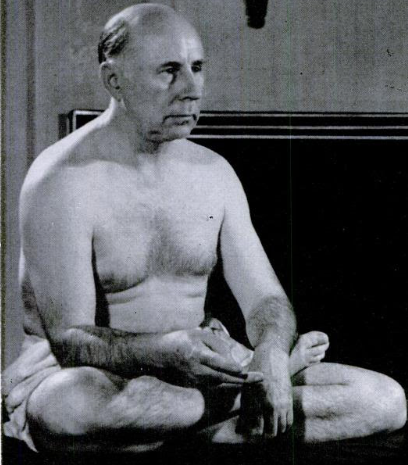
Lou Nova trains using the methods of "Oom the Omnipotent."
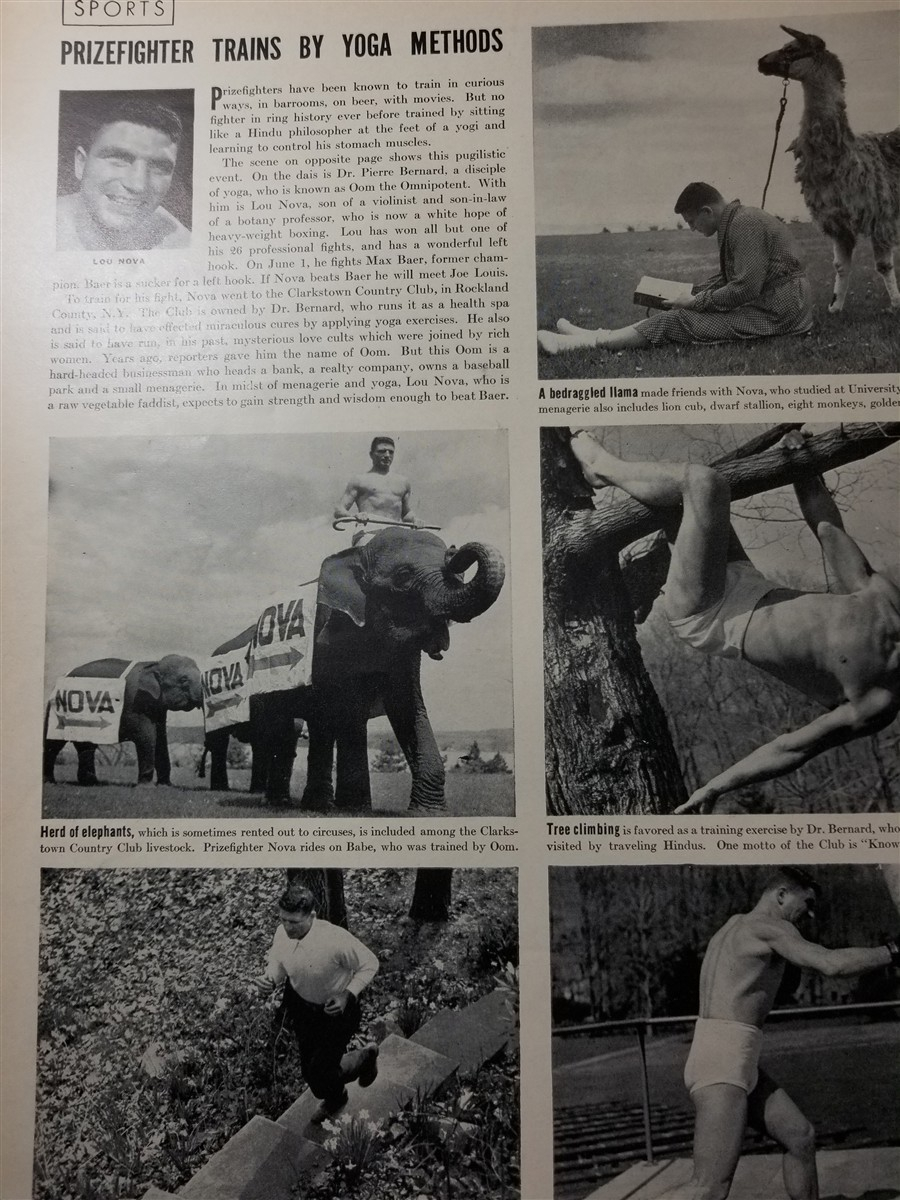
I can't help but chuckle every time I see this photo of Lou Nova riding an Elephant owned by "Oom the Omnipotent."
Lou Nova really did have a good punch, he iced Max Baer twice, he was a great fighter up until the point he met "Two Ton" Tony Galento, that fight changed Nova forever. Galento was known to be a dirty fighter, he would use thumbs, elbows, you name it, and Galento is alleged to have fought dirty against Nova, thumbing him in the eyes, almost blinding him, and really roughing Nova up. This is an interview conducted with Lou Nova by the Los Angeles Times in 1988.
Jab From the Past : With New Fight Facing Him, Lou Nova Focuses On the Many Memories of a Memorable Boxing Career
By EARL GUSTKEY
July 24, 1988 12 AM PT
LAS VEGAS — The old heavyweight pointed to the photographs on the wall, to the framed black-and-white of his 1941 bout against Joe Louis, and to another showing his knockout of Max Baer.
“Max Baer . . . ,” Lou Nova said quietly. “Max Baer could hit harder than anyone. Harder than Sonny Liston. . . . Harder than Tyson? Oh, my yes. Listen, Mike Tyson isn’t a great fighter yet. He will be, but he isn’t yet.”
In the late 1930s, the 6-foot 2-inch, 200-pound Nova came out of Alameda, Calif., with a crackling left jab, a knockout right hand and a dream that he would be the man to take Louis’ heavyweight championship.
Lou Nova thinks a lot about the old days. Though a fit-looking 75, he is battling cancer.
James J. Corbett, like Nova, was a heavyweight from the Bay Area. In 1892, Corbett dethroned John L. Sullivan for the heavyweight championship.
“I can’t get over the coincidence between Corbett and me,” Nova said. “We’re both from the same area, we both represented the San Francisco Olympic Club, we were both world amateur boxing champions, we were both prominent pro heavyweights, we both became Broadway actors, we were the only two boxers ever admitted to the Lamb’s Club (for actors) in New York, and he died of cancer.
“Now I’ve got it. How do you like that? Makes you wonder . . . “
The morning sun was warming the sun porch in Nova’s Las Vegas mobile home. The memories came tumbling down.
Of the 20 men Louis defeated during his championship years, Nova is one of the more interesting ones.
Born in Hollywood, Nova was the son of a symphony pianist. In the mid-1930s, he was a standout football player and javelin thrower at Alameda High School. He was recruited to play football at UC Davis, where he was, for one season, a single-wing tailback.
“If pro football players made any money in those days, I probably would have wound up playing pro ball,” he said.
Of course, no one made much money in those days. Nova recalled a visit to a downtown Oakland boxing gym.
“Amateur boxing was very big in those days,” he said. “Every big city in the country had thousands of amateur boxers. So I was a good high school athlete, and I figured I could box, too. So one day I walked into Duffy’s Gym, around 1935. I was wearing cardboard soles in my shoes.
“Duffy’s Gym was in the seedy part of town. The trainer there, Harold Broom, also owned a bar in the neighborhood, and the boxers who used the gym could always get a free bowl of hot stew at the bar. I lived on that stew.
“Well, I learned pretty quickly. I was the national (and world) amateur heavyweight champion in 1935. Max Baer’s first manager, Ham Lorimar, was around the gym a lot, and he became my first manager, until he sold my contract for $10,000 to Ray Carlin.”
Nova turned pro in 1936 and won his first 20 bouts, until losing a decision to Maxie Rosenbloom at Hollywood Legion Stadium in 1938. Nova then easily decisioned Britain’s Tommy Farr before achieving his breakthrough victory, an 11th-round knockout of Baer in 1939.
“After that, I knew I’d eventually get my shot at Louis,” Nova recalled. “So I signed for a fight with Tony Galento, with the winner guaranteed a shot at Louis. The Galento fight ruined me.”
Nova fought Galento in Philadelphia. As The Times’ Jim Murray described it decades later, “Galento should have been arrested that night for practicing surgery without a license.”
The referee finally stopped it, in the 14th, and declared Galento the winner. The Associated Press reporter described the referee’s shirt as blood-soaked “from collar to waist.”
The reporter also called it “the most brutal bout of modern times.”
“I was never the same after that fight,” Nova said.
“See, my trainer then was Ray Arcel. Ray’s still around. People think he’s some kind of boxing genius. Let me tell you something. Ray Arcel didn’t know anything about boxing. He’d never been a fighter. I never forgave him for letting that fight go that long.
“I’d never taken a beating before. I always assumed when you’re taking a bad beating, your corner stops it. Mine didn’t.
“They put me in the hospital for three days. To this day, I have no memory of anything in that fight after the third round, including the three days in the hospital.
“Physically, I bounced back. But mentally, never. I subconsciously promised myself never to let myself take that kind of beating again. I finally got my chance with Louis. But I wasn’t the same fighter. I was cautious, very conservative. I really believe I’d have beaten him had I never fought Galento.
“Years later, people who knew Louis told me that Louis was afraid of me. He knew I’d beaten Tommy Farr worse than he did, but that it really bothered him that I’d knocked out Baer twice. And he knew that I had the best left jab in boxing in those days.
“Looking back on it all, I really believe I was the worst-managed fighter in history. I had ability, I’d shown that. All my life, I’ve wondered how far I’d have gone if my corner had stopped that Galento fight early.”
Arcel, who turns 89 next month, seemed surprised when told Nova blamed him for the length of his beating by Galento.
“I’m sorry Lou feels that way,” Arcel said. “I was his trainer, but I had no authority to stop the fight. Ray Carlin was his manager, he was in the corner, and he was in complete charge.
“Lou Nova was a courageous and talented heavyweight. He had talent. At his best, he would’ve given any heavyweight in any era a lot of trouble.”
Louis-Nova, on Sept. 29, 1941, was witnessed by 56,549 at New York’s Polo Grounds. It isn’t on anyone’s best-remembered list. Nova, boxing cautiously, largely avoided contact with the stalking Louis, until Louis knocked him out with one right hand in the sixth round.
After expenses, the 27 year old returned to Southern California with a check for $125,000, wondering how best to invest it.
“This banker was recommended to me, a guy named Davis,” Nova recalled, starting to laugh. “I’d found this piece of property in the farm country of the San Fernando Valley, near Van Nuys. It was a four-bedroom, three-bath house on 6 acres, with fruit orchards. It also had a guest house and stables. Remember, this is 1941.
“It was on the market for $25,000. So I asked this Davis guy for advice, and he said: ‘Nova, you go ahead and buy that place if you really want it, but don’t sink a lot of money into it, because that farmland out there (in the San Fernando Valley) will never be worth anything. If you’ll take my advice, you’ll put that money in long-term, 3% bonds.’
“I bought the place anyway. And when my wife divorced me in 1954, she wound up with the whole thing anyway.”
Nova broke up, laughing heartily at the story.
Nova and Louis later became friends. Louis also lived in Las Vegas in his last years, working for Caesars Palace. He died in 1981.
“Joe and I became closer as we got older,” he said. “I saw him maybe once a week in his last years.”
After he left boxing in 1944, Nova took up acting. He appeared on stage in “Guys & Dolls” and still performs, when he’s feeling well, as a stand-up comic. In the 1960s, Nova was selling a padded stool-like exercise device that enabled people to easily stand on their heads.
Nova has always had a thing about standing on his head. For 40 years, he has been convinced that headstanding would cure baldness, face wrinkles, hypertension, double chins, disk trouble, halitosis, sinus trouble, deafness, hemophilia, constipation and tooth decay.
He had a contraption he called the Yogi Nova. He pointed to one in his bedroom. It had aluminum legs, and raised, padded arms where the shoulders rested.
“I sold thousands of those things, for $20 apiece,” he said.
Nova said he learned of the wonders of headstanding decades ago from a yoga instructor, Dr. Pierre Bernard, also known as “Oom the Omnipotent.”
“Walk with your head up and your heart has to work too hard pumping all that blood to it,” he said.
As Nova has always said after fighting Galento, if he’s an expert on anything, it’s blood.
Lou Nova's fight with Tony Galento, this fight gained a reputation as one of the dirtiest and bloodiest in boxing history. Galento is alleged to have used an array of illegal tactics, including head-butting, heeling, elbowing, and back-handing, in addition to eye-gouging with his thumbs. This is the only actual footage of the fight, a brief clip at the end of this video.
These are the only two photos I can find from the actual Lou Nova-Tony Galento fight itself. One thing about Lou Nova, he had heart, he took one severe thumping from Tony Galento, who used every dirty trick in the book, before succumbing in the 14th round.
Like I said before, Lou Nova could punch. In his first fight with Max Baer, the left side of Baer's face was battered out of shape after ten rounds of the most excruciating fighting he had ever undergone, and was bleeding so severely from a severe laceration of the lower lip he could hardly breathe when the referee stopped the bout. Nova beat Baer again by TKO in 1941.
And Lou Nova did this to Pat Comiskey in 1941.
Lou Nova was quite a character in boxing lore, in his later years he was a stand up comedian in Las Vegas.
This is actually my favorite photo of Lou Nova, jogging up some stairs during his time training with "Oom the Omnipotent" it's a cool image.
Time for a music break. Big Pun is up there with that the best that ever did it.
Hasim Rahman sporting a baseball-sized Haematoma sustained during his showdown with Evander Holyfield in 2002. The swelling was believed to be the result of an accidental clash of heads.
The injury was significant enough for referee, Tony Orlando call an end to the contest midway through the 8th round and Holyfield was awarded the win by split technical decision.
Holyfield, who was 39 at the time showed that he was still among the elite, landing 44% of punches thrown before the fight was stopped. It should be noted that Holyfield was notorious for headbutting his opponents, he would lean in really close while infighting and it often resulted in a clash of heads, it's the reason Mike Tyson but his ear off, Tyson had become furious that Holyfield was getting away with headbutting him.
"If there was something I would have done differently. I think of all the running I did and wonder if it was necessary. I mean I ran a lot, which was always difficult with my bad foot. Well one day I run into Jake LaMotta, and I ask him how much he ran. He looks at me and says, 'Vito, I never ran a f...... day in my life."
Orlando Canizales, aka "El Gato", 1980s and 90s bantamweight champion, who was born in Laredo, Texas on this day in 1965.
Canizales was a slick boxer-puncher with impressive footwork and maneuvering in the ring. He made 16 defenses of the IBF bantamweight title and retired at 50-5-1 with 37 KO. Orlando Canizales earned his nickname “El Gato” for his agility and quick reflexes.
Music break, let's get one more Big Pun track in here. One of the greatest that ever did it.
"Boxing? To me it's the darkest game in the world. It really is dark, and you've got few friends or none at all."
Sibson’s words capture the lonely, unforgiving nature of the fight game. A sport where the lights are bright, but the shadows run deep.
He knew it well — a rugged, working-class fighter from Leicester, Sibson battled his way up the ranks to challenge three times for world titles. In 1983, he stood across the ring from the legendary Marvin Hagler for the undisputed middleweight crown. Though he came up short, Sibson’s toughness and grit earned respect on both sides of the Atlantic.
But beyond the glory nights and championship opportunities, fighters like Sibson lived the hard truth of boxing: endless training camps, brutal sparring, broken promises, and the isolation of a career where everyone wants a piece of you — until you lose.
That’s the paradox of boxing. A sport of glory and heartbreak. Where legends are made, but few friendships survive.
Tony Sibson, aka "Sibbo", is one of my favorite fighters to watch, tough as a woodpeckers beak, he really was epitome of what a fighter is and goes through in this sport, the brutality, the ups and downs, the highs and lows, the sheer toll it takes on you. Whenever I see a photo of Tony Sibson, the first thing that pops in my mind is, "damn, now that's what a fighter looks like." He had a love/hate relationship with boxing, there were things he liked about it, he knew the glory, but he knew the ugly side of it as well. One thing about Sibbo, he was all guts and heart, he never backed down and always took the fight to his opponent.
Tony Sibson: The Leicester Lionheart
In the rich tapestry of British boxing, few figures embody grit and perseverance quite like Tony Sibson. Born into a working-class family in Leicester, Sibson never had the fanfare of Olympic medals or Hollywood glamour. What he did have was toughness, tenacity, and a willingness to face the best of his era. Coming up during the golden age of the middleweight division, he fought legends like Marvin Hagler and Dennis Andries, and while a world championship eluded him, his career stands as a story of courage and pride. This is the journey of Leicester’s beloved fighting son. Tony Sibson was born on April 9, 1958, in Leicester, England. Like many working-class kids, boxing became both a passion and a pathway to opportunity. He showed a natural strength and aggressive style early in his amateur career. Though he never captured national or Olympic glory, Sibson built a reputation as a fighter who never backed down. By the age of 18, he turned professional in 1976, choosing to chase greatness in the pro ranks rather than extend his amateur stay. His decision reflected his blue-collar mentality: work hard, take your chances, and learn by doing. Sibson’s professional debut came on October 26, 1976, with a first-round TKO over Peter Brown. Fans quickly noticed his come-forward style and punishing body shots. By 1979, he had separated himself from domestic rivals. His biggest breakthrough came that year when he captured the British Middleweight Title with a victory over Dennis Minter. In April 1979, Sibson became the best middleweight in Britain.
Later that year, he defeated Alan Minter in a non-title fight, sending shockwaves across the UK boxing scene. These wins marked Sibson as more than a local contender—he was a rising international name. After dominating the British scene, Sibson sought bigger challenges. In 1981, he captured the Commonwealth Middleweight Title and then traveled to Paris, where he defeated Gratien Tonna to win the European Middleweight Title. That victory elevated him into the global top 10 and paved the way for his most significant opportunity: a shot at the world middleweight crown. The following year, Sibson stunned the boxing world by upsetting Dwight Davison, the number-one contender. That win officially punched his ticket for a chance at boxing immortality. On February 11, 1983, Tony Sibson stepped onto the grandest stage of his career—challenging Marvelous Marvin Hagler for the undisputed middleweight title. The bout, held in Worcester, Massachusetts, pitted Sibson’s relentless pressure against one of the greatest champions in history. Despite his 55–3–1 record and fearless approach, Hagler’s southpaw jab and surgical accuracy overwhelmed Sibson. The fight ended in the sixth round, with the referee stopping the action after Hagler unleashed a brutal barrage. Though defeated, Sibson’s heart and bravery won admiration, showing he belonged among the best. Sibson’s career didn’t end with Hagler. He rebounded with strong performances, including a win over Louis Acaries to reclaim the European Middleweight Title. Seeking new opportunities, he moved up to light heavyweight. In 1986, he challenged Dennis Andries for the WBC title in London. Sibson started well but faded late, with Andries’ size and pressure proving too much. He was stopped in the 9th round. He made one final attempt at world glory against Frank Tate for the IBF Middleweight Title in 1988 but fell short. Shortly after, he retired with a record of 55 wins (31 by KO), 7 losses, and 1 draw. Tony Sibson was never flashy. He lacked the showmanship of Sugar Ray Leonard or the explosive speed of Thomas Hearns. But what he did have was grit. His style was built on relentless pressure and ring generalship, a vicious body attack that wore opponents down, and unshakable determination, even against legends. Though he never held a world belt, Sibson was a constant presence in one of boxing’s toughest eras. Sharing the stage with Hagler, Hearns, Roberto Durán, and John Mugabi ensured his name was forever tied to a golden age of middleweights. Unlike many fighters, Sibson avoided the chaos that can follow retirement. He returned to Leicester, living quietly and occasionally offering reflections on his career..Leicester, a city with few boxing icons, proudly regards Sibson as one of its finest athletes. To fans, he remains a symbol of working-class toughness and perseverance. His humility outside the ring only enhanced the respect he earned inside it. Tony Sibson’s story is not one of titles won, but of respect earned. He fought in one of boxing’s most competitive eras, facing Hall of Famers without hesitation. While the belts slipped through his fingers, his legacy rests on his courage, resilience, and connection to the fans who saw themselves in him. For Leicester and for British boxing, Sibson stands as a reminder that greatness isn’t always measured by hardware. Sometimes, it’s about the battles fought, the heart shown, and the pride carried into every round. And in those terms, Tony Sibson was—and remains—every bit a champion.
Reading that article about Tony Sibson, this really jumped out at me:
"greatness isn’t always measured by hardware. Sometimes, it’s about the battles fought, the heart shown, and the pride carried into every round."
That is intense, and it really applies to every sport, everything we do in life.
The first time I ever watched Tony Sibson fight was in a losing effort, against "Dangerous" Don Lee. I had heard of Don Lee, I knew he was a hard puncher, hence the nickname "Dangerous", and I had never heard of Sibson, I fully expected Lee to blast Sibson out rather quickly. I was shocked when I watched the fight how saw how hard Sibson was to deal with, and while Lee did eventually stop Sibson, he had his hands filled every step of the way. Sibson was one tough, tenacious, relentless bastard of a fighter, like a mosquito that just won't go away.
1981 EBU Middleweight Title Fight at Wembley, Tony Sibson after knocking out Nicola Cirelli in the 10th round. Sibson could whack, when he threw a punch he didn't hold back, he really loaded up. Left hooks did the deed in this one, Sibson had a brutal left hook, that left hook did the deed in quite a few of his fights.
Tony Sibson vs Alan Minter. Both of these guys had a few things in common, both had fought Marvelous Marvin Hagler, and both were British, which naturally led to a bit of a British rivalry towards eachother. They became good friends, but the rivalry had to be settled in 1981. Alan Minter was a good fighter as well, he was a tough, aggressive southpaw, he had good power, could brawl, but was also a good technical fighter with a solid jab. He had a strong chin, though he was also known for having fragile skin that was prone to cuts. Just a year prior to this fight Minter had been world middleweight champion, but had lost the belt to Marvelous Marvin Hagler, if this fight had happened a year earlier, Sibson would have won the middleweight crown.
.
A Boxing Memory: Tony Sibson vs. Alan Minter
“Sibson hit me with a blinder of a punch. I think it would have knocked out any fighter in the world.” - Alan Minter
Boxing rarely allows a former champion to leave the sport without shedding at least some semblance of their dignity. Very few leave boxing on their own terms. Many are in denial that they are no longer what they once were. Some reside on the right side of delusion, but they still need to fight on for a multitude of reasons. The reasons may differ, but the majority end up on the wrong side of a vicious or humiliating defeat.
In September of 1980, Alan Minter was the undisputed middleweight champion of the world. Less than a year later, Minter was starting life as a retired boxer. Marvelous Marvin Hagler had ripped away his world titles on an infamous night in British boxing history. Minter’s face was sliced to pieces by the slashing fists of the fearsome American, and a section of the Wembley crowd let themselves down, and their country, with a racially motivated drunken riot as Hagler was crowned the new world middleweight champion.
Minter talked about once again winning the world title, but after a comeback win over Ernie Singletary, Minter travelled to America and lost a split decision to Mustafa Hamsho that ended any immediate hopes of another world title shot. Minter seemed to fade down the stretch, and those closing rounds cost Minter the decision, although many still had him beating Hamsho.
Tony Sibson was the up-and-coming British middleweight contender. Sibson had enjoyed reigns as the British, Commonwealth and European champion and hadn’t tasted defeat since the night Kevin Finnegan beat him in 1979 when the Leicester fighter turned up in less than-peak condition. By 1981, Sibson was the reigning European champion and was coming off a win in Spain against Andoni Amana, which had earned Sibson his European bauble. With Minter needing to take a step down after his loss to Hamsho and Sibson needing a marque win against an established name to push himself into the world title picture, the fight between the two was a natural and was made with the European title on the line. But after nine years as a professional, and after losing two of his last three fights, Minter knew his entire career was on the line also.
“This is my chance to come out of the shadows,” Sibson said while Minter talked about old sparring sessions and said he couldn’t retire without facing his British rival. Minter believed he was the fighter with the bigger punch. The fight itself would tell a very different story.
The fight was scheduled to air on the BBC, but when Minter got an advertising deal with DAF Trucks, the BBC wouldn’t show the fight because of the DAF logo on Minter’s shorts. The Minter camp tried to cover the logo with sticking plaster, but when the plaster kept falling off, the BBC pulled the fight from their schedule because of their strict advertising policy. The fight took place on the 15th September at the Wembley Arena with Sibson and Minter, both earning a reported £80,000. Although there was some suggestion that Minter earned a little more than his British rival.
After a tight opening round, which Minter probably edged from his southpaw stance, the former world champion continued his good start in the following round. Sibson was missing with his patented left hook, and Minter picked him off almost at will. But the fight between the two former sparring partners would explode in the third round.
After his slow start, Sibson picked up the pace and started landing more frequently with his more powerful punches, but there were no signs that the end was imminent. But one almighty left hook dropped Minter when the two fighters were on the ropes. Somehow, Minter got to his feet, but when Sibson dropped him again, the fight was over. And the career of Minter also. Minter was only 29, but his long career had taken its toll.
Sibson couldn’t quite emulate Minter on the world stage. He found Marvin Hagler far too good for him in 1983, and at the tail end of his career Sibson lost world title fights to Dennis Andries and Frank Tate and retired in 1988 after a long and eventful career.
Shots from the Sibson-Minter fight.
Here are the highlights of Sibson-Minter, you can see what a cracking fighter Sibson was, three rounds and he had Minter out of there, and it was the left hook that did the business.
In 1983, Sibbo stepped up and challenged Marvelous Marvin Hagler for the middleweight title. I'll start off by saying, no one should ever be embarrassed to lose to Hagler, you're talking about arguably the greatest middleweight to ever live. Sibson was all guts, he never backed down from anyone, he fought well, but nobody outworks prime Hagler. Tony Sibson was all class, after the fight he stated:
"He might have beaten me up but I will always adore Marvelous Marvin Hagler." He also described Hagler as the "master of disaster" whose punching was incredibly quick and accurate, stating, "I couldn't find him". After the fight, Sibson also conceded that Hagler was just too good, and that no one could do what Hagler had just done to him.
A Boxing Memory: Hagler vs. Sibson
Marvelous Marvin Hagler had many good nights in a boxing ring, and most of them went underappreciated, at least until 8 minutes of mayhem with a ‘Hit Man’ in a shootout for the ages. Hagler was an angry man in 1985. He went to war for many reasons in Las Vegas, Tommy Hearns found a Hagler we hadn’t seen before. But Hagler was perhaps even more ‘Marvelous’ two years earlier.
The sold-out Worcester Centrum in Massachusetts was surrounded by blizzards. Inside it, Tony Sibson was caught up in a different type of storm. Sibson had ventured from Leicester with hope, but he caught the undisputed world middleweight champion on perhaps his best-ever night.
Sibson 24 had found success and plenty of it on the domestic front. British, Commonwealth and European middleweight titles were in his collection. He was ranked the number one middleweight contender in the world, Sibson looked like a much tougher challenger than the merry-go-round of challengers Hagler had to endure in his search for acceptance and respect.
The fearsome middleweight champion always had a chip on his shoulder about how he was viewed and treated in the sport. The big fights were still just a desire. He needed a dance partner that would elevate his own status. For Hagler, that wait would continue.
Sibson looked like a far stronger challenger than some of Hagler’s recent opponents, he was a 7-2 outsider, but he came with real pedigree and his powerful left hook, at least this challenger had some intrigue.
A couple of early career defeats were soon forgotten when Sibson beat Frankie Lucas in a savage forgotten fight in 1979 for the vacant British middleweight title. It looked too soon for Sibson. In truth, it came too late for Lucas. After three more wins in 1979, Sibson surrendered his British title to Kevin Finnegan, Sibson recovered and remained unbeaten until his moment of truth against Hagler.
On the road to Hagler, Alan Minter passed the torch, and the good American Dwight Davison saw his world title hopes extinguished by the fists of Sibson. But Hagler would be a much more formidable foe.
Sibson’s trainer Ken Squires set in motion his plan to ready his charge for what lay ahead. With an axe in his hands, Sibson would do three minutes chopping down trees, an old-school simulation aimed at building a fighter’s strength and stamina.
The specific boxing training began early in 1983 for the scheduled date in February. But when a large press party turned up to help promote the fight, disaster struck.
Sibson, under the watchful eye of those with the mighty pens, sparred when he wasn’t fully warmed up, and he paid the price. Cliff Gilpin caught Sibson with an uppercut. He said:
“He bruised my sinuses and enflamed my eyes. That was that. I got changed and walked out of the gym again.”
Sibson did no further sparring in the build-up to the Hagler fight.
Training carried on with fitness now the primary aim. Unable to spar, the usual bread and butter for fighters to sharpen their tools in readiness for battle, Sibson’s task was made even harder. Impossible even.
Hagler had ripped the world title from Minter on an unsavoury night in London in 1980. The evening had a rancid smell of racism in the air, and hate and prejudice ruined Hagler’s moment. A seven-year and 30-fight unbeaten run, Hagler was some fighter, but without the then-retired Sugar Ray Leonard, Hagler was drifting without the recognition he craved. If ever a fighter deserved a big fight, it was Hagler.
Sibson was challenger number six, and despite the problems in camp, Sibson said he was fitter than ever and genuinely thought he could beat Hagler. The innocence of youth can blind even the best of us.
The British challenger was expected to offer far more resistance than the likes of William ‘Caveman’ Lee, who had folded inside a round in a recent title defence by Hagler. But from the opening seconds of the fight, Hagler demonstrated the sheer spite and class in his work. Sibson was brave, but Hagler was on another level. The confidence pre-fight gave way to Sibson admitting that he believed no man could do what Hagler had just done to him. “He just knocked me all over the place,” the beaten challenger conceded after 6 largely one-sided rounds.
Hagler said: “I was just dipping into my toolbox. I was enjoying my work.”
Harry Mullan reporting for Boxing News said, ‘Hagler’s performance was quite flawless. It was cold, ruthless perfection.’
Sibson called Hagler an artist. Hagler’s fists certainly painted a not-so-pretty picture on Sibson’s face. Hagler was simply brilliant on that cold winter night, just maybe, the best version of Hagler that we ever saw.
Sibson had a nightmare trip to America. Catching Hagler at his peak was just part of the problem. He would be left to rue his lack of sparring, the bad weather hampered his preparations even further, and there were problems with his protective cup, Sibson would later say, “Everything went wrong,” a painful night in many ways. Sibson believed in his heart he could beat Hagler. He found out the truth the hard way.
It would take a hotly disputed decision in a fight that he badly wanted, which finally arrived in 1987, to relieve Hagler of his titles. Leonard caught Hagler at the right time. He picked his moment, both brilliant and calculated in equal measure.
Hagler was slipping and threatened retirement, Leonard saw his chance and executed a plan to tempt Hagler, who eventually took the bait and left the sport a bitter man courtesy of that loss to Leonard in Vegas that still splits the boxing world.
Sibson drifted in and out of the sport after the loss to Hagler. There were moments when the old fire returned, especially when he returned to America to blast out the unbeaten Irish-American John Collins in two rounds. But a defeat to the dangerous American Don Lee in an up-and-down thriller stopped the momentum gained from the Collins win.
A win over Mark Kaylor promised more than it delivered. He regained his old titles on his road back, but Sibson never really got to where he wanted to go. Fights with domestic rivals Herol Graham and Errol Christie never happened for various reasons. A return was offered against Kaylor. It was good money, but Sibson wasn’t interested. Sibson was semi-retired, out of shape, recovering from surgery on his elbow, he’d got married, and boxing seemingly was in his past.
But a change in promoter to Frank Warren tempted Sibson back and offered him two further chances to win a world title. A move up to light-heavyweight to challenge Dennis Andries in 1986 came at the wrong time and at the wrong weight. Mentally, he wasn’t there and admitted afterwards that he had underestimated Andries. Many others did the same.
Sibson did give us one last reminder of his talents when he beat Brian Anderson for the British middleweight title and secured the Lonsdale belt in the process.
A final attempt and indeed a final fight to win the world title came against another American Frank Tate in 1988 for the IBF middleweight title. The IBF still had their title fights scheduled for 15 rounds, the British Board of Control stuck to their new 12-round rule on safety grounds, and the fight was in serious doubt as fight night loomed. The day before the fight, they belatedly reached a solution to have the fight reduced to a 12-round title fight.
The fight with Tate was close until not for the first time, Sibson started to lose concentration. In the 10th round, the fight and his career were over. He said afterwards that he just melted away. There was talk of one last comeback, but thankfully, it never happened.
Even on his best night, Sibson wouldn’t have beaten Hagler, but in another era where the titles were splintered, Sibson could easily have won a world title. In the talk of the best British fighter never to win a world title, Sibson is more than worthy of a mention.
When he faced Hagler, Sibson was almost certainly the second-best middleweight on the planet. At his peak, he was just unlucky to be around at the same time as perhaps the greatest middleweight in boxing history.
Some images from Sibson-Hagler.
Sibson and Hagler embrace after the fight.
These are two of my all-time favorite boxing photos, Tony Sibson covered in blood after the Hagler fight, absolutely savage.
Great images of Sibson taking questions from the media after the Hagler fight.
Hello, ok, yes, I also want to mention the Sibson vs John Collins fight in 1983, Collins was a tough Irishman from Chicago with brutal knockout power. Collins was 29-0 with 26 knockouts at the time of this fight. Sibson mowed him down. This fight really demonstrated how bada$$ Sibson was.
Bad Left Hook
Sibbo vs. Collins: Blast from the Past
by Scott Christ
"He [John Collins] could put you to sleep with a right hand."
After watching David Lemieux recently dismantle Elvin Ayala in Montreal, I was reminded of another compact, strong fighter with a somewhat hunched stance and that was Tony Sibson who fought in the 1970s and 1980s and was regarded as one of Britain’s best. He was Commonwealth and European champion and a serious world title challenger
When “Sibbo” was on and had trained properly, he was a very dangerous fighter. He was a stocky scrapper who came out of the Belgrave gym in Leicester. Going undefeated in his first 25 bouts, he finished with a great record of 55-7-1and was seldom in a dull fight. After losing to Kevin Finnegan in 1979 with the BBBofC British middleweight title at stake, he reeled off 14 straight wins, including TKOs over former world champion Alan Minter and Bobby “Iceman” Coolidge and a points win over talented Dwight Davison the later being a final eliminator for the WBC Middleweight Title. He then met Marvelous Marvin Hagler at the Centrum in Worcester, Mass on February 11, 1983. Hagler (55-2-2 coming in) pummeled the shy and affable challenger decking him twice as he stopped him in the 6th. Sibson, badly cut, was game and courageous, but simply did not have enough to stand up to Hagler’s relentless fury.
His next fight would be against John Collins in Atlantic City on October 8, 1983.
John Collins (1980-1986)
Like Sibson, Chicagoan Collins had a stellar amateur record and got off to a great pro start winning his first 29, 25 by way of stoppage. Most of his fights did not go beyond the third canto, and this may have contributed to his later downfall. Among his victims were Teddy Mann, a fading Oscar Albarado (58-11-1 at the time), undefeated fellow Chicagoan Lenny Lapaglia (19-0), and a prime Kenny Whetstone (23-1).
When he fought in the Windy City, the good looking and tall (6’1”) Collins had the appeal of a rock star. Indeed, he brought out the City’s South Side Irish in droves. When his fights began, the place would erupt into chants of “Collins! Collins! Collins!” The fans would go wild when he put together slick combinations and landed his signature straight-right cross which carried menace and finality when it connected flush.
The Fight
Collins was the undefeated favorite when he met Sibbo who was coming off the aforementioned loss to Hagler. A win by the Collins could well position him for a big pay day fight against the Marvelous one, but it was not to be.
In the first round, a fit and ready Sibson hit his taller opponent with solid jabs and some damaging short rights. Sibson was a great inside fighter and that’s where the he was doing the early damage. Then, with 27 second left in the round, Tony cornered the Irishman in a neutral corner and rocked him with two vicious left hooks and a brutal head-snapping jab that had all of his weight behind it. Again trapping him in a corner, this time his opponent’s corner, a crunching hook sent Collins to the canvas, but he was saved by the bell and his corner quickly tried to revive him.
The second round began as the first ended and it was clear Collins had not fully recuperated. Sibbo quickly sent Collins down with a powerful straight right and then finished him off with a series of short but effective shots that sent him sprawling across the ring and then onto the canvas for the third and final time in the fight.
It had been a Chicago-style mugging, but this mugger was not a Chicagoan.
The Sibson-Collins knockout.
The brutal Sibbo left hook on display once again in 1986 against Juan Elizondo.
One thing about Tony Sibson, his high work rate style made for some exciting fights, one more here against Frankie Lucas in 1979, nice little donnybrook.
Let's get a few good photos of Sibbo in here, the life of a prizefighter right here.
Sibson floors Matteo Salvameni in 1980.
A young Tony Sibson, sick photo, I'd love to own it.
Great book about the legendary Tony Sibson.
About Ronald "Winky" Wright, one of the most brilliant technical fighters this sport has ever seen. From Brain boxing on Facebook, and brilliantly written:
Winky Wright: The Master of Defense and the Art of Technical Perfection
Ronald “Winky” Wright, born on November 26, 1971, in Washington, D.C., stands as one of the most technically gifted and defensively brilliant boxers of his era. Renowned for his precise jab, strategic intelligence, and exceptional defensive craft, Wright’s legacy is built on skill, discipline, and consistency.
Turning professional on October 16, 1990, Wright stormed onto the scene with a 25-fight unbeaten streak that showcased his refined fundamentals and ring composure. Despite an early career setback against Julio Cesar Vasquez on August 21, 1994, for the WBA Light Middleweight Championship, Wright continued to evolve—his mastery of defense and tactical patience making him a nightmare for opponents in the ring.
Wright reached the pinnacle of his career in 2005 when he produced a boxing clinic against Puerto Rican legend Felix “Tito” Trinidad at the MGM Grand in Las Vegas. With his signature high guard, laser jab, and brilliant ring control, Winky dominated every round, handing Trinidad one of the most decisive defeats of his illustrious career. Trinidad himself admitted, “Winky Wright was a great fighter—his jab was very strong.”
That victory followed his back-to-back triumphs over Shane Mosley, solidifying Wright’s position as the undisputed king of the light middleweight division. His name became synonymous with technical mastery, ring IQ, and defensive excellence—traits that defined an entire generation of boxing purists.
“Boxing is not just about power—it’s about intelligence, defense, and making your opponent fight your fight.” — Winky Wright
That quote perfectly captures his boxing philosophy: a thinker, a tactician, and a craftsman who turned defense into dominance.
Though later years brought losses to Paul Williams and Bernard Hopkins, Wright retired in 2012 with a proud record of 58 fights, 51 wins (25 by knockout), 6 losses, and 1 draw. His legacy as a two-time light middleweight world champion—and the undisputed ruler of that division—remains unshaken.
Winky Wright’s career is a testament to the beauty of boxing’s “sweet science.” He proved that great defense, intelligence, and patience could conquer even the most powerful punchers.
Closing Remark:
Winky Wright will forever be remembered as one of boxing’s finest tacticians—a master of defense whose precision and discipline elevated the sport to an art form.
Ricky "The Hitman" Hatton absolutely wrecked Carlos Maussa with a brutal 9th round KO while making his first defense of The Ring and unifying the IBF and WBA junior welterweight titles at Sheffield Arena in Sheffield, England in 2005.
Hatton beat Kostya Tszyu up to seize the junior welterweight title a few months earlier, and he was matched with WBA title-holder Carlos Maussa, a wily and awkward boxer-puncher from Colombia.
Unfortunately Hatton was cut early on, but it was an issue he contended with throughout his career. And he walked Maussa down in each round anyway, slowly wearing him down. In round 9, Hatton launched a left hook that caught Maussa and crumbled him in the corner for the count.
"He was very awkward," Hatton said. "He was pulling back from the punches and it made it very difficult to nail him. I think I was trying too hard."
Here is that Hatton-Maussa knockout, absolutely brutal leaping left hook.
"Rockabye" Rubén Olivares, 1960s and 70s bantamweight and featherweight world champion from México, D.F. who carried serious, serious punching power in both hands. He got the nickname "Rockabye" because he put opponents to sleep and was once referred to as a "pocket knockout king." He earned that nickname 79 times over, finishing his career with a record of 89-13 (79 KO).
Juan Manuel Márquez rose from a hard knockdown to defend the unified and lineal lightweight titles with a 9th round TKO in a war with Michael Katsidis at the MGM Grand in Las Vegas, Nevada in 2010.
Márquez was highly skilled, but not as exciting or popular as his Mexican contemporaries Marco Antonio Barrera and Erik Morals. But he was in some better fights later in his career, perhaps due to the rise in weight and a conscious decision to stand and trade a bit more. While Katsidis wasn't unbeaten, he was a puncher who always gave his all. He also bravely went through with this fight despite his brother's death one month earlier.
It looked as though Katsidis might win when he surprised Márquez with his aggression and sent the champ down in round 3. But Márquez, a resilient champion, gradually seized control of the fight.
In round 9, Katsidis he ran into a right uppercut and a combination that shook him to his boots as he charged forward. Márquez couldn't miss with his right hand and uppercuts with either hand after that, forcing a referee stoppage.
"I was surprised by his left hand," Marquez said. "I didn't protect myself and I got caught. I knew how to manage the fight with my combinations and conditioning. That's why I got up so quickly after I got knocked down."
Johnny Coulon, aka "The Chicago Spider", was an all-time great bantamweight in the 1900s and 1910s, and after he retired he developed a famous trick where he made himself unliftable, he would put his finger on the lifter's neck and wrist, and nobody could lift him. He did this trick for decades, challenging boxers, wrestlers, to lift him. He was only 5'0", barely 110 pounds, and no matter how big and muscular you were, you couldn't lift him. He took the act on the road and performed the trick everywhere he went, music halls in Paris France, saloons, you name it, the public was mystified by it and some people even attributed it to the occult.
Muhammad Ali attempts to lift Johnny Coulon
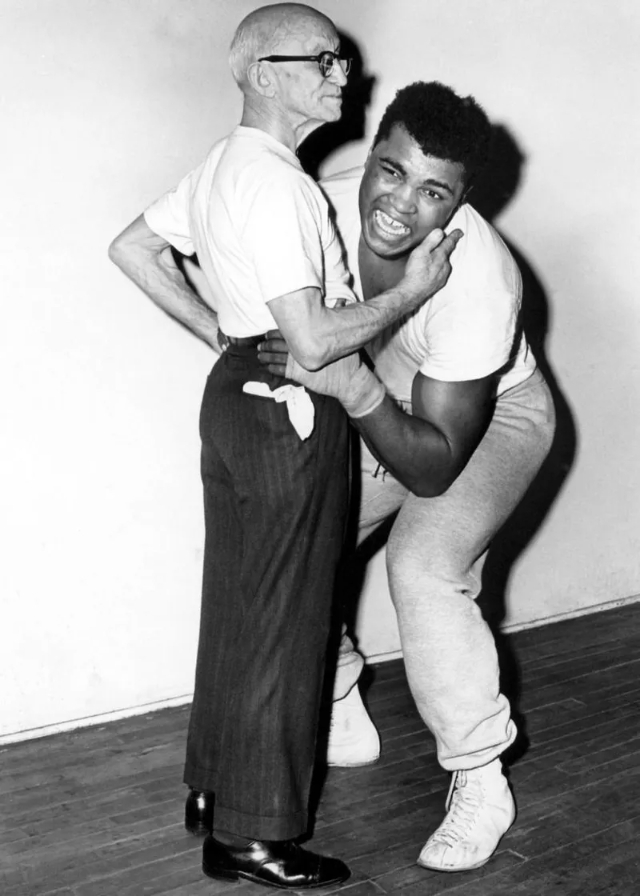
Jack Johnson attempts to lift Johnny Coulon.
A wrestler attemps to lift Johnny Coulon.
Johnny Coulon's trick was studied by all kinds of people, psychiatrists, physiologists, it even ended up being studied by the famous escape artist Harry Houdini and Robert Ripley of "Ripley's Believe it or Not."
Jack Dempsey watches as Johnny Coulon performs his trick