Options
Southern So-Called Dollars Mega Thread
 Pioneer1
Posts: 219 ✭✭✭
Numerous so-called dollars and medals relate to Southern Expositions from the 1870s to the 1900s. I was a bit astounded by the sales price of this "SCD key" related to the William Warner & Brother Company of Philadelphia PA in May 2025. I would like to start a long-term discussion regarding this collecting area as there seem to be people with money to invest in this area.

Of course, this bronze medal connects the William Warner & Bro Co (and Philadelphia) with numerous Southern themed SCDs of which more posts will follow.
A So-Called Dollar and Slug Collector... Previously "Pioneer" on this site...
5
Comments
There are numerous Southern Expositions from the 1870s to the 1900s that are in the Shevlin & Hyder book and of interest for discussion. After the civil war (1861-1865), the South was under reconstruction (1865-1877), an effort at rebuilding the South and integrating former Confederate states back into the Union. Lincoln and Johnson initially pursued lenient policies toward the South, but after Lincoln;s assassination, radical Republicans took control and pushed stringent measures. As the South tried to rebuild, it became clear that Southern Expositions were of value.
To start out with, here is the 1872 Louisville Industrial Expo:
One wonders if the logo on the medal is Tiffany and Company (T&C at 4:00 on the reverse). While KY was not under reconstruction, considering it a Southern State (given the eventual 1883 Southern Exposition), the 1872 Louisville Industrial Expo could be considered an early " Southern " Expo... before the Panic of 1873 created financial havoc.
The 1872 Louisville Industrial Expo featured beautiful woodwork, artistic engraving lithographs, and sculpture (Hebe featured here), the Greek goddess of Youth… known as the cupbearer of the Gods, serving them nectar and ambrosia…. She was also associated with the prime of life, eternal youth, and forgiveness. Hebe was the daughter of Zeus and Hera,
One would assume that a Cincinnati die sinker like Charles Theiler would have been involved in the creation of this medal, and perhaps T & C references him as opposed to Tiffany and Company. If it does, Charles Theiler was in Cincinnati from 1874 to mid 1880s. He engraved one of the 1883 Southern Expo pieces (SH 3-61) but also engraved several Ohio Ag Fair Medals (Harkness OH-60 Hamilton County Ag Soc + OH-100 Southern Ohio Fair – 1880s) … seemingly competing with P.L. Krider. Theiler eventually went to CT by 1886… with his work including the 1887 Soldier’s medal and 1888 HK-614 (New Haven CT) .. and his signature on these medals referencing Meriden CT which is near Waterbury CT ... so presume Theiler went to CT and could have had an association with Scovill Mfg in nearby Waterbury CT.. which makes one wonder if he did some fine work for Meriden Britania or Meriden Gravure Co…. in parallel with Scovill like HK-13 given the quality of his work
In any event, point being, numerous NORTHERN die sinkers did all the engraving work for SOUTHERN expositions.
A So-Called Dollar and Slug Collector... Previously "Pioneer" on this site...
Wow! What a nice specimen and strong price for a HK-791A! Thanks for posting it!
Here is a decent example of SH 3-61... the 1883 Southern Exposition medal by Theiler of Cincinnati... along with this collection of Theiler medals for reference...
A So-Called Dollar and Slug Collector... Previously "Pioneer" on this site...
Moving on to the 1883 Southern Exposition (SH 3-61 to 3-63), and beyond Theiler's medal... for those of us who know of the infamous William H. Warner and Brother Co (Brother = Charles K Warner (CK Warner) of Civil War Token Fame like GW-733), with this fabulous silver store card re-sold by Steve Hayden in 2025 (after being last sold in the 2020 Stacks sale of the E Pluribus Unum Collection):
The William Warner and Brother Co of Philadelphia Co began much earlier under John Warner, an established medalist in Philadelphia PA. There were lots of connections between John Warner (who passed in 1868) and the US Mint in the 1840s-1860s. There is much speculation that numerous engravers at the US Mint worked with him. C.K. Warner, John's son, began his own company work in the mid 1860. He has numerous post-civil war store cards, made by Wm H. Key and Robert Lovett Jr (see GW-728 to GW-747 --- 19 storecards alone with varying artistry and post civil war themes, including Lincoln, US Generals, and Union/constitution). Charles Warner was cataloging and selling medals -- such as the Louis Brechemin collection (Washingtonia/Patterns) in 1867 … cataloged by C.K. Warner. Note that Lewis Brechemin, born in France ca. 1786, was a Philadelphia jeweler and known artist of lithographs. A member of the French Benevolent Society, he died (following an accident) on March 12, 1866 while a resident at 224 South Second Street in Philadelphia.
By 1876, C.K. Warner seems to have been involved with selling centennial medals as is seen in his sales list published in the TAMS journal. Key and Soley’s work at the 1876 exposition featuring the Liberty Bell and George Washington were marketed thru Warner. Warner's business really took off and was busy between 1880 and 1900.
Warner was associated with a famous Philadelphia engraver -- Edward A Kretschman (initials EAK on numerous 1880s medals); he is connected to the Southern Exposition through SH 3-62. The liberty head obverse on the medal is paired with numerous reverses engraved by Kretschman (between 1883 and 1890). EAK was born in Germany in 1849 and died in 1923. He moved to America and worked as a sculptor in Philadelphia, willing awards bu 1875. The Collis Zouave atop the 114th PA infantry monument in front of the Sherfy Farm House in Gettysburg PA National Monument is his work. In medallic art, did a series of Washington medals, numerous 1884 New Orleans Cotton Expo medals, and a North, Central, and South American Exposition medals, and is associated with numerous medals related to the libery head obverse thru 1890. He is also likely connected to the 1883 Germantown PA medals.
The Steigerwalt’s Coin Journal references the William Warner Co as creating the smaller Southern expo medal (sold by Fred Holabird auctions) as well as the Germantown medal.
The Southern exposition (in Louisville KY) was a series of annual expositions from 1883 to 1887 in “Old Louisville” which highlighted Thomas Edison’s newly made incandescent light bulb, the upcoming Statue of Liberty in New York, and numerous exhibits including Tobacco, Distilling, Leather, Glassworks.
A So-Called Dollar and Slug Collector... Previously "Pioneer" on this site...
This bronze SH 3-62 is a Philadelphia PA creation by Edward A Kretschman (initials EAK on numerous (perhaps 7-8 reverses engraved by Kretschman(between 1883 and 1890). Most Warner pieces can be identified by the style of the lettering.
A So-Called Dollar and Slug Collector... Previously "Pioneer" on this site...
In addition to the 1883 white metal piece (Rulau-Ky-Lo-32) above, here is it's iteration into the 1884 Southern Exposition medal....
A So-Called Dollar and Slug Collector... Previously "Pioneer" on this site...
.. and these pieces .. which are attributed to Warner... include the 1884 NC Exposition:
... and this confederate reunion piece from Portsmouth VA (1884)....
... all of which are the same size.... 32-33 mm
A So-Called Dollar and Slug Collector... Previously "Pioneer" on this site...
... and before moving on to another exposition... I needed to throw in this 1900 Winston Salem NC piece.... also from what I believe to be Warner and 32-33 mm .... and notice the scrolls on the back as numerous other pieces from around 1900 re-use that motif....
A So-Called Dollar and Slug Collector... Previously "Pioneer" on this site...
A few comments on this 1881 Atlanta Exposition medal:
The 1881 Atlanta International Cotton Exposition (often just called the Atlanta Cotton Exposition) was held in Atlanta, Georgia from October 5 to December 31, 1881. It was designed to showcase the South’s recovery after the Civil War and to promote Atlanta as the leading city of the “New South,” focused on industrialization and modern agriculture, especially cotton production and new cotton-related technologies (cotton gin & mills) as the South was embracing industry and moving beyond a purely agricultural economy.
Held at a specially built site called Oglethorpe Park, just west of downtown Atlanta, the exposition featured a huge Exposition Building with machinery halls, agricultural displays, and a working cotton factory. There was an operating cotton mill on the grounds — cotton would be processed from raw fiber all the way to finished cloth right before visitors' eyes, which was considered very innovative. Political leaders like President James A. Garfield were invited (though Garfield had been assassinated earlier that year, so Vice President Chester Arthur, who became president, was associated in spirit). Exhibitors and visitors also came from the North and Europe which helped legitimize Atlanta as a rising industrial hub.
The above medal by Charles Theiler of Cincinnati OH has cotton on obverse and the exposition building on reverse with a bee hive – symbolic of:
• Industry, Harmony, and Order - the beehive seen as a model of a well-organized society where everyone worked together for a common purpose.
• Frugality - reflection of the community's ability to create resources and build a successful industry, even in a new and challenging environment.
• Sweet Results - referencing honey produced by the bees, symbolizing the positive outcome of their labor.
A So-Called Dollar and Slug Collector... Previously "Pioneer" on this site...
Another medal from the exposition... not of SCD size, but related and part of the exposition... courtesy of https://www.tipsicocoin.com
A So-Called Dollar and Slug Collector... Previously "Pioneer" on this site...
Photo of what a visitor might see at the 1880s Southern Expositions... (these photos from the 1884 North Carolina Exposition in Raleigh NC.... which led to the formation of NC State University).... showcasing agriculture and electricity....
A So-Called Dollar and Slug Collector... Previously "Pioneer" on this site...
Jumping back to Southern reconstruction (1865-1877).... Military districts were established to enforce Reconstruction laws, and efforts were made to rebuild the Southern economy and infrastructure. Despite this, the South experienced intense resistance, leading to the rise of white supremacist groups and violent opposition to Reconstruction policies. With the Compromise of 1877, federal troops were withdrawn, marking the end of Reconstruction. but there was an ongoing resurgence of the Old South.
In this context, it's important to mention that the US Centennial Exposition of 1876 ... supposedly which had an air of national reconciliation (per what was advertised by the Northern States) was very much snubbed by the Old South as they were still under military occupation / reconstruction. New South advocates from the defeated Confederacy recognized that expositions provided a perfect mechanism for promoting their region and attracting northern capital and expertise after the Civil War.... but it would appear that the only participant of note was Mississippil
Carpetbagger Governor Adelbert Ames (famous military officer) promoted the Timber Industry through Mississippi’s participation in the 1876 Centennial Celebration. The Republican-controlled Mississippi legislature passed a bill making Ames head of the state Centennial committee with authority to appoint all the members. They decided that a modest log cabin constructed entirely from Mississippi’s vast timber resources would be the best way to promote that industry. At that time, the rest of the Deep South, still seething about reconstruction, had no interest in participating. The memory of federal troops occupying the southern states was ongoing and remained vivid as the political landscape was shifting.
Federal troops were withdrawn and the Black and Tan Republican legislature was ousted by White Democrats who immediately threatened Ames with impeachment. They took over his Centennial Committee and replaced him with the speaker of the house as well as firing and replacing all his committee members. However, they were too late to stop Mississippi’s participation in the 1876 Expo.... so they took credit for it and turned back what money of the appropriated $5,000 was left. As a result, Ames resigned and returned to his military career which was to include leading a charge on San Juan Hill in the Spanish-American War.
These photo capture the text above as well as Joseph R. Hawley, CT senator who was the president of the 1876 US Centennial Commission (from 1873-1876). Of interest, he descended from Laurinburg, North Carolina, where Hawley's father, a native of Connecticut, was pastor of a Baptist church. His father returned to Connecticut in 1837 and Joseph attended and graduated from Hamilton College in New York in 1847. He was admitted to the bar in 1850 and practiced law in Hartford, Connecticut for six years. An ardent opponent of slavery, in 1856, he took a leading part in organizing the Republican Party in Connecticut, and in 1857 became editor of the Hartford Evening Press, a newly established Republican newspaper. Prior to becoming president of the exposition commission, Hawley advocated for the Centennial celebration and International Exhibition in his speech to the House of Representatives on May 7, 1874. I found it interesting that a gentlemen from North Carolina was key to helping organize the Philadelphia 1876 US Centennial Exposition.
Too bad the 1876 Exposition did not have more Southern participation. There are no known medals from the exposition memorializing Southern participation.... other perhaps than Lovett's "Battle of Moore's Creek" HK-90-92 medals and the "Sullivan's Island" HK 93-95 medals (in Silver, Bronze, and White Metal) acknowledging North Carolina and South Carolina's roles in the 1876 Battles to free America. If you are ever in Wilmington NC, the Moore's Creek Battle site is a short drive out of town on 421. It's a great site to visit.... and better yet, the Lovett Battle Series Medals are cool to own. Equally cool is the battle site on Sullivan's Island outside of Charleston SC.
A So-Called Dollar and Slug Collector... Previously "Pioneer" on this site...
The 1887 Piedmont Exposition was an event held for two weeks in Atlanta, Georgia in October 1887, organized to showcase the economic recovery and industrial growth of the South after the Civil War, part of a broader effort to promote the idea of a "New South" that embraced modernization, industrialization, and reconciliation with the North. The exposition was hosted at the newly created Piedmont Park, which at the time was on the outskirts of Atlanta (now it’s very much inside the city). Charles Collier, city council member and exposition president, bought the land to form Piedmont Park and built everything in 104 days. The event drew huge crowds — somewhere around 200,000 visitors — over the two weeks and was considered a big success.
Highlights:
• President Grover Cleveland visited and spoke at the exposition on October 26, 1887, adding major national prestige to the event.
• There were large exhibits focusing on Southern industries like textiles, agriculture, mining, and railroads.
• It was seen as a major way for Atlanta to stake its claim as the new commercial and industrial center of the South.
The exhibition medal has President Grover Cleveland on the obverse and the main exhibition building on the reverse.
President Cleveland was to be hosted by the Piedmont Driving Club (around to this day). Collier was later named as the president of the 1895 Cotton States Exposition. Henry W. Grady was a major figure in Atlanta history (newspaper editor – Atlanta Constitution; and Grady Memorial Hospital in Atlanta named after him), who helped with organizing the Piedmont expositions.
A So-Called Dollar and Slug Collector... Previously "Pioneer" on this site...
In 1889, the second Piedmont Exposition was held.
A So-Called Dollar and Slug Collector... Previously "Pioneer" on this site...
https://ruthrawls.wordpress.com/2011/06/26/the-savannah-volunteer-guards-organized-1802/
A So-Called Dollar and Slug Collector... Previously "Pioneer" on this site...
The 1884-1885 Cotton Expo in New Orleans, LA... titled "the World's Industrial and Cotton Centennial Exposition" has 13 SCD medals (see Shevlin/Hyder book) that can be very difficult to find / collect. I think this exposition provides quite an amazing assortment of medals to choose from. The image above is for HK-142.. the "official" medal for the expo engraved by George Morgan (US Mint), using David Yates artistic symbolism from the 1876 Philadelphia exposition. I have many cool pieces from this exposition I will post in time, but as stated in prior posts, the William H Warner & Brother Company was quite active in medallic art for this Southern Exposition. All of the prior posts on Atlanta aside, cities like New Orleans and Charleston live on to this day as desirable tourist destination for fun and revelry.... not to mention the amazing food scene in both cities. I think collecting Southern expositions can create memories of great food, sports (Golf and Basketball), and cool travel opportunities for collectors.
A So-Called Dollar and Slug Collector... Previously "Pioneer" on this site...
Wow, really great thread! I love your specialized collection and background knowledge/research.
Jumping way ahead in this thread... to the 1907 Jamestown VA Exposition (Apr 26 - Dec 1, 1907).... celebrating the 300th anniversary of the first permanent English settlement in America (in the colony of Virginia at Jamestown). Fortunately this is my SH 15-2.... a FOB... but a darn cool one at that. I don't know who made this. The Jamestown VA Battleship medal is really hard to own, collect, find, ... I have only ever seen one owned by a California collector (no, not Jeff or Bill).. rather Billy G. To me, this exposition is all about collecting Naval themed medals. Norfolk is a Navy town to this day. The Great White Fleet was anchored off the exposition due to Roosevelt. There was a re-enactment of the civil war battle of the U.S.S. Monitor and the C.S.S. Virginia.
If you are ever in Eastern NC at Manteo, there is a cool site ... The Lost Colony ... worth visiting:
https://www.thelostcolony.org
... and I think the ANA plans to hold a show in Norfolk VA in March 2027.... so that could be your chance to explore the outer banks in NC a bit after the show....
A So-Called Dollar and Slug Collector... Previously "Pioneer" on this site...
Congratulations to the buyer and seller.
A So-Called Dollar and Slug Collector... Previously "Pioneer" on this site...
Here is the Stonewall piece with a blue ribbon.. the blue and the gray, right ? Both are rare, but makes sense to own both... although the gray (confederate color) might be more popular....
A So-Called Dollar and Slug Collector... Previously "Pioneer" on this site...
... and for those who collect this area, here is a great rarity... a bronze HK-761... from the Jesinger collection (thanks RJ for the photo); I've never seen another... although the original photo at the start of this post is in bronze.
A So-Called Dollar and Slug Collector... Previously "Pioneer" on this site...
I was at the August 2025 ANA show in Oklahoma City, and I had the privilege of seeing Bruce Thomas there (from Charleston SC). He had a number of Charleston SC medals that he acquired from Tony Chibbaro (who wrote the book on Merchant Trade Tokens of SC). What an amazing group of medals with many in the SCD arena.
One of my personal favorites was HK-295A (official medal by US Mint in Nickel):
I have wondered about this medal for quite a while, and previously famed SCD dealer Jeff Shevlin told me Mr. Chibbaro had one. Well, now it's Bruce Thomas ex Tony Chibbaro collection. There were at least 10 other amazing Charleston SC pieces in the collection.
As an aside, sales were very brisk in OK at the ANA show. I think most dealers had VERY good sales.
Here is a photo of one of the original band stands from the 1902-1902 SC Inter-State Expo which I saw in the park near the Citadel during a visit to Charleston several years ago. Charleston is an AMAZING town with lots to do.
A So-Called Dollar and Slug Collector... Previously "Pioneer" on this site...
HK-292 in Gilt....
The palmetto tree on the obverse nis tied with the Battle of Sullivan's Island in 1776.... and Ft Sumpter on the reverse protects the harbor. Like many Southern Expositions, the S.C. Inter-State Expo was held to improve economic prosperity for Souther States in trade both nationally and internationally with the Caribbean and South American nations. Cotton features prominently on this medal.
A So-Called Dollar and Slug Collector... Previously "Pioneer" on this site...
Here is HK-142a ... in bronze.... which I sent to PCGS for conservation and grading; I will post the results when able.
A So-Called Dollar and Slug Collector... Previously "Pioneer" on this site...
The fire department shield featured on HK-143d (SH 4-11) was used on New Orleans Fire Department helmets. The opposite side of the medal features a globe with the exposition building and grounds, engraved by Edward A. Kretschman (EAK), a famous Philadelphia sculptor/engraver who worked with the William Warner & Brother Co on many medals as previously discussed in the previous post herein on May 12, 2025.
A So-Called Dollar and Slug Collector... Previously "Pioneer" on this site...
In follow-up to the firemen's medal ... the 1884-1885 World Cotton Centennial (aka World’s Industrial & Cotton Centennial Exposition) World’s Fair was held in New Orleans, Louisiana between Dec 1884 and June 1885. The purpose of the fair was to commemorate the 100-year anniversary of the first shipment of cotton from the US to England (in 1784-1785) when New Orleans was a Spanish port. France ceded Louisiana to Spain in 1763 and reclaimed it in 1800 and sold it to the US in 1803. The fair showcased the US cotton industry to encourage world wide use of cotton. President Chester Arthur opened the fair via telegraph on December 16, 1884.
The fair was held at a time in US history when people had more disposable income and traveled more (via the railroad system) for vacations to other US cities and to national parks. The original fair site is now Audubon Park/Zoo/Golf Course in New Orleans, between St Charles street and the Mississippi River, a former plantation purchased by the city of New Orleans in 1871 after the Civil War. Many Southern states participated and erected their own buildings. The main expo building was the largest at the time, holding numerous industrial exhibits. The horticulture hall held numerous tropical plants and was modeled after the London Crystal Palace, surviving until 1950 when it was destroyed by Hurricane. An Art building held pottery by the Woodward Brothers of Newcomb Pottery. The Mexican exhibit was particularly lavish and popular, featuring a huge brass band that was a great hit locally. A massive piece iron ore from the Alabama state exhibit (as Alabama was the iron works center of the South) survives to this day in the golf course in Audubon Park.
Numerous federal displays were present including a display of the Liberty Bell (sent as a symbol of post-war reconciliation) as well as a Mint Exhibit. This photo shows the liberty bell escorted in New Orleans:
Two liberty bell medals that are very interesting to me are HK-144a/b (Liberty Bell loaned to New Orleans) ..
... and the subsequent HK-144 c/d (Liberty Bell returned to Philadelphia) from the Crescent City (ie. New Orleans)...
I have seen these medals in bronzed copper and white metal, with the latter in original William Warner & Brother boxes:
The official medal (HK-142), engraved by George Morgan, was apparently struck in the mint exhibit on the fairgrounds. Research by John Raymond would seem to suggest that William H Warner had some involvement with the dies and distribution of this medal. HK-142 to HK-144 covers the range of these SCD medals, but the Rulau token catalog also has numerous smaller medals from this fair (R-LA-NO-12 and spanning R-LA-NO-39 to R-LA-NO-58); R-LA-NO-58 would appear to be an unlisted SCD.
In an unsuccessful attempt to recover some of the financial losses from the Fair, the grounds and structures were reused for the North, Central & South American Exposition (R-LA-NO-29) from November 10, 1885, to March 31, 1886, with little financial success. Interesting medals are also collectable from the 1885-86 expo.
A So-Called Dollar and Slug Collector... Previously "Pioneer" on this site...
In the theme of reconciliation, several other interesting medals from the 1884-1885 New Orleans Cotton Exposition include this rare (SH 4-13) in gilt white metal:
The obverse design commemorates the meeting of the "Blue and the Gray." By 1885, the 20-year anniversary of the end of the Civil War prompted massive intersectional veteran reunions. During these highly publicized events, aging Union and Confederate veterans met in "Blue-Gray fraternalism;" a core feature of the event was the military drill, where former enemies (the Grand Army of the Republic (GAR) and United Confederate Veterans (UCV)) paraded, performed synchronized infantry maneuvers, and symbolically shook hands to demonstrate national reconciliation. The obverse design has a small scene of soldiers and a cannon from the Civil War at the center under, eagle above, and hands shaking below. At the sides of this scene are soldiers facing away from each other, a confederate Gray on the left and a union Blue on the right.
The reverse design has a raised globe of the Western hemisphere at the center surrounded by views of four buildings from the Exposition: The Main Building, the Horticultural Building, the State Exhibits and the Art Gallery. The initials EAK (for Edward R. Kretschman) are below the Art Gallery Building, visible in the image.
These pieces are often found holed; finding the original green ribbon attached is a plus.
A So-Called Dollar and Slug Collector... Previously "Pioneer" on this site...
Multiple medals of interest related to the United Confederate Veterans (UCV) are found related to the 1887 Georgia State Fair. The Georgia State Fair first began in 1846 at Stone Mountain, but after the civil war, it permanently settled in Macon, GA, 60 miles southeast of Atlanta. The H&K book features only one... HK-610 featuring Jefferson Davis and the 1887 fair with a date of October 25, 1887; note that Robert E Lee had passed away about 17 years earlier from a massive stroke on October 12, 1870 while serving as the college president of what is now Washington & Lee University in Lexington VA. The October 25 date, presumed connected with the Richmond VA time capsule for the Lee statue discussed below and also is connected with a United Confederate Veteran (UCV) reunion, in addition to the fair exhibits, parades, and fair-related events:
The HK-610 medal references a date of October 25, 1887. It was on this day that a time capsule was being prepared for placement with a massive Lee statue in Richmond VA. Two days later, the laying of the cornerstone for the massive statue in Richmond VA occurred, encasing the time capsule, commemorated by this medal:
Both of these medals were likely made by William Warner & Brother Co out of Philadelphia, PA. Their styles match the firms other 1880s medals. I have only seen them in white metal, but some copies in bronze probably exist. In a future post, I plan to show the medals related to the 1890 Richmond Lee statue dedication. Note that the Richmond VA Lee statue was taken down on September 8, 2021 and remains in storage. Its controversial legacy serves as a reminder of the complex heritage of the South, the disastrous American civil war, the UCV, and the difficult aftermath of the last 160+ years.
On October 26, 1887, Jefferson Davis continued to be the featured guest at the Georgia State Fair. Davis rode in the carriage being drawn by the white horses.. as seen in this old photo in front of the Lanier House on Mulberry Street in Macon GA:
Two other medals featuring Jefferson Davis can be found; the first, a 38mm medal picturing Jefferson Davis, was made by Henning & Eyman NY:
A second medal, produced by Abraham Demarest (New York), features Davis with the date of 26 October 1887 and references the UCV reunion::
The Henning & Eyman firm is discussed previously in this post:
https://forums.collectors.com/discussion/1072880/hk-unlisted-so-called-dollar-tracking-thread
The Georgia State Fair lives on to this day -- see: http://www.georgiastatefair.org
A So-Called Dollar and Slug Collector... Previously "Pioneer" on this site...
The controversial Robert E Lee statue (monument unveiled on May 29, 1890) stood in Richmond VA on Monument Avenue for 131 years, removed in September 2021 and placed in storage. The 10,000-pound bronze equestrian statue was the work of French sculptor Jean Antonin Mercie, constructed in France and shipped to Virginia. During dismantling of the status, the time capsule was found, mostly containing items from 1889.
There are 5 known medals commemorating the statue dedication in 1890, mostly found in white metal, rarely found in bronze (engraved and struck by Northern die-sinkers such as William Warner & Brother Co):
Raymond 235, Obverse statue dedication, reverse seal of Virginia (38 mm)
Raymond-235a, First Obverse of Robert Lee (more common), reverse statue dedication (44 mm)
Raymond-235b, Second Obverse of Robert Lee (rare), reverse statue dedication (44 mm)
Raymond-236, obverse Robert E Lee, reverse statue dedication (on green ribbon, 38 mm)
Raymond-236a, obverse Jefferson Davis, reverse statue dedication (38 mm)
Raymond-236a, obverse Jefferson Davis, reverse statue dedication (38 mm) on yellow-black ribbon
September 2021 statue removal
Historians and activists had a range of opinions on the monument, but the monument seemed problematic in modern times in its perpetuation of The Lost Cause of the Confederacy. The surviving medals are a historical reminder of a time when memoralizing Confederate civil war heroes was culturally important to the post-civil war old South.
A So-Called Dollar and Slug Collector... Previously "Pioneer" on this site...
One important aspect of Southern expositions to acknowledge was segregation and how African American participation (really lack there of) occurred in 1880s-1890s expositions. In the 1884 NC exposition, the "NC Industrial Association" had African American militia involvement on a separate day, but most expositions remained segregated.
Over the next decade, before the 1895 Atlanta Cotton Expo (to be discussed in the near future) which featured a Negro Building, efforts to have separate Colored Fairs ensued. The "Colored World Fair Association" was formed to request funding from Congress for these events. In Feb 1887, Senator Henry W Blair introduced a bill in the US Congress for $400,000 of funding for a Colored Worlds Fair (CWF). In March 1887, President Grover Cleveland appointed CWF Commissioners. In April 1888. the Carpetbaggers in the US Senate managed to kill the bill and the funding. Regardless, African American farmers, artisans, and industrial workers organized independent fairs to display crop yields, livestock, manufactured goods, and handiwork .. when they were often barred from participating in white-dominated state and regional fairs and expositions. The lack of invited participation of African Americans in the 1893 Columbian Worlds Fair is the topic of a very interesting video about Fredrick Douglas, the Haitian Pavilion at the WCE, and President Obama's library recently built in Jackson Park, site of the 1893 WCE (please google 'youtube obama black history Jackson park" and watch that video). The video discusses how Fredrick Douglas spoke at the WCE Colored American Day at the fair on August 25, 1893... and why President Obama has his presidential center in Jackson park. I would post the link by the forum often blocks posts with links to other sites.
The failed efforts back in the late 1880s morphed into a "First Colored Interstate Agriculture and Industrial Fair" in 1890 in Eufaula, Alabama. There is an incredibly rare medal from that event:
Many more medals in the 1895 Atlanta Cotton Expo feature Douglas and African American participation in that exposition in Georgia.
A So-Called Dollar and Slug Collector... Previously "Pioneer" on this site...
I think this area .. captured in Southern Expositions ...the military-related post civil-war medals is interesting. North and South Carolina and Tennessee stand out in my mind as having a number of interesting collectable medals. As early as 1860, there is a South Carolina Washingtona piece GW-351... the Washington Light Infantry (South Carolina) 38.6 mm piece, celebrating a military theme. The "Fair of the Carolinas" held in Charlotte NC in 1872 has some award medals (like Harkness NC-20) with some military themes, as did the 1880 Nashville Tennessee Centennial Exposition (HK-591).
This event held in focused on civic progress and city history, with most significant military-themed highlight being the unveiling of a massive bronze equestrian statue of General Andrew Jackson on the grounds of the Tennessee State Capitol (on the medal reverse). In 1883, Nashville hosted a Military Tournament ... with an interesting medal (Rulau R-TN-NA-15l); I think it's interesting from a collector point of view because there are many... many... mules of it's obverse with other military-themed medals:
... in particular, here are a few:
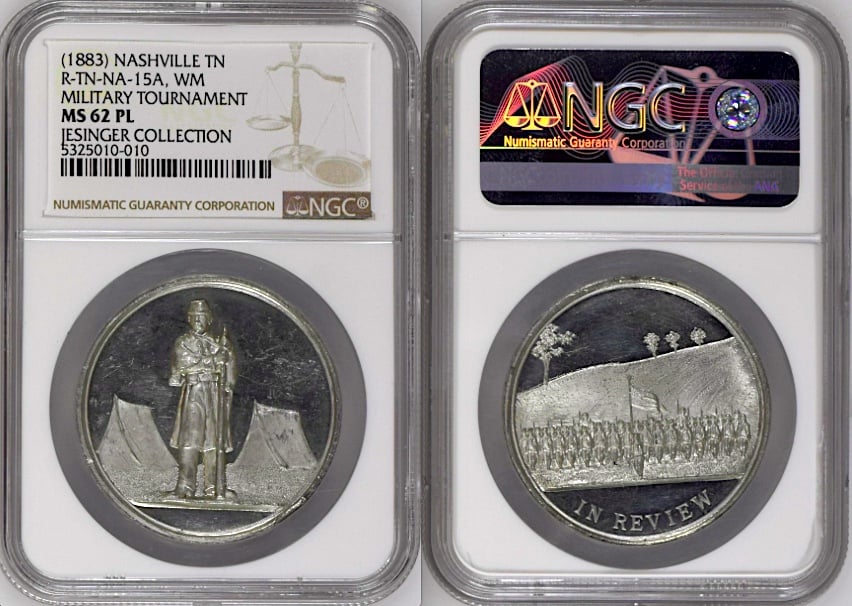
1883 Nashville Military Tournament (R-TN-NA-15A) with the In Review reverse (thanks RJ for the photo); )
1891 medal with HK-762 Stonewall obverse and In Review reverse
1911 Reunion of UCVs held May 13-20, 1911 in Little Rock, Arkansas (Lee obverse and In Review reverse)
So, I concluded based on the die-connections with other medals that the Philadelphia PA die-sinker firm William Warner & Bro was responsible for many of these 1880s medals.
A So-Called Dollar and Slug Collector... Previously "Pioneer" on this site...
One award medal of great interest from the 1872 North/South Carolina "Fair of the Carolinas" in Charlotte NC was a Harkness NC-20 award medal to Alberty Guerry (sold by Jeff Evans Auctions in 2023).
Medal in Case
Reverse "First Premium / Awarded To" above a reserve engraved "Albert Guerry, Spartanburg, S.C. For best Original Portrait in Oil of Genl. Lee. 1872"
This medal was issued at the Second Annual Fair of the Carolinas held October 22-26, 1872. It's rare. The only other example of Harkness NC-20 from the fair that the auction company could locate was in Alan V. Weinberg's Collection
Photo of Albert Guerry (Southern Artist)
Albert Capers Guerry (South Carolina, 1840-1898) was a notable Southern portrait painter. During the Civil War, Guerry joined the Confederate Army and was seriously wounded three times, attaining the rank of Sergeant. There is an extensive article on his work in the South Carolina Historical Magazine issue from July 1990 (v91, no 3). His political portraits include President and Mrs. Benjamin Harrison, President and Mrs. Grover Cleveland, and President and Mrs. William McKinley, all three in the collection of the White House. He also is credited with portraits of Vice President John C. Calhoun, Vice President of the Confederacy Alexander H. Stephens, Georgia Governor Joseph Brown, and North Carolina Governor Zeb Vance. He also painted several portraits of Confederate General Robert E. Lee, one of which was the subject of this award, possibly being the example now in the Spartanburg South Carolina Art Museum painted in 1872:
After the award medal sold, it seems the descendants of the family of Albert Guerry (who completely missed the sale) reached out to the buyer for the medal, but alas, no re-sale occurred, so the medal apparently remains with an anonymous Southern collector who has a large North Carolina medal collection.
A So-Called Dollar and Slug Collector... Previously "Pioneer" on this site...
Augusta Georgia's Nov 8-Dec 19, 1888 National Exposition & Military Encampment ran concurrently with the Georgia State Fair (in Macon) and celebrated the economic potential of the South's Textiles/Horticulture as well as hosting the Volunteer Soldiery of Georgia military encampment. The Volunteer Soldiery were elite community-organized citizen-soldier units in the state. Famous historical units included the Chatham Artillery (formed in 1786 in Savannah GA), the Savannah Volunteer Guards, the Clinch Rifles of Augusta, and the Gate City Guards of Atlanta. The encampment event featured a battle recreation with calvary charges and cannon fire with 30,000 in attendance.
One interesting fact related to the Horticulture aspects of the exposition was early promotion of local nursery innovations (such as adapting exotic ornamental plants to the Southern climate). The primary driver behind these innovations was Prosper Jules Berckmans, a world-renowned Belgian-born horticulturist who served as a leading board member for the 1888 Exposition. His local property, Fruitland Nurseries, was the epicenter of the agricultural breakthroughs, and later his property became the site of the Augusta National Golf Club. It is fitting that the Augusta National keeps the name of the Berckmans family alive as a reminder of their remarkable legacy of beauty there and in landscapes throughout the world.
A So-Called Dollar and Slug Collector... Previously "Pioneer" on this site...
The 1895 Atlanta Georgia Cotton States International Exposition (held 18 Sept - 31 Dec 1895) was conceived soon after the 1893 Chicago World's Fair. The 1895 Atlanta Exposition was funded locally and held in Piedmont Park; the exposition celebrated multiple themes (reconciliation, Southern advancements, agriculture/landscaping, electrical lighting, a "Phoenix" Wheel, achievements of Women and African Americans), with the overall goal of showcasing Southern commodities and markets to the world. The seal of the exposition featured a phoenix-like "Resurgeons" for Atlanta's resurgence from it's destruction when burned to the ground in the Summer of 1864 by Union General T. Sherman 30+ years earlier.
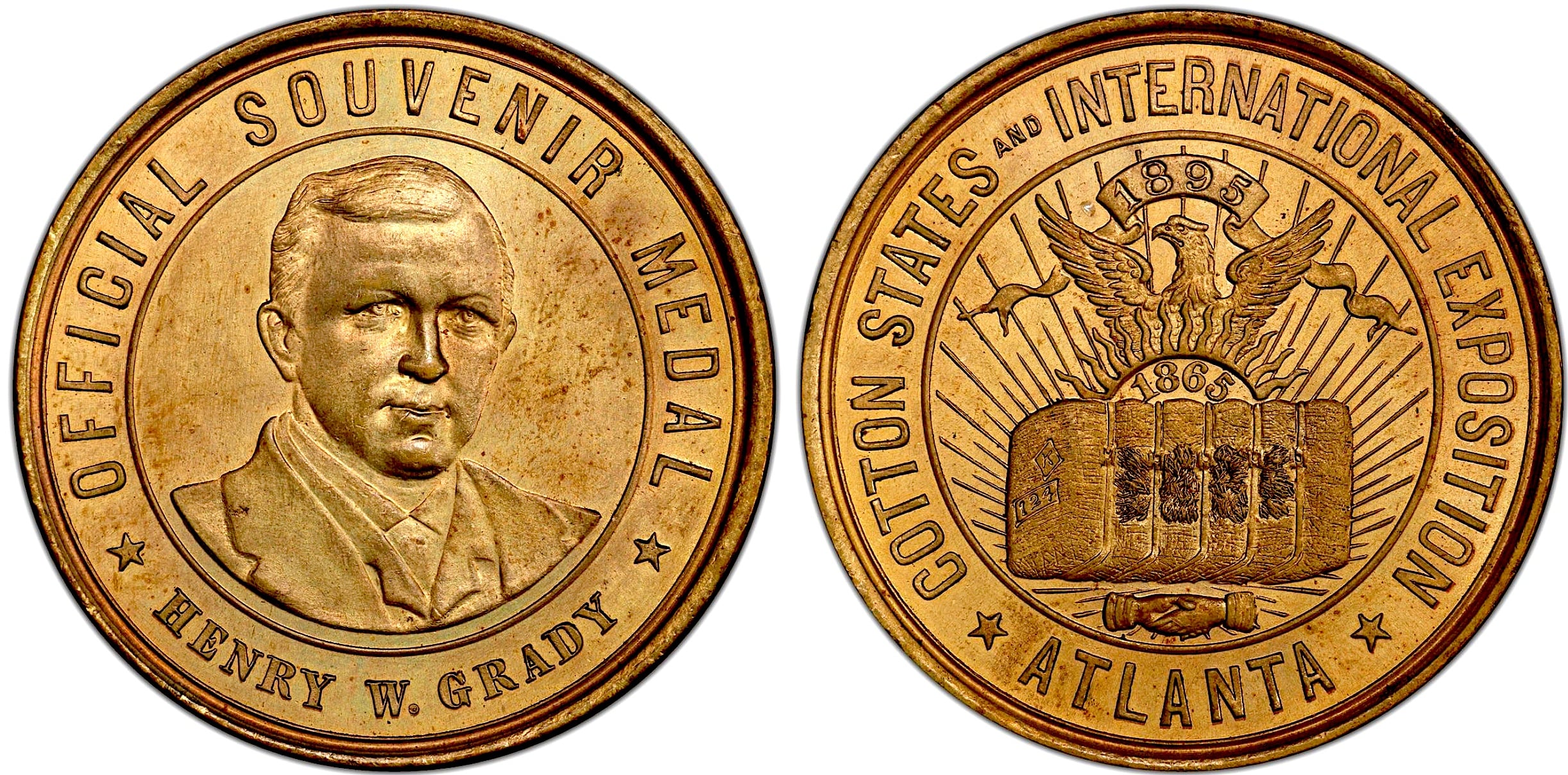
The official 34 mm medal, struck by the US Mint, featured Henry W Grady (the well known journalist and editor of the Atlanta Constitution) for his efforts to restore friendship between the North and the South:
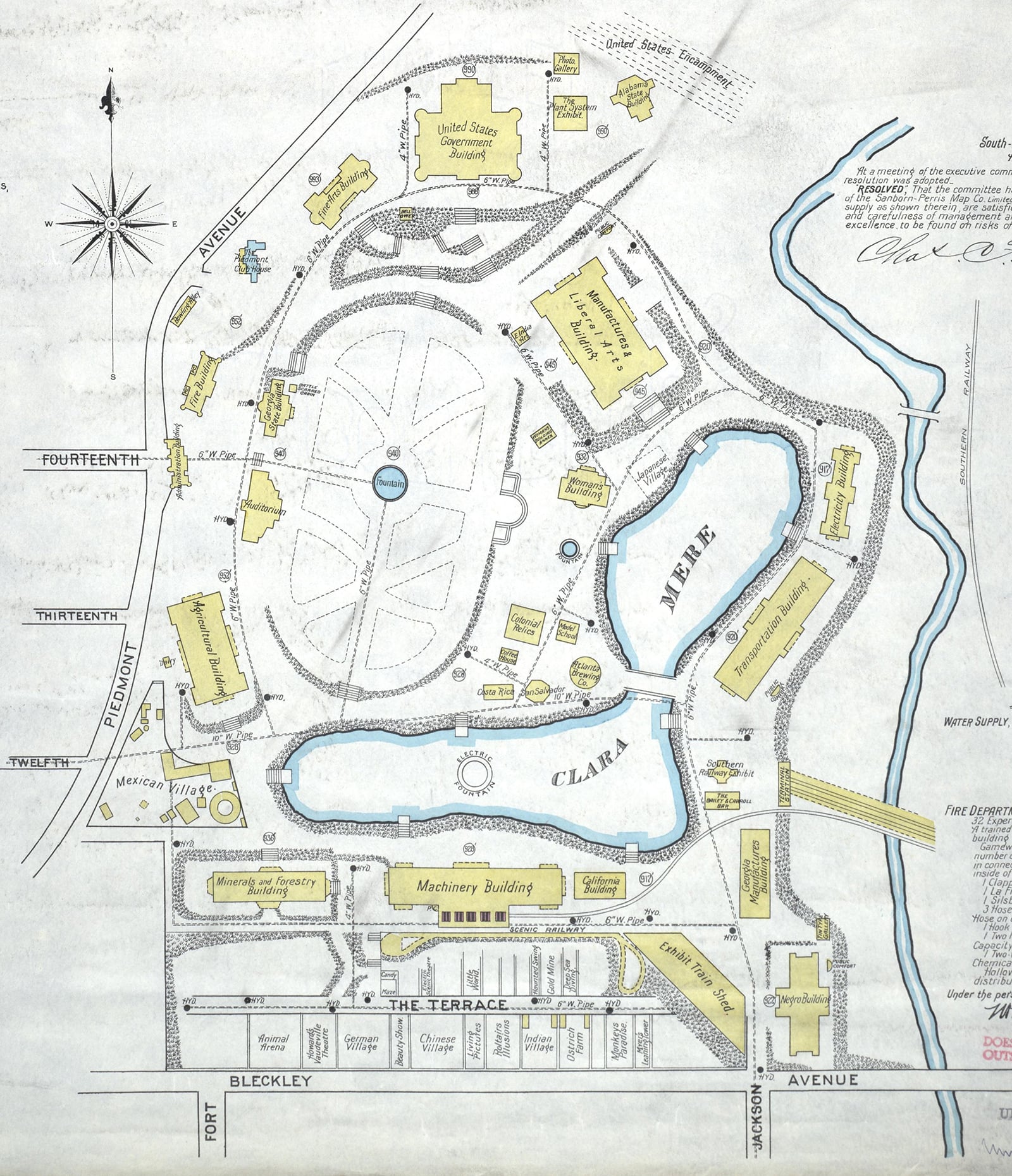
The grounds are seen in this map:
Four important medals (by S.D. Childs Chicago) showcasing key buildings in the exposition include:
Administration Building (HK-269a), featuring a castle-like illusion imagining "tales of King Author and the knights of the Round Table
Fine Arts Building (HK-270), containing numerous works of national art from the Smithsonian
Women's Building (HK-271), a three story building entirely for women and children, designed by Elise Mercur of Pittsburgh PA
Negro Building (designed and built entirely by African Americans) and featuring scientific, business, and agricultural achievements of African Americans
One other rare medal related to African Americans (which must have been part of a multi-part handing medal judging by the holes at 12:00 and 6:00, probably made by Schwaab Milwaukee WI) is similar to the medal above:
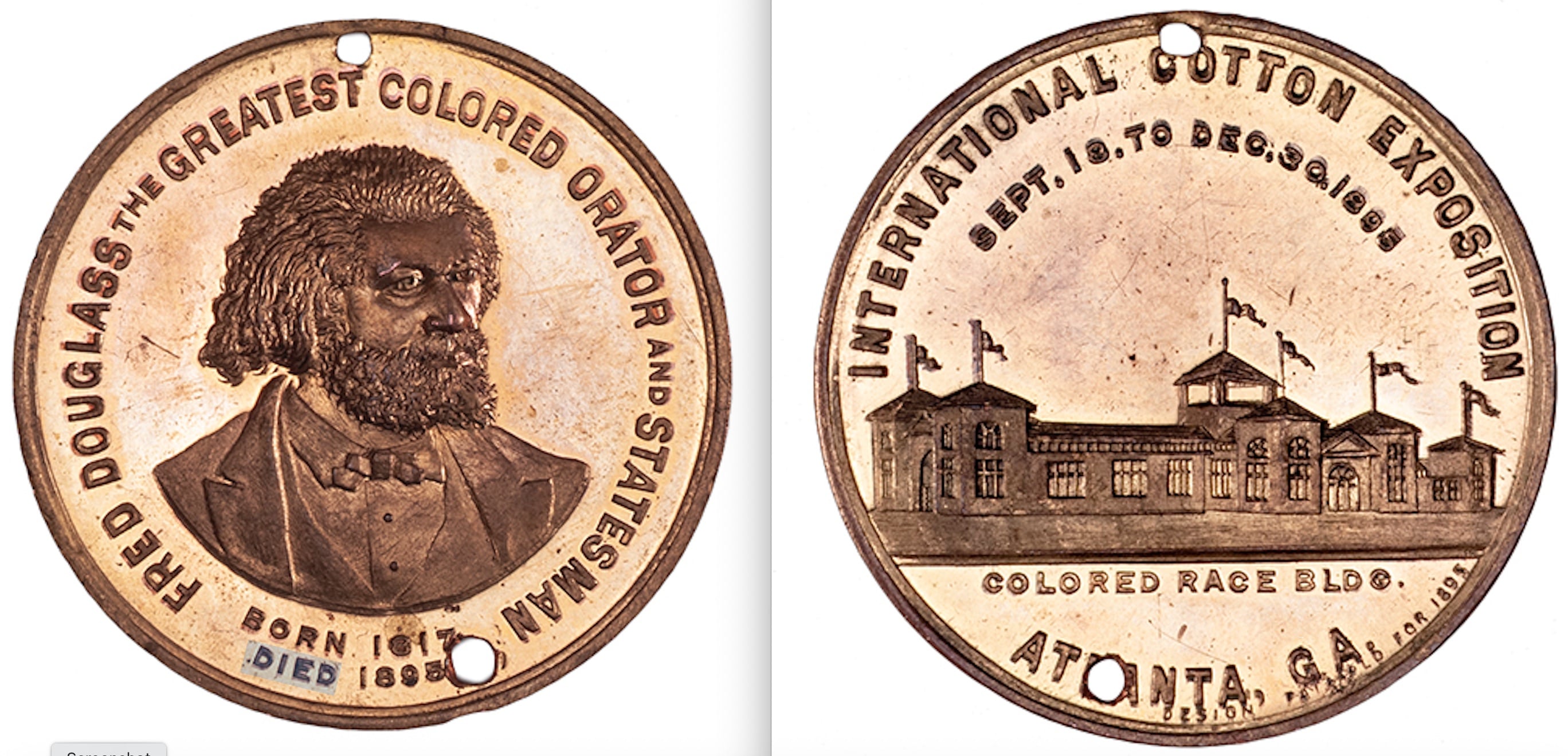
I've seen two of these in person, most recently at the ANA show in Pittsburgh in 2026.
Additional important buildings included the US Government Bldg, Transportation Bldg, Agriculture Bldg, Electricity Bldg, Georgia Manufactures Bldg, Machinery Bldg, and the Minerals and Forestry Bldg (built with wood from Georgia). Smaller state buildings were present as well (including Georgia, Alabama, Pennsylvania, and California).
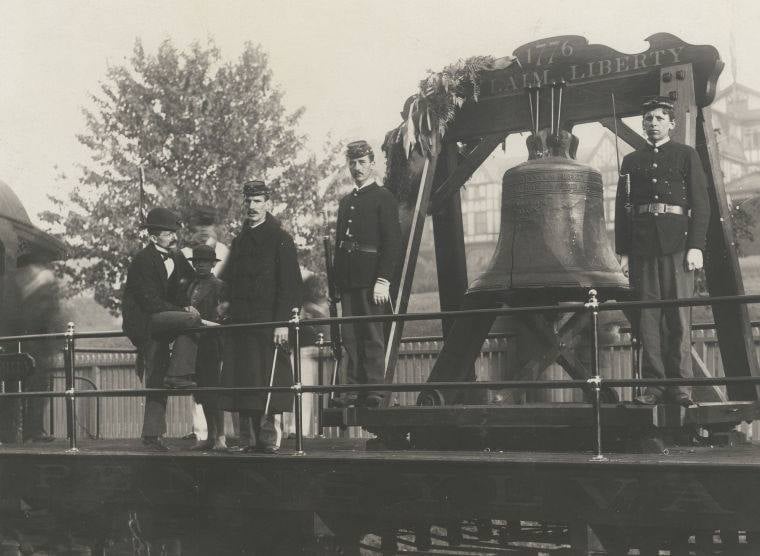
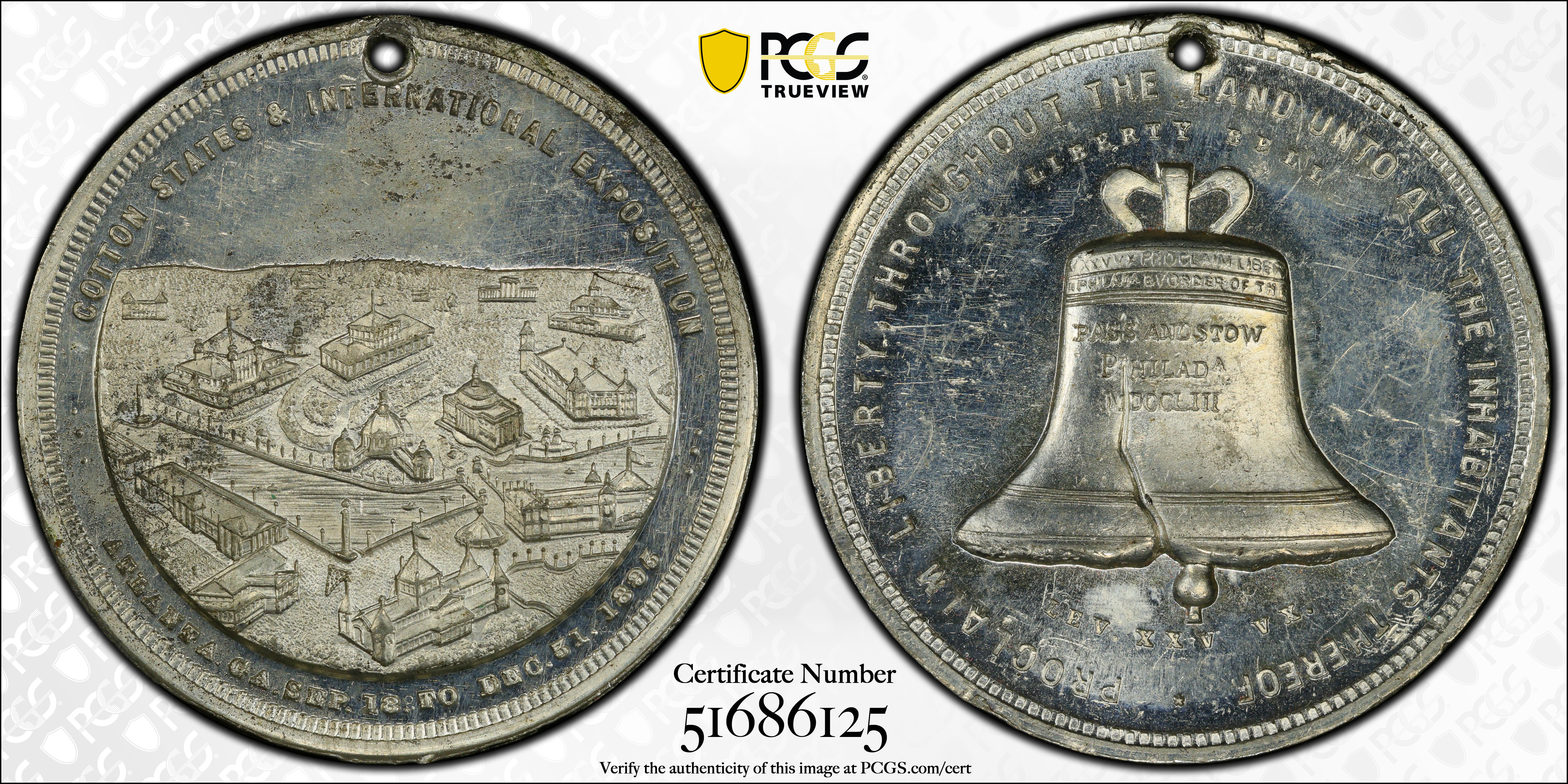
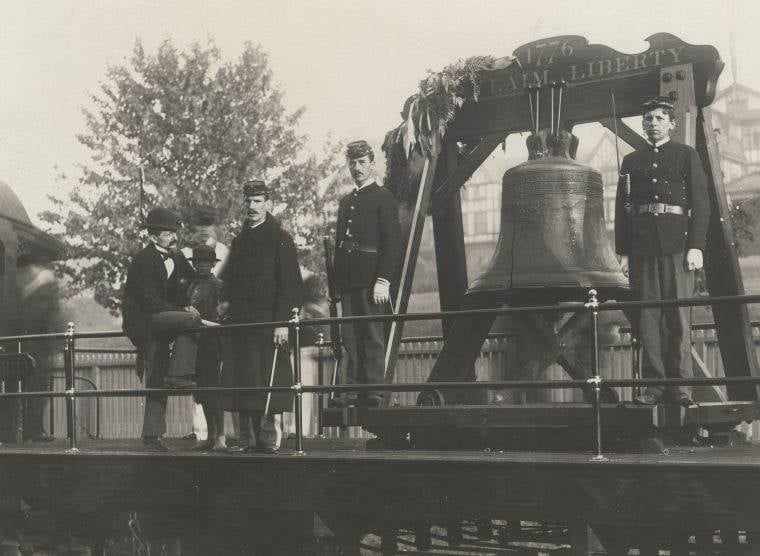
The Liberty Bell (from Philadelphia) was present at the exposition on Oct 9, 1895 and was featured on a medal (SH 8-2):
The Phoenix wheel (akin to a Ferris Wheel) is seen in this photo with the adjacent Midway:
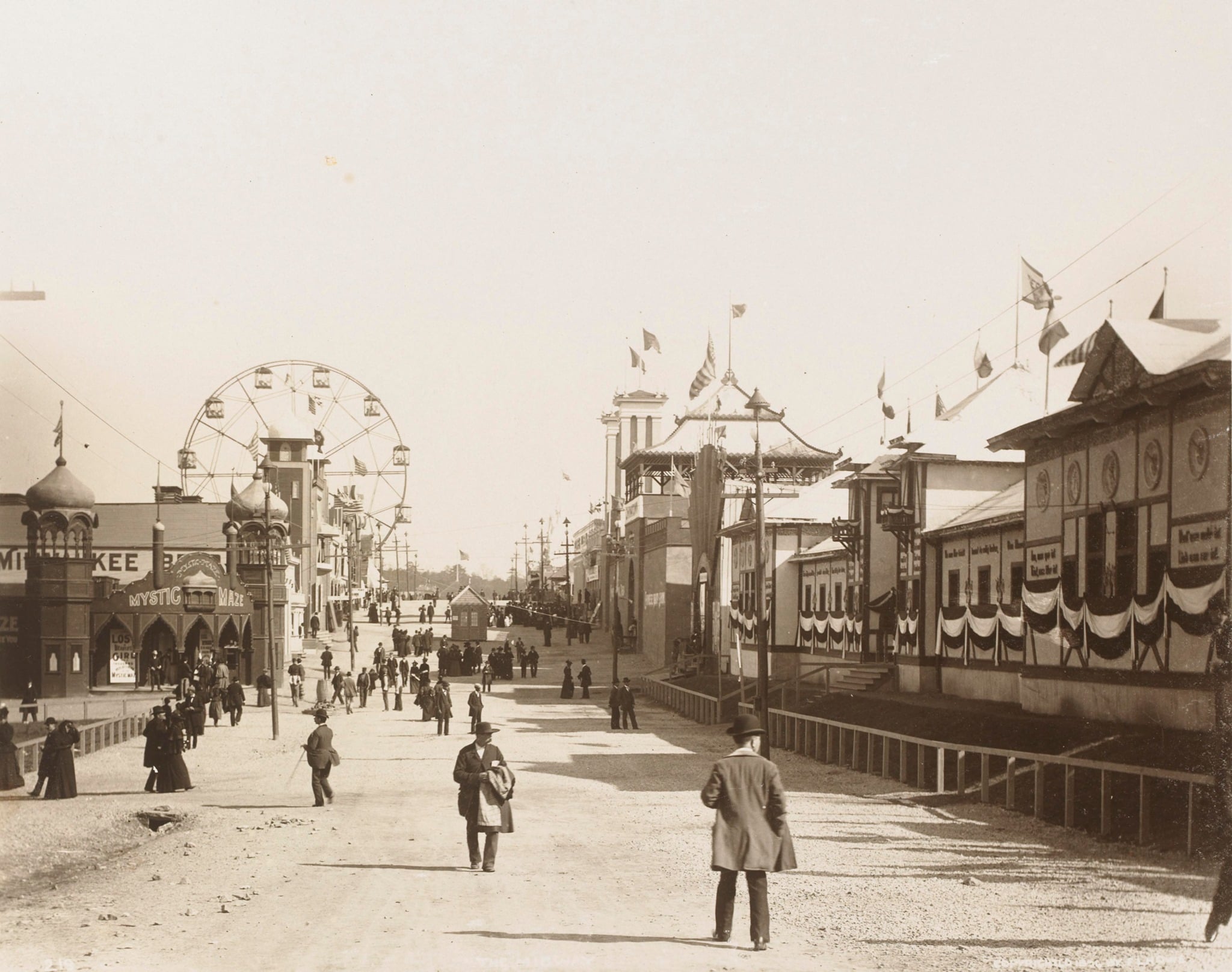
While downtown Atlanta had numerous luxury accommodations and dining for out-of-town visitors, the Midway featured savory Southern food such as BBQ, risqué dancing, a Southern plantation, and international villages After the exposition closed at the end of 1895, it was judged to have helped the South in the world of commerce. Piedmont Park is alive and well today and seemed an interesting place to visit during the ANA Show in Atlanta in 2025. Note that there is an excellent article on the exposition in the August 1978 issue of the TAMS journal by W.D. Hyder and R.D. Colbert.
A So-Called Dollar and Slug Collector... Previously "Pioneer" on this site...
One other interesting related advertising medal from Defiance OH related to the 1895 exposition:
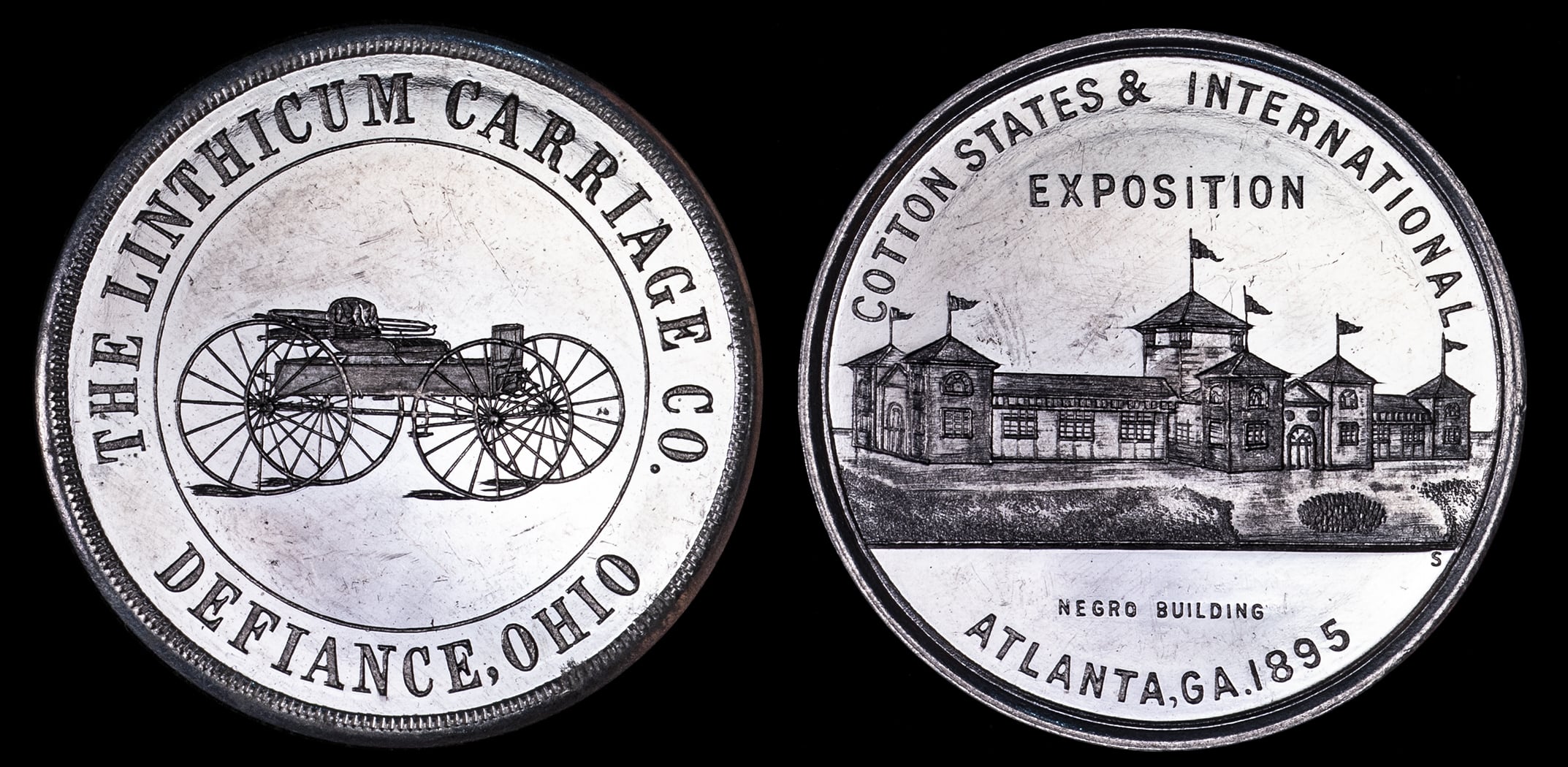
This aluminum medal was made by Schwaab Stamp and Seal (Mikwaukee WI); the "S" to the right of the building truncation on the reverse is found on other Schwaab pieces and was thought to reference the engraver, but perhaps it references Schwaab itself. The lettering for "Defiance, Ohio" on the obverse matches an 1894 medal for the Maumee Valley Milling Co. in Defiance, Ohio (with the Schwaab makers label on the latter medal obverse, "Defiance, Ohio" lettering on the reverse). There is a very good Numismatist article from October 2012 on the 'Numismatic Legacy of S.D. Childs' by David E. Schenkman.
Lastly, this "Birds Eye" view, similar to the Liberty Bell medal referenced above, likely struck in Philadelphia by W. Warner & Bro Co, is paired with a Souvenir reverse:
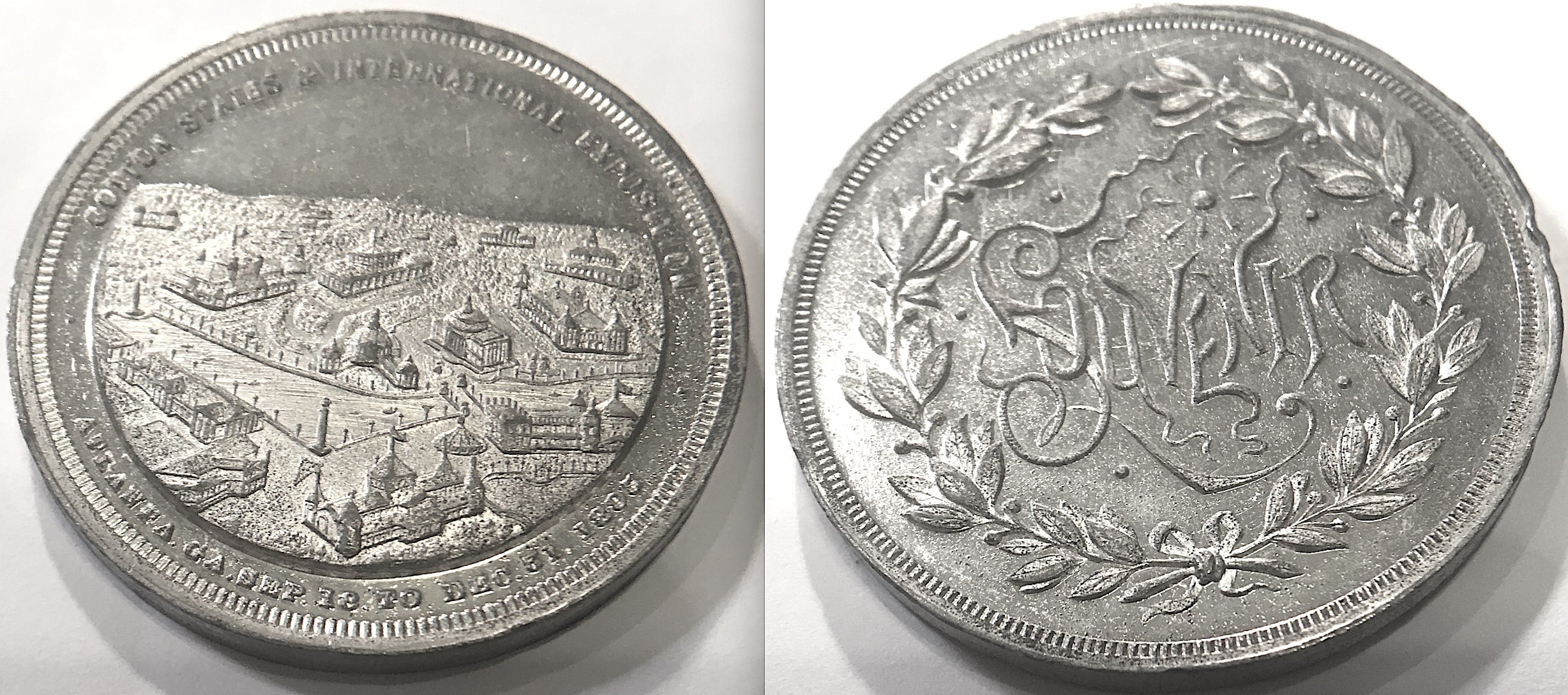
All of these 1895 Cotton States Intl Exposition medals seem difficult-to-impossible to collect, with many of these photos provided by other collectors; they serve as a historical reminder of an important event near the turn of the century in Atlanta about 131 years ago.
A So-Called Dollar and Slug Collector... Previously "Pioneer" on this site...
1860 Robert Lovett Washington Light Infantry Medal (GW-351)
A So-Called Dollar and Slug Collector... Previously "Pioneer" on this site...
An interesting 35 mm medal related to the Spanish American War ending is the 1898 Atlanta Peace Jubilee; the medal commemorates the two-day civic celebration held in Atlanta December 14–15. While Atlanta is famous for its 1895 Cotton States and International Exposition (posted above), the 1898 event was a patriotic festival commemorating the Treaty of Paris ... rather than an industrial world's fair; on December 15, thousands of spectators gathered at Piedmont Park, the former grounds of the 1895 exposition, to watch the festivities and hear speeches. President William McKinley attended as the guest of honor alongside Georgia Governor Allen D. Candler and Major General William Rufus Shafter. The city hosted massive military parades, a floral parade, public receptions, and a grand banquet.
This medal is the rarer version of HK- 643a with Atlanta as opposed to Philadelphia on the obverse, sold by Heritage in 2022. This MS-65 DPL example is from the Bruce Thomas collection and holds a place in Southern so-called dollars.
Here is a literature reference:
"A Memorable Day in the History of the Georgia City. Southerners Tendered an Ovation to the Chief Executive of the Nation President McKinley Before a Joint Session of the Georgia Legislature, in Which He Paid a Glowing Tribute to Those Who Fell during the Civil War. Old men who fought for the South rose from their seats and waved their hats. Of all the many conciliatory speeches which have been made since Grant said, "Let there be peace," nothing has more deeply stirred a Southern audience than the simple words of President McKinley this afternoon. The US army, in conjunction with the US Navy, was ordered to attack and destroy the Spanish forces at Santiago. In four weeks that order was obeyed and its purposes accomplished. The proud Spanish nation stood suing for peace from the nation which a month before it had held up to ridicule and scorn. In Atlanta, the "prettiest and most novel event of the day's festivities" was a floral parade in which all the people of the city took part. Decorated carriages of every description were in line. The ladies of the city vied with one another in their efforts to present their most beautiful carriage. Decorations of every description were seen, from the hot house to the hardy plants which had no fear of cold. The parade proceeded through the business portion of the town with thousands of school children, waving flags."
A So-Called Dollar and Slug Collector... Previously "Pioneer" on this site...