Question about marks or discoloration on a gold coin
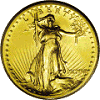
What do you make of the black marks on the eagle feathers and rim of this MS-63 coin? Gold is chemically inert, and doubt there is enough of other metals to result in this. Is it an unfortunate photographic relic? Something else? What causes it?

Comments
-
My guess is cabinet/album friction.
Young Numismatist • My Toned Coins
Life is roadblocks. Don't let nothing stop you, 'cause we ain't stopping. - DJ Khaled2 -
Counting table dirt. Quite common on gold, and considered by some to be a good indicator of originality.
Professional Numismatist, Retired. 55 year member ANA. Former ANA Senior Authenticator. Winner of four ANA Heath Literary Awards; three Wayte and Olga Raymond Literary Awards; Numismatist of the Year Award 2009, and ANA Lifetime Achievement Award 2020. Winner of the PNG's 2026 Robert Friedberg Award for "The Enigmatic Lincoln Cents of 1922," Available now from Whitman or Amazon.18 -
@CaptHenway said:
Counting table dirt. Quite common on gold, and considered by some to be a good indicator of originality.Actually, your coin is fairly clean compared to many that I've seen. A lot of US gold coins repatriated from European banks show that dirt to a far greater extent and I've frequently heard it called "Euro-dirt".
Worry is the interest you pay on a debt you may not owe.
"Paper money eventually returns to its intrinsic value---zero."----Voltaire
"Everything you say should be true, but not everything true should be said."----Voltaire6 -
Dirt. I can't imagine how it could have come from a counting table though.
1 -
I have seen black specks like this on $10 Indian coins. I had thought that they were a foreign substance in the metal.
Retired dealer and avid collector of U.S. type coins, 19th century presidential campaign medalets and selected medals. In recent years I have been working on a set of British coins - at least one coin from each king or queen who issued pieces that are collectible. I am also collecting at least one coin for each Roman emperor from Julius Caesar to ... ?2 -
It's just schmutz and I like it on the coin.
7 -
I saw it in an auction, but the "dirty" look gave me pause. I took a lens to the two dozen or so Indians in my collection, and none of them have that look. Think I will pass on this item.
0 -
@Married2Coins said:
Dirt. I can't imagine how it could have come from a counting table though.Sliding across the leather
All comments reflect the opinion of the author, even when irrefutably accurate.
2 -
I’ve always understood it to be dirt, I like dirt! 🤓
I believe my type one $20 has some
 5
5 -
It could be from biological attack. Beyond that consult a coin preservation specialist. Many them stored in cloth bank bags of for decades. Heat, humidity, salt air, microbes take your pick.
Investor1 -
Learn to love the dirt.
2 -
@jmlanzaf said:
@Married2Coins said:
Dirt. I can't imagine how it could have come from a counting table though.Sliding across the leather
So let's see...I'm learning something here. There is leather in the counting room on the tables? Then this coin slid across some leather in a counting room sometime in the past and finally reached this forum with the dirt still attached? Besides your post, do you have a source for this info. Apparently another member suggested the counting room also. I was not there but I'll respectfully need to say NUTS! I have heard this is found on coins from Europe. I have also read an article some time ago in Numismatic News that dirt is applied to fhe high points of coins to make them look more original. IMO, this was not done to the OP's coin.
@BillJones said:
I have seen black specks like this on $10 Indian coins. I had thought that they were a foreign substance in the metal.I have too. Many times the impurity is surrounded by a discoloration. That is not the case with the OP's coin. It is dirt. Run the coin under hot water and it will remove the black stuff. One of my $5 Indians had the same look and the water tool it off.
1 -
I am the OP and for clarification I saw the coin pop up yesterday in an auction. While I wish the seller to rinse it and have it reholdered, I don't see that in the cards. I will wait for another example to come along.
Thanks for all the helpful responses.
 0
0 -
Coins in general are dirty. Counting tables acquire dirt from some coins and redistribute it onto other coins. There is absolutely no reason to clean the table between batches.
Professional Numismatist, Retired. 55 year member ANA. Former ANA Senior Authenticator. Winner of four ANA Heath Literary Awards; three Wayte and Olga Raymond Literary Awards; Numismatist of the Year Award 2009, and ANA Lifetime Achievement Award 2020. Winner of the PNG's 2026 Robert Friedberg Award for "The Enigmatic Lincoln Cents of 1922," Available now from Whitman or Amazon.1 -
@Married2Coins said:
@jmlanzaf said:
@Married2Coins said:
Dirt. I can't imagine how it could have come from a counting table though.Sliding across the leather
So let's see...I'm learning something here. There is leather in the counting room on the tables? Then this coin slid across some leather in a counting room sometime in the past and finally reached this forum with the dirt still attached? Besides your post, do you have a source for this info. Apparently another member suggested the counting room also. I was not there but I'll respectfully need to say NUTS! I have heard this is found on coins from Europe. I have also read an article some time ago in Numismatic News that dirt is applied to fhe high points of coins to make them look more original. IMO, this was not done to the OP's coin.
@BillJones said:
I have seen black specks like this on $10 Indian coins. I had thought that they were a foreign substance in the metal.I have too. Many times the impurity is surrounded by a discoloration. That is not the case with the OP's coin. It is dirt. Run the coin under hot water and it will remove the black stuff. One of my $5 Indians had the same look and the water tool it off.
I really can't know how it got dirty. Someone suggested counting tables (in the early 20th century) and someone asked how that could happen. I told you how it COULD happen. It's also possible that the coin simply got dropped onto the greasy mint floor or was handled by an oily mechanic. But such high point dirtiness is so common that you would think some of them have a common, coin-related source.
Bottom line: it's dirt.
All comments reflect the opinion of the author, even when irrefutably accurate.
0 -
Thanks for the direct response. We both agree it is dirt. I think most old timers will agree is is especially found on the gold coins coming from the European banks long ago but over the years it tends to be removed. A grading instructor told us that when he worked ant NGC, lots of AU $5 Indians where sent in that had this dirt and that it was put on by coin doctors because "dirty gold" = original gold. How a professional grader can tell the difference beats me.
0 -
It is a C coin IMO. The black stuff - Carbon spots? Have u shopped it around the bourse at a show.
Investor2 -
The 15-S Saint is generally a pretty uninteresting coin.
This is the only one I have ever seen with any kind of toning so I'll excuse the bit of dirt.
Picked it up years ago for below what is now melt price and it's still in my #1 set.
Don't worry about dirt if you like it
 2
2 -
@Cougar1978 said:
It is a C coin IMO. The black stuff - Carbon spots? Have u shopped it around the bourse at a show.Not my coin. Saw it on eBay.
0 -
it's a visual accumulation of time
1







Leave a Comment
Categories
- All Categories
- 520.1K Coins and Currency - PCGS
- 328.6K U.S. Coin Forum
- 14.8K PCGS Set Registry Forum
- 5.2K Q & A Forum
- 41.4K World & Ancient Coins Forum
- 3K U.S. & World Currency Forum
- 96.4K Buy, Sell, & Trade - U.S. Coins
- 7.3K Buy, Sell & Trade - World & Ancient Coins
- 1.5K Buy, Sell & Trade - Currency
- 61 Random
- 246.2K Trading Cards, Autographs and Memorabilia - PSA
- 90.3K Trading Cards & Memorabilia Forum
- 1.7K Autographs Forum
- 16.4K PSA Set Registry Forum
- 22K Sports Talk
- 115K Buy, Sell & Trade - Cards & Memorabilia
- 663 Buy, Sell & Trade - Autographs
- 2.2K Stamps
- 1.5K Stamps Forum
- 670 Buy, Sell & Trade - Stamps
- 83 Coin Shows
- 83 General Coin Show Information and Discussion
- 11.9K Misc
- 11.9K Testing Forum