Options
Hey error guys, is this feeder-finger damage ? * New pics added *
 JRocco
Posts: 14,277 ✭✭✭✭✭
These are older pics but I just found them looking through a file and would like your input. Is this feeder finger damage on this Lincoln cent ? This was a roll coin and as you can see it is strongly toned.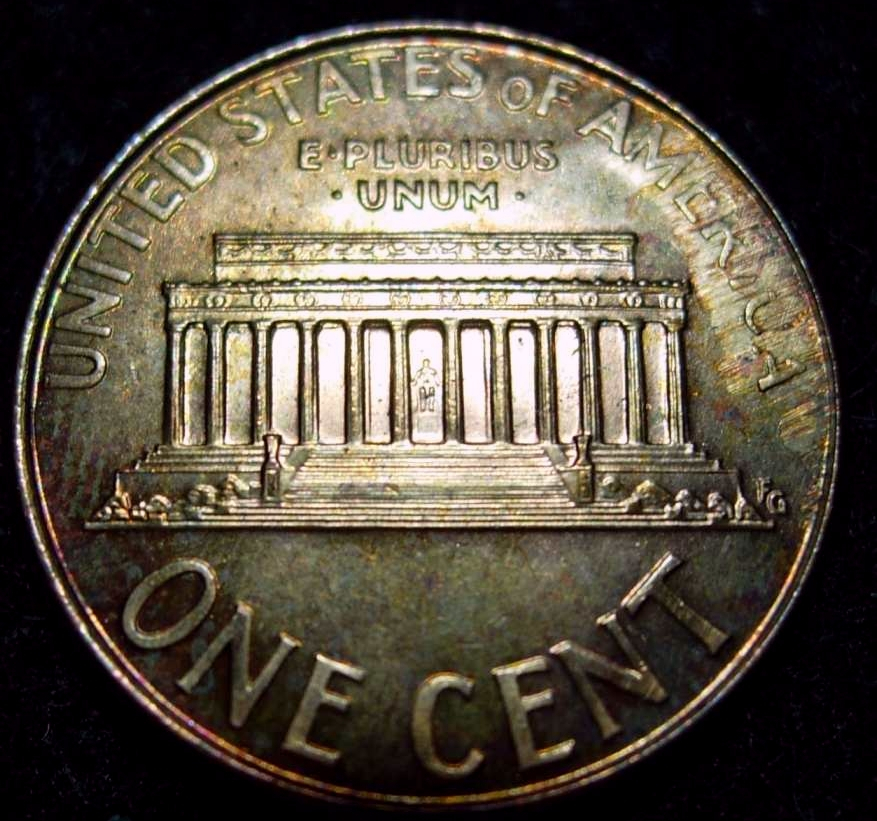
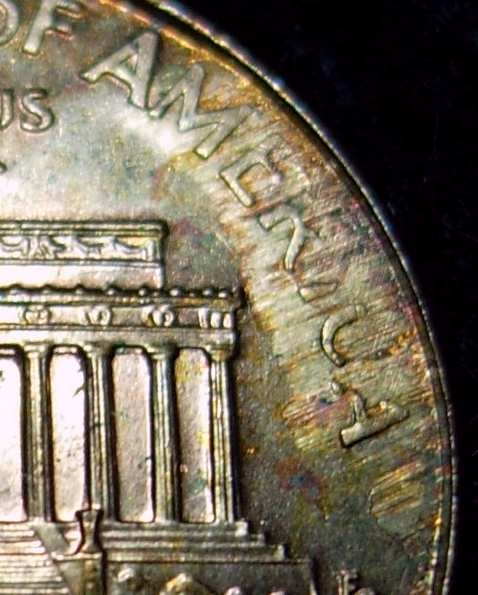
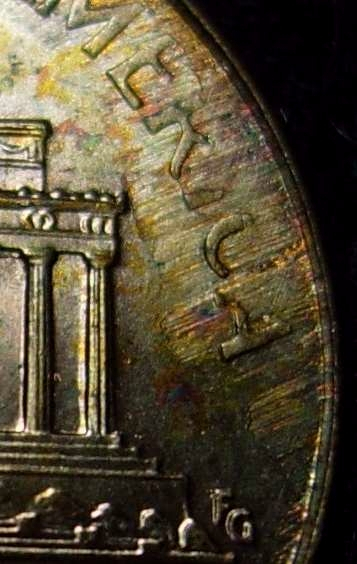
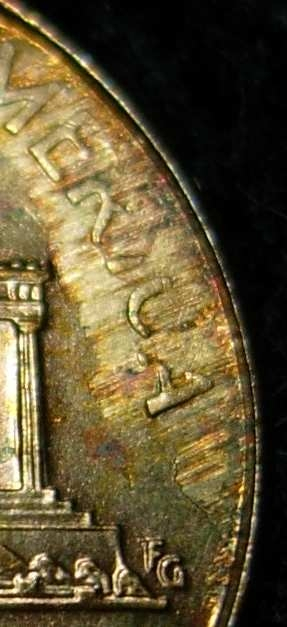
Some coins are just plain "Interesting"
0
Comments
Doesn't look like it at all, to me.
Is there a photo of the Obv. ?
Wow. That is weird.
I also want to see more pictures, please.
i waited for you guys to comment to see what i may come up with but all i got is grease struck-through.
i can't commit to pmd. can't commit to delamination. no authenticity issues i see. tapered flan would affect the rim, no?
My dumb guess is grease fill.
I will try to find another example to post.
Just so we are not looking at an optical illusion here, that grainy field in and around MERICA is raised higher than the rest of the field, right? What you would get if the field on the die were ground down or otherwise lowered on the die?
What is the date/ mint mark on the coin. All I can tell is that is 1974 or later.
Brass or zinc?
If it is the same thing I have seen I have only seen it on zinc cents.
Hey guys, I will try to locate the coin and take some obverse pics.
Hey Tom, yes it is raised on the coin.
Thanks.
Hi Tom,
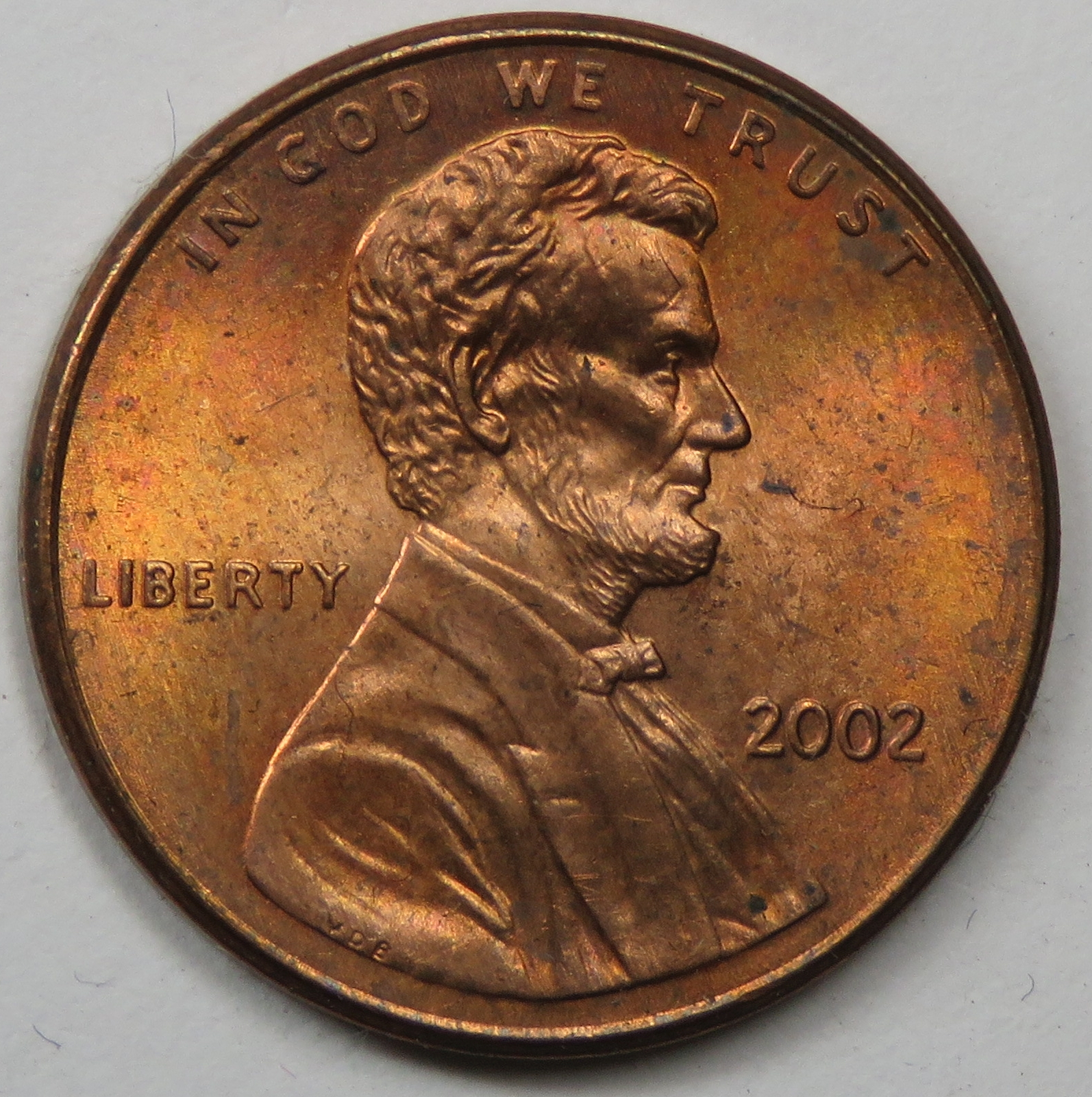
Found it. So I just poured myself a nice scotch as a reward
It is a 2002 Lincoln. Here is an obverse pic
And here is a quick pic of the reverse I just took
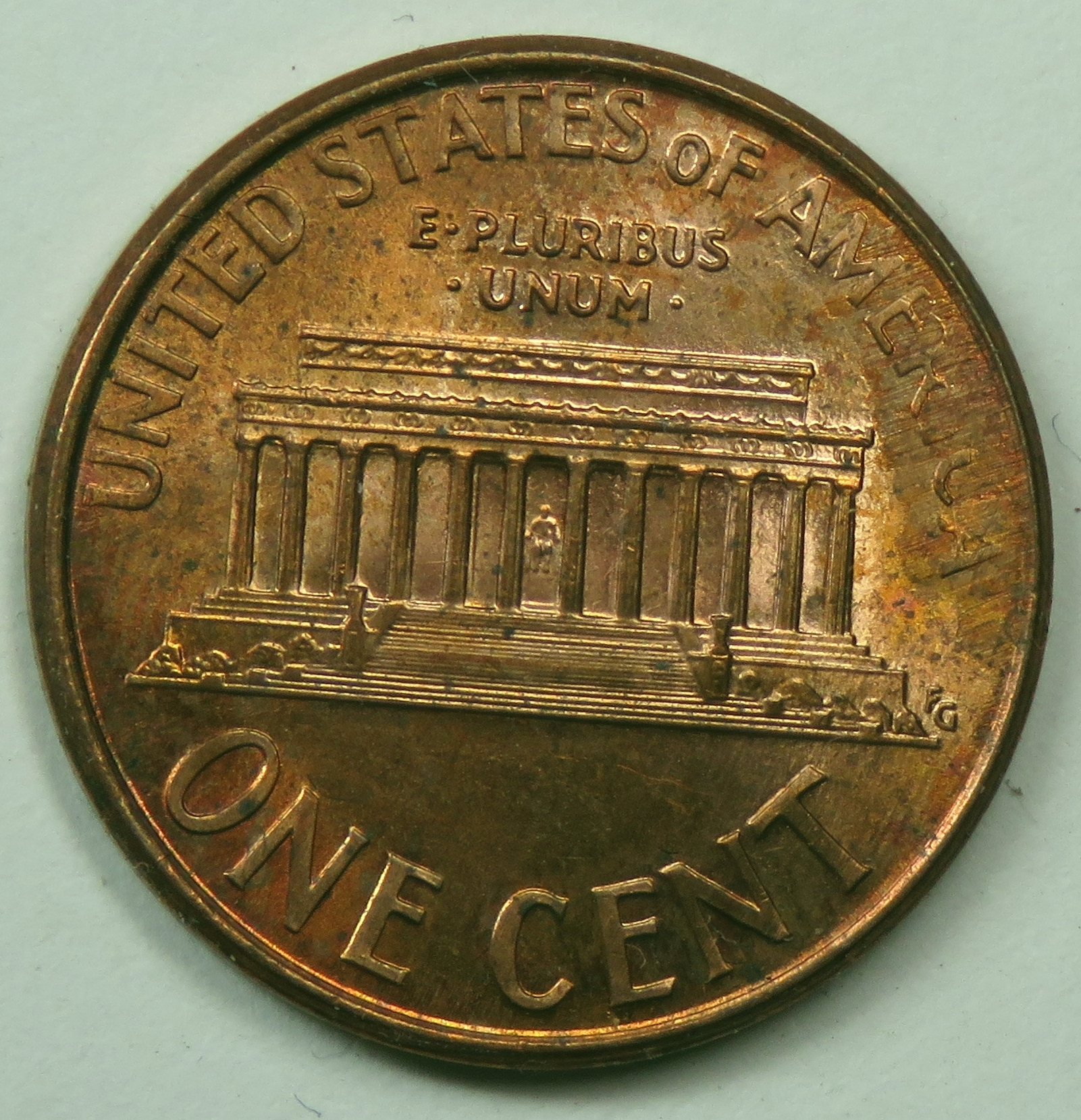
Since it is raised it would appear to be die damage not grease fill.
It looks like there may be some weakness on the obverse rim.
Agree. Looks like die scrapes of some sort, but the cause could be nearly anything.
Good eye.
I thought it might be an ever so slight MAD
Yes, the obverse strike is one reason why I, and I assume Fred, wanted to see the obverse die. Definitely struck this way.
I am stumped as to what could have beveled the obverse die down like this. Do the modern horizontal presses even have feed fingers? Last time I was on the floor of a Mint (Philly 2009) you couldn’t see anything about the mechanism through the dirty plastic safety covers.
i was going to push hard for grease-filled but those parallel lines takes that out of contention imo.
it does not seem raised to me on the reverse. i'm still not 100% it isn't pmd partially because of the "staining" around that area rev and obv.
if this could make it to an error person at a show, i bet it would be cleared up fairly quickly. images can be tough sometimes.
a fun exercise nonetheless.
That appears to be a seriously abraded/scraped die. There should be more out there if that's the case.
Collector, occasional seller
Coin looks like its bowed at the point of contact.
FG in the raised area was untouched, hmmm?
The letter I in AMERICA seems odd to me, as if it is cockeyed.
If a feeder part was involved, it would only strike, (a dragging effect)
a small area of the raised area, ( FG unaffected and raised) as it would not clear the grippers or push motion dragging against metal to metal.
I would like to add," the struck thru grease" is getting very old to me.
Just an educated guess.
Cool.
Die damage. Very interesting.
"It's like God, Family, Country, except Sticker, Plastic, Coin."
the obv rim is there in full. the lighting angles are making it difficult to see.
for now, i'll say not mint made. its physics for me. anything that would remove enough of the die down the full depth of letters would cause major raised areas on the die level with the letters. not much different than a cud.
the general rule i follow. if it goes down on the die, it comes up on the coin.
i would say the angles/lighting may be hiding some major raised area on the coin but then they would be up there in height with the rim, which they aren't.
i'm a bit tired now and a lingering thought is that perhaps there wasn't enough pressure to fill the void that would be created by the possible scraping but then it doesn't look like any other low pressure striking areas which usually have an untouched look.
also, at least going by silver dollars, this looks nothing really like any of the many known feeder finger gouges on them. although they are separated by around a century of die/machine/striking technology.
not arguing with anyone, just running this down logically.
Not sure it is lighting, check the OP's photo and enlarge check this area of the rim.
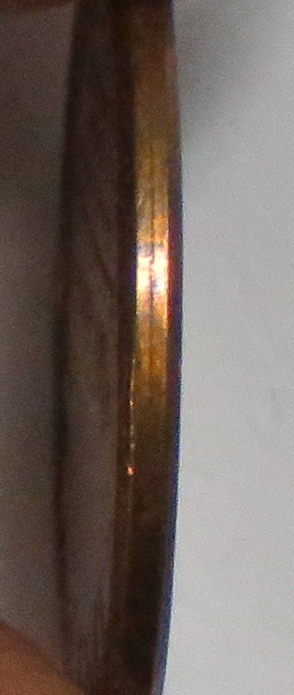
Looking at the pictures, it 'appears' to me, that the coin rim on the reverse (area in question) is down to the same level as the coin surface...though no metal 'smear' appears from the rim to the interior surface - or distortion to the remaining rim. And yet, the letters show damage, as does the field. Can we get an edge picture of the area? There certainly is conflicting visual manifestations. Cheers, RickO
buenos dias, guten morgan, bonjour and Ohayōgozaimasu.
imo, the obv rim is untouched. the low and high points can be followed all the way around.
imo, the rev rim is the same height but it does appear the metal at around k4 is higher going up to the rim.
i have seen feeder fingers (not sure what period) and they are pretty thick. imo, w/o something breaking (meaning fewer strikes) it would take a while to dig into the die that deep. so there should be quite a few of these out there. it would be somewhat odd to only see it on one year. no impossible, just odd. then again, lots of "odd" occurrence errors out there.
the feeder finger i saw, it was not flat straight across. it has a half moon shape in the middle to fit around the denomination of flan.
It looks to me like it is either struck thru grease (or similar substance.) I would've said pre-strike damaged planchet as a possibility, but you would see "zinc" showing if that was the case, so most likely a strike thru.
die polish with a grinder?
Not struck through grease. A blob of grease on the surface of a die pushes a depression down into the struck coin. This area is raised, and angles upwards towards the rim. Part of the surface of the die was somehow removed, which is why the obverse rim opposite it IS weaker.
The parallel lines in the area where the die was deeply ground down (so much so that the grinding went deeper than the tops of the letters) does suggest a back and forth motion from something like a pair of feed fingers, but I cannot find a schematic of how a modern Schuler press actually feeds planchets between the dies. I will continue looking.
TD
A few random observations.
Other than the obvious die damage, these dies look to be in pretty good shape. Whatever caused the die damage, it happened very early in the life of these dies.
There should be more of these out there, but it appears to be unknown. Hypothesis: A new pair of dies was installed and the press turned on. Some as yet undetermined press problem immediately began attacking the reverse die, eroding it severely. The press operator came back, looked at the catch bin on the press and said "oops!," and condemned the lot. This one was missed and got out.
TD
Here is a picture of a modern feed finger, from Mint Error News. You will have to scroll down a bit.
https://minterrornews.com/news-8-10-19-mint-errors-featured-in-upcoming-ana-heritage-auction.html
Grease filled die?
.
+1 Agree
well all i got to say about this damaged rim business is:
Looks like a partial collar strike to me. Broad struck.
Here's one very similar to what your showing.....I am in NO way an error expert be any stretch of the imagination. Maybe your coin is not a broad struck coin but it does look slightly similar to this buff I'm showing.
Different pattern to the incomplete lettering. The OP's coin appears to show a degraded die, not an incomplete strike.
I have made inquiries of the coin press manufacturer to try to obtain information about the feed mechanism. I will let you know what I find out.
TD
I can't figure it out at this point from the photos either -
Better photos showing the elevation and taper would help if the Op is able to do it.

The photos may need to be taken at a slight angle to show it.
FWIW, the classical vertical coin press (like the one Dan Carr uses) has the anvil die mounted upright in the collar with the 12 o'clock position of that die towards the press operator. The hammer die is mounted upright directly above it with the 6 o'clock position of that die towards the press operator, The feed fingers are on the front of the press because in olden days the press operators had to feed the planchets into a feeding tube by hand, from which they were picked up by the feed fingers.
If the feed fingers drag across the anvil die, they will degrade it in an up and down pattern probably at the 12 o'clock position of the anvil die, with possible exceptions caused by rotated dies or the dies being mounted 180 degrees away from the above standard positions. The important thing is that the drag lines will be roughly vertical.
I have been able to determine that the modern horizontal coin presses have the feed mechanism bring the planchets down a curved slot that results in the planchet standing on edge to one side of the pair of dies. Some sort of mechanism then moves the planchet horizontally over to where the dies are. If this mechanism is a metal feed finger like the struck one I linked above, and if the two dies are set with one die upright and the other die upside down, then any hypothetical feed finger damage to one die or the other would show more or less horizontally on the side of the affected die, rather than at the 12 o'clock or six o'clock position.
In other words, the OP's coin may indeed be a most marvelous example of feed finger damage.
TD
Those Cent presses back in 2002 were Schuler Horizontal Presses,
so that is a distinct possibility, Tom.
The Schuler Presses I saw at the Phily Mint in 2008/9 had a
''rotary dial' that was vertical, and fed the planchets as the
Dial rotated to meet up with the two horizontal dies.
We've all seen lots of State Quarters with the Feeder Finger
scrapes on the dies, and this 2002 cent looks different.
At some point, someone will have to examine the piece in-hand,
to give a better explanation or clue to it's cause.
Just got home. Need to get a couple things done than I will see if I can comply.
Thanks all for the in depth, thoughtful commentary.
OK so had a chance to really look at the coin.
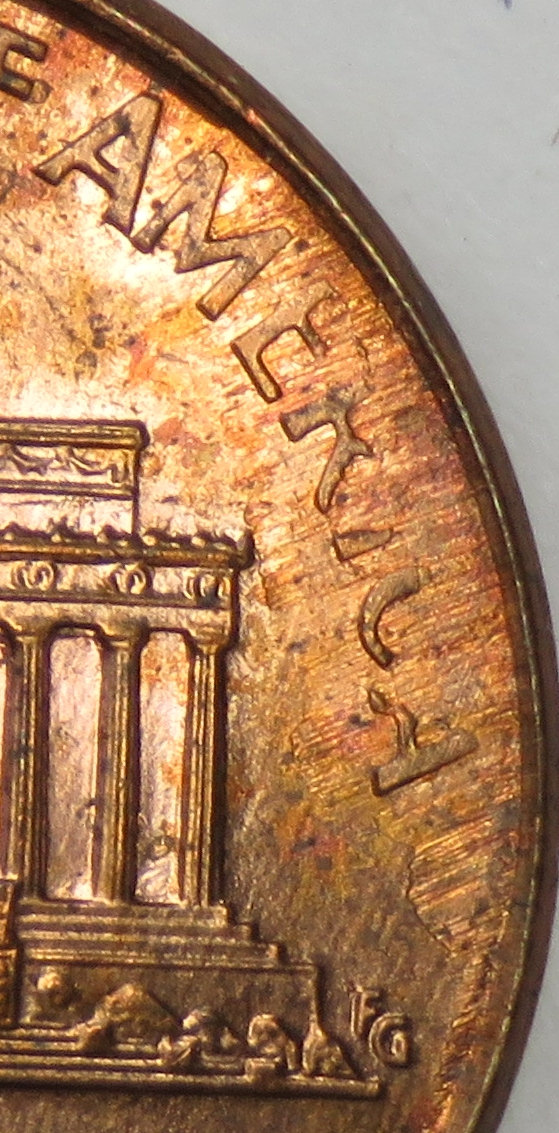
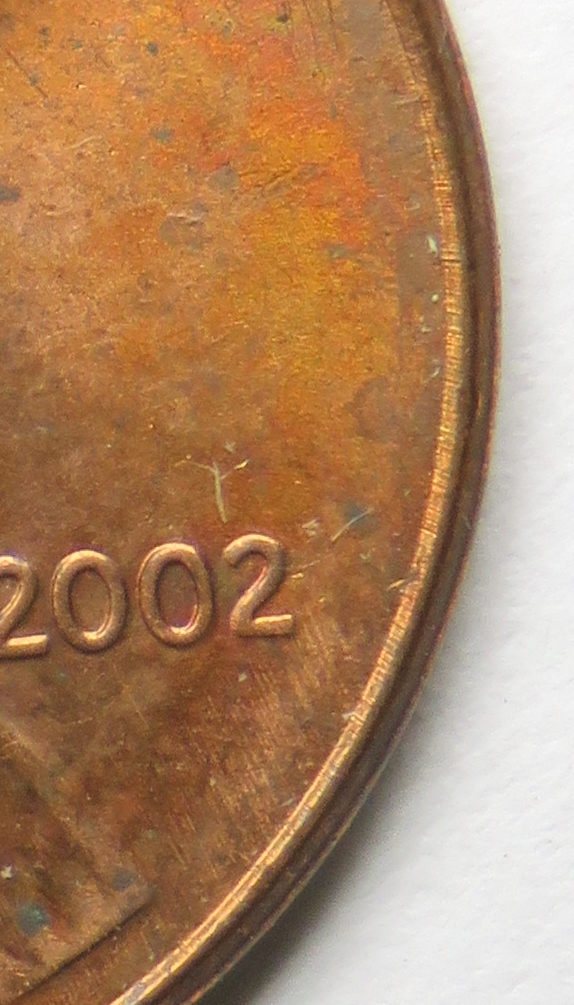
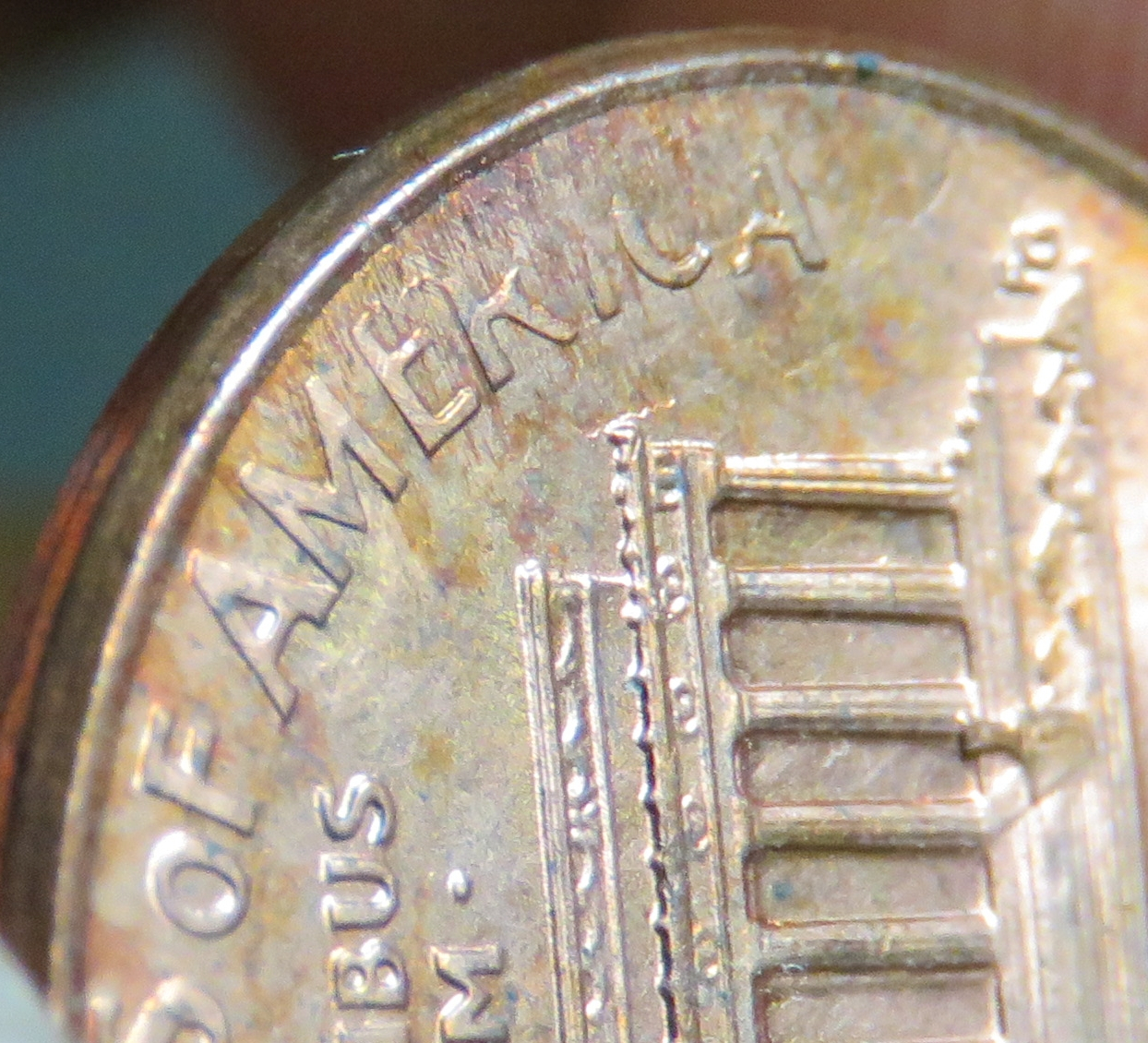
First off, the area around MERICA is definitely raised and inclined toward the rim. There is an abrupt start
to the incline and it presents as a very striated raised area with the letters missing. The area under the A shows
this effect strongly.
The obverse rim is weak and shows some signs of polish lines around the date.
But really interesting is on the rim there is an apparent incuse center line around the entire coin but
showing strongest looking at the reverse from K9 to K6 and almost disappearing from K6 to K9.
Fascinating
"There is an abrupt start to the incline and it presents as a very striated raised area with the letters missing."
This would be a good indicator of die damage.
Your photos are great! Thanks for the new photos!
I hate to be picky but could you try one kinda like (at an angle) this that may show the elevation?
Sure
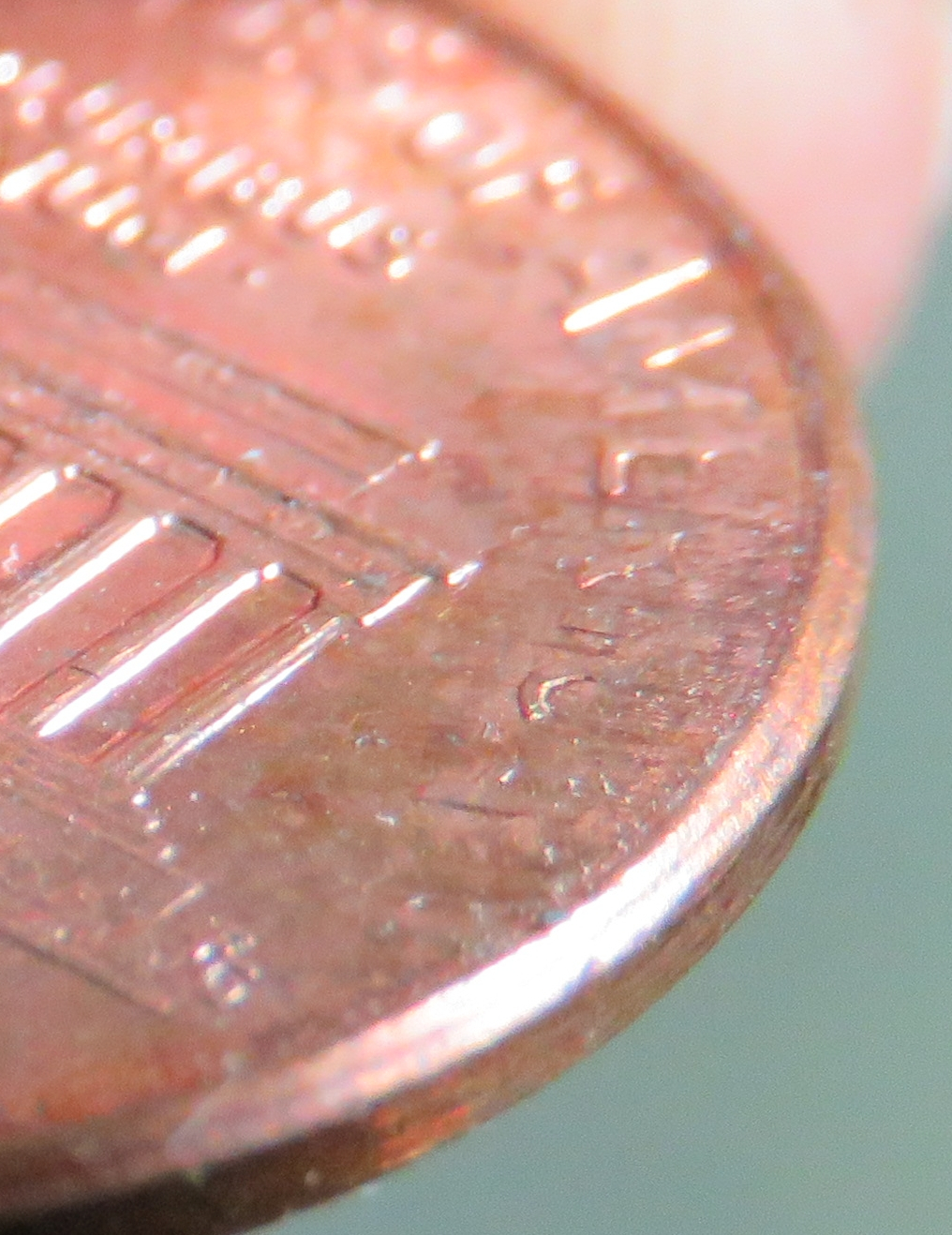
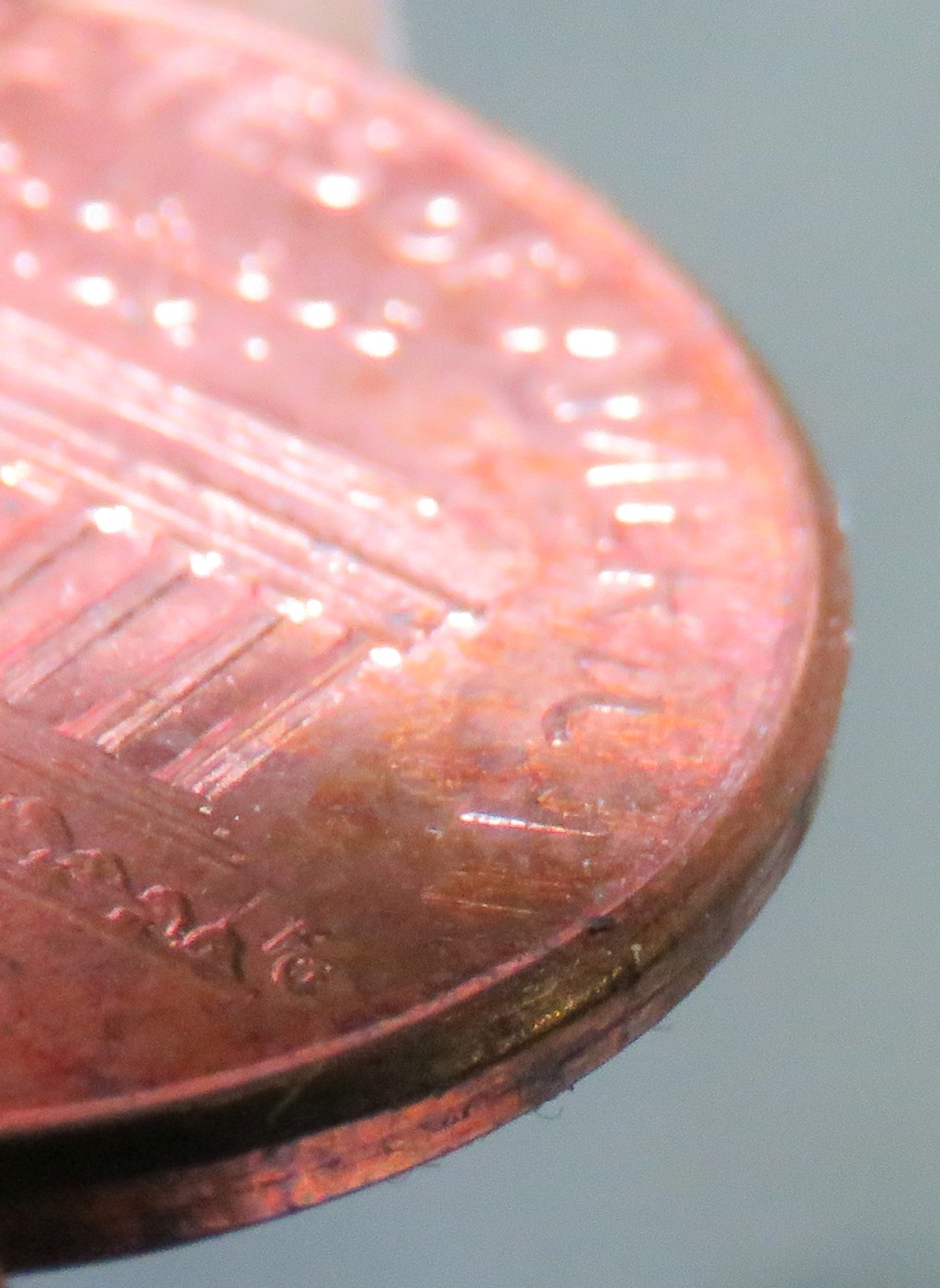
The third pic shows the rim center line well
The taper to the letters in this photo help to show the elevation change.
I know it can be tricky to capture in a photo what you can see with your eye.
Could this be a lamination on the face of the die? There seems to be a definite irregular edge to the raised area on the planchet, which would be recessed on the die.
Sean Reynolds
"Keep in mind that most of what passes as numismatic information is no more than tested opinion at best, and marketing blather at worst. However, I try to choose my words carefully, since I know that you guys are always watching." - Joe O'Connor
Looks like die damage to me.
I am having a hard time seeing this as anything but die damage.
If I may vam, gonna borrow your pic a min.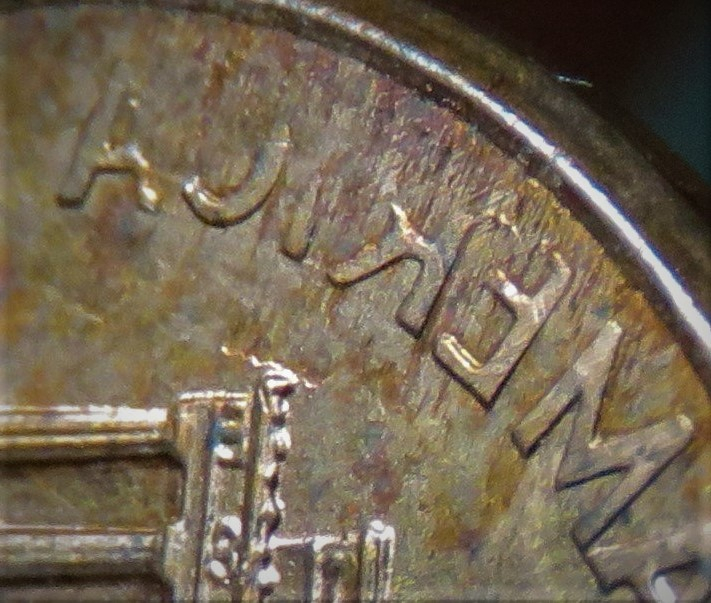
Why are the letters unaffected ?
This might show die damage surrounding the letters.
I have an inquiry in to the press manufacturer asking for details about the feed mechanism. Will advise if I hear anything useful.
Thanks Tom for all your help and insight with this.
Glad to help. I am always interest in something new in the field of errors.