Correspondence with US Mint on 2019 Sac Proof Reverse Doubling.
 Intueor
Posts: 310 ✭✭✭✭
Intueor
Posts: 310 ✭✭✭✭
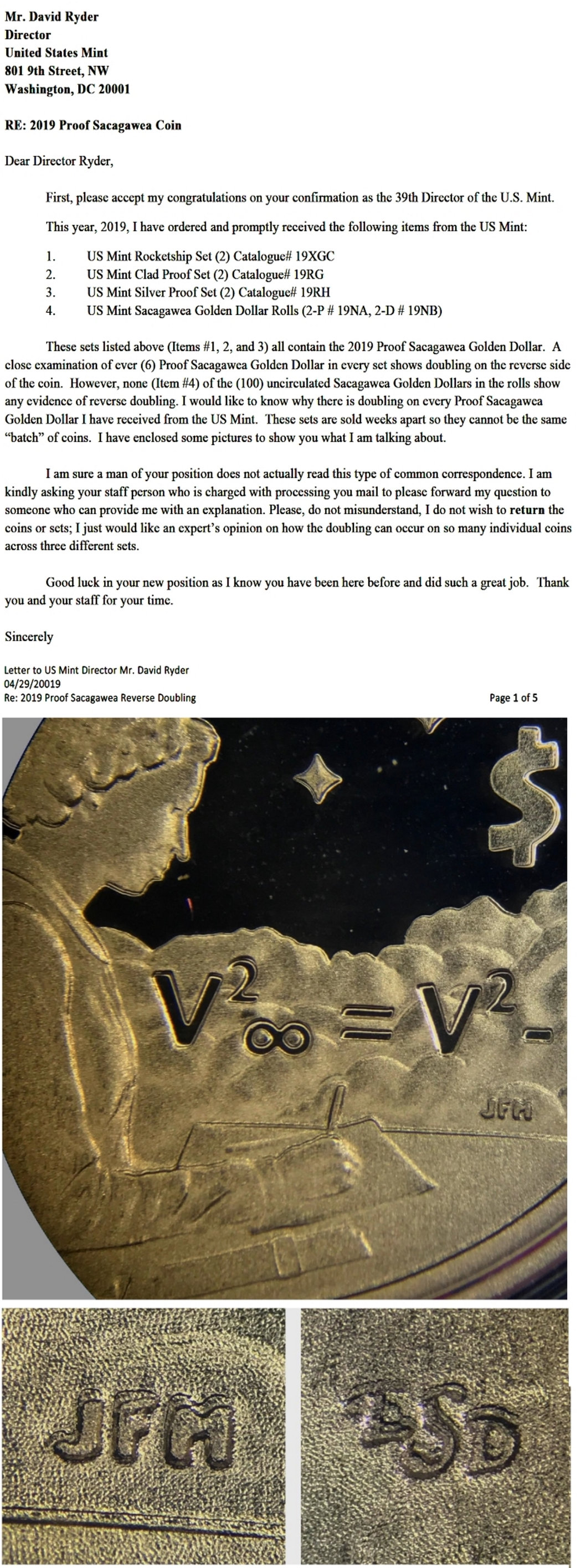
After making the observations discussed in the correspondence below, it became obvious that there was a consistent pattern of specific doubling on many 2019 Proof Sac dollars. While the cause of Machine Doubling is well documented, the ubiquity of this particular type of doubling anomaly on one type of coin warranted an explanation. Below is an abridged letter sent to US Mint Directory, Mr. Donald Ryder and the subsequent response from Mr. David Croft, Associate Director of Manufacturing, US Mint.
Response:
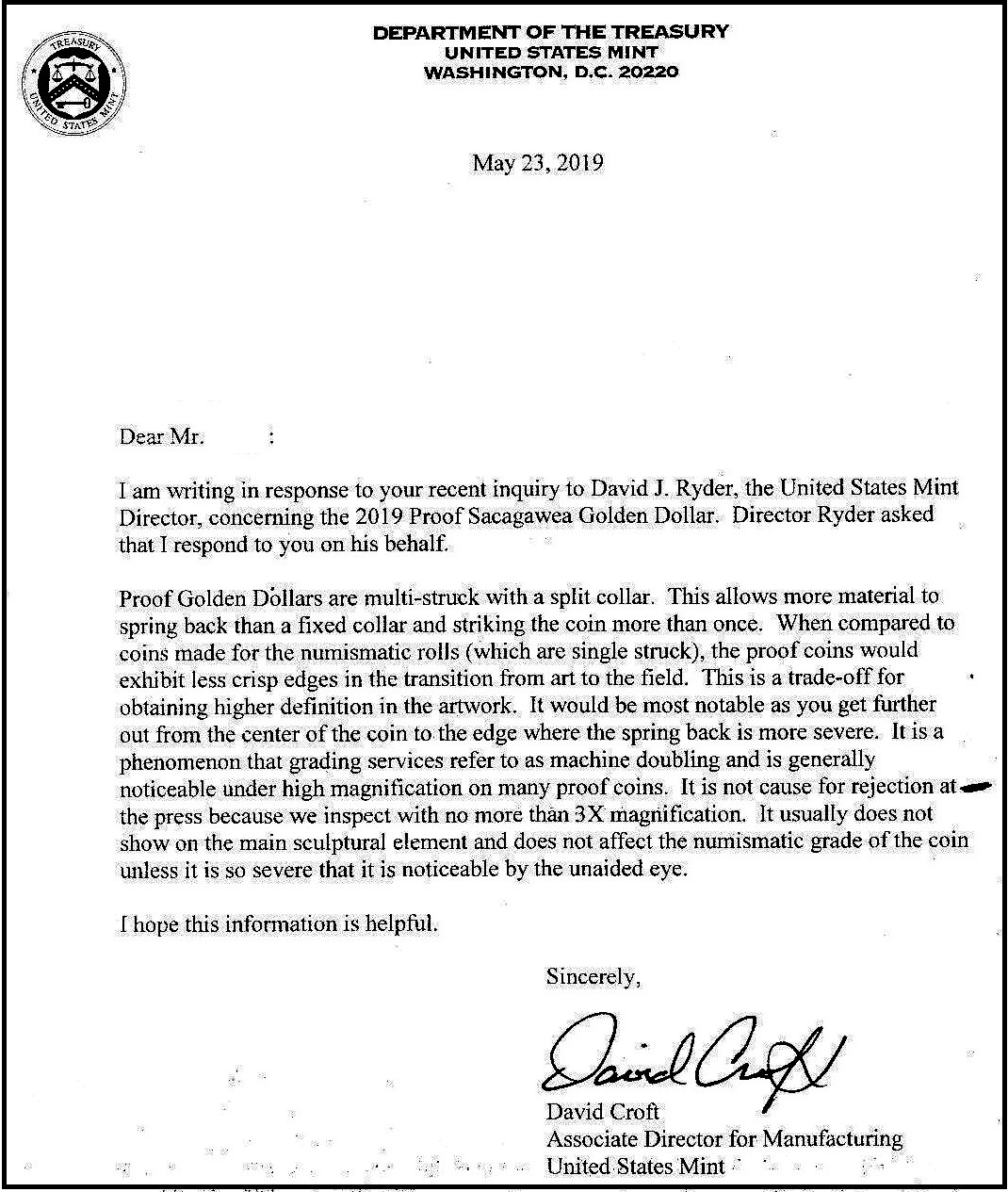
While Mr. Croft’s explanation is in line with the appearance of the anomaly, his description is more consistent with the accepted cause of Proof “Strike Doubling”. Machine Doubling, on the other hand, is the “accidental” result of an unintentional impression of the Working Die during or subsequent to a strike. Most references on SD suggest the slight shifting of the planchet in a fixed collar or a slight rotation of a Working Die during one of the strikes. The split collar scenario more accurately explains the perpetuation of the Sac Proof SD anomaly and is not dependent on an isolated mechanical failure. This is important since every examined 2019 Sac Proof reverse showed some degree of doubling. Since multiple strikes are intended for a Proof coin, it suggests that the Mint has acknowledged an acceptable level of tolerance for Strike Doubling to improve the definition of devices on a coin. This Strike Doubling is frequently skewed to just one area of the coin and is not usually uniform 360ᵒ from the center to edge. It is likely that the “partial” SD may be due to the actual mechanical and metallurgical dynamics of a “split collar”. Most images of a split collar are a two-half design. If the Mint’s press collar were a similar two-piece design than it would help to explain why the SD is not uniform on some SD proof coins. It is fascinating that an inherent flaw in the minting process of modern proofs can be exploited to improve the perceptual quality of a coin. Who knew? 
Mr. Ryder, Mr. Croft, and their respective staffs are to be sincerely commended for answering this correspondence in an accurate and timely manner. Other attempts to ask questions directly to the Mint have never received any response. Thank you.
Comments
Thst is a great response. Worth keeping.
Thx for sharing.
@Intueor
Thanks for sharing!
Very interesting, thank you for posting this communique'.... Cheers, RickO
An outside opinion is that the coin shown illustrates an unacceptable manufacturing defect. While I agree with "strike doubling" (or "doubling during multi-strikes"), it is such a basic defect that I am amazed the U.S. Mint would allow it to occur - especially on premium coins. (But, the "frost" is also of poor quality compared to real sandblasting with grit - so what do I know....?)
@RogerB
It's a feature, not a bug!
It's only a "feature" if it's software....
For the US Mint, it is simply unacceptable.