Options
**WARNING** Trick poll question? PMD? ANSWERED!
 Insider2
Posts: 14,452 ✭✭✭✭✭
Insider2
Posts: 14,452 ✭✭✭✭✭
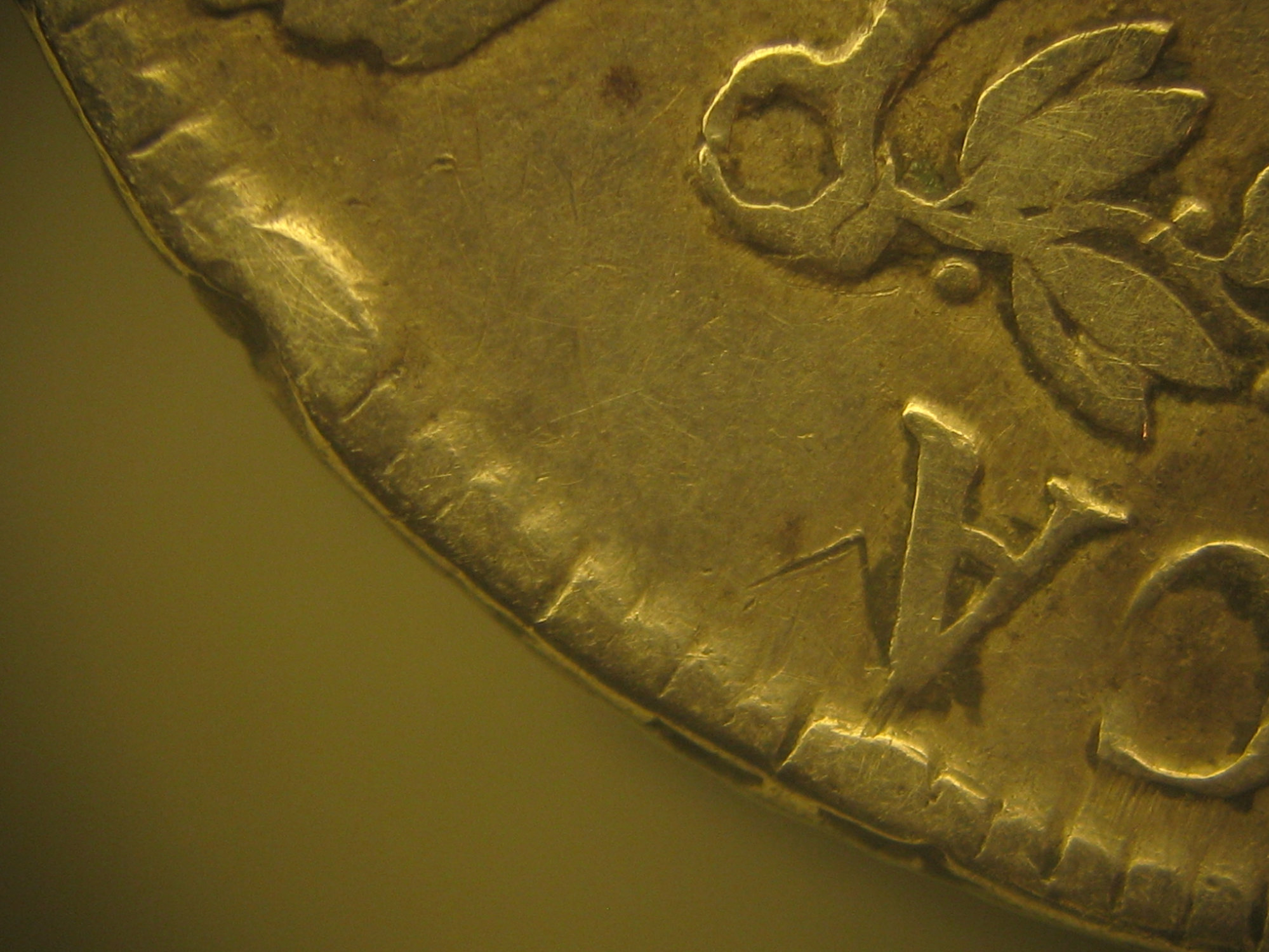
Hopefully the "experts" will not respond for a few hours.


Is the edge/rim of this Capped Bust half dollar damaged?
So, you are looking to buy a Capped Bust half in an old holder w/o the prongs and you see that its edge may have a big hit yet the coin is straight graded.
**WARNING** Trick poll question? PMD? ANSWERED!
This is a private poll: no-one will see what you voted for.
0
Comments
why do I only get one vote? This is not the new American way.
No picture, just a 'pick an answer' poll... So, I picked one... Cheers, RickO
Yikes! Thanks Ricko.
I'll hold off but I think I have an idea what's going on with the rim.
I decided not to choose #3, even though that's probably correct, I went with what
my observation is.
The only thing I'm pondering is what happened to the dentils? It almost appears like a tiny cud,
except the metal on the edge is indented in the same location.
Waiting to learn....
Some people are too anal about rims.....I'm more concerned about the graffiti(?) next to the "A".
There is a difference between a small scratch and Graffiti.
Because of the way these coins were made, the edge lettering may not be perfectly centered. This results in the characteristic you see in the OP that can look lie a "rim ding."
Now who can answer the reason for this?
The edge design is imparted on the coin in a separate operation using a castaing machine so rim irregularities are to be expected..
Worry is the interest you pay on a debt you may not owe.
"Paper money eventually returns to its intrinsic value---zero."----Voltaire
"Everything you say should be true, but not everything true should be said."----Voltaire
I chose #4 because I think it's a minting flaw. So there! Peace Roy
BST: endeavor1967, synchr, kliao, Outhaul, Donttellthewife, U1Chicago, ajaan, mCarney1173, SurfinHi, MWallace, Sandman70gt, mustanggt, Pittstate03, Lazybones, Walkerguy21D, coinandcurrency242 , thebigeng, Collectorcoins, JimTyler, USMarine6, Elkevvo, Coll3ctor, Yorkshireman, CUKevin, ranshdow, CoinHunter4, bennybravo, Centsearcher, braddick, Windycity, ZoidMeister, mirabela, JJM, RichURich, Bullsitter, jmski52, LukeMarshall, coinsarefun, MichaelDixon, NickPatton, ProfLiz, Twobitcollector,Jesbroken oih82w8, DCW
Yes, separate operation but is the edge design put on the planchet before the coin is struck or after it is struck?
Don't know but it wouldn't surprise me if some coins had the edge devises applied before striking while other coins were after striking.
Worry is the interest you pay on a debt you may not owe.
"Paper money eventually returns to its intrinsic value---zero."----Voltaire
"Everything you say should be true, but not everything true should be said."----Voltaire
I don't consider this to be a "hit on the rim" so I picked #3. I figured it was related to striking the edge lettering.
...so which is it for Capped Bust halves? Applied before or after? Inquiring minds want to know. Then tell all of use where you found the answer please.
The method was primarily developed in France by Jean Castaing about 1685. Wikipedia has articles on both Jean Castaing and The Castaing machine, but both articles say roughly the same thing. https://en.m.wikipedia.org/wiki/Jean_Castaing
I always thought the edge lettering was applied first, and my impression could have come from the various detailed engravings of the minting process in Denis Diderot's Encyclopedia (c. 1760). In France, I bought a book that had copies of Diderot's many engravings on the topic of minting. Actually, I bought (1993) about three or four copies, as it was inexpensive. However, I really don't know the answer to Insider's question.
The Castaing Machine:
It seems that Benjamin Peale later introduced the collared die that did away with the need for the Castaing machine in Philadelphia.
I hate spellchecker.
Lettered edge applied before striking. Otherwise there would be a bulge on both rims next to where each edge character was pushed into the coin. Bulges on planchet flattened by steel dies.
Coin in pic shows rim bump.
That's the answer I'm looking for. Interestingly, I have only found one source that spells this out directly. You can figure it out reading From Mine to Mint but so far in my search only one reference, Overton, states it directly:
",,,on the edge of the planchet PRIOR to striking the coin."
PS Actually it is NOT a rim bump. It just looks like one - especially to someone who did not have the chance to hold the coin and image it. That's the reason I posted this discussion. Edge lettering that overlaps the rim into the flat coin surface causing the rim to look either cut-damaged or bruised is fairly common on Capped Bust halves. On circulated coins, the bump (when present) is worn off.
I respectfully disagree. This is a rim bump that happened to overlap an edge character.
Unless the die was damaged, I don’t see how it would have failed to impart reeding during striking in this area, even if the planchet rim had been previously raised by the edge lettering. I think I’m with @CaptHenway on this unless someone can explain why I’m wrong.
Perhaps it could have worn off, but as usual @Insider2 has neglected to show us anything but a small part of the coin and it’s difficult to appreciate the overall context of the coin. Is it a worn coin or one closer to mint state with a softly struck rim??
I appreciate your opinion as It sure LOOKS that way: A bump to the EDGE caused the raised portion on the rim and into the field.
Unfortunately, I no longer have the coin to take images of the other three to four places on the rim showing the same effect.
Note there is wear all over the top of the "bump." Check out the three other parts of the rim w/no separation! As I posted before, in most cases It is not necessary to see the entire coin or other parts of the coin to appreciate what is being discussed.
EXAMPLE: If I post a planchet flaw on the obverse of a coin, ANYONE who asks to see the reverse or edge is a ...Ah, Ah, a very curious person.
IMHO
Curiosity is good but
Oops, I meant dentils, not reeding of course.