WSJ - An American Icon That Almost Wasn't (Lincoln Memorial)
 Catbert
Posts: 8,302 ✭✭✭✭✭
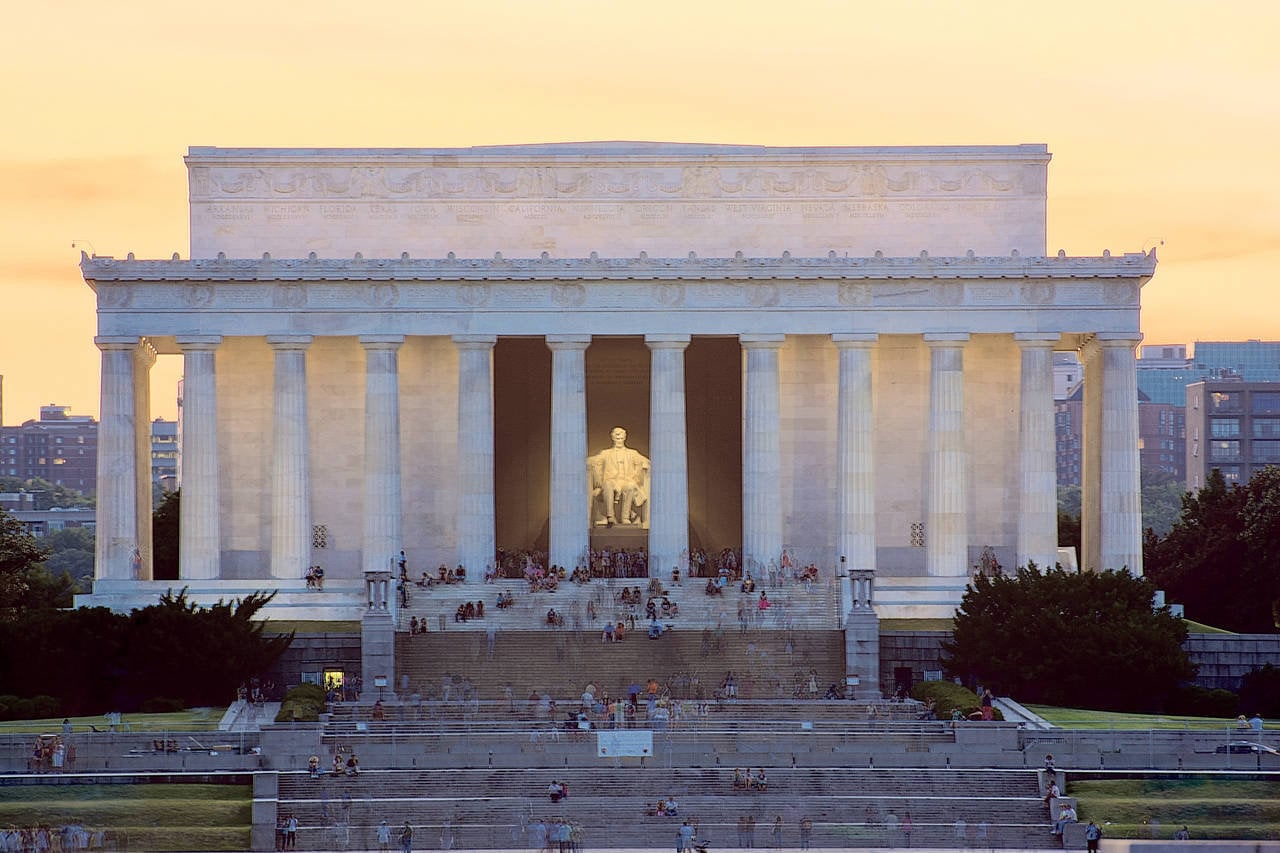
Daniel Chester French’s monumental, enthroned statue of Abraham Lincoln has long served as the backdrop of choice for national aspiration. But it could easily have become an entirely different sculpture at an altogether different Lincoln Memorial.
As ideally situated as it seems today, many officials charged with building the Memorial did not want to locate it at West Potomac Park, the once-marshy fringe of Washington’s National Mall. Bizarre alternative proposals included Virginia’s Arlington Cemetery—in the former Confederacy.
Finally, Lincoln’s onetime deputy private secretary John Hay, by then the U.S. Secretary of State, brought the decision-makers to their senses with his powerful testimony and professional pedigree. Hay’s preferred choice, West Potomac Park, finally won the nod.
But then, to adorn architect Henry Bacon’s classical temple, some misguided planners proposed saving time and money by installing a bronze replica of Augustus Saint-Gaudens’s Chicago statue, “Abraham Lincoln: The Man” (1887). A horrified Bacon vowed opposition. That honor he wanted for his friend and frequent collaborator, French, who secured the coveted assignment in 1915.
Even then, the project might have gone awry. Originally, French aimed for a work in bronze, but fortunately switched to marble. But then, in 1917, French realized that the approved 12-foot-high statue might be dwarfed by Bacon’s majestic atrium, and battled for a $25,000 supplemental appropriation to make it bigger. He won the argument only when he suspended a plaster version of the statue’s newly enlarged head from the ceiling of the Memorial’s unfinished interior.
Still, French faced formidable challenges and intense expectations. His would be the largest seated statue in the country, yet one of many extraordinary Lincolns already gracing American pedestals.
After turning for inspiration to books and photographs, French opted for a downcast, dreamlike gaze and then struggled as much with the exact positioning of the feet as he had with the face—seeking in all the statue’s elements to combine ruggedness with power.
French decided to show Lincoln in a fine suit—casually worn—just as he imagined Lincoln might have dressed. “Hands,” French added, “are almost as expressive as the face to me.” To replicate Lincoln’s enormous hands, he adapted life casts made in 1860, and then made a cast of his own in the position he wanted for the statue.
The fortuitous combination of details and effects combined for a talismanic work of art: both magisterial and intimate, or as a newspaper critic put it in 1922, “colossal in size and yet distinctly personal.”
Besides working on the statue, which was finished in 1920, French was responsible for the epigraph behind it composed by his friend, art critic Royal Cortissoz. Though one contemporary denounced the result as “poor, cheap, sentimental, erroneous, disfiguring,” the lines soon achieved the status of secular scripture: “In this temple / As in the hearts of the people / For whom he saved the Union / The memory of Abraham Lincoln / Is enshrined forever.”
If there was anything wrong with the sentiment, it was its focus on Union, not slavery. But in this emphasis, Cortissoz merely echoed the conciliatory themes reflected in the building and the statue alike. The Memorial features 36 Doric columns, one for each of the reunited states at the time of Lincoln’s death, but provides no mention of secession or war. French’s Lincoln sits alone in majestic contemplation, surrounded by his eloquent oratory, the Gettysburg Address and the Second Inaugural, a figure so reverenced he needs no sculptural attributes to remind viewers of his stature—or, apparently, what he himself judged the act by which history would remember him: the Emancipation Proclamation. But in the new age of Jim Crow, sectional, not racial, reconciliation animated “official” American memory.
As if to accentuate this skewed perspective, the Memorial came officially to life on May 30, 1922, at a shamefully segregated dedication ceremony. African-Americans were herded off to a “colored” section at the rear—replaced in the choice seats by aged Confederate veterans dressed in their tattered gray uniforms.
Adding injury to insult, the only black speaker at the ceremony, Robert Russa Moton, head of the Tuskegee Institute, could not even deliver the full oration he had composed. The White House demanded he omit his most provocative words: “So long as any group within our nation is denied the full protection of the law,” what Lincoln called his “unfinished work” remained “still unfinished,” and the Memorial itself “but a hollow mockery.”
Renewal and redemption did not finally come until 1939, when African-American singer Marian Anderson, barred by the Daughters of the American Revolution from performing at their all-white Washington headquarters, sang instead at Eleanor Roosevelt’s urging from the steps of the Memorial. At a concert witnessed by 75,000 spectators and heard by millions more on radio, the Memorial became the staging ground of the American dream.
“Mr. Smith Goes to Washington” and “Young Mr. Lincoln” (both 1939) further burnished the shrine’s evolving image as a symbol of inclusion and aspiration. Most momentously of all, of course, Martin Luther King Jr. sanctified the site forever with his 1963 “I Have a Dream” speech.
Those who overcame the Memorial’s disgraceful dedication have often reminded us that Lincoln’s—and America’s—work remains unfinished. What would have astonished even the self-assured French is how much progress has been made in the inspiring shadow of the statue poet Langston Hughes once well described as “Quiet—And yet a voice forever.”
—Mr. Holzer, director of Hunter College’s Roosevelt House, is the author of “Monument Man: The Life and Art of Daniel Chester French” (Princeton), out on March 5.
https://wsj.com/articles/an-americanicon-that-almost-wasnt-11550261017
"She comes out of the sun in a silk dress,
running like a water color in the rain...."
Comments
The Saint-Gaudens statue referenced early in the above article that was considered as an alternative to save money is pictured here:
[By AndrewHorne - Own work, CC BY-SA 3.0, https://commons.wikimedia.org/w/index.php?curid=17379983](By AndrewHorne - Own work, CC BY-SA 3.0, https://commons.wikimedia.org/w/index.php?curid=17379983 "By AndrewHorne - Own work, CC BY-SA 3.0, https://commons.wikimedia.org/w/index.php?curid=17379983")
"She comes out of the sun in a silk dress,
running like a water color in the rain...."
He is is most famous face as far as ex president ...... pennies and all Thank you for a wonderful writing

Memorial Bridge, with Frasier's "Arts of War" at the guard, was part of the overall plan which was to unify Arlington National Cemetery with the City of Washington. The bridge connects the Lincoln Memorial with the Cemetery.
@Catbert .... Thank you for that history, little known wrangling that transpired for the Lincoln Memorial. Been there several times, and always impressed. Cheers, RickO
Yes I’m bumping my thread (for shame) since I’d like for a few more readers to see this interesting history!
"She comes out of the sun in a silk dress,
running like a water color in the rain...."
Tankyou for the interesting history
Enjoyed the read. Also interesting is how it was built.
Is that the place that the punk kid from KY was getting into that distinguished elderly Native American’s face?
I believe that is Arts of Peace. I love Frasier's work.
"Look up, old boy, and see what you get." -William Bonney.
Thanks for the correction - they look so much alike these days....