Options
$2.50 struck from French indemnity gold - 1836
 RogerB
Posts: 8,852 ✭✭✭✭✭
RogerB
Posts: 8,852 ✭✭✭✭✭
Anyone have some of these in their collection?
"Treasury Department
June 2, 1836
Sir:
I acknowledge the receipt of your letter of the 31st ult. with ten quarter eagles
struck from the French Indemnity gold, and enclose you herewith my individual draft for the
amount of them. They will be quite a curiosity, as a part of the long expected Indemnity.
In regard to the silver alloy, you have on this, I presume, received another line
from me, and the subject may be left where it is, until Congress shall act upon it or adjourn.
I am, Sir, your most
Sam Woodbury
Secretary of the Treasury
Director R.M. Patterson
Philadelphia
N.B.: A draft for $25 is herewith sent you on the Girard Bank."
2
Comments
That's all they made was 10? Would there really be any way to trace those specific ones? How does that date of production correspond with the regular production runs for 1836's? Before, after, middle, etc. No clue if they were Script 8 or Block 8 I suppose.
Curiously though - NGC has graded ONE 1836 PL coin (MS63). If the run of 10 was unique, that's probably as close to unique among the thousands of other ones graded I can think of.
"You Suck Award" - February, 2015
Discoverer of 1919 Mercury Dime DDO - FS-101
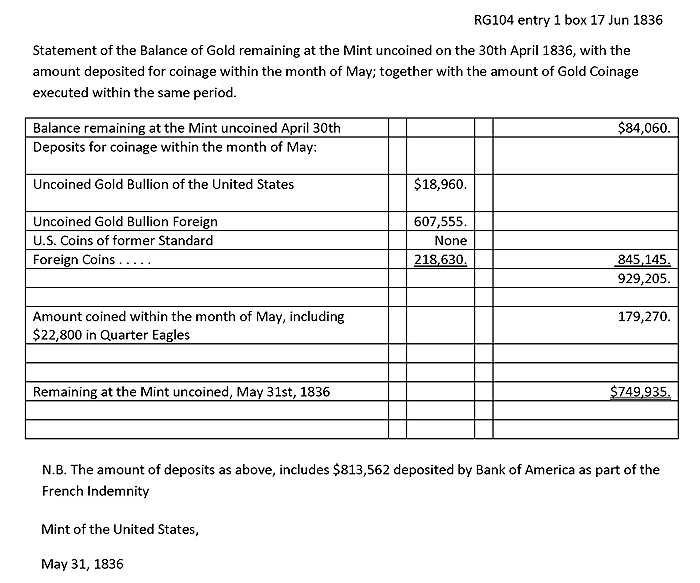
Here's a transcription of the May 31 letter mentioned above:
Interesting, thanks for sharing !!!
Roger - you have a hunch if those 10 could be considered "Proof"?
From here: (Ref 1836 Proof Quarter Eagles)
https://coinweek.com/us-coins/us-gold-coin-profile-proof-1836-quarter-eagle/
The mintage for this issue is unknown, delivered as it was years before the Mint started keeping records on the number of Proof coins struck. Just seven different specimens have been traced, and given the likelihood that a specially prepared and distributed issue such as this would have been carefully preserved over the years, it is likely that virtually all of the coins struck have survived to the present day. Based on this assumption, the mintage for this issue is probably on the order of only eight to 10 pieces.
Think it's possible those 10 Indemnity Gold coins are the 10 proofs?
"You Suck Award" - February, 2015
Discoverer of 1919 Mercury Dime DDO - FS-101
RE: "Roger - you have a hunch if those 10 could be considered 'Proof'?"
I think it's unlikely. Making a proof required special care. These 10 samples were apparently intended to show the Secretary what ordinary coins made from French gold looked like.
The closing sentence about silver alloy is actually critical. The Secretary and director hand been exchanging views about how much silver should be in the 0.100 alloy of US gold coins. French indemnity gold was about 0.994 gold with the balance copper. The Secretary preferred using 2/3 copper and 1/3 silver in gold coin alloy.
Use of silver in gold coin alloy was little more than an admission that refining techniques could not economically part all the silver from native gold. This meant the un the 18th and early 19th century all gold coins contained a measurable proportion of silver AND most silver coins contained a measurable proportion of gold. The US Mint position was intended to cut parting and refining cost to the minimum, but too much silver alloy gave gold coins a "greenish" color cast. French indemnity gold, containing less silver had a deeper color and coins made with copper as the primary alloy were a richer orange-gold color. It was not until the late 1890s that US gold reached to color that mint officers desired. This happened only after adoption of electrolytic refining.
Couldn't an XRF help determine if a 1936 $2.5 was one of the French indemnity gold coins based on the differing alloy and finess? It might be interesting to see what the "PL" 1836 $2.5 read as...
ShadyDave - Probably. I doubt anyone has tested this...like much numismatic "knowledge" we've assumed a lot and known little.
PS: We don't know the actual alloy of Lincoln cents, particularly during and after WW-II.
There are two major varieties of 1836 quarter eagles, the script 8 and the block 8. The script 8 is far more common although the block 8 is not hard to find. Overall the 1836 quarter eagle is the most common date in the Classic Head Quarter Eagle series.
Here are the two varieties.
Script 8 with a close-up
Block 8 with a close-up
It is my understanding that the 1836 half eagles contained French gold as well. The 1836 half eagle is the second most common date in the Classic Head Half Eagle set, behind the 1834 Plain 4 variety.
Breen indicates (Numismatic Scrapbook, May 1966) that 1836 half eagles were struck partly from French indemnity gold, "a personal triumph for Andrew Jackson."
If French gold was an important source of the 1836 gold coinage, the few sample coins at the beginning might have seemed less remarkable a few months later.
The Classic Head gold coins were the subject of my exhibit that this year's Winter FUN show. Here the text from my exhibit on the year 1836.
1836
The mintages for the Classic Head gold coinage reached their highest levels in 1836. The combined coinage for the quarter and half eagles was just over 1.1 million pieces. The second highest mintage year was 1834 when the quarter eagle and half eagle combined mintage was 770 thousand.
These high mintages were fueled by continued submissions of “old tenor” gold pieces for re-coinage and an indemnity payment from France. After years of negotiations, France agreed to compensate the United States, in six installments, for damage done to its shipping industry during the Napoleonic Wars (1803—1815). This installment, which was in gold, was sent to the Philadelphia Mint and converted into coins. The result was a bumper crop of 1836 dated gold pieces for modern collectors.
Half eagles were also made from indemnity gold.
Old standard gold coins were shipped to the Mint in large quantities during June-December 1834. The June deposits were held until the new standard was in force, then melted as bullion. The gave depositors a bonus since they had purchased the coins at face value and now deposited them as bullion.
After 1834 deposits of old standard US gold declined, although a few straggled in almost every month at the Philadelphia Mint and later the NYAO. It was this influx of old US gold that gave impetus to formalization of the Mint's Cabinet of Coins and Ores. (Before the gold standard change, old US gold coins were not accepted for deposit or exchange.)
Here's the consolidated report for 1835. Note the deposit of US coins "old standard."
All good info.
Unless the 10 QE sent to the Secretary of the Treasury were made with unique dies - it may take alloy testing to tell them apart.
If by chance they used a specific die pair for only those 10 (unlikely, but let's go with it for a moment)... with only 10 made, there wouldn't be too many today. Of the 15? varieties known - variety 9 (1 coin PL), V10 (2 known) or V14 (5 known) would be the first candidates for testing. Varieties according to this: https://coins.ha.com/s/d/cqedvg.pdf
I found in here:
https://books.google.com/books?id=ihvTQyYinYgC&pg=PA155&lpg=PA155&dq=1836+french+indemnity+gold+coins&source=bl&ots=mB7UGT6sxR&sig=ACfU3U343u4OJ6B3mcFp0hEkmlNU3KH3_g&hl=en&sa=X&ved=2ahUKEwj_iYS_joLgAhWxuVkKHQ7jAu8Q6AEwDHoECAAQAQ#v=onepage&q=1836 french indemnity gold coins&f=false
Where the mint received some French Indemnity Gold on May 14th, 1836.
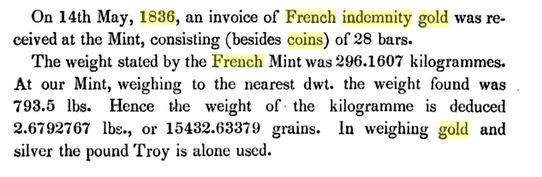
Huge assumption - but if the 10 QE were made from this delivery of gold, it narrows down the actual mintage dates between May 14th and May 31st when the letter arrived minus transport time, so only about a 2 week window?
"You Suck Award" - February, 2015
Discoverer of 1919 Mercury Dime DDO - FS-101
The complete volume, "RG104 E-216 vol 1" is available on NNP. Several indemnity deposits are described. This allows anyone to go direct to the source.
Does anyone have a pic of the french gold coins that are being discussed? Was this the payment Haiti made to France in 1825?
Most payments were in gold bars.