Need help 1914 Great Britain George V, 1/2 Sovereign GOLD
 Gluggo
Posts: 3,566 ✭✭✭✭✭
Gluggo
Posts: 3,566 ✭✭✭✭✭
Is this coin real I just bought it and while I should not buy raw every now and then. I am trying to take better pictures but having a hard time.
Reverse: St. George slaying the dragon
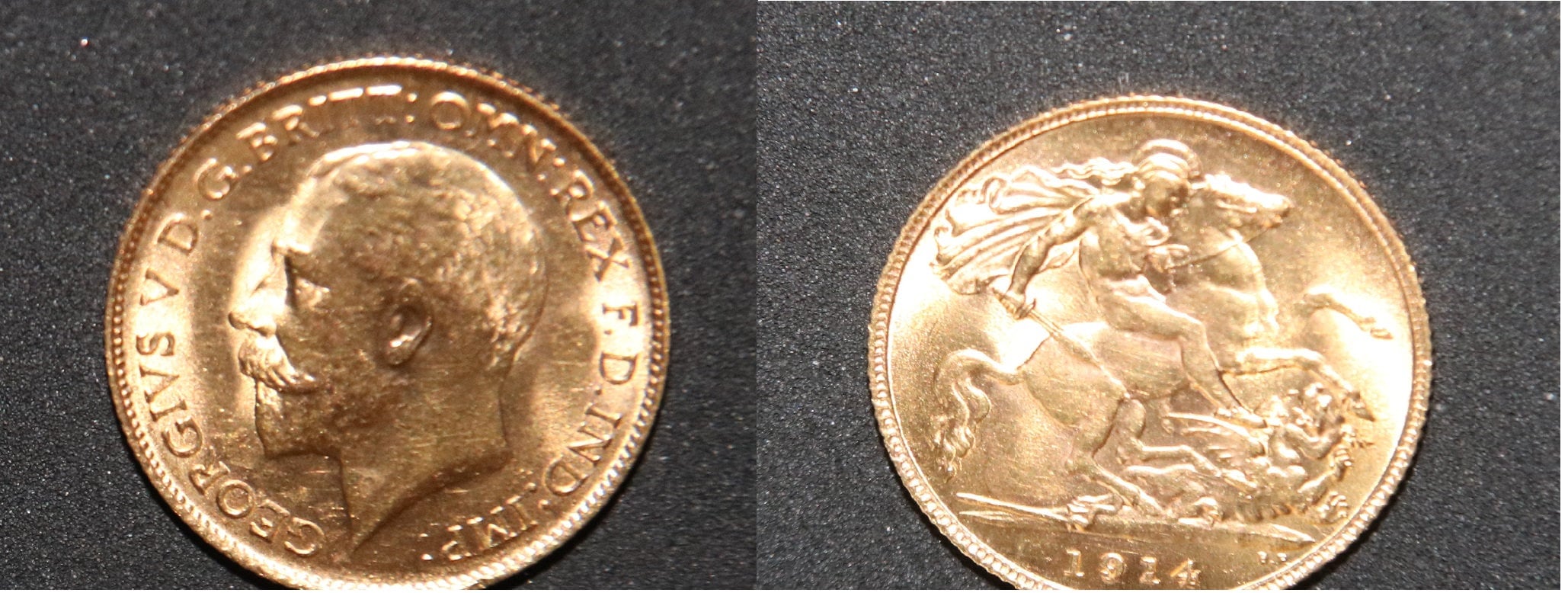
Thank you overdate
The sovereign is a gold coin of the United Kingdom, with a nominal value of one pound sterling. Struck from 1817 until the present time, it was originally a circulating coin accepted in Britain and elsewhere in the world; it is now a bullion coin and is sometimes mounted in jewellery. In most recent years, it has borne the well-known design of Saint George and the Dragon on the reverse—the initials (B P) of the designer, Benedetto Pistrucci, may be seen to the right of the date.
The coin was named after the English gold sovereign, last minted about 1603, and originated as part of the Great Recoinage of 1816. Many in Parliament believed a one-pound coin should be issued rather than the 21-shilling (£1.05) guinea struck until that time. The Master of the Mint, William Wellesley Pole, had Pistrucci design the new coin, and his depiction was also used for other gold coins. Originally, the coin was unpopular as the public preferred the convenience of banknotes, but paper currency of value £1 was soon limited by law. With that competition gone, the sovereign not only became a popular circulating coin, but was used in international trade and in foreign lands, trusted as a coin containing a known quantity of gold.
The British government promoted the use of the sovereign as an aid to international trade, and the Royal Mint took steps to see that lightweight gold coins were withdrawn from circulation. From the 1850s until 1932, the sovereign was also struck at colonial mints, initially in Australia, and later in Canada, South Africa and India—they have been struck again in India since 2013 (in addition to the production in Britain by the Royal Mint) for the local market. The sovereigns issued in Australia initially carried a unique local design, but by 1887, all new sovereigns bore Pistrucci's George and Dragon design. Strikings there were so large that by 1900, about 40 per cent of the sovereigns in Britain had been minted in Australia.
With the start of the First World War in 1914, the sovereign vanished from circulation in Britain, replaced by paper money, and it did not return after the war, though issues at colonial mints continued until 1932. The coin was still used in the Middle East, and demand rose in the 1950s, which the Royal Mint eventually responded to by striking new sovereigns in 1957. It has been struck since then both as a bullion coin and, beginning in 1979, for collectors. Though the sovereign is no longer in circulation, it is still legal tender in the United Kingdom.
Comments
Did I mess up?
The legend of Saint George and the Dragon describes the saint taming and slaying a dragon that demanded human sacrifices; the saint thereby rescues the princess chosen as the next offering. The narrative is set in Cappadocia in the earliest sources of the 11th and 12th centuries, but transferred to Libya in the 13th-century Golden Legend.[1]
The narrative has pre-Christian origins (Jason and Medea, Perseus and Andromeda, Typhon, etc.),[1] and is recorded in various saints' lives prior to its attribution to St George specifically. It was particularly attributed to Saint Theodore Tiro in the 9th and 10th centuries, and was first transferred to Saint George in the 11th century. The earliest narrative record of Saint George slaying a dragon is found in a Georgian text of the 11th century.
The legend and iconography spread rapidly through the Byzantine cultural sphere in the 12th century. It reached Western Christian tradition still in the 12th century, via the crusades. The knights of the First Crusade believed that St George with his fellow soldier-saints Demetrius, Maurice and Theodore had fought alongside them at Antioch and Jerusalem. The legend was popularised in western tradition in the 13th century based on its Latin versions in the Speculum Historiale and the Golden Legend. At first limited to the courtly setting of Chivalric romance, the legend was popularised in the 13th century and became a favourite literary and pictorial subject in the Late Middle Ages and Renaissance, and it has become integral part of the Christian traditions relating to Saint George both in Eastern and Western tradition.
If you bought it as bullion you should be ok. Just a quick glance, but it looks real. How much and who did you buy from? Not Alibaba I hope.
No some man from Idaho with a real high rating and he also guaranteed it when I asked him After I bought it if its real.
Yes, it's REAL. Unfortunately, the images are too blurry. The glare makes it hard to determine if it is authentic.
Yes having a hard time on the picture but I did run it under the Verifier Pro Precious Metal machine and it did register as gold. Which it took a while to figure it out but finally I was able to get it at 91%. 22K
I am not an expert on British coins.. but I have always liked the reverse design... years ago I had two sets of gold Britannia's. Really nice coins. Cheers, RickO
Just for fun, British sovereigns and half sovereigns were not really money - but gold discs of specific weight and purity. The "value" depended entirely on the market price of gold metal. Notice there is no denomination on the piece.
Yes it was a different type purchase for me, a different reason more of a celebration purchase. Thank you for the response's its much appreciated. Forced me to use my fancy metal analyzer. I just kept it in the closet.
actually, it looks good to me
Steve
Like Kruggerands, I guess.
Gluggo, You will probably find more foreign coin experts if this was posted on the World and Ancient Coins forum.
Also if you want to see world coin values go to CoinWorld and look at the world coin values there. They have a lot of data. Here is a link to help:
https://www.coinworld.com/content/dam/cw/coinvalues/foreign/2016/090516 - British Values.pdf
Also you will find a huge selection of old world gold coins at bullionexchanges, jmbullion and dozens of other places that are authentic and priced really well at the moment.
My US Mint Commemorative Medal Set
It is Crown gold. Purity .9167 I think same as Krands and AGE's.
The weight on your machine would indicate that this is a sovereign, not a half sovereign.
Maybe you did even better than you thought?
Although they were money of account at 20 shillings.
Well, just Love coins, period.
Which equates to one pound. Each coin's gold content is very close to 4/17 of an ounce.
" . . . it was originally a circulating coin accepted in Britain and elsewhere in the world; it is now a bullion coin and is sometimes mounted in jewellery." --Wikipedia
https://en.wikipedia.org/wiki/Sovereign_%28British_coin%29
Well-known British secret agents sometimes carry gold sovereigns.
The Mysterious Egyptian Magic Coin
Coins in Movies
Coins on Television
Yes, sovereigns were most certainly money and coin of the realm. Early sovereigns go back to at least Henry VIII in the early 1500's. After 1600 they circulated along side Crowns, Pounds, Unites and Guineas. These were all gold coins of the realm and circulated in daily commerce. And none of them had a denomination either. The gold sovereigns of Queen Victoria from the early 1800's to 1900 circulated in daily commerce and most are in very good to very fine condition.
Looks good to me, congratulations !!!
Nice pick up!
My YouTube Channel