Was this a Treasury policy in conflict with coin collecting?
 RogerB
Posts: 9,070 ✭✭✭✭✭
On July 1, 1894 the mint director was asked of the New Orleans Mint could exchange new, 1894 date, silver dollars for ones of a prior year. The request was based on exchange on only small sums, possibly by local coin collectors or others who wanted a few shiny new dollars.
Director Preston's reply was that the new dollars could only be issued for gold coin or treasury notes and under a transfer order from the Treasurer.
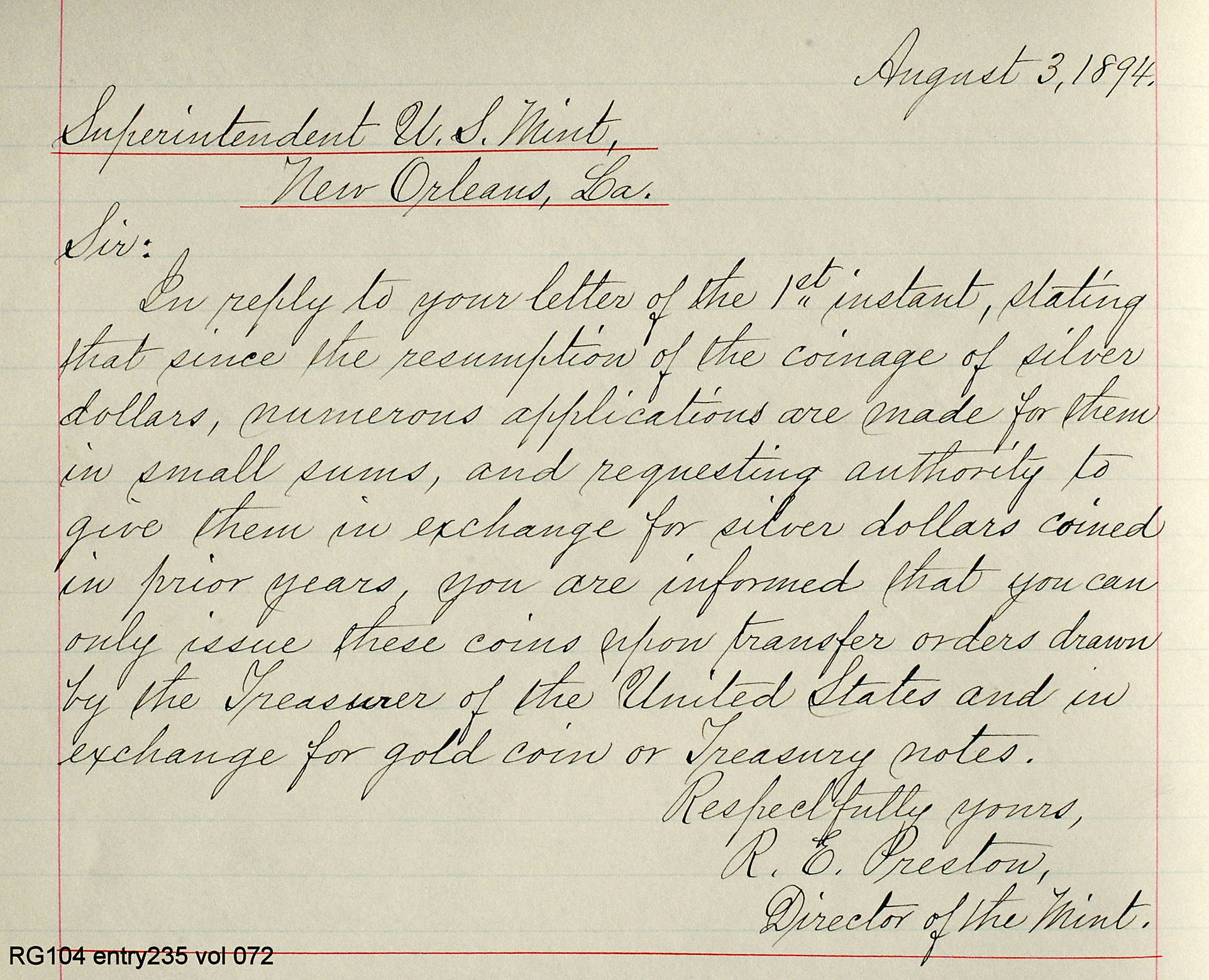
August 3, 1894
Superintendent, U.S. Mint
New Orleans, La.
Sir:
In reply to your letter of the 1st instant, stating that since the resumption of the coinage of silver dollars, numerous applications are made for them in small sums, and requesting authority to give them in exchange for silver dollars coined in prior years, you are informed that you can only issue these coins upon transfer orders drawn by the Treasurer of the United States and in exchange for gold coin or treasury notes.
Respectfully yours,
R. E. Preston,
Director of the Mint
Preston's comment was Treasury policy.
Yet, the Treasury and Mint also routinely told collectors to write to each mint to obtain coins of the current year and to included payment in Treasury Notes or gold-for-gold and silver-for-silver.
Was Preston actively obstructing collectors, just confused, or do we misunderstand the situation in August 1894?
Comments
Interesting question
Successful transactions with : MICHAELDIXON, Manorcourtman, Bochiman, bolivarshagnasty, AUandAG, onlyroosies, chumley, Weiss, jdimmick, BAJJERFAN, gene1978, TJM965, Smittys, GRANDAM, JTHawaii, mainejoe, softparade, derryb, Ricko
Bad transactions with : nobody to date
It does sound uniquely governmental:
Treasury: "Don't ask us, ask the mints."
Mints: "We can't because Treasury says no."
But it may not have been specifically targeted at collectors. It may have been the view that manufacturing facilities shouldn't waste time dealing with the public in small quantities? (Which ultimately did have the affect of stomping on collectors, and Grandma's wanting shiny coins, the most).
Those troublesome coin collectors ...
I believe collectors of the day, and the local mint cashiers, were probably thinking: "It's easier to ask forgiveness than it is to get permission." Some things about the government are universal across time.
The policy probably had something to do with the "Free Silver" debate then raging.
But Preston's enforcement was super strict.
Treasury policy since reintroduction of standard silver dollars in 1878 was to require payment in gold coin or treasury notes/gold notes. This naturally helped reinforce the practical effect of the US being on a gold standard rather than a bi-metallic standard.
"Free silver" occupies many Mint letters from 1893 to about 1897 - not even the gold hoarding executive orders of 1933 come close. (The number 2 subject? Columbian Exposition medals: errors in name spelling and delay in receipt.)
I have read (what little I have read) that Preston owed his elevation to the Mint's top job to his being a career Mint employee. Apparently President Cleveland wanted a strict, by-the-book, Director who could not be accused of partisanship during the debate over bi-metalism. This possibly kept Preston on 'pins and needles', but it may have been in his personal nature too (as shown by that picky letter to the assayer you posted a few days ago).
Do you happen to know the date of Director Preston's death?
I do not know what will be the death of Western civilization, but Spellchecker is a prime candidate.
Interesting stuff!
My YouTube Channel
I think Preston died in 1911. when McKinley appointed George Roberts to the Directorship, Preston went back to his career position of Examiner - effectively the number 2 man. Several other career people have also become directors.
I can only be amazed at the penmanship on some of these early documents
Soon to be a lost art.....
Bob
Lordmarcovan, WTCG, YogiBerraFan, Phoenin21, LindeDad, Coll3ctor, blue594, robkoll, Mike Dixon, BloodMan, Flakthat and others.
Well, one could gather others and head to the end of the last railway line. There, various forms of penmanship could be practiced, preserved and passed to a new generation. (As with books in "Fahrenheit 451.")
I do know that my twenty year-old daughter cannot write in cursive, and I guess her ability to read it is very limited too. Similarly, her boyfriend cannot do either one.
Both are products of private schools.
@BillDugan1959 .... Really?? Wow... I had no idea that the lack of cursive instruction has been in place for that long. I have read about schools dropping it the last few years, but thought it would be much longer before the deprived students entered adulthood.... Guess it started much earlier. Cheers, RickO
@ricko
I have a dozen nieces and nephews between the ages of 35 and 15, and several are now married. I will ask them about whether or not they can read and write in cursive handwriting.
FWIW, that Emery-Nichols Collection that I referenced the other day in the thread about Proof coin purchasers was built over two generations and several decades by writing to each branch mint and purchasing one of everything that they made up to the dollar each year. They also bought Proofs of everything from Philadelphia up to the quarter eagle. This began around 1896 or 1897, and there was even a page of instructions as to how to do so from the first generation to the second. Judging from the high quality of the coins so collected, the mints were very accommodating to collectors.
Much of the correspondence with the Mint survived with the paperwork that I saw when I viewed the collection.
OT Cursive writing - off topic!
I asked my nieces and nephews, and I also asked my first cousins' children too (my extended family has a closed Facebook group to stay in contact with each other). I have gotten about ten responses so far, and I will try to summarize a little later.
Interestingly, one female first cousin once removed (33 years old) is a school teacher in the north part of metro St. Louis. She is very smart and very conscientious. She reports that 99% of her students cannot read or write in cursive. Those kids cannot decipher a signature in cursive, even if they know the name of the person who wrote it, or if they watched the person writing their signature on a paper or blackboard.
In west central Illinois, it seems that my first cousins twice removed/ kids presently eight years old and six years old are being taught how to write their names/signatures in cursive. The eight year old is learning to read cursive too. This public elementary school is a pretty good one, located on the edge of a town of 20,000.
So the report is a mixed bag.
Holy run on sentence Batman!
I was HORRIBLE at writing cursive, as much as they tried to teach me. (Born 1963). I just have no artistic "flair". I stopped as soon as I could get away with it, and now write in horrible block printing instead.....
But I guess I hadn't considered the angle of READING cursive. That I can do....so it wasn't a totally wasted exercise, I guess.
Added: It occurs to me that this makes Roger's efforts to transcribe and digitize the Mint archives even more critical. Have to do that before we lose all the people with the "specialized skill" of READING cursive!!
RE: "Added: It occurs to me that this makes Roger's efforts to transcribe and digitize the Mint archives even more critical."
I am only one of several who are digitizing US Mint documents; it is very tedious work. Many of the transcriptions are being made by volunteers some of whom began last December. It is often difficult to begin transcribing handwriting; however, it becomes easier with a little practice.
Here's a sample more typical of routine individual handwriting. This was not done by a professional clerk. (The letter writer proposes Robert Patterson for Mint Director.)
OT - More information from my family inquiry on reading and writing in cursive.
It seems that all of my nieces and nephews, and all of my cousins' children claim that they can read cursive. Nobody writes much in cursive except for checks and signatures - they print almost exclusively.
One of my nieces is married to a high school teacher who lives and teaches slightly north of STL. He is 32 years-old. He claims that not a single student in his high school (600 students) can read or write in cursive.
My second eldest nephew (32 years-old) is an IT specialist. He says that he personally handwrites out less than one page of information on paper or whiteboard in any given quarter.
My 20 year-old daughter claims that she CAN read cursive, but admits that it is nearly impossible for her to write it. She prints her signature. She is a junior at a large state university.
My 22 year-old nephew in the USMC says that Marines don't like cursive writing very much at all. But he claims that he can read and write in cursive if necessary.
I guess part of the upshot is that rural and small town schools still teach cursive writing with more frequency than highly urban city schools.
I can read and write cursive, but I don't think the impending loss of this skill is something to get upset about. In today's society there is progressively less need for it, just as there is progressively less need for handwriting in general. I now use cursive only for my signature and handwritten Christmas card messages.
Anyone who wants to use Mint documents prior to 1897 will have to read cursive handwriting.
Understanding Treasury and US Mint policy at any specific time, is one means of helping us understand why certain coins exist or why availability is limited for coins produced in large quantities.