Options
1798 Die Clash at 1 o'clock or...?
 sjk1776
Posts: 132 ✭
sjk1776
Posts: 132 ✭


Thanks in advance, I need to check in here more often!
--sjk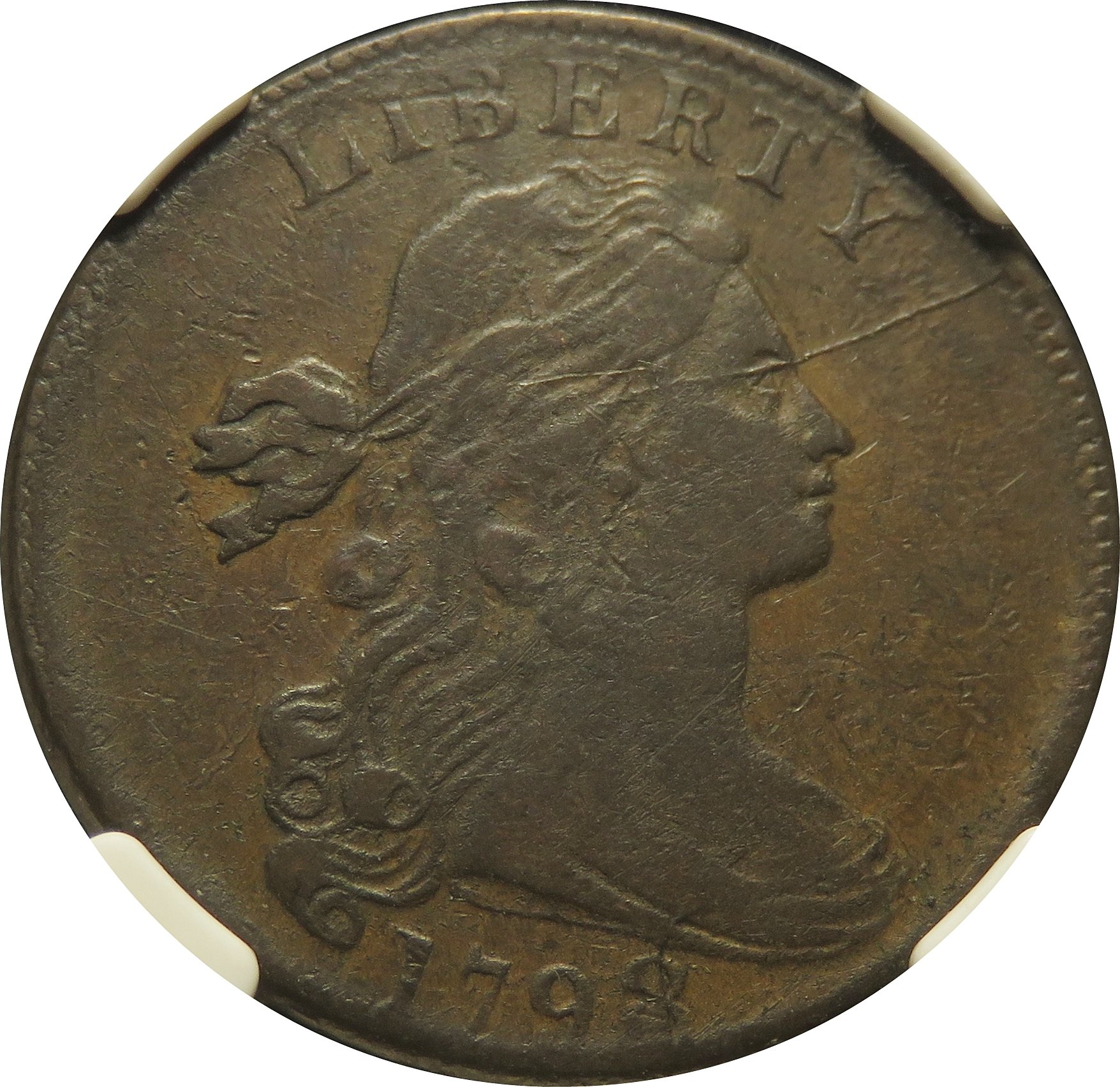
Colonial and Continental Currency Collector.
1
Comments
Nice S-167, and great photos!
The reference manual lists them as die chips, that appear in Die State II, and continue through Die State VI. They run in a line above the O in ONE, through the E in STATES, as you can see in your example. I believe yours is a Die State III example.
Ahh, die chips..never heard of that, but thanks for the great info on the die state and the pic compliments. It took a few tries and and few IPA's to get it just right!
The other word they used was 'scaling' - which I had never heard before - perhaps Captain Henway or someone can tell us where that word came from.
It's also an R-1 for the variety, but certainly those die breaks and nice planchet add greatly to the overall appeal.
I don't want to be a "Donny Downer", but what about the recessed area between "S" and "O" in the OP first and second image? Those are not die chips touching the "S".
BST transactions: dbldie55, jayPem, 78saen, UltraHighRelief, nibanny, liefgold, FallGuy, lkeigwin, mbogoman, Sandman70gt, keets, joeykoins, ianrussell (@GC), EagleEye, ThePennyLady, GRANDAM, Ilikecolor, Gluggo, okiedude, Voyageur, LJenkins11, fastfreddie, ms70, pursuitofliberty, ZoidMeister,Coin Finder, GotTheBug, edwardjulio, Coinnmore, Nickpatton, Namvet69,...
Part of the clash? Reference coin for the S-167 variety.
http://www.largecents.net/collection/coinpics/s167.jpg
Those look like minor pmd to me.
I am inclined to agree. Looks more like pre-strike damage to the planchet. Note also the IB of LIBERTY on the obverse. That looks like a planchet ding.
Those do look like damage... the central rectangular shape could be 'scale'...Cheers, RickO
Ok, I thought the OP was referring to the raised area through the top of the wreath below the S and O, not the concave pi symbol between the S and the O. That looks like damage, pre or post mint, I can't tell.
Thanks for all of the input! Now I need a 1/2 cent to keep her company.