1936 to 1942 Lincoln Cent Proofs
 OldIndianNutKase
Posts: 2,717 ✭✭✭✭✭
I have found Roger Burdette's book on 1936 to 1942 Proof Coins to be a very valuable book if you collect proof coins in this time frame. His statistical population analysis for Lincoln cents only addressed numerical grade and was not inclusive of BN/RB/RD grades. I have begun a collection of BN and RB Lincoln proofs 1936 to 1942 and have noticed most of the population is RD. But BN and RB coins did not seem to exist in higher grades as I have found with IHC proof coins.
Using Roger's format I constructed a Pop/Grade report based upon only PCGS population:
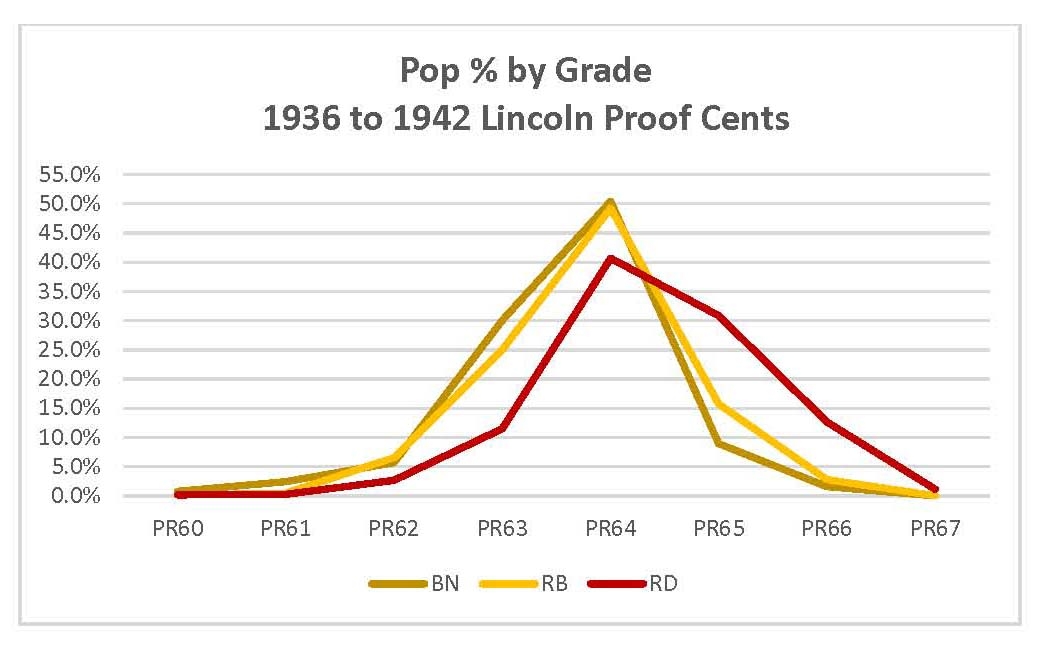
I find that 1936-1942 Lincoln Cent proofs receive significantly higher numerical grades if they are graded RD than if they are graded RB or BN. Typically RD coins are graded 64 to 66 while toned coins are graded 63-65. Do you think that this indicates a bias on the part of TPG's to give higher numerical grades to RD coins? And when RD coins already are given a higher status, should they also receive higher numerical grades?
OINK
Comments
Double dipping in the grading room? Perish the thought.
P.S. Plenty of those RD proofs are fake red. I have seen enough of them after they turned (frequently in slabs) and even been burned a couple of times.
RMR: 'Wer, wenn ich schriee, hörte mich denn aus der Engel Ordnungen?'
CJ: 'No one!' [Ain't no angels in the coin biz]
More of the RB and BN are cents with extra stuff like fingerprints or storage hairlines inducing colors.
The values (except for the 1936) are much lower compared to Indianhead cents, and many of the lower graded coins are not cost effective to even grade.
The collector mindset for the Proof cents from 1936 to the present seems to be "it's red or it's nothing" or perhaps no better than a filler. As a young collector in the 1960s I remember reading about "bad penny Proof sets." Any set that had a toned cent was dubbed to be a "bad penny Proof," and therefore shunned. There can be little doubt a fair number of the red coins have received some chemical help, but the modern storage devices have had an influence too.
Starting in 1936 the coins were shipped in celluloid sleeves. Many coins were stored in those for a long period of time usually out of the light. The introduction of Lucite and other forms of plastic holders in the 1950s furthered the cause for red copper coin preservation.
Early Proof coins were shipped and stored in tissue paper which contained sulfur. That toned the coins. A few pieces were stored in coin cabinets which were velvet lined and subject to chemical exposure. All of those factors worked against the preservation of the red color. The bottom line is Brown and R&B Proof cents are far more acceptable because original red cents are in short supply.
OldIndianNutKase,
Interesting table. I deliberately avoided all the subdivisions.... Hope you are enjoying the book!
Interesting stuff. Thanks for posting. I'm a big fan of the '36 T1 (satin) Lincoln proofs. If you charted those, I think you'd see the RBs are a higher % and there are more BNs as a % of slabbed for that type/year. This is most likely a result of the "matte-like" finish vs. the T2 brilliant (shiny) finish.
https://pcgs.com/setregistry/showcase/2819
For 1936 Type 1 PCGS graded 27 coins BN (6.2%), 188 RB (43.1%), and 221 RD (50.7%). From Type 2 onward BN was less than 1% and RB was typically 10-21%. Very difficult to put together a nicely toned set, as I am finding out.