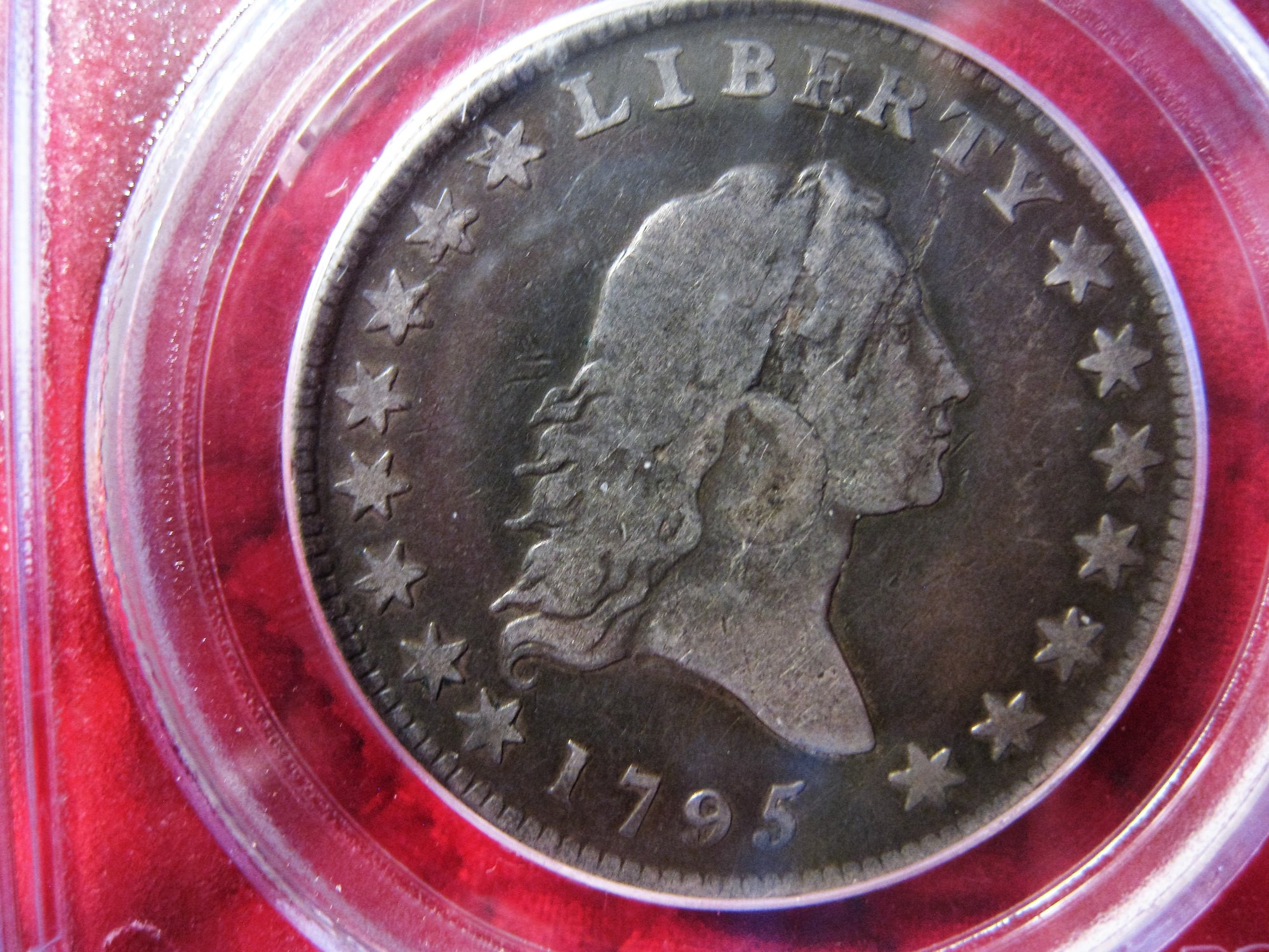
1795 silver center dollar enigma
 craZ4coins
Posts: 81 ✭
craZ4coins
Posts: 81 ✭
There are many storied coins that are a breed apart from the routine and somewhat hard to explain.
One of my favorites is the 1795 silver plug dollar. It existed over 150 years before being discovered and still is an enigmatic coin.
I'm not sure I buy into the underweight planchet, drilled in the center, plugged and struck theory.
One fact that belies this theory is that some of the coins have adjustment marks because the planchets were overweight and filed to remove some metal. It the generally accepted theory is valid, then these must have been waaaay over-adjusted to the point of being underweight.
The mint was on a learning curve in the late 1700s and a silver center dollar with adjustment marks may have been the result of trial and error, mostly error.
I hope there are some knowledgeable experts out there that can comment on this enigmatic coin.
Comments
Oops - - the title should read silver plug dollar.
To err is human.
I would like to see more than theory as well.. though I am not sure any real factual information exists... Roger would likely know more on this topic. Cheers, RickO
I don't believe any original documentation is known, so we have to speculate and take the most plausible explanation.
Why would they have to be 'over adjusted' before the plug? Makes more sense to add a slightly overweight plug and THEN adjust them to perfection
..... Interesting comment TDN.
So you buy in to the theory. You then assume that the adjustment marked pieces were underweight and were over-corrected by plugging and thereafter subjected to weight reduction adjustment by filing.
Plausible, but have you ever seen one with adjustment marks on the plug which would tend to validate your theory?
The basic theory is counterintuitive inasmuch as it belies the alternative of simply tossing the underweight planchet into the melting pot and starting over.
As you know, the so-called "first US dollar" and another legendary high grade '94 are plugged. The other survivors, all from the same dies, are unplugged. What does that add to the mystery?
Yes, there DOES exist silver dollars with both central silver plugs and adjustment marks, where the adjustment marks cross over the central silver plug. Obviously, the plug was put in place first!
"Simply tossing the underweight planchet in the melting pot" was not "simple" in those days. As you can tell from the preponderance of early coins showing adjustment marks, the early mint had a hard time making planchets of precise weight. Why would they risk melting down an otherwise usable planchet, just to end up with another likely underweight planchet???
Just the "first US dollar" has an undisputed central silver plug. I have personally examined ALL of the known silver-plugged dollars from XF grades on up to gem mint state pieces, along with quite a few of the lower grade pieces, so I do have experience in identifying the plugs. As you say, there is one other high grade 1794 dollar that has been described as having a silver plug, but I have examined that piece in hand very closely, and I disagree with the finding of a silver plug. Planchet surface irregularities and handling marks can readily be imagined into various recognizable shapes, and the raised relief of the central areas of the design invite those handling marks.
I'm not SURE, but think I owned one back in the 70's.
I didn't even know about them, but when I first read of them, it triggered a memory of one I had for a while that had a "strange" looking circle in it.
Again, maybe not. ???
Cardinal, you are THE MAN. Many thanks for your sage input.
I recall seeing images of a second 1794 dollar with a prominent plug and will try to locate and post. But who am I to question the expertise of the most prominent expert? Speaking of which, one of my 1794 dollars was added to the second edition of the book and I have been unable to locate a copy. Please PM if you know where I can obtain the second edition.
.....
I have heard that the silver plug dollars were "discovered" by coin doctors who were trying to tone or otherwise enhance the appearance of a 1795 dollar by applying heat. Imagine the look on their faces when the heat disclosed a prominent plug in the center of the coin?
Yah, I don't really see it
Does anyone have an estimate of silver plug populations on 1795 dollars? I don't think I've seen any, but I'm sure they exist amount early dollar enthusiasts.
TD
Let's shade in the areas the cataloger had identified as the outlines of the roughly oval "plug":
Now, let's overlay the reverse on top of the obverse, and line up the clash marks:
The outlines of the "plug" don't line up at all, and the widest dimension of the "plug" on the obverse is under 6mm, when most of the actual silver plugs measure out at 8mm diameter.
ain't no plug there IMO.
If the theory is that the plugs were designed to make up for the planchets being underweight doesn't it seem logical that the silver content of the plugs may have been higher than the rest of the coin? If all they had done was remove some of the silver and then replace it with more of the same the weight would have been the same.
Has this ever been checked? How would one go about doing such a check without damaging the coin?
Metallurgical analyses have been made of the plugs and the host coins, and found the silver content to be consistent between the coin and the separate plug. (Jules Reiver was the first to have that done on early silver dollars -- something he told me during the 1998 ANA convention.) This just makes sense. Since the early mint had such trouble just producing decent planchets to strike, how much more effort would it have been for them to create an entirely different run of metal with precisely the amount of "extra" silver content needed to fix the problem?
The History Channel has shown a documentary of the inner working of the Canadian Mint. (It's dated now, as it came out in 2007, when the Canadian Mint was in the headlines for producing the world's largest gold coin - weighing in at 100kg!) By modern standards, it was rather easy for them to refine gold to .999 and .9999, but the lengths they needed to go to refine the gold to .99999 was truly astounding! Now think what was possible in the late 1700's!!
.....
I always thought that the premise was that mint inserted a plug that was larger and heavier than the silver it removed by punching or drilling (anyone know which technique was used?) a hole. Upon striking, the metal diffused.
My '95 silver plug seems to verity this theory since the plug appears to have been "flattened" into the host planchet.
BTW, methinks this is the highest and best use of this forum. We have some of the foremost experts in the field (author of this post excluded) weighing on a mystery that dates back over 220 years. It doesn't get any better than this.
This.
There are Mint documents, along with knowledge of machine processes and variation, that can indicate the probable scenario.
February 9, 1795 in Elias Boudinot's report to Congress while leading the Congressional Committee on the Mint, "The works consists of two rolling machines, one for hot and one for cold metal, worked by four horses, and require five hands constantly to attend them, while in operation...The rolling machines, for large coin, will roll from twelve to fifteen thousand ounces per day."
Mint Director Henry William De Saussure, October 27, 1795, just before his resignation, "Great delays were incurred in obtaining the heavy iron-work, particularly the rollers; and these were not always fit for use, when obtained. Those which are now in use almost being worn out, I have been striving to replace them with the fine Andover iron."
Britannica, 1889, Mint of the United States, "It is not possible to reduce the strips of metal [for coins] to perfectly uniform thickness in the rolling machine."
The rollers for the Mint were of very poor quality in 1794. There would have been considerable deflection in the rollers, and the bushings for the rollers were not close tolerance hardened tool steel. This was not six sigma quality, the variation in the strips would have been both higher and lower than thickness needed for accurate weight, requiring adjustment up and down. The drawing machine that equalized the strips lengthwise for the punch also had issues.
In 1794 the Mint did not have the office of the Melter and Refiner, 2/9/1795, "It has already been mentioned, as one cause of delay, the omission in the law, for the position of the melter and refiner."
The Mint had problems and delay with melting and refining in 1794. Intuitively, in current times, it would seem the best solution for an underweight planchet would be to throw it in the melting pot, however in 1794-95 this would not have been possible, for providing timely return to customers (depositors) of their coins. So, plugs were added to underweight blanks.
The Mint did not have an adequate size screw press in 1794 for dollars. They would have needed to perform one feasibility test of a trial planchet, to determine if the press was capable of pressing out adjustment marks to an adequate degree, and to determine if the plug would work. A unique silver blank, adjusted on both sides along with being plugged, would be needed for this trial planchet. Incidentally, the Mint did use copper die trials in 1794 to test the dies. There is also record of Chief Engraver Robert Scot having a reference set of coins, which could have included some early strikes.
For mintage of dollars, the adjustment marks and plugs enabled the Mint to work around inaccurate rolling machines in 1794 and 1795.
The whole subject of plugged coins has been of interest to me since I'm fortunate to own a plug dollar and a couple of plug half dollars. One which was the discovery half dollar around 2002. Metallurgical analysis of that coin showed plug and the host coin to be consistent as Cardinal mentioned.
The second1795 half
appears to have been plugged due to a planchet lamination that resulted in coin being underweight and then adjusted most likely due to then being overweight.
Wish I had kept a reference that I once read that stated the practice of plugging underweight planchets was not started in the US mint was done in some of the South American mints prior to the US mint
That crusty irregular part of the plug alongside her cheek is the evidence of "flattening" mentioned in my prior post.
It's amazing that it was MORE costly to just toss and start on a new planchet.
I wonder what a "plug banger-inner" was paid?
Excellent thread... interesting history involving early mint processes. Cheers, RickO
Is there a census on the number of 1795 half dollars with a mint installed silver plug?
A newly discovered plug half sold at a Stack's Auction about a year ago which was the first example to sell at auction. It's felt to bring the number to five perhaps six known examples.
That coin was the first and only plug half to have been recently graded at NGC while only two others have been graded at PCGS over 12 years ago. None are high grade
Estimates of plug dollars that I've seen have run from 60 to 120. That's a question best asked of Cardinal who has examined many plug dollars and perhaps some of the halves.
In 1795, some of the adjusters and their daily pay:
Rachel Summers 50 cents per day
Sarah Waldrake .50
Henry Voigt, Jr. .88
Lewis Bitting $1.20
Lawrence Ford $1.20
John Cope, Chief Adjuster $1.60
Lewis Laurengen, "Puncher," would also have been involved @ $1.20 per day, to punch the holes in the planchets.
The small plug in the flowing hair dollars and half dollars would be effective at increasing the weight. In silversmithing, I was taught to planish the edges of hollowware to thicken the edge and prevent cracking, which actually thickens the sterling inward as much as half an inch. The plugs would have the same effect, during the strike the oversized plug would force the hole larger, thickening the area outside the hole, and spreading out with the slightly convex dies. The plug would not be fused, but would be a very tight rivet force fit that would not fall out after the work hardening of the strike.
Boudinot also stated 2/9/1795, "Great delays have also taken place for want of a refiner and melter." To avoid these "great delays" it was much quicker to punch and fill, than to re-melt, refine, assay, roll, anneal, draw, adjust - with the chance an underweight planchet could happen again. The Mint knew that nobody would notice, and they were right for 150+ years. The artisans at the Mint were very ingenious.
The Congressional Act of March 3, 1795 established the Office of the Melter and Refiner, and when they developed processes there was no need for the plugs, the gold $5 coinage of July 31, 1795 did not have plugs. There was still a need for adjusting overweight planchets for the next ~100 years, as rolling machines still could not hold required tolerances, but underweight silver and gold planchets were melted after late 1795. Adjusting was eventually done around the rim, eliminating the unsightly adjustment marks.
Great post Nysoto.
When I view these plugs I can't help thinking about the silver center cents.
My 1866 Philly Mint Set
Thanks Nysoto - very interesting read and timeline.