Interesting gold dollar situation - 1858-59
 RogerB
Posts: 9,039 ✭✭✭✭✭
In 1858-1859 gold dollars were not welcome in New Orleans. The full-weight, legal tender pieces conflicted with locally issued private banknotes and the banks gave preference to their own paper currency. The coins were also time consuming to count. with double eagles being preferred for settlements and Customhouse payments.
The following excerpt is from a letter by mint director Snowden recommending that no gold dollars be sent to New Orleans.
January 11, 1859
The discrediting of this [gold dollar] coin by the banks is one of the faults of our [present] banking system. Whenever small notes are issued or circulated, the efforts of the banks are directed against the circulation of such of the coins of the United States as conflict with their notes. And I am sorry to say that government officers are very much disposed to avoid the labor of counting small coins, and hence to encourage the use of the double eagle only because it suits their personal convenience best.
At New York both these causes have led to the accumulation of a large amount of gold dollars in the Assistant Treasury.
Comments
That is amazing that anybody would prefer speculative paper dollars to good gold dollars.
Which reminds me of an old question I have been thinking about for decades. When I worked at various coin shops in the Chicago area, I had numerous customers over the years refer to standard silver dollars as "bo dollars," as in "Do you buy bo dollars?" or the like. The people using this term were almost exclusively older black people, many of whom migrated to Chicago, or their parents did, up from the lower Mississippi Valley decades earlier. Think of the train "The City of New Orleans" moving back and forth on the Illinois Central Gulf Railroad.
I do NOT know if "bo" is spelled "bo" or "bow" or "beau." I often asked, and received various answers. Some people said that they did not know how it was spelled, as it was just an oral tradition that they heard from their parents.
I have speculated that it might be the cajun french "beau" as in good, and that during or after the Civil War a standard silver dollar might have been "Beau" or "good" whereas a private or Confederate paper dollar was worthless. I know of no equivalent term for a gold dollar as opposed to a silver dollar.
Any thoughts? Every seen any references to the term "bo dollar?"
And FWIW, a couple of time when I was working at coin shows on the East Cast and was purchasing coin collections from older black customers that included silver dollars I asked them if they were familiar with the term "bo dollar," and they never were.
TD
dare.wisc.edu/words/quarterly-updates/QU3/beau-dollar
Above from a Google search....
Kind of a scattered page, with thoughts and ideas more than a single answer. If I can interpret it correctly, it's a list of references to the terms use over time in literature, etc?.....but you aren't crazy!
Added:
https://en.wikipedia.org/wiki/Beau_Dollar
Also a soul singer, (William Hargis Bowman, Jr., b. 1941), though one would surmise his name was derived from the term for a dollar, rather than the dollar getting it's name from him...
Interesting numismatic tidbits like this are always fun to read about... Thanks... Cheers, RickO
Thanks for the excellent information!
I too had people asking me if I bought 'Bo' dollars. This was back in the seventies. I didn't understand what they were talking about until one day.......I bought a lot of silver dollars from someone. While sorting them out, I found one with a decal on it. The decal said something about a 'Bo' dollar and it was from 'Bo' whiskey.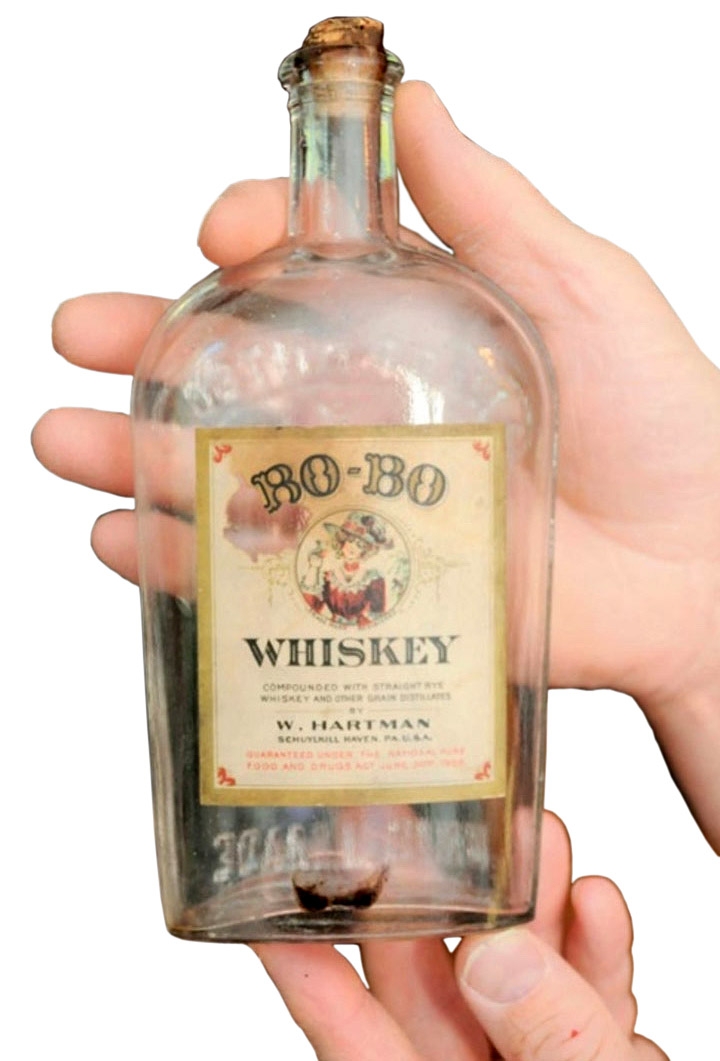
Maybe this stuff......I thought that had solved the riddle. Now, 40 years later, I'm not so sure.....
beau dollar
Word Origin
noun, South Midland and Southern U.S. Older Use.
1.
a silver dollar.
Origin of beau dollar Expand
beau perhaps to be identified with beau, but sense is uncertain
Dictionary.com Unabridged
Based on the Random House Dictionary, © Random House, Inc. 2016.
I can understand this. The coins are super small and hard to count. Larger coins could be counted like poker chips - just stack them and the height would give the count, or on a counting board. Gold dollars can't be counted like that. Also, when given the choice of sound money or a paper currency based on the sound money, consumers usually go with the paper. The problem arises when they get a whiff of trouble at the bank - then they want specie. In the early 1900's people would not usually have gold coins to spend. They could get them easy enough if required, so why lug them around. Easier to use paper based on the gold.
@RogerB Interesting look into everyday life back then.
I'd rather count paper money over a batch of tiny coins.
Give the Mint Director credit for basically saying "don't even bother......"
"If I say something in the woods and my wife isn't there to hear it.....am I still wrong?"
My Washington Quarter Registry set...in progress
interesting
One reason why it was hard to count gold dollars was that you had coins of two different diameters and thicknesses in circulation, so that stacks of random coins could be two different heights.
I would accept a stack of them if nobody else wants them.
My YouTube Channel
A minor side note: Gold dollars are the first US coins described in US Mint documents as being put into paper rolls for convenience of handling. Each roll had 100 pieces, but nothing was mentioned about allowing for the different diameters.
Roger,
What was the year?
Was that only for distribution of new coin, or did banks re-wrap rolls for sale to customers?
It was a US Mint document, but I don't recall the date. I'll look it up. I don't recall anything about the actions of banks.