Bust Quarter, 1815 "L" B-1 --- NGC MS65.

I expect that some members have seen these and quite probably own or have owned one or more. Can anyone provide pictures or information about the coins and perhaps some better reasoning as to what the meaning of the letters might be?? Thanks in advance.
Al H.
Comments
-
thanks for the link.
Current speculation is that the Economite religious community in Pennsylvania counterstruck these pieces as a voting measure.
I am no expert but from what little research I have done since first seeing the coin it seems clear that the stamp was probably done at the Mint. with counterstamps I have seen and owned there is always some distortion on the opposite side of the stamp. the coin I saw and the pictures of others I have seen show no distortion and all the MS examples don't show any signs of handling. for an outside source to have done this they would first have had to obtain a supply of gem coins from small mintages and then stamp them without affecting the coin in any negative way.1 -
I owned this one for about ten years while waiting in vain for PCGS
to recognize them in the same way that they recognize chopmarked Trade Dollars now.
So I sold it to CRO. PCGS still refuses to grade them.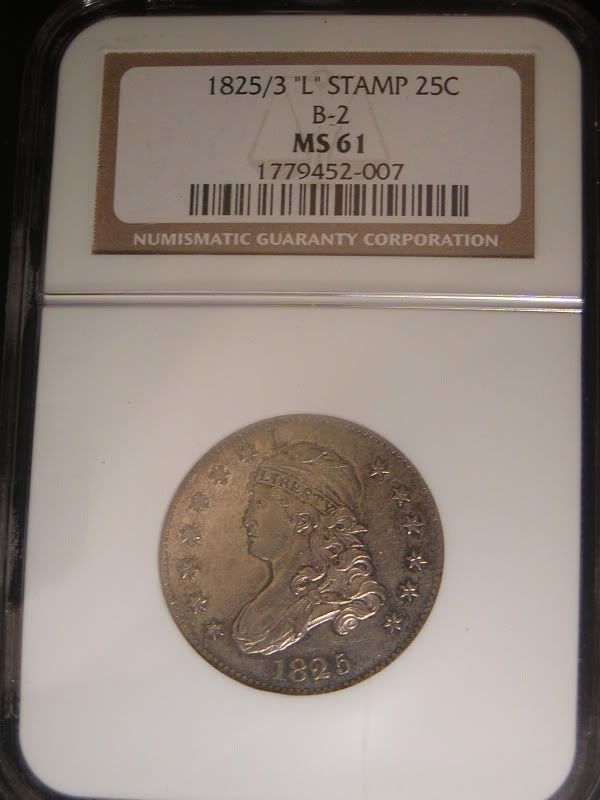
"Everything is on its way to somewhere. Everything." - George Malley, Phenomenon
http://www.american-legacy-coins.com0 -
From a different Heritage auction:
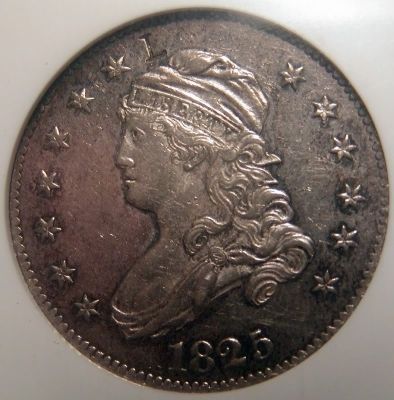
Certain 1815 and 1825/3 Capped Bust quarters display E and L countermarks about the upper obverse rim. The meaning of these countermarks is not known for sure, but Karl Moulton, who has been studying these pieces for quite some time, asserts that the first example, an 1815, appeared in Captain John W. Haseltine's December 12, 1881 sale. Although these pieces were absent from earlier numismatic circles, they suddenly flooded auctions throughout 1882 and 1883. Moulton believes that the death of William DuBois in July 1881 may be connected to the sudden appearance of these pieces. DuBois had served as Assayer at the Philadelphia Mint and also as curator of the Mint Collection. It is possible that the countermarked 1815 and 1825/3 quarters were dispersed to prominent dealers following DuBois' death. The high grade of these pieces, coupled with the fact that other numismatic rarities such as the 1804 silver dollars surfaced at this time, seems to support Moulton's theory.
The circumstances surrounding the production of these pieces is still cause for debate. It is obvious that the E and L counterstamps were added to the coins sometime after striking. Whether or not the letters were impressed at the Mint is not known. All of the countermarked 1825 quarters are of the 1825/3 B-2 die variety. Some authors claim that these countermarked coins served as weight standards at the Philadelphia Mint. Breen, among others, asserts that the letters were added to denote English and Latin, respectively. He believes that the coins were then distributed to students at local schools as awards for contests. Mark Hotz claims that these letters were impressed to indicate adjustments to the screw presses. The countermarked coins were then released into circulation, thus enabling the Mint to trace wear patterns and see which press adjustment produced the best coins.0 -
'deuce, PCGS is probably erring on the side of caution until further study comes up with something aside from random speculation. given what the luminaries of the Hobby have come up with so far I wouldn't hold my breath. absent either some Mint records or estate manuscript from long ago I think this will go down as a piece of Numismatic Legend or Folklore, depending on perspective. with that in mind I consider the coin(s) speculative at best and meant for a specialist Quarter collector. the example shown to us had been offered at a recent Baltimore show with an asking price of mid-five figures and the owner rejected it, modestly ahead of the PCGS guide price for a regular coin.
when you tried to have it encapsulated by PCGS did they consider it an "unrecognized variety" or a damaged coin due to the counterstamp??0 -
PCGS would probably give it a "details" for being conterstamped. It would be cool to hear/read its meaning of the "L" stamp.oih82w8 = Oh I Hate To Wait _defectus patientia_aka...Dr. Defecto - Curator of RMO's
BST transactions: dbldie55, jayPem, 78saen, UltraHighRelief, nibanny, liefgold, FallGuy, lkeigwin, mbogoman, Sandman70gt, keets, joeykoins, ianrussell (@GC), EagleEye, ThePennyLady, GRANDAM, Ilikecolor, Gluggo, okiedude, Voyageur, LJenkins11, fastfreddie, ms70, pursuitofliberty, ZoidMeister,Coin Finder, GotTheBug, edwardjulio, Coinnmore, Nickpatton, Namvet69,...0 -
part of what had been speculated was three stamped letters, E-R-L, which was supposed to correlate to the weights of the coins. no "R" stamped coins have ever surfaced and most of the coins tended to weigh the same so that theory was scrapped as most others have.0
-
One of my favorite numismatic mysteries! Steve Tompkins' book on Bust quarters provides detailed information on this issue, and hopefully he will post to this thread. Karl Moulton has also done extensive research on this issue, and there's a section of his book on Voigt that presents his thoughts on the matter.
Of all of the theories put forth over the years about this truly enigmatic issue, I have always been a proponent of the Economite concept. There was a great write up about this in the late 1990s (I think) in the JR Journal (JRCS). I cannot remember the author's name, but it was a well written piece that made a good argument for the Economite theory.
I have owned several over the years, including back in the day when they were not popular and often considered damaged goods. It has been over 10 years since I have handled one.1 -
Dennis, have the coins you've seen or owned shown signs of distortion opposite the stamped letter?? this single point makes me believe they were done at the Mint where it would have been possible to use a reverse die to support the coin when it was being counterstamped. also, the size and shape of the letters matches closely the letters used on the coins themselves which suggests they were done with Mint punches. I suppose that the religious group may have had access to the Mint but isn't it more likely that it had to do with something internal??0
-
Dennis, have the coins you've seen or owned shown signs of distortion opposite the stamped letter??
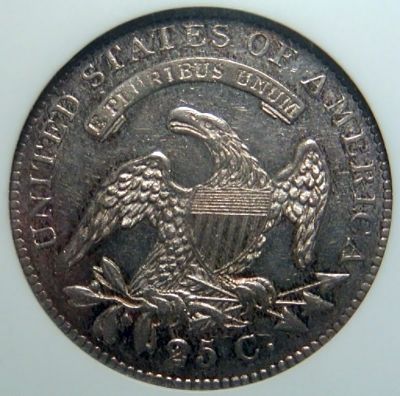
We actually studied this point, and were curious why there was little to no distortion on the reverse in the area of the stamp. It appeared that the coins were counterstamped while in a die or fixture. However, there are examples extant that show reverse distortion, further complicating the mystery.0 -
Yes, I read about these in the Bowers Treasures & Hoards book.
But... MS65? Cool.Collector since 1976. On the CU forums here since 2001.
0 -
Thanks for the discussion; I bought two 1825 "L" counterstamped quarters that were around EF gradewise around 6 years ago from a small NH dealer. I would think an exhaustive analysis of the origin, condition, and other records connected to the quarters would help get to the bottom of the mystery. And with Breen's and others' theory that they were part of gift tokens in a language class, that is a stretch as far as I can see; for example, were counterstamps so commonly used of such quality indented into coins, with only two years represented in the gift Bust quarters?
0 -
People have been studying these for decades but nothing conclusive has been found about "why" the counterstamps were placed.
1 -
Those interested in reading ALL the theories that have been put forth in the John Reich Journal are invited to go to the Newman Numismatic Portal and read the articles that have appeared in the journal over the years.
Many theories have been put forward but ALL of them have significant holes. I agree that the truth may, and probably will never be known, but that does not make them any less collectible and interesting.
Have at it boys and girls, maybe one of you will be the one to discover the truth!
Q: When does a collector become a numismatist?
A: The year they spend more on their library than their coin collection.
A numismatist is judged more on the content of their library than the content of their cabinet.0 -
This content has been removed.
-
@afford said:
I am afraid the truth will just never be known about these and speculation will always rule.
So in the end they are counterstamped coins and that should be that anything else would be akin to making them more dramatic for increase in valuation.The unique thing about these coins is that they LIKELY were counterstamped at the mint while resting in the reverse die. This is evidenced by the lack of distortion on the reverse of the pieces. The counterstamps match even though the dates on the coins are a decade different and most of the host coins are AU or better, unlike most other counterstamped coins.
A little more interesting than other coins with single letter counterstamps, EH?
Q: When does a collector become a numismatist?
A: The year they spend more on their library than their coin collection.
A numismatist is judged more on the content of their library than the content of their cabinet.1 -
There is nothing among the extensive records of George Rapp or the Harmony Society (English or German) that offers any suggestion of the E and L quarters originating with the society or its members.
1 -
This subject comes up about every two years - on average - and despite the interest, we seem to be no closer to conclusive facts. One would think that somewhere, someone must have documented these coins... the stamped letters are well done...little to no reverse effects are seen.... Obviously done with intent and care. I keep hoping that someone will discover a long lost document discussing their origin. Cheers, RickO
0




Leave a Comment
Categories
- All Categories
- 520.1K Coins and Currency - PCGS
- 328.6K U.S. Coin Forum
- 14.8K PCGS Set Registry Forum
- 5.2K Q & A Forum
- 41.4K World & Ancient Coins Forum
- 3K U.S. & World Currency Forum
- 96.4K Buy, Sell, & Trade - U.S. Coins
- 7.3K Buy, Sell & Trade - World & Ancient Coins
- 1.5K Buy, Sell & Trade - Currency
- 61 Random
- 246.2K Trading Cards, Autographs and Memorabilia - PSA
- 90.3K Trading Cards & Memorabilia Forum
- 1.7K Autographs Forum
- 16.4K PSA Set Registry Forum
- 22K Sports Talk
- 115K Buy, Sell & Trade - Cards & Memorabilia
- 663 Buy, Sell & Trade - Autographs
- 2.2K Stamps
- 1.5K Stamps Forum
- 670 Buy, Sell & Trade - Stamps
- 83 Coin Shows
- 83 General Coin Show Information and Discussion
- 11.9K Misc
- 11.9K Testing Forum