Options
Question about 1884 Austria 2 Florin
 coinpictures
Posts: 5,345 ✭✭✭
coinpictures
Posts: 5,345 ✭✭✭
It's been quite a while since I did anything with darkside coins. My local shop owner retired in December and the new owner brought in some world material, including a piece that after doing a double-take, I gave close scrutiny and then purchased this afternoon.
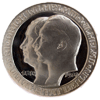
Austria 2-Florin
1884
KM 2233
Mintage: 87,000 (the entire series is VERY low mintage, all things considered)
This coin is in an NGC holder, graded MS62 PL.
Krause does not list any proofs for the date or series, but if I had seen this coin raw, I would have bet my paycheck it is a proof. Cameo frost on devices, full mirrored fields. The lettering has fully squared off edges and there is absolutely no mushiness in the beaded border. Both sides are completely hammered; no strike variance at all.
It just looks too good for a circulation strike of that era.
If not proofs, were there any presentation stikes made? Any modern restrikes?
I haven't had a chance to image it (and I suck at shooting proofs anyway)...
EDIT: According to the NGC pop report, there have been 2 PLs slabbed across the entire series, both dated 1884. This one in 62 and one in 66. If memory serves, unless PCGS has changed their policies, they don't give the PL designation on world coins.
Austria 2-Florin
1884
KM 2233
Mintage: 87,000 (the entire series is VERY low mintage, all things considered)
This coin is in an NGC holder, graded MS62 PL.
Krause does not list any proofs for the date or series, but if I had seen this coin raw, I would have bet my paycheck it is a proof. Cameo frost on devices, full mirrored fields. The lettering has fully squared off edges and there is absolutely no mushiness in the beaded border. Both sides are completely hammered; no strike variance at all.
It just looks too good for a circulation strike of that era.
If not proofs, were there any presentation stikes made? Any modern restrikes?
I haven't had a chance to image it (and I suck at shooting proofs anyway)...
EDIT: According to the NGC pop report, there have been 2 PLs slabbed across the entire series, both dated 1884. This one in 62 and one in 66. If memory serves, unless PCGS has changed their policies, they don't give the PL designation on world coins.

0
Comments
TalerUniverse.com is a curated numismatic project dedicated to the silver talers, crowns, and medals of the Habsburg Empire and the Holy Roman Empire, spanning the 16th–18th centuries. The collection emphasizes historically significant issues, rare mint varieties, and high-grade NGC/PCGS examples, presented with detailed historical context, scholarly references, and high-resolution photography. TalerUniverse aims to serve both as a private collection showcase and a growing reference resource for collectors, researchers, and students of early-modern European coinage.
Is yours a circulated grade or MS? Two major differences I can see right off the bat on mine are that the hair details on the bust and the crown and feathers on the eagle are much more sharply chiseled on my example.
Thanks.
1/2 Cents
U.S. Revenue Stamps
TalerUniverse.com is a curated numismatic project dedicated to the silver talers, crowns, and medals of the Habsburg Empire and the Holy Roman Empire, spanning the 16th–18th centuries. The collection emphasizes historically significant issues, rare mint varieties, and high-grade NGC/PCGS examples, presented with detailed historical context, scholarly references, and high-resolution photography. TalerUniverse aims to serve both as a private collection showcase and a growing reference resource for collectors, researchers, and students of early-modern European coinage.
EDIT: Took a few more...
1/2 Cents
U.S. Revenue Stamps
TalerUniverse.com is a curated numismatic project dedicated to the silver talers, crowns, and medals of the Habsburg Empire and the Holy Roman Empire, spanning the 16th–18th centuries. The collection emphasizes historically significant issues, rare mint varieties, and high-grade NGC/PCGS examples, presented with detailed historical context, scholarly references, and high-resolution photography. TalerUniverse aims to serve both as a private collection showcase and a growing reference resource for collectors, researchers, and students of early-modern European coinage.
World Collection
British Collection
German States Collection
<< <i>I think there is still a lot of disagreement on several 19th C. European issues about being proofs or not. And the strike on that one sure fits in the category, very strong coin. >>
Agreed. It looks like an impaired proof (unsure how it can be 62 of any designation).
How does one get a hater to stop hating?
I can be reached at evillageprowler@gmail.com
<< <i>Agreed. It looks like an impaired proof (unsure how it can be 62 of any designation). >>
The hits are magnified by the lighting and the resolution; it looks nicer in hand. Also, the designation "impaired proof" is usually reserved for proofs that show signs of wear, i.e., PF55. There are no signs of wear whatsoever. Hits yes, wear no.
P.S. A lot of what you are seeing in the fields are die polish lines.
1/2 Cents
U.S. Revenue Stamps
Franz Joseph Proof 2 Florins 1870-A PR66 Cameo NGC, KM2232. Vienna, (A), mint. Lightly toned with superb reflectivity. Very rare in Proof quality.
TalerUniverse.com is a curated numismatic project dedicated to the silver talers, crowns, and medals of the Habsburg Empire and the Holy Roman Empire, spanning the 16th–18th centuries. The collection emphasizes historically significant issues, rare mint varieties, and high-grade NGC/PCGS examples, presented with detailed historical context, scholarly references, and high-resolution photography. TalerUniverse aims to serve both as a private collection showcase and a growing reference resource for collectors, researchers, and students of early-modern European coinage.
1/2 Cents
U.S. Revenue Stamps
TalerUniverse.com is a curated numismatic project dedicated to the silver talers, crowns, and medals of the Habsburg Empire and the Holy Roman Empire, spanning the 16th–18th centuries. The collection emphasizes historically significant issues, rare mint varieties, and high-grade NGC/PCGS examples, presented with detailed historical context, scholarly references, and high-resolution photography. TalerUniverse aims to serve both as a private collection showcase and a growing reference resource for collectors, researchers, and students of early-modern European coinage.
Whereas PL is a descriptor of quality or characteristics that comes after a numeric MS grade, PF is a prefix and is designator of striking mechanics or process.
1/2 Cents
U.S. Revenue Stamps