Options
Colonial EYE CANDY---1688 AmPlant Transposed Shields arrives via USPS 6 Day Priority TM
 ambro51
Posts: 14,372 ✭✭✭✭✭
ambro51
Posts: 14,372 ✭✭✭✭✭
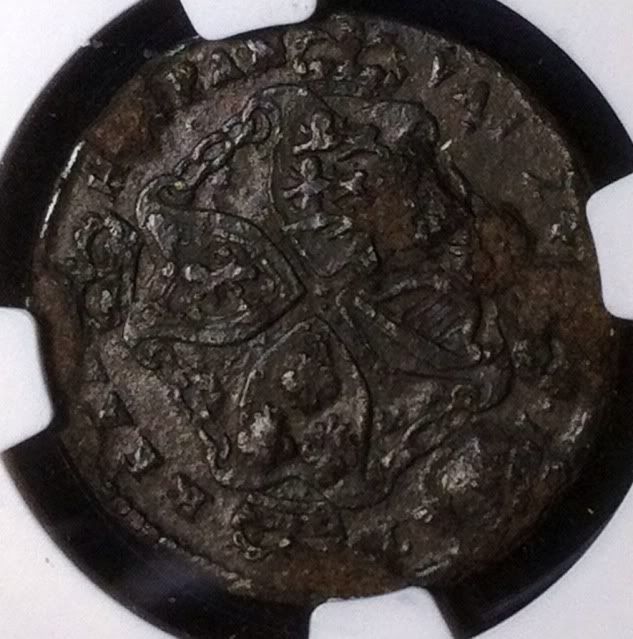
Good things take time. It took 6 days to arrive. 21 days from my bid to hammer. 6 Years since I first read about these coins........ And 325 Years for this coin to become what it is. It's hard to fathom, you know, when they speak of "8-12" known. You could hold them all in the palm of your hand. I love this kind of Rarity and indeed it IS what keeps my spark very much alive in this hobby. Curiosity, in this case the question of why this one reverse had the harp and Scottish shield transposed. How does that relate to the rarity? If has been said this variety has the reverse details cut deeply into the die. These facts suggest to me this may be the initial "pattern" design which was shortly changed. Obverse 2 is also used with the more 'common' B reverse. With 10 varieties it's obvious at one time a great mintage was planned. Unfortunate, things went quite sour for James II only 8 weeks after striking commenced on these pieces. Some dies were only used during this era, while others are known mostly from 1828 Restrikes, which are also R5 rarities. Anyway, my Cherrypick of the Decade, and what some (me included) think is Worthy of the "You Suck".... 1688 Holts American Plantations Token Newman 2-G Transposed Arms Breen knew of 6, Whitman reports 8-12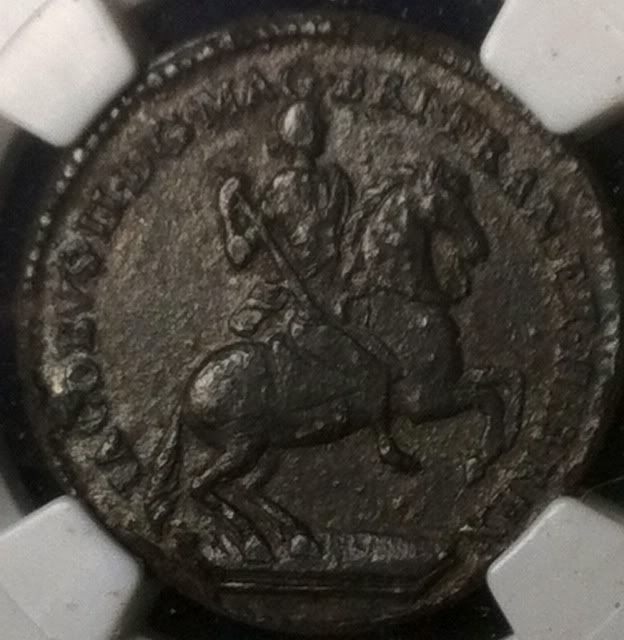 .
. 
. 0
Comments
Not really looking for much these days but if I were, it might be a toner.
Looks great. I recall that thread and, after checking, see I never got around to posting that I found the rim very impressive. Is "tin pest" the same as the "tin disease" and "tin plague" (from low temperature) seen in European cathedrals and thought to be the devils work, or is this something else? While reading about tin I see the word comes from the Latin, "stannum", which might sound better than "tin" in a description. "Struck in stannum, this luxe example..." - yeah, might sound better
Eric
<< <i>Tin was a poor choice for coins. Alloying it with about 3% lead, antimony or bismuth reduces the effect of tin pest. England had little copper. At this period, it needed to be purchased from the King of Sweden. England had Tin. In fact, James II owned the tin farms in Cornwall. In the end Tin failed miserably and £40000 pounds of the £65000 of tin farthings and halfpence were recalled and destroyed, replaced by copper >>
"...about 3% lead, antimony or bismuth..."
So it is the same. The surfaces are created at least partially by cold. Neat. Not for coins, but I always liked tin, old corrugated tin...reminds me of Jackson Pollock and Hiroshima shack photos in my collection (the photos, not the Pollock
Eric
I would be worried about having something that fragile forced into the prongs, or someday forced out of them.
<< <i>
<< <i>Tin was a poor choice for coins. Alloying it with about 3% lead, antimony or bismuth reduces the effect of tin pest. England had little copper. At this period, it needed to be purchased from the King of Sweden. England had Tin. In fact, James II owned the tin farms in Cornwall. In the end Tin failed miserably and £40000 pounds of the £65000 of tin farthings and halfpence were recalled and destroyed, replaced by copper >>
"...about 3% lead, antimony or bismuth..."
So it is the same. The surfaces are created at least partially by cold. Neat. Not for coins, but I always liked tin, old corrugated tin...reminds me of Jackson Pollock and Hiroshima shack photos in my collection (the photos, not the Pollock
Eric >>
I have relatives dating all the way back to Joseph of Arimathea whose wealth came from working in the tin mines of England. His wealth also provided a tomb for the crucified Lord Jesus Christ. And yes, I truly believe this.
Leo
The more qualities observed in a coin, the more desirable that coin becomes!
My Jefferson Nickel Collection
Successful BST deals with mustangt and jesbroken. Now EVERYTHING is for sale.
I have been off this site for a while. Too bad because there have been some real nice and rare coins that look like they have been shared recently, starting with this very very very cool and rare James II 1/24 Real "Transposed Shields". If you can track it down, Eric Newman wrote a great article about these coins in ANS Museum Notes XI in 1964. Also one in the Numismatist Vol. 68 #7, July 1955.
These coins are quite historic and a lot of facts have been posted already, but just a few more neat fun facts are that this is the first coin struck for the "Plantations" or Southern Colonies by England. Pretty cool that this was the very first coinage for the American Colonies.
Next, it is the only coinage ever issued by Great Britan denominated in something other than the British Pound. To this date, I believe this is true. When issuing them, there was great concern that they would be accepted as Tin currency received a pretty harsh reception in England and Ireland. The thought was, if denominated in Spanish Reals, they would be more recognizable and acceptable in a part of the world were Spanish silver was still the "coin of the realm".
You are also right that this is indeed the rarest of the "collectible" James II 1/24 Reals and is one of the original issues (the Newman 4-D and F-7 are R-8s and I have only seen two of each). But I think it is not as rare as you may have hoped for. I have notes on 11 examples. I have not tried to plate match yours to the ones I know of, but if it is new, that makes 12. I have been meaning to look more deeply into this and older catalogs, but my guess is a high R-6+. Say maybe 15 to 20. Interestingly, though most people think the related 2-G is the more common of the originals, I actually think it is on the rarer side and the HB Rex is a bit more common. It is just that the HB REX Newman 1-A is more collectible due to the legend blunder (HB REX instead HIB REX).
One more thing. The Transposed Shields Newman 2-Gs always come wretched. All with Tin Pest (yes from cold). And the highest grade I have seen is one EF, a few VFs and the rest Fine or worse.
Anyway, a great, historic interesting set to collect. In Newman's article he has all sorts of other great history and intrigue. Except for the R-8s, a doable set.
Great post...Thanks
nova caesarea
<< <i>Great post...Thanks >>
<< <i>nova caesarea >>
Great post right back atchya.
Very interesting info, especially about denomination.
"If I say something in the woods and my wife isn't there to hear it.....am I still wrong?"
My Washington Quarter Registry set...in progress
Mmmmm....on the pattern point, that is pretty hard to say. Out of the 10 varieties, 4 are errors so hard to say which error was first. And, out of all the original varieties, I guess I would say that the HB Rex and the Newman 2-B come the most sharply struck that I can recall. But it was a long time ago when these were made and who knows.
On the reference work, yes I think I have heard that to. But the guy working on it took over a decade to get his last book done, so I wouldn't hold my breath. But there may be some reference plates done with the 10 varieties in the not too distant future and published in CNL or the C 4 Newsletter.
Best,
nova caesarea
By the way, it is always hard to tell from pics, but your 2-G looks pretty nice as far 2-Gs go. And the pesting is not excessive for one of these. Did the seller/auction know what they had? Was there a slab grade. That is a great addition to your collection.
Best
nova caesarea