Options
Mint policy about returning old dies - Carson Mint , 1881. New letter added.
 RogerB
Posts: 8,852 ✭✭✭✭✭
RogerB
Posts: 8,852 ✭✭✭✭✭
The following letter might aid collectors interested in silver dollar varieties. It describes the Mint Bureau's policy for destruction of previous year's dies.
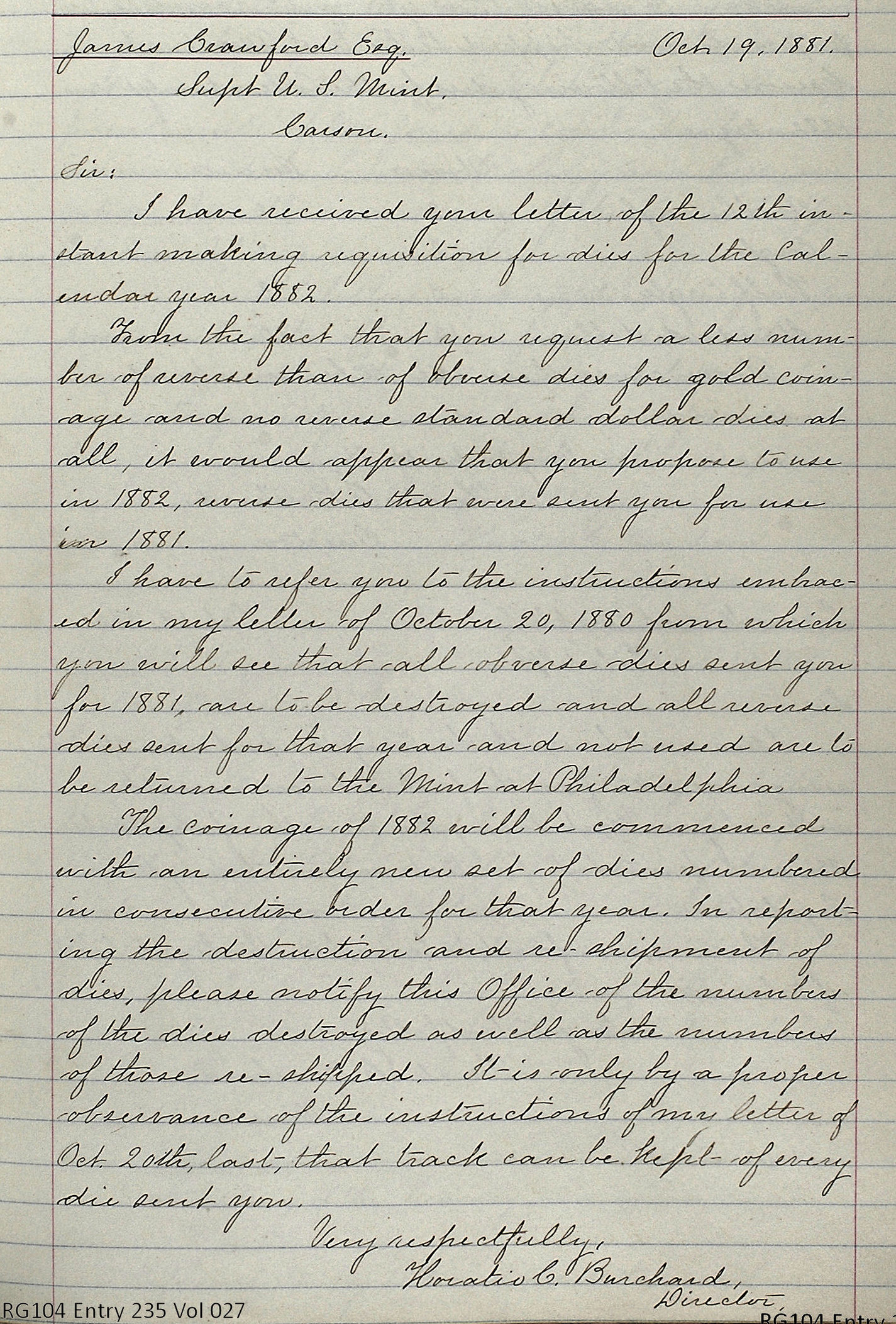
The letter is in a volume that had not been opened in at least 60 years.
See the end of this thread for a newly added letter explaining the Director's reason for having reverse dies returned.
5
Comments
So how did those 20c dies get buried at the Carson City Mint? Cannot remember but I think a dollar die was found also. Perhaps, stolen to be dug and used later?
Carson was allowed to destroy/deface old obverse dies. Used reverse dies could also be handled locally. But unused reverse dies were supposed to be returned to Philadelphia. The Engraver hen checked them, and if in good condition, they were renumbered and issued for the next year. The engraving department was trying to send like-numbered obverse and reverse dies to simplify local mint record keeping.
Only unused dies had to be returned is what I read.
Many dollar dies were found next to the mint building when excavation was done for an addition. These dies were all X cancelled by chisel.
bob:)
Interesting! Thanks for posting. We know of San Francisco dollar dies from 1878 that were used in both 1878 and 79, but I'm not aware of this happening for CC dollars. I also read that if a die was put into service at the end of the year, it could remain in service for the following year. A closer look at 81-CC and 82-CC might show what they actually did. I'll have to see when the 81-CC coins were made (or at least submitted to the Assay Commission) to see if there was coinage at the end of the year.
Keeper of the VAM Catalog • Professional Coin Imaging • Prime Number Set • World Coins in Early America • British Trade Dollars • Variety Attribution
Anyone interested in seeing the cancelled dies that were excavated near the wall of the Carson City mint, I took a picture of those there on display and posted it in the first post on the below linked thread. (The dies are pictured in the 9th photo of the first post on the thread.)
Anyone interested in "the rest of the story" regarding these dies go to the posts within the linked thread dated April 18, 2016 and January, 2017. AUandAG and Zoins provided some very interesting history regarding them.
https://forums.collectors.com/discussion/914924/remembering-the-pony-express-at-the-carson-city-mint-a-photo-essay
OK, here is my photo from the above linked thread. However you will need to go to the link to follow AUandAG and Zoins most interesting commentary as referenced above.
There’s a CC reverse die that was used for 73, 74, 75 and 76 trade dollars.
As more of the correspondence volumes are digitized, I suspect additional relevant information will turn up. Morgan dollar variety collectors might be especially interested.
Volumes 027 (10/18/1881 to 1/17/1882) and 028 (1/17/1882 to 4/25/1882) will soon be available on Newman Numismatic Portal (NNP).
Very interesting... I really enjoy these old letters. Really demonstrates the difference - in so many ways - of how business was conducted and materials controlled in those times compared to now. We live in a radically different world today..... Cheers, RickO
I expect it would be really easy for the VAM guys to prove CC reverse dies were used the following year as was done for many other coin types.
The letter's author Horatio C Burchard. (1825-1908)
My Early Large Cents
Actually the 1878 reverse was reused in 1880 (parallel arrow feather, small cc)
bob
Perhaps this use of the 1878 reverse in 1880 made the Philadelphia Mint want to check the CC Mint's entire stock of reverse dies to make sure that there were no more 1878 reverses sitting in the vault at the end of 1881. I can't think of any other logical reason for Philadelphia wanting to see undated reverses.
Nascent inventory control and attempts to further standardize dies, collars and other aspects of coining operations could explain handling of unused reverse dies.
As volumes are scanned back to 1878-1880, new insights might turn up. Also, some of these fair copy letters (sent) can be paired with original letters received. The volumes can help identify the date range of incoming letters. [This was how I discovered the citizen letter explaining the SL quarter's raised date and the mint's action for the next calendar year. (See CW article.) ]
PS: The black squiggle of Burchard's forehead is not a birthmark. It's lint that was on the glass plate when the photo was made.
Some misc fun stuff from the CC mint. Click for a closer view.
Lance.
Paging @Crypto. Care to comment? I bet we know only a fraction of the legwork that you've put into your Micro CC hunt/research. Still only two 75-CC Micro CC examples known?
About 8-10 years ago they sent me
a 20 Cent CC Reverse Die, and a
1876 20 Cent Obverse Die, but
they were both so corroded,
(especially the CC reverse die)
that it was impossible to determine
if they matched the struck coins, or
if they were 'unused', and trashed.
Based on what Roger said earlier,
it appears that they could be the dies
that struck the extremely rare
1876-CC Twenty Cent Pieces.
I have two lead impressions of the
dies - but they're not too impressive
looking, due to the bad corrosion of
the dies, from being buried so long.
Thanks to all supplying this info. Truly interesting. Unreal that so much drama occurred to what I would normally think of a as having a very stringent guideline of procedures for such an important event in our monetary system's manufacture. Wow.
Jim
When a man who is honestly mistaken hears the truth, he will either quit being mistaken or cease to be honest....Abraham Lincoln
Patriotism is supporting your country all the time, and your government when it deserves it.....Mark Twain
Maybe this letter will help:
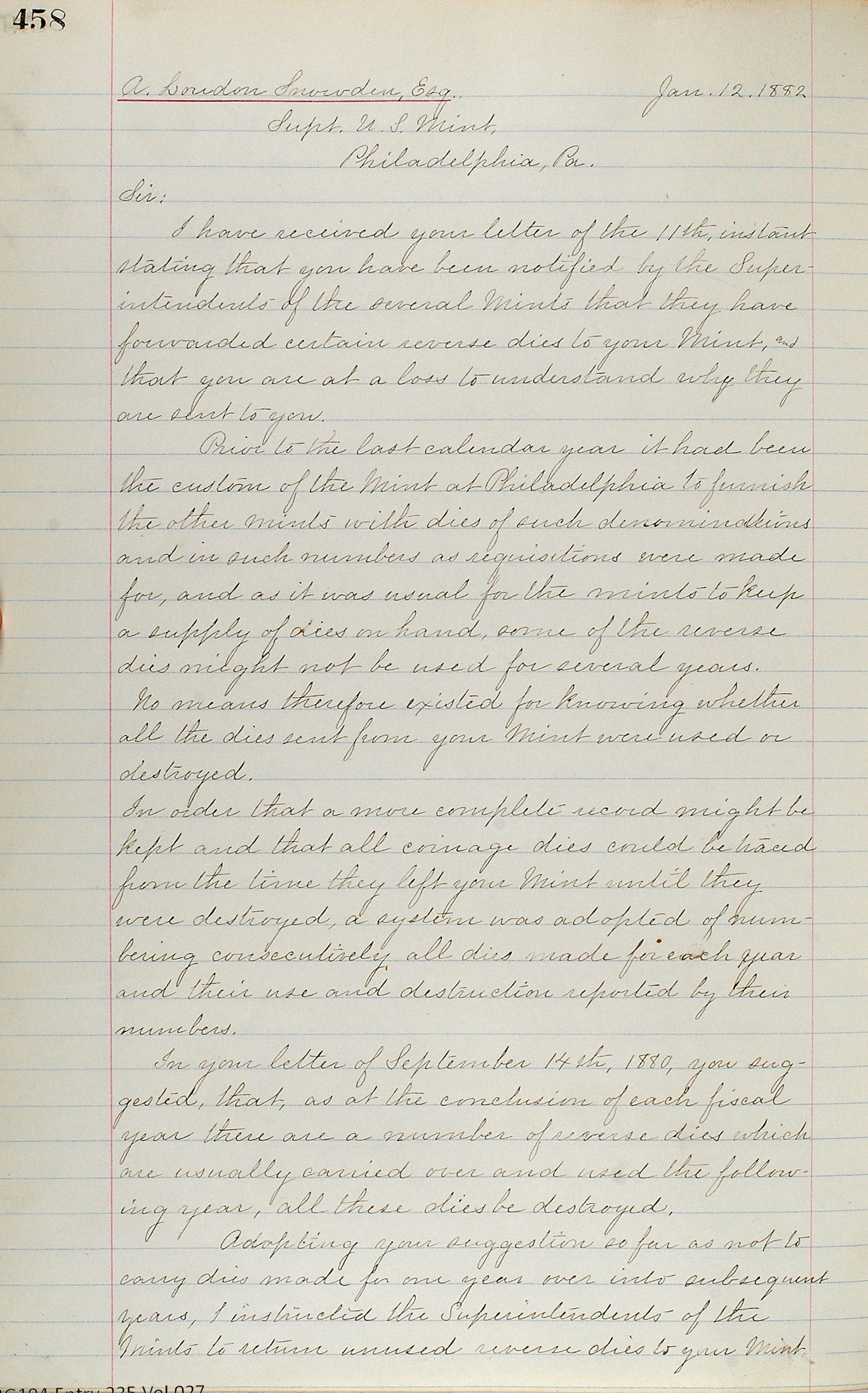
Bump for added information.
I am impressed with the quality of the penmanship on those letters. Is cursive writing even taught in schools today?
It is highly possible that the letter was dictated to a secretary whose job it was to have nice penmanship.
My Early Large Cents
The Director had a clerk assigned to him. This man took shorthand dictation and transcribed the final letter for delivery to the recipient. A different clerk - one paid less and sometimes a woman - entered letters into the fair copy journal just before they were mailed. A similar situation prevailed at the individual mints.
The Director rarely wrote a letter himself.