Foreign Substance

I recently purchased a very nice 1909 Barber Dime in AU condition with some sort of a foreign substance on the obverse. It appears white to the naked eye in an arcing fashion. Perhaps the foreign substance was deposited with another dime shielding the coin? Does anyone have an idea what the substance is? I tried an acetone and then a vinegar soak to remove it with no success,
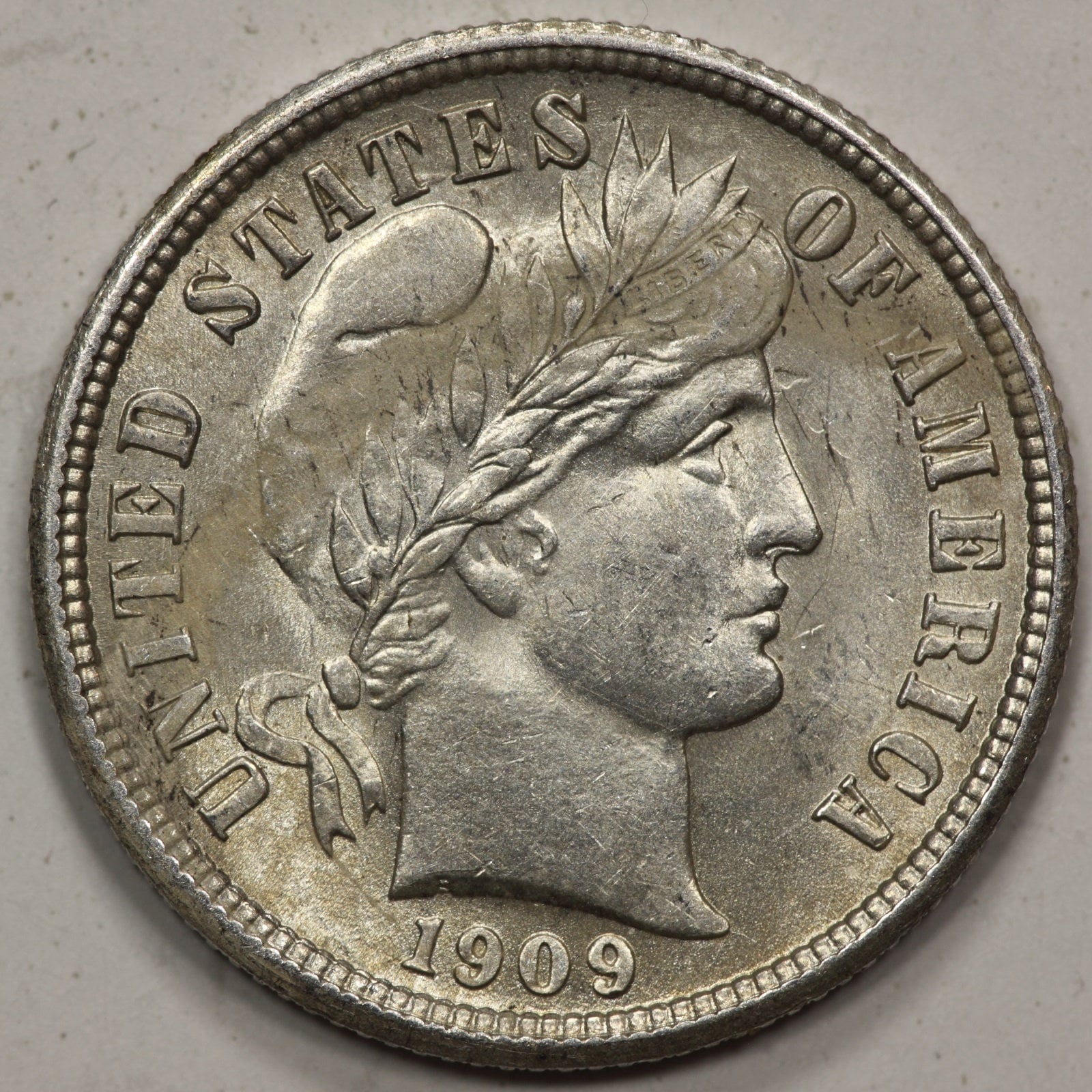
I had a Morgan Dollar years ago with a similar residue; I sent it to NGC for conservation, the residue was removed, and the coin straight graded. My guess is the residue will come off easy if I knew what it was.
Comments
-
Looks like something has etched the surface.
1 -
@amwldcoin said:
Looks like something has etched the surface.No, there's a "powdery" looking substance on the coins surface. It looks like zinc? I've seen it before, but what is it?
I love them Barber Halves.....0 -
Silver Oxide would be my guess!
@JeffMTampa said:
@amwldcoin said:
Looks like something has etched the surface.No, there's a "powdery" looking substance on the coins surface. It looks like zinc? I've seen it before, but what is it?
0 -
I don't see a foreign substance, I do see a die clash.
Frank
BHNC #2031 -
The black spots make me think it's from a bad dip.
Larry0 -
@Treashunt said:
I don't see a foreign substance, I do see a die clash.There is a very distinct die clash, but the "substance" is brownish in color in an arc through "Liberty".
Darrels guess of Silve Oxide seems promising; I'll check it out.
I love them Barber Halves.....0 -
I think he is talking about the small black streaks. I think that they might be impurities that were in the metal when the coin was struck. There is nothing wrong with them per say. Some collectors might wish that they weren't there.
Retired dealer and avid collector of U.S. type coins, 19th century presidential campaign medalets and selected medals. In recent years I have been working on a set of British coins - at least one coin from each king or queen who issued pieces that are collectible. I am also collecting at least one coin for each Roman emperor from Julius Caesar to ... ?0 -
@amwldcoin said:
Silver Oxide would be my guess!@JeffMTampa said:
@amwldcoin said:
Looks like something has etched the surface.No, there's a "powdery" looking substance on the coins surface. It looks like zinc? I've seen it before, but what is it?
Whatever it is, it looks like it's not coming off easily. Good luck with that and let us know how it turns out.
Tom
0 -
@TPRC said:
@amwldcoin said:
Silver Oxide would be my guess!@JeffMTampa said:
@amwldcoin said:
Looks like something has etched the surface.No, there's a "powdery" looking substance on the coins surface. It looks like zinc? I've seen it before, but what is it?
Whatever it is, it looks like it's not coming off easily. Good luck with that and let us know how it turns out.
I don't think that "off" is the right term from those marks. I believe that the word "in" might be more accurate. To remove those marks, you would have to get below the surface, which is not a good thing to do. It is best left alone. They really don't amount to much, and as the coin tones over time, they will become less obvious.
Retired dealer and avid collector of U.S. type coins, 19th century presidential campaign medalets and selected medals. In recent years I have been working on a set of British coins - at least one coin from each king or queen who issued pieces that are collectible. I am also collecting at least one coin for each Roman emperor from Julius Caesar to ... ?0 -
Try an acetone dip. Maybe it will be easier (and less expensive) than you think.
0 -
I tend to agree with Bill... a harsh dip would likely remove much of it, however, I do not think you would like what remains. Cheers, RickO
0 -
I had a Morgan Dollar a few years back with a very similar substance on it. "On" is the opertative word. I tried dipping that coin with no effect. NGC removed it without a problem. My guess this is the same thing, but what to put on it?
I love them Barber Halves.....0 -
Xylene?
 0
0 -
@BillJones said: "I think he is talking about the small black streaks."
No Bill, he is talking about the dull gray ARCHED stain that has ETCHED the surface. I apologize for not knowing its chemical name (perhaps silver oxide?). I have heard them called "dip burn" by numismatists who conserve coins. I'll bet the black stains you referred to will turn the same color if the coin is dipped.
Summary. The surface of the silver became tarnished (corroded) due to contact with something. It darkened and when the coin was dipped, only the etched, gray surface remained.
BTW Those Proof Seated dollars and Proof Trade dollars with a similar, entirely gray surface suffered the same fate after being dipped to remove toning.
0 -
How about a bit of MS70 on it? Rolled on gently with a q-tip shouldnt hurt it.
0 -
Terminal corrosion! Sorry.
0



Leave a Comment
Categories
- All Categories
- 520.1K Coins and Currency - PCGS
- 328.5K U.S. Coin Forum
- 14.8K PCGS Set Registry Forum
- 5.2K Q & A Forum
- 41.4K World & Ancient Coins Forum
- 3K U.S. & World Currency Forum
- 96.4K Buy, Sell, & Trade - U.S. Coins
- 7.3K Buy, Sell & Trade - World & Ancient Coins
- 1.5K Buy, Sell & Trade - Currency
- 60 Random
- 246.2K Trading Cards, Autographs and Memorabilia - PSA
- 90.3K Trading Cards & Memorabilia Forum
- 1.7K Autographs Forum
- 16.4K PSA Set Registry Forum
- 22K Sports Talk
- 115K Buy, Sell & Trade - Cards & Memorabilia
- 663 Buy, Sell & Trade - Autographs
- 2.2K Stamps
- 1.5K Stamps Forum
- 670 Buy, Sell & Trade - Stamps
- 83 Coin Shows
- 83 General Coin Show Information and Discussion
- 11.9K Misc
- 11.9K Testing Forum