Options
What is this called?
 Insider2
✭✭✭✭✭
Insider2
✭✭✭✭✭
Many toned coins show an untoned area next to the relief like letters and numerals. One well-known numismatist calls this characteristic "Draft." I have used that term before. Does anyone know what others have called it. Does anyone know what causes coins to tone this way (I have my theory)?
Thanks!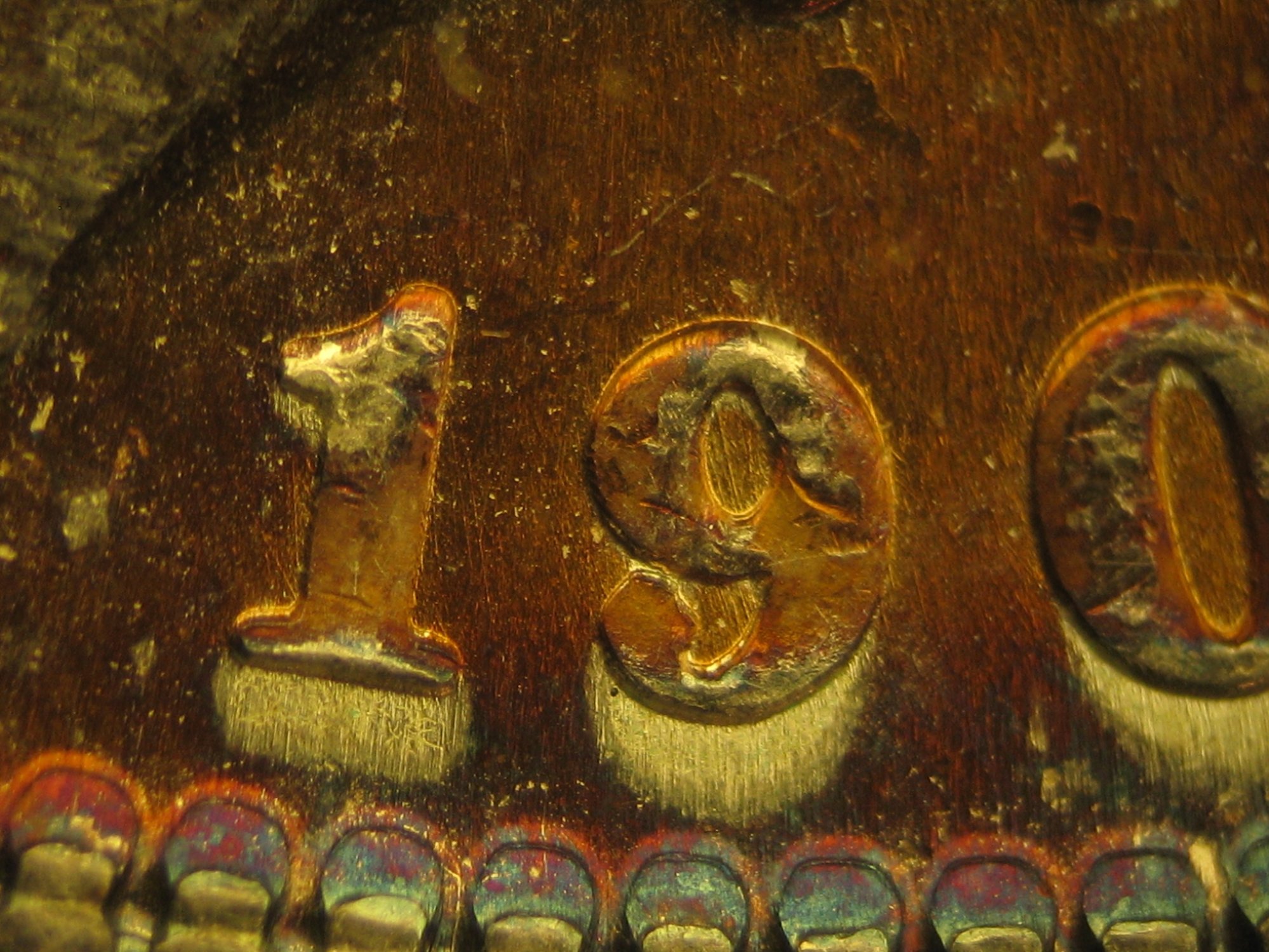
0
Comments
This is known as "pull away".
I thought "pull-away" was the term used when a clad layer pulled away from the relief on Lincoln's for example. On those, there was something that actually "pulled-away." Nothing "pulled-away" on a toned coin!
NOTE: I'm not posting a photo of something I already know the answer to as I have done in the past on CT to get members to examine their coins closely. I have posted all I know about this characteristic except what I think causes it. So I'll reject "pull-away" for my personal use. Hope to read some other suggestions or I shall stick with "Draft."
The person who "named it" called it draft because he believed the contaminated air flows over the coin like a draft as it tones the surface. The raised parts of the coin interrupt the flow of air. I do not agree with that.
On the PCGS boards I have quite often read "pull-away toning" or some variant when this is discussed, especially in relation to Morgan dollars.
In honor of the memory of Cpl. Michael E. Thompson
The areas that do not tone outside of the lettering near the rim have undergone significantly more plastic deformation in the metal than other areas of the coin. This cold worked metal must have some sort of anodic protection keeping it from toning at the expense of the rest of the coin. That's my theory anyway.
Pull-away toning has become the accepted term for it. There is discussion of this as one of the diagnostics of long term toning vs. instant toning on Jhon E Cash's website. If he/they invented the term and it has become mainstream, that's fine with me given the toned coins they show and the level of detail and coverage given on their page about toned Morgans.
Keeper of the VAM Catalog • Professional Coin Imaging • Prime Number Set • World Coins in Early America • British Trade Dollars • Variety Attribution
That is along the lines of what I was thinking. I don't agree with any "anodic protection" though. I think it has to do with the "strike-hardening" for want of a scientific word. Simply, the metal at those points is affected by the strike and metal flow in such a way as to make it less susceptible to chemical alteration. Hopefully a metallurgist can enlighten us.
Anyone else have ideas or different terminology.
"Bingo" I'm going to post this where Dan Carr can comment.
Thanks, I'll read it. Nevertheless, I'll stay odd man out as nothing has pulled away. At least now I know what it is if I hear/see those words.
When this happens, does it always appear between devices and the rim?
New collectors, please educate yourself before spending money on coins; there are people who believe that using numismatic knowledge to rip the naïve is what this hobby is all about.
Yes, and it's consistently sharp as well.
Keeper of the VAM Catalog • Professional Coin Imaging • Prime Number Set • World Coins in Early America • British Trade Dollars • Variety Attribution
** I think it has to do with the "strike-hardening" for want of a scientific word. **
a more appropriate term might be "work hardened" as a result of the strike force and metal flow. it is the same phenomenon which allows for the worn away date on Buffalo Nickels to be restored.
So the strike hardening makes the metal atoms closer and harder to affect?
Looks like a shadow being cast.
@fivecents said: "Looks like a shadow being cast."
Maybe "cast shadow" toning. Except it is bright.
"Toning Flash"
"Flash"
It is a toning interruption but that term better explains the untoned spots on the numerals.
Please humor this post as it already must be called "pull away" by the experts. I just prefer Draft." DRAFT FLASH! Even better. Yes? "Pull-Away-Flash" I could possibly live with.
Anyway, a word would need to be agreed on by the experts and used by them. I'll see the dealer who used "draft" at FUN. I'll see if I can reveal his name - may sway some minds.
I an be agreeable to the term "draft". I have always known it as "pull away" as some others here have put it as well as many other well known dealers and collectors.
I've referred to it as a toning shadow in the past, but I'm good with "pull-away" for reasons stated above, even if it isn't a technically precise term. It's not like our hobby isn't rife with other terms that don't exactly make sense if you think about them. A consistently used and accepted name is most important. If you call it something else, be it "draft," "toning shadow," or "stretched Silly Putty™ toning," you'll end up having to translate that for people who know the de facto standard term.
Keeper of the VAM Catalog • Professional Coin Imaging • Prime Number Set • World Coins in Early America • British Trade Dollars • Variety Attribution
First you ask the forum members what it is. Now that they share with you, you would like to change what we call it?
As an aside, this toning is considered a positive attribute for NT as it is difficult, if not impossible to reproduce.
It's pull away toning
mark
Fellas, leave the tight pants to the ladies. If I can count the coins in your pockets you better use them to call a tailor. Stay thirsty my friends......
Definitely called pull away toning. Just do a search here and you will find endless amounts of threads referring to it as such. Search draft toning and get ready to be disappointed. You can call it whatever you like though.
Not at all. It is going to take more that me to change a term everyone likes. Look how long "cud" has remained in use. When all the dinosaurs die, major die break will become standard.
Actually, I asked what terms are used to describe the chacteristic I learned to call "draft" toning. Then I said I had a theory what caused it. Thanks for the replies. Writing/reading the opinions helped me think up a term I like better for my personal use: "draft flash." But I will try to remember to use that other term (that will remain unmentionable) you all like on this forum.
Work hardening or strain hardening changes the crystalline structure of the metal in this region. Virtually all metals or metal alloys have a complex internal structure as opposed to an amorphous glob of molecules. Impurities and alloys change the way these crystalline structures form, effectively changing the material properties of the alloy. Work hardened metal becomes harder, less ductile, less tough (more brittle), and this change also has an effect on the surface electrochemical properties, at least in relation to the surrounding regions.
We've called it pull-away toning for so long I can't think of it another way.
Is it a function of strike pressure? Pull-away toning is not uncommon on Morgans but kind of rare for screw press coins. I looked through hundreds of bust half examples and came up with only a few. (Below, an 1822 O.108a.)
Lance.
No, the distance between the atoms is essentially unchanged. What does happen is an increase in atomic dislocation in the crystalline structure which results in resistance to further plastic deformation. In other words the metal is indeed harder, but this has nothing to do with changes in the spacing between the atoms. Only the way the atoms align themselves have the mechanical properties and likely chemical properties been changed.
Here's a few photos I've dug up. In my own collection, I only find this effect on larger coins. It seems to be rare on quarter-size coins and smaller.
This is fairly classic around the date and stars of a Morgan:
Here's some on a Barber half:
Here's some on an 1806 Draped Bust Half:
While not precisely the same, this Franklin shows a radial pattern of toning in the right obverse field which is likely influenced by radial flowlines and metal stresses in this area:
This pattern of toning where devices are "outlined" or ghosted is probably different and may have to do more with protection of these areas from certain contaminants such as surface oils. It's possible that metal strain has something to do with it too:
So is that why the area remains untoned?
Negative Shadow
There is a name for the unusual toning that was the subject of the enquiry by Steve Huber in last week's E-Sylum. That name is negative shadow. It is well known to medal collectors because that phenomenon is prevalent on medals struck in tin and white metal. It is caused by stress, tin and cold temperature.
It is a form of surface displacement and is created at the instant of striking. It is not metal flowing into, then out of die cavities, as the two numismatists theorized. Surface metal flows toward the deepest die cavities. Since lettering, figures and stars near the border or rim are deep cavities, adjacent surface metal flows into these die cavities from metal near the rim. (The collar has nothing to do with it, as mentioned, this occurs on pieces struck with open face dies where no collar is present.)
Tin and tin alloys have this very unusual property which displays the shadow effect. Tin does not work harden like other coinage metals. Instead it exhibits this condition in its flow marks. This shadow effect is not present immediately after the piece is struck. Freshly struck tin appears bright over the entire struck piece.
In time (say two years) tin surfaces will begin to darken from cold exposure -- this is a form of toning but is not called "toning" for tin and white metal. Instead it is called darkening on these metal surfaces. The dark areas on the surface piece which have darkened is a natural phenomenon. This dark area is in contrast to the flow marks caused by the surface displacement which remain bright on the same piece.
I have seen two-hundred-year-old medals struck in white metal which still have bright negative shadows! It is assumed this condition is now permanent and will exist forever!
The dark toning on white metal is a mild form of tin pest and is a result of the piece exposed to a cold temperature! Tin is unstable below 18 degrees centigrade (64 degrees Fahrenheit). Tin does not rust due to moist air (as does iron) but only by prolonged exposure to temperatures below 18 degrees C. The disease, also call tin plaque, forms a discoloration -- darkening on the struck surface -- then in time forms a gray powdery surface corrosion. Chemically the somewhat unstable metallic tin (beta-tin) changes to the stable powdery form (alpha-tin).
Why some silver coins display negative shadow and others do not, I don't know for sure, but I surmise there is some tin in the composition of the struck pieces that do exhibit negative shadow.
While shadows usually display dark areas, this phenomenon is just the opposite -- it displays bright areas. I guess it could have been called "reverse shadow" but this would have been confusing on coins and medals. Thus "negative" shadow.
I learned of this phenomenon from the old-timers at Medallic Art Company when I worked there decades ago. They were aware of this condition and tried to dissuade clients from using white metal or tin compositions for modern medals for this very reason.
You will find this type of toning on quarters as well. Below a group of MS68 Barber quarters of which many have pull away toning under the date. A few of them also exhibit it around the peripheral stars and lettering, though not seen as often vs. the date.
https://coins.ha.com/c/search-results.zx?Ne=16&N=3183+790+231+366+76&expand=Coin+Grade&ic4=Refine-CoinGrade-102615#expand-16
I believe examples can be found on coins of any alloys.
Negative shadow is nice. "Flash shadow" nicer?
It would be neat to see someone stick a coin with pull-away toning in a scanning electron microscope and check out those areas. Remember the experiments on dipping using SEM imaging?
sundial toning
Government is the great fiction through which everybody endeavors to live at the expense of everybody else. - Bastiat
I would think that a review of broadstruck and capped die coins might be enlightening.
Doggedly collecting coins of the Central American Republic.
Visit the Society of US Pattern Collectors at USPatterns.com.
Are you attemping to highjack this discussion? I'm going to change the name on you!
Doggedly collecting coins of the Central American Republic.
Visit the Society of US Pattern Collectors at USPatterns.com.
Here's a good example of pullaway toning
Excellent discussion.... I have taken courses in metallurgy (long ago career in a shipyard)... I notice the pull away effect is manifested between devices in close proximity (i.e. edge/denticles-numbers or letters). This area experiences unique stresses during coining with metal flowing up and into the devices and stressing the small area between. This will affect the molecular structure and as such affect the chemical resistance to tarnish. Certainly the metal alloy (or lack thereof) can also contribute to this effect. @Insider2 ...your dealer friend has an interesting idea, however, the air flow idea makes no sense, especially if you notice that the effect is obvious around the coin, which would indicate air flow from the center out...not possible. So draft goes down the tubes. Cheers, RickO
I always rejected his idea BUT never sought the excellent way you raised to refute it! I've always believed it had something to do with the different characteristics of the surface.
I'm going to continue to be an "outsider" and call the effect "flash-something." I lean towards "flash shadow" or perhaps "strike shadow." It is 100% connected to the minting process as this effect is also visible on untoned Morgan dollars.
The Barber dime was struck multiple times, which is undoubtedly why the shadow in front of the profile extends so far into the field. Exactly how it happens is beyond me.
Doggedly collecting coins of the Central American Republic.
Visit the Society of US Pattern Collectors at USPatterns.com.
Here's a 17th century coin with pull-away toning here and there.
Keeper of the VAM Catalog • Professional Coin Imaging • Prime Number Set • World Coins in Early America • British Trade Dollars • Variety Attribution