Legality of “pattern and experimental ‘coins.’ ”
 RogerB
Posts: 8,914 ✭✭✭✭✭
A common question among message board participants and in my email concerns the “legality of pattern coins.” The usual comment is “Why?” The following brief material should prove helpful.
On June 25, 1887 Mint Director James P. Kimball attempted to confiscate pattern/experimental pieces from the Estate of former Director Henry Linderman.
“…It becomes my duty to inform you in respect to the United States pattern and experimental coins comprising catalogue numbers 55 to 171 inclusive, as appears by the classification, that these coins are, prima facie, of a character which the laws of the United States preclude from becoming private property. They are accordingly regarded by the Treasury Department as United States property, which should be returned to the custody of the United States government.”
The auction company complied, and the sale cancelled.
But Kimball did not do his homework. First, Linderman’s son was a fully competent Philadelphia lawyer who was not about to permit confiscation of his family’s property. Linderman, Jr. prepared a robust response citing decades of open sales of such pieces. Second, Kimball had not sought the guidance of Treasury counsel or the Justice Department before issuing his demand. The ultimate result was that Kimball was forced to return the coins and cease any prosecution. The “nail in the coffin of confiscation” was an informal opinion of the U.S. Attorney, Southern District of New York, quoted below.
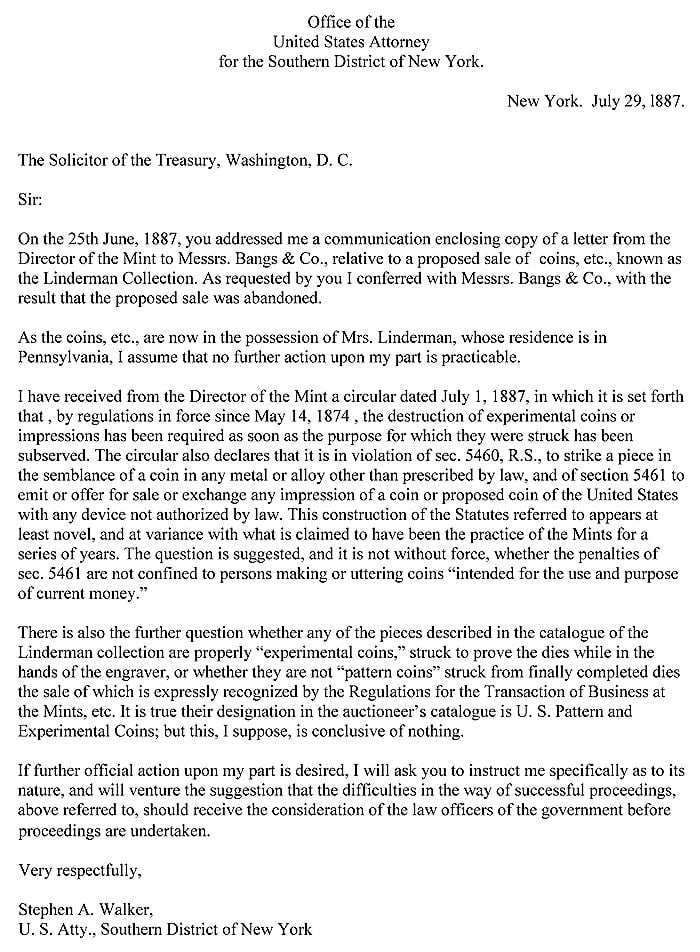
A similar attempt was made by Director Andrew in 1910. Andrew was the one who ordered destruction of all existing pattern hubs and dies - a huge loss to American medalic art. In this instance, the Director was met with a similar Treasury legal opinion. Since then, these important pieces of American monetary history have enjoyed free and open exchange among collectors and numismatic institutions.
[Note: The 19th century Mint's definition of an "experiment piece" was of one used to test or "try" the dies. It did not include pieces in non-standard alloy or of unusual dimensions - these were technically "pattern pieces."]
Comments
Fascinating reading - thanks for posting it.
Thanks Roger.You never cease to amaze me with your ongoing research.
Thanks Roger, very interesting. Cheers, RickO
The interesting thing is that, according to noted pattern expert Saul Teichman, the only pieces that ended up being seized were the aluminum patterns, which arguably were true pattern pieces. They left the truly spurious coins like the Gobrecht dollar "Cabinet Coins" which are obvious fantasy pieces!!!
A list of aluminum pieces does not appear among the available documents. In the sale catalog, aluminum pieces account for lots: 76, 84, 92, 95, 96,155 and 164. These include some, but not all, of the aluminum pieces made by order of the Secretary of the Treasury.
Perhaps a re-reading of my earlier comments on the legality of patterns after 1916 will amuse some and annoy others:
https://forums.collectors.com/discussion/comment/11056650#Comment_11056650
TD