Options
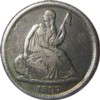
Received a nice surprise: 1853 Proof Half Cent
 Weepinglion
Posts: 30
Hello everyone. I've been lurking on here for a while now and figured this was as good a time as any to start posting.
I've worked at a coin shop for a couple years now, and I'm in charge of selecting coins and submitting them for grading, usually with PCGS. Well I just received a large submission back from our hosts, and got a neat surprise: the 1853 Half Cent I submitted turned out to be a Proof! An impaired Proof to be exact, but I'll take it!
Here's the cert: Linky
I guess they randomly photograph submissions, and I'm glad they did for this one. It doesn't say in the link, but the slab says PCGS PR Genuine.
I was hoping for an AU, and almost didn't send it because of the strong possibility of it being cleaned. But I went for it and got lucky. Does anyone here specialize in half cents, and especially Proofs? Because I still don't even know what differentiates this with a business strike. What makes it even more interesting is that I can't even find it in any price guide or auction records. That probably has to do with it apparently having a mintage of only 5. At least, that's what they say on the certification page.
So might this coin be unique in the market?? Any idea of value? All thoughts and comments will be appreciated!
John
0
Comments
Congrats!
To my knowledgel, there are no known proof 1853 half cents.
If real, you have yourself a VERY valuable coin, but I suspect that is not the case.
<< <i>It is likely a mechanical error (mistake) on PCGS' part.
To my knowledgel, there are no known proof 1853 half cents.
If real, you have yourself a VERY valuable coin, but I suspect that is not the case. >>
-Paul
type2,CCHunter.
It's weird isn't it? I called PCGS thinking the same thing about a mechanical error on the tag, but that's what they have in their system too. Unfortunately I couldn't talk to the grader. You'll notice the PCGS # of 1320 isn't on the PCGS price guide, but it falls within the range of other Proofs. And the fact that they bothered to put the mintage of 5 on the cert page makes it very intriguing...
<< <i>I'm also seeing no known proofs for this adte but PCGS gives it a unique coin number and a mintage of 5 to me this does not seem like a mechanical error. I think you might have a unique specimen on your hands worths more then a couple of thousand. I hopes it the real deal! >>
Beat me to it. That's certainly what I'm hoping! But I'm going to keep my expectations tempered until I know for sure.
Does anyone recognize anything from the picture to make it a Proof?
good luck!
Empty Nest Collection
My Early Large Cents
<< <i>I dont think PCGS would have photographed a cleaned 1853 half cent with XF details. >>
Well they photographed the whole submission of 51 coins (economy). I asked about that too, and I guess they randomly photograph depending how busy they are.
Hope you have what they say you have,,, ,,,but,
I believe there was only one set of dies for this date.
Proof coins were generally made from new dies on specially
prepared planchets and double struck.
Business strikes would be made afterwards.
New dies usually have not developed die cracks & also still
show all the features on a original die, even unwanted features.
Your coin appears not to show repunching on the 1 and die file
marks left of STATES, which would be present in Die State 1.
Your coin does appear to show a die crack within the right pendant
of the 1st T in STATES that goes through the center of the base
into the field, which would not appear until Die State 3.
There are no images known of an 1853 proof, per CoinFacts. There are no
1853 proofs required in the PCGS Registry sets.
There are no PCGS Price Guide listings for an 1853 proof.
I would think that if this was an 1853 proof coin that someone would contact
you from PCGS, but who knows.
R.I.P. Bear
<< <i>Well the mintage on the verification site says 5... >>
http://www.coinfacts.com/half_cents/1853_half_cents.htm
None known or reported
My Early Large Cents
http://www.pcgscoinfacts.com/CoinDetail.aspx?s=1320&g=1&redir=t
My Early Large Cents
<< <i>Then there is this
http://www.pcgscoinfacts.com/CoinDetail.aspx?s=1320&g=1&redir=t >>
I would think they would have graded a coin that unique better than genuine. If it is the only one known I think it is market acceptable.
My Early Large Cents
Keep us posted about the half cent saga.
Mike
FWIW, I hope that the OP has found the first example, that would be a HUGE numismatic find.
<< <i>Hope you have what they say you have,,, ,,,but,
I believe there was only one set of dies for this date.
Proof coins were generally made from new dies on specially
prepared planchets and double struck.
Business strikes would be made afterwards.
New dies usually have not developed die cracks & also still
show all the features on a original die, even unwanted features.
Your coin appears not to show repunching on the 1 and die file
marks left of STATES, which would be present in Die State 1.
Your coin does appear to show a die crack within the right pendant
of the 1st T in STATES that goes through the center of the base
into the field, which would not appear until Die State 3.
There are no images known of an 1853 proof, per CoinFacts. There are no
1853 proofs required in the PCGS Registry sets.
There are no PCGS Price Guide listings for an 1853 proof.
I would think that if this was an 1853 proof coin that someone would contact
you from PCGS, but who knows. >>
Thank you for the analysis. I think I see what you're referring to about the die cracks in the pictures, but it could just be a smudge. I'll need to get the coin back here at the shop to look at it (the boss put it in the SDB).
In regards to PCGS contacting us, I would have thought that too. In the same submission, I sent a 1927-S SLQ with an inverted mintmark. I paid for variety attribution, but they sent it back without one. But there was a hand written note stuck to the slab that said "we don't do this variety", so that led me to believe that that grader was on the ball, at least regarding what they do and don't grade. --shrugs-- (I may start a thread on that coin as well.)
Now, I JUST got this coin back, so maybe the PCGS guide will be updated? Who knows, but I think we can all agree that there have been none on the market previously.
<< <i>Then there is this
http://www.pcgscoinfacts.com/CoinDetail.aspx?s=1320&g=1&redir=t >>
Tantalizing, isn't it? There's just enough info to keep that "what-if?" part of the brain active
NOT a Proof striking. Put me in the typo camp.
<< <i>I just checked Manley and Breen -- both say no proofs exist. Breen says "rumors persist" of examples, but none have yet been found.
FWIW, I hope that the OP has found the first example, that would be a HUGE numismatic find. >>
Thank you. I've been wanting to get a copy of Breen, but haven't been able to yet.
There were a bunch of restrikes of the 1840's Proof Half Cents, so maybe that would explain any die cracks. If I understand it correctly, a collector could request Proofs made from a previous year, hence the restrikes. Is that correct? Would they re-polish an old business die to make them?
<< <i>I would think a key would be the sharpness of the dentils, but I can't see them well enough in that pic to know. Definitely show it to some of the specialists at CSNS, even PL is cool. >>
As has been pointed out to me on several occasions, "proofiness" has nothing to do with diagnostics or strike or strike completeness. Here is a photo of my proof 1854 cent. Notice the incomplete denticles between three and four o'clock on the obverse, and the incomplete star centers, which are so, in spite of this being a very early die state, which is evidenced by the die polish lines extending vertically under the date:
Also, here is a link to a thread that may shed some light on the whole diagnostics argument. Basically, I have this 1860 that is better struck than any MS coin I've seen of that date, has all the proof diagnostics, has been in for a review, has experts like John Danruther and Rick Snow disagreeing with the majority opinion, and is certified as MS.
No, what I've seen with regard to "calling" a proof has more to do with the overall appearance of the coin, and is based on the coin having all of the attributes of a proof, whether or not it matches a set of diagnostics. And in some cases, it still is not clear. PCGS appears to be putting their name behind their opinion that this coin is a proof, and if it was intentional, it was not done casually. It was likley done by a group of experts who voted on the outcome.
So, what makes a proof? Most importantly, it has to look like a proof. This means that it should not have MS or "cartwheel" luster. Devices and rims should be squared off and definite. Fields should show some evidence of mirroring. Rims and edges should be extremely uniform. In many cases, a trained eye can see evidence that the planchet was specially prepared. And often, it is easy to tell that the dies were polished, as is shown by the appearance of raised die lines on the coin.
But of course, there are exceptions to all of these rules. Especially with regard to proof coins made prior to 1855. Well, maybe not all of these rules. You should never see devices blending into the fields. That to me would disqualify a proof. But if you go through coinfacts and look at the photos of early proofs, it's easy to see that many examples are incompletely struck, not perfectly centered, etc. Even moreso, the manufacturing method of some dates makes it extremely difficult to be certain. My 1860 cent, for example, has rounded edges. That's how both proofs and MS examples were made that year. Even furthermore, as I do own a PR65CAM 1860 as well, (and I can tell you with certainty that that coin IS a proof), I can tell you that there is some evidence of cartwheel luster on that coin. But still, nobody disagrees that THAT coin is a proof, even when shown the cartwheeling. However, when presented with the MS coin with all the matching diagnostics, the main thing that gets pointed out as the disqualifier is the cartwheeling!
During a discussion with John Danruther last year, he told me about some proof gold issues where the exact same dies were used to strike MS and PR coins. He told me that in some instances, they would make a run of proofs, then, using the same die, make a run of MS coins, and then later, make some more proofs, and then more MS, and then more PR coins (and on and on?).
Now, if you're not confused, I must be doing something wrong. It IS confusing sometimes, and any open-minded expert will agree to that.
Empty Nest Collection
Check out some of my 1794 Large Cents on www.coingallery.org
<< <i>Thanks for the replies.
It's weird isn't it? I called PCGS thinking the same thing about a mechanical error on the tag, but that's what they have in their system too. Unfortunately I couldn't talk to the grader. You'll notice the PCGS # of 1320 isn't on the PCGS price guide, but it falls within the range of other Proofs. And the fact that they bothered to put the mintage of 5 on the cert page makes it very intriguing... >>
I just looked up the coin numbers for half cents and 1320 is listed as a proof 1853 half cent so the coin number is at least right if such proof does exist. To me that another good sign this is not a mechanical error. I just hoping for the best for ya, I like to see people do good.
type2,CCHunter.
<< <i>
<< <i>I would think a key would be the sharpness of the dentils, but I can't see them well enough in that pic to know. Definitely show it to some of the specialists at CSNS, even PL is cool. >>
As has been pointed out to me on several occasions, "proofiness" has nothing to do with diagnostics or strike or strike completeness. Here is a photo of my proof 1854 cent. Notice the incomplete denticles between three and four o'clock on the obverse, and the incomplete star centers, which are so, in spite of this being a very early die state, which is evidenced by the die polish lines extending vertically under the date:
Also, here is a link to a thread that may shed some light on the whole diagnostics argument. Basically, I have this 1860 that is better struck than any MS coin I've seen of that date, has all the proof diagnostics, has been in for a review, has experts like John Danruther and Rick Snow disagreeing with the majority opinion, and is certified as MS.
No, what I've seen with regard to "calling" a proof has more to do with the overall appearance of the coin, and is based on the coin having all of the attributes of a proof, whether or not it matches a set of diagnostics. And in some cases, it still is not clear. PCGS appears to be putting their name behind their opinion that this coin is a proof, and if it was intentional, it was not done casually. It was likley done by a group of experts who voted on the outcome.
So, what makes a proof? Most importantly, it has to look like a proof. This means that it should not have MS or "cartwheel" luster. Devices and rims should be squared off and definite. Fields should show some evidence of mirroring. Rims and edges should be extremely uniform. In many cases, a trained eye can see evidence that the planchet was specially prepared. And often, it is easy to tell that the dies were polished, as is shown by the appearance of raised die lines on the coin.
But of course, there are exceptions to all of these rules. Especially with regard to proof coins made prior to 1855. Well, maybe not all of these rules. You should never see devices blending into the fields. That to me would disqualify a proof. But if you go through coinfacts and look at the photos of early proofs, it's easy to see that many examples are incompletely struck, not perfectly centered, etc. Even moreso, the manufacturing method of some dates makes it extremely difficult to be certain. My 1860 cent, for example, has rounded edges. That's how both proofs and MS examples were made that year. Even furthermore, as I do own a PR65CAM 1860 as well, (and I can tell you with certainty that that coin IS a proof), I can tell you that there is some evidence of cartwheel luster on that coin. But still, nobody disagrees that THAT coin is a proof, even when shown the cartwheeling. However, when presented with the MS coin with all the matching diagnostics, the main thing that gets pointed out as the disqualifier is the cartwheeling!
During a discussion with John Danruther last year, he told me about some proof gold issues where the exact same dies were used to strike MS and PR coins. He told me that in some instances, they would make a run of proofs, then, using the same die, make a run of MS coins, and then later, make some more proofs, and then more MS, and then more PR coins (and on and on?).
Now, if you're not confused, I must be doing something wrong. It IS confusing sometimes, and any open-minded expert will agree to that. >>
Thanks for the great response. Early Proofs are tricky. At first I was trying to discern any mirrored fields or special diagnostics, but honestly I don't notice any. The fact that this coin is only XF details throws a wrench into the works. Maybe at one time it had mirror surfaces, but as you say, it might never have had them.
You're right, PCGS has their name behind this coin, right or wrong. I haven't heard of many labeling errors, but I know they happen. Usually I've seen the wrong date, or wrong denomination. I'm not sure how that happens, but it must be the last person to look at it who puts it in the system. But don't 2 people look at it before slabbing, and a third verify it once it's in a slab? So either it's somehow a clerical error, or somehow definitely a Proof. In this situation I don't know which is likelier! If it's the latter, I'd love to know how it came to that conclusion. If the former, has anyone heard of that kind of error? Mistaking a MS for a PF?
Interesting thread you referenced. That thing looks like a Proof to me!
<< <i>I just looked up the coin numbers for half cents and 1320 is listed as a proof 1853 half cent so the coin number is at least right if such proof does exist. To me that another good sign this is not a mechanical error. I just hoping for the best for ya, I like to see people do good. >>
I saw that too, and was thinking the same thing. And thanks, I'll keep everyone posted!
What is now proved was once only imagined. - William Blake
What a great read and how exciting!
<< <i>If it were a proof, I would imagine there would have been a phone call from the graders...finding a currently unknown coin isn't the kind of thing they just slab and send back to you. They WOULD give you a call. There would be a discussion about such an important item. That is one of the reasons I think it was an error. >>
I think they'd want to up the return shipping cost too
Send an email to David Hall and I am sure he will look into it.
At the next major show, let John Dannreuther examine it. He is a savant with US Mint proof coins.
Remember that although Breen was prolific, he was not infallible. Some of his information is wrong.
If it was the first proof graded and "proof" positive that the coin existed, I am sure PCGS would have done more than just sent it back to you. This kind of news would rock our nerdy world and would be worthy of a press release.
BTW ... I hope it wasn't a mechanical error and it is a proof.
Edited for early morning, pre-coffee, poor grammar
See http://www.doubledimes.com for a free online reference for US twenty-cent pieces
The coin has also starting to get some comments on EAC site (it appears that 1853's are a well struck date).
I have a choice 55 and it is pretty well struck as well.
Right now I hope for the best for you but am in the non-proof camp right now but an expert really needs to see it outside the holder.
If you are anywhere near Buffalo in early May, many of the experts will be there and would be glad to look at it.
Surprised we have not heard from Halfcentman.
My Early Large Cents
My Early Large Cents
<< <i>
<< <i>If it were a proof, I would imagine there would have been a phone call from the graders...finding a currently unknown coin isn't the kind of thing they just slab and send back to you. They WOULD give you a call. There would be a discussion about such an important item. That is one of the reasons I think it was an error. >>
I think they'd want to up the return shipping cost too
Haha, yeah. For now at least, I'm gonna keep it in the slab it's in. Until I find out one way or another.
<< <i>Very interesting. The image, however, looks like a circulation strike and not a proof (but that's just an image).
Send an email to David Hall and I am sure he will look into it.
At the next major show, let John Dannreuther examine it. He is a savant with US Mint proof coins.
Remember that although Breen was prolific, he was not infallible. Some of his information is wrong.
If it was the first proof graded and "proof" positive that the coin existed, I am sure PCGS would have done more than just sent it back to you. This kind of news would rock our nerdy world and would be worthy of a press release.
BTW ... I hope it wasn't a mechanical error and it is a proof.
Edited for early morning, pre-coffee, poor grammar >>
We're currently sending some emails to some PCGS folks to try and verify it. I didn't think to email David Hall himself, but maybe I will.
I would've thought they'd make more of a deal out of it too, but I'm still hoping.
For what it is worth, the key diagnostic on business strike 1853 Half Cents is the tiny dot on the left lower serif of the T in CENT that is visible on your coin. I am reasonably sure that PCGS would not certify an 1853 Half Cent made with that die as a proof, no matter how well it was struck. However, if they have called it a proof and you can convince the EAC guys that they made the right call, you have a VERY valuable coin on your hands.
What is now proved was once only imagined. - William Blake
Doggedly collecting coins of the Central American Republic.
Visit the Society of US Pattern Collectors at USPatterns.com.
<< <i>g048406 - If your 1849 looks like that image, I'm guessing it's fake. >>
Andy,
is it just the rims on the '49 and the strike or are there other things you are seeing, odd color aside?
Best,
Eric