Options
An Important Lincoln Civil War Token Die
 BillJones
Posts: 35,963 ✭✭✭✭✭
BillJones
Posts: 35,963 ✭✭✭✭✭
I have heard some collectors say that they were interesting in coins, but had absolutely no interest in the dies that produced them. Although I can understand this opinion from a budgetary standpoint (You can't buy everything!) I still can’t see why the die that struck something in your collection that you admire could be of so little interest.
I recently acquired this Lincoln Civil War token die at auction. It produced Fuld Civil War token # 131, and it was also used to Sullivan-DeWitt number AL 1864-32. According to Fuld it was married to two different reverse dies, and he lists it has an R-8, 5 to 10 known for each of the die combination and metal compositions reported. It piece probably falls in that rarity range because I have seen very few of these pieces offered for sale either at auction or in dealer inventories.
This piece was struck to mark the opening of the Union League which came into existence during the Civil War to support pro-Union candidates. Later the organization, which still exits today, became pretty much of a Republican Party organization.
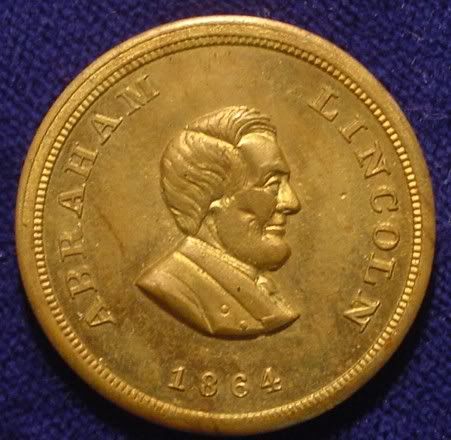
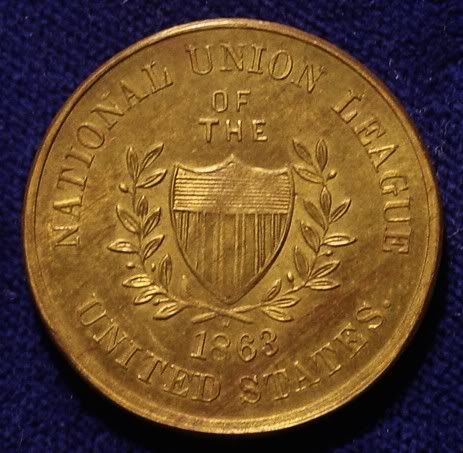
The die is one of one of only a handful of Civil War tokens dies that are known to exist. The Philadelphia, Pennsylvania of F.C. Key and Sons produced this die for the 1864 presidential election. Fuld speculates that the pieces that made of a composition of other copper or bronze were restrikes that were made at a latter date.
The Key Company was active in making tokens in the 1850s and ‘60s. There die executions were first rate. One of the sons, William Key, landed a job at the U.S. mint and is in a famous group picture that provides us with one of the most recognizable images of Chief Mint Engraver, Charles Barber.
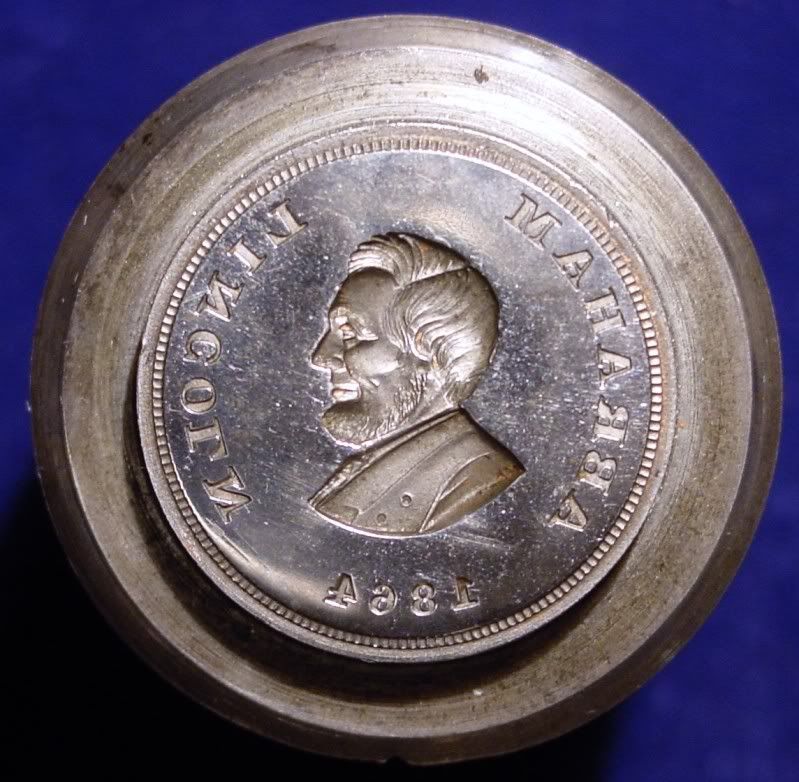
I have few other dies, but none are as nice or important as this one. All of the U.S. coin dies, which include Proof 1968-S nickel dies and a die for the flag bearer $5 gold from the 1996 Atlanta Olympics, have been defaced, of course. I do have an intact die for a merchant token that was issued circa 1900, but that piece is not of great collector interest.
I recently acquired this Lincoln Civil War token die at auction. It produced Fuld Civil War token # 131, and it was also used to Sullivan-DeWitt number AL 1864-32. According to Fuld it was married to two different reverse dies, and he lists it has an R-8, 5 to 10 known for each of the die combination and metal compositions reported. It piece probably falls in that rarity range because I have seen very few of these pieces offered for sale either at auction or in dealer inventories.
This piece was struck to mark the opening of the Union League which came into existence during the Civil War to support pro-Union candidates. Later the organization, which still exits today, became pretty much of a Republican Party organization.
The die is one of one of only a handful of Civil War tokens dies that are known to exist. The Philadelphia, Pennsylvania of F.C. Key and Sons produced this die for the 1864 presidential election. Fuld speculates that the pieces that made of a composition of other copper or bronze were restrikes that were made at a latter date.
The Key Company was active in making tokens in the 1850s and ‘60s. There die executions were first rate. One of the sons, William Key, landed a job at the U.S. mint and is in a famous group picture that provides us with one of the most recognizable images of Chief Mint Engraver, Charles Barber.
I have few other dies, but none are as nice or important as this one. All of the U.S. coin dies, which include Proof 1968-S nickel dies and a die for the flag bearer $5 gold from the 1996 Atlanta Olympics, have been defaced, of course. I do have an intact die for a merchant token that was issued circa 1900, but that piece is not of great collector interest.
Retired dealer and avid collector of U.S. type coins, 19th century presidential campaign medalets and selected medals. In recent years I have been working on a set of British coins - at least one coin from each king or queen who issued pieces that are collectible. I am also collecting at least one coin for each Roman emperor from Julius Caesar to ... ?
1
Comments
Not really looking for much these days but if I were, it might be a toner.
Dennis
Like VOC Numismatics on facebook
Worry is the interest you pay on a debt you may not owe.
"Paper money eventually returns to its intrinsic value---zero."----Voltaire
"Everything you say should be true, but not everything true should be said."----Voltaire
<< <i>Very neat die. Do you put any thing on it to protect it from rusting? >>
I have to leave it to your expertise to advise me on how to preserve it. It's been around since 1864 and has not rusted. I'm not about to clean it and will store the same way as do my copper coins, which has not let me down yet.
That is truly a neat item. I have a couple of questions:
1) Do you suppose "back in the day" they made a hub first and the die second? Personally I doubt it, but I would definitely bow to your expertise.
2) How do you suppose that die came down to us? Why do you think it wasn't discarded along with (almost?) all the other dies?
Mark
In terms of preservation, the enemy of steel is oxygen. To prevent oxidation, a thin layer of petroleum jelly covering the die face would be protective and easily reversible. Anything else that keeps oxygen and moisture and their deadly spawn (rust) off it would work just as well.
I'm glad you got this, and I'm glad you posted it too!
The Penny Lady®
Collector since 1976. On the CU forums here since 2001.
<< <i>
<< <i>Very neat die. Do you put any thing on it to protect it from rusting? >>
I have to leave it to your expertise to advise me on how to preserve it. It's been around since 1864 and has not rusted. I'm not about to clean it and will store the same way as do my copper coins, which has not let me down yet. >>
A light coating of silicone oil should protect it from rust and is easily removed with acetone. I've read that die steel will easily rust and based on certain issues of New Orleans mint coins struck from rusted die it's easily believable..
Worry is the interest you pay on a debt you may not owe.
"Paper money eventually returns to its intrinsic value---zero."----Voltaire
"Everything you say should be true, but not everything true should be said."----Voltaire
Congrats on your find.
Michael Kittle Rare Coins --- 1908-S Indian Head Cent Grading Set --- No. 1 1909 Mint Set --- Kittlecoins on Facebook --- Long Beach Table 700
Awsome! I love seeing coin dies.
<< <i>Bill:
That is truly a neat item. I have a couple of questions:
1) Do you suppose "back in the day" they made a hub first and the die second? Personally I doubt it, but I would definitely bow to your expertise.
2) How do you suppose that die came down to us? Why do you think it wasn't discarded along with (almost?) all the other dies?
Mark >>
I doubt that the Key token die company hubbed the complete die, but there is evidence that they might have hubbed the central device for some them. This would have included the Lincoln portrait which required to the most time and effort to make. For example the Lincoln portrait that appears on these two token varieties looks to be the same. This would indicate that the Lincoln portrait was hubbed. By the way the hubbing the “hard stuff” technique was the also employed at the first U.S. mint which was not able, given its level of technology, hub the entire die face. (Below: left die # 128, right die # 131A
Two other very small tokens seem to also share a common portrait although the lettering is spaced differently. Fuld token # 130 (left) was struck first, and it appears that the die broke either before any tokens were struck or soon after it went into production. Die # 129 (right) was its replacement.
BTW the 129 die is a gold filled token which is more than likely struck for collectors after the 1864 election. The piece has a huge wire rim on the reverse, and the detail is very sharp. The die for #129 still survives and was used for a token that was issued during the 1939 Central States Coin Show. Here is that piece.
The Key family was known to make restrikes of their products years after their initial release. Somehow a couple other of their dies have survived.
Any relation?
Thanks for the comments and insights.