Options
1794 and 1795 Half Cents … Same Type Different Designs.
 BillJones
Posts: 35,991 ✭✭✭✭✭
BillJones
Posts: 35,991 ✭✭✭✭✭
Many years ago, when I was starting to get serious about my type collection, I mentioned my goals to long time coin dealer Catherine Bullowa. She asked me if I was going to go for both the 1794 and 1795 half cents. I knew what she meant, but I answered, “No,” to which she said that I was only going for “general types” not all of the types.
Now that I’ve completed my set, at least in terms of the registry parameters, I’ve started to go back to some of these “obscure types.” At the recent Baltimore show I came across the best 1794 half cent that I have ever seen for sale. I’ve seen a couple better ones at the Early American Copper club convention “Half Cent Happenings,” but those don’t count because the coins are in “strong hands” and won’t be available any time soon. And when they are sold, they will probably be out of my price range.
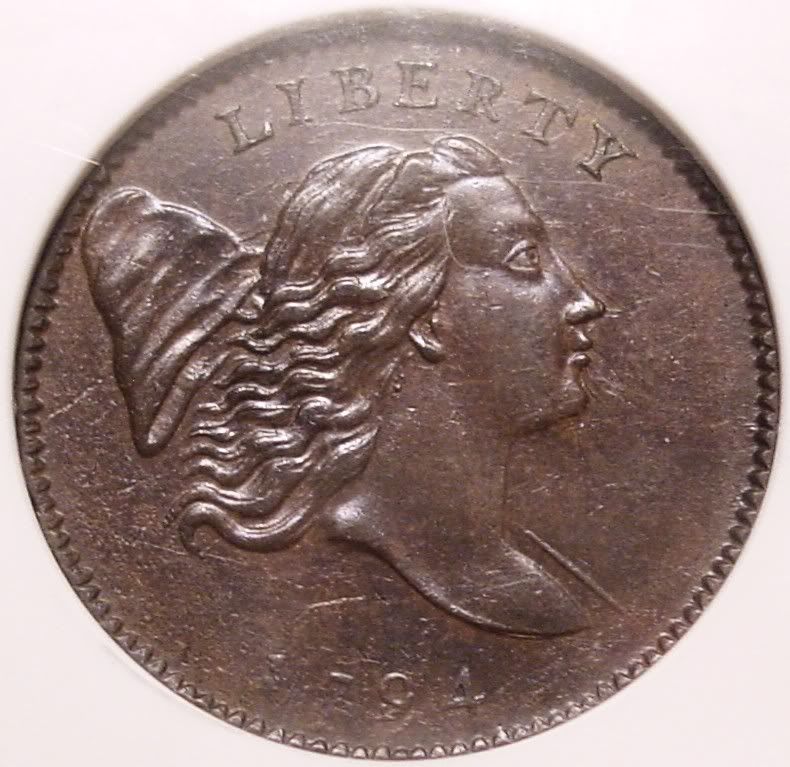
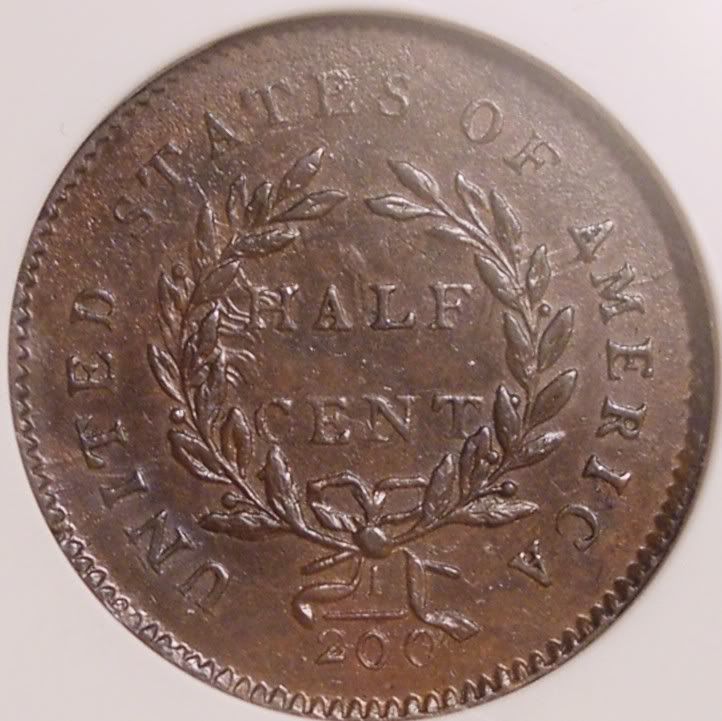
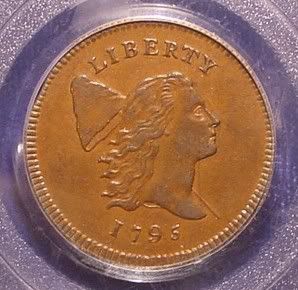
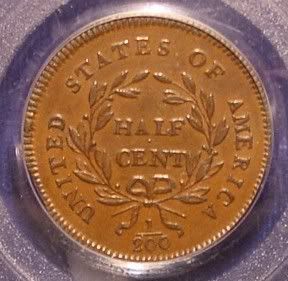
You will note that the designs of both coins are quite different, yet according to most type coin lists they fall under the same category, “Liberty Cap half cent, Facing Right. The 1794 has proved to be a bear to photograph in the holder, and this is best I’ve been about to do with it so far. Still you can sell that these coins really are two distinct types, and if the truth be told that are more that just these two. In fact one could come with two more 1794 types, plus the reduced weight, plain edge planchet varieties for 1795 through ’97. Clearly if these coins had been minted a century later, they would be distinct type coins. One need only look at the Type I and Type II 1913 Buffalo Nickels and the three types of Standing Liberty Quarters to see that this is true.
I hope that this will lead to further discussions since I don’t know what I might know about this topic that would be of interest. At any rate, here are the two coins:
1794, Cohen 1a
1795, Cohen 1, Lettered Edge
Now that I’ve completed my set, at least in terms of the registry parameters, I’ve started to go back to some of these “obscure types.” At the recent Baltimore show I came across the best 1794 half cent that I have ever seen for sale. I’ve seen a couple better ones at the Early American Copper club convention “Half Cent Happenings,” but those don’t count because the coins are in “strong hands” and won’t be available any time soon. And when they are sold, they will probably be out of my price range.
You will note that the designs of both coins are quite different, yet according to most type coin lists they fall under the same category, “Liberty Cap half cent, Facing Right. The 1794 has proved to be a bear to photograph in the holder, and this is best I’ve been about to do with it so far. Still you can sell that these coins really are two distinct types, and if the truth be told that are more that just these two. In fact one could come with two more 1794 types, plus the reduced weight, plain edge planchet varieties for 1795 through ’97. Clearly if these coins had been minted a century later, they would be distinct type coins. One need only look at the Type I and Type II 1913 Buffalo Nickels and the three types of Standing Liberty Quarters to see that this is true.
I hope that this will lead to further discussions since I don’t know what I might know about this topic that would be of interest. At any rate, here are the two coins:
1794, Cohen 1a
1795, Cohen 1, Lettered Edge
Retired dealer and avid collector of U.S. type coins, 19th century presidential campaign medalets and selected medals. In recent years I have been working on a set of British coins - at least one coin from each king or queen who issued pieces that are collectible. I am also collecting at least one coin for each Roman emperor from Julius Caesar to ... ?
0
Comments
What is the grade PCGS assigned? I would assume AU55 or so.
The 1795 is a PCGS AU-58. It has a very small planchet clip, which was fortunately too tiny to make the coin into an error piece, which would have lowered the value.
Both pieces are probably within the top ten examples for the varieties, depending upon your taste.
As for comment that these are better than a collectors’ entire collection, I sort of disagree. When you are collecting by variety, you can’t really buy stuff like this unless you have unlimited funds. As a type collector I gravitate toward high grades when I can afford them.
I knew it would happen.
The marks look like the strands of hair from the obverse.
Beatiful coins!
Bill Jones' examples are terrific, as are most of his pieces.
I offer lesser examples for comparison purposes of the two types of issue.
1794 Half Cent C-2a Sm Edge Letters, Normal Date, Heavy Wreath
1795 Half Cent C-1 Lettered Edge
The 1795 exhibits a poor quality planchet, which was often common during these times,
with cracks , porosity and insufficient striking. It took the mint a while to produce consistently
well made pieces. Note the numeral one in the date was struck using the "I" in LIBERTY.
R.I.P. Bear
I recently acquired a '94 half cent from a fellow forumite, that, despite worn down to the ~Good level, is uncorroded, problem free, a C5-A variety, and the price was quite reasonable. Didn't really need one, but I couldn't pass it up, as it was just too neat not to own.
<< <i>The 1794 is an NGC MS-61, brown. When it was stuck the dies were somewhat out of alignment which caused the date to be weak and resulted in the rough patches you see on the reverse. They were marks on the planchet that dies could not remove because of the alignment issue and “soft striking.” Sometimes the pressmen at the first mint took it easy when they struck the coins to prolong the life of the dies.
The 1795 is a PCGS AU-58. It has a very small planchet clip, which was fortunately too tiny to make the coin into an error piece, which would have lowered the value.
Both pieces are probably within the top ten examples for the varieties, depending upon your taste.
As for comment that these are better than a collectors’ entire collection, I sort of disagree. When you are collecting by variety, you can’t really buy stuff like this unless you have unlimited funds. As a type collector I gravitate toward high grades when I can afford them. >>
Interesting, I wasn't aware that the rough patches were due to die issues, I figured it was a planchet thing. It is very educational to see these in such high grades, I study the series a bit, but that study is relegated to the lower grades, it makes a difference.
Not really looking for much these days but if I were, it might be a toner.
<< <i>Interesting, I wasn't aware that the rough patches were due to die issues, I figured it was a planchet thing. It is very educational to see these in such high grades, I study the series a bit, but that study is relegated to the lower grades, it makes a difference. >>
If you would like to see or own an example of post strike planchet roughness on a more modern issue, take a look at some of the Philadelphia Sesquicentennial commemorative half dollars. Quite often some or all of the marks that you see on Washington’s cheek are marks that were on the planchet before the coin was struck. The dies for the Philadelphia Sesqui coin were very shallow, which examples why this coin is often unattractive.