Options
A Numismatic Curiosity
 2windy2fish
Posts: 1,151 ✭✭✭✭✭
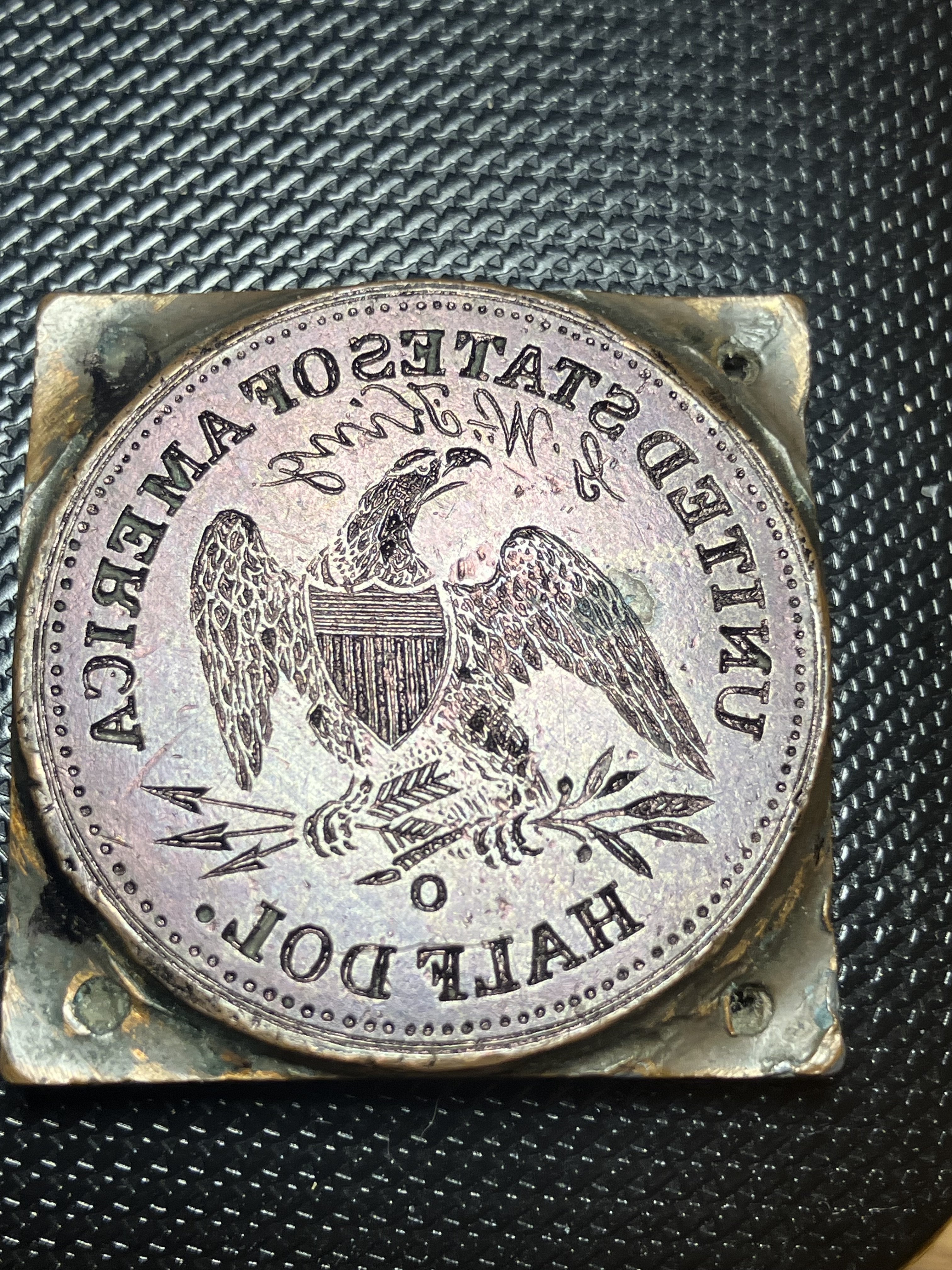
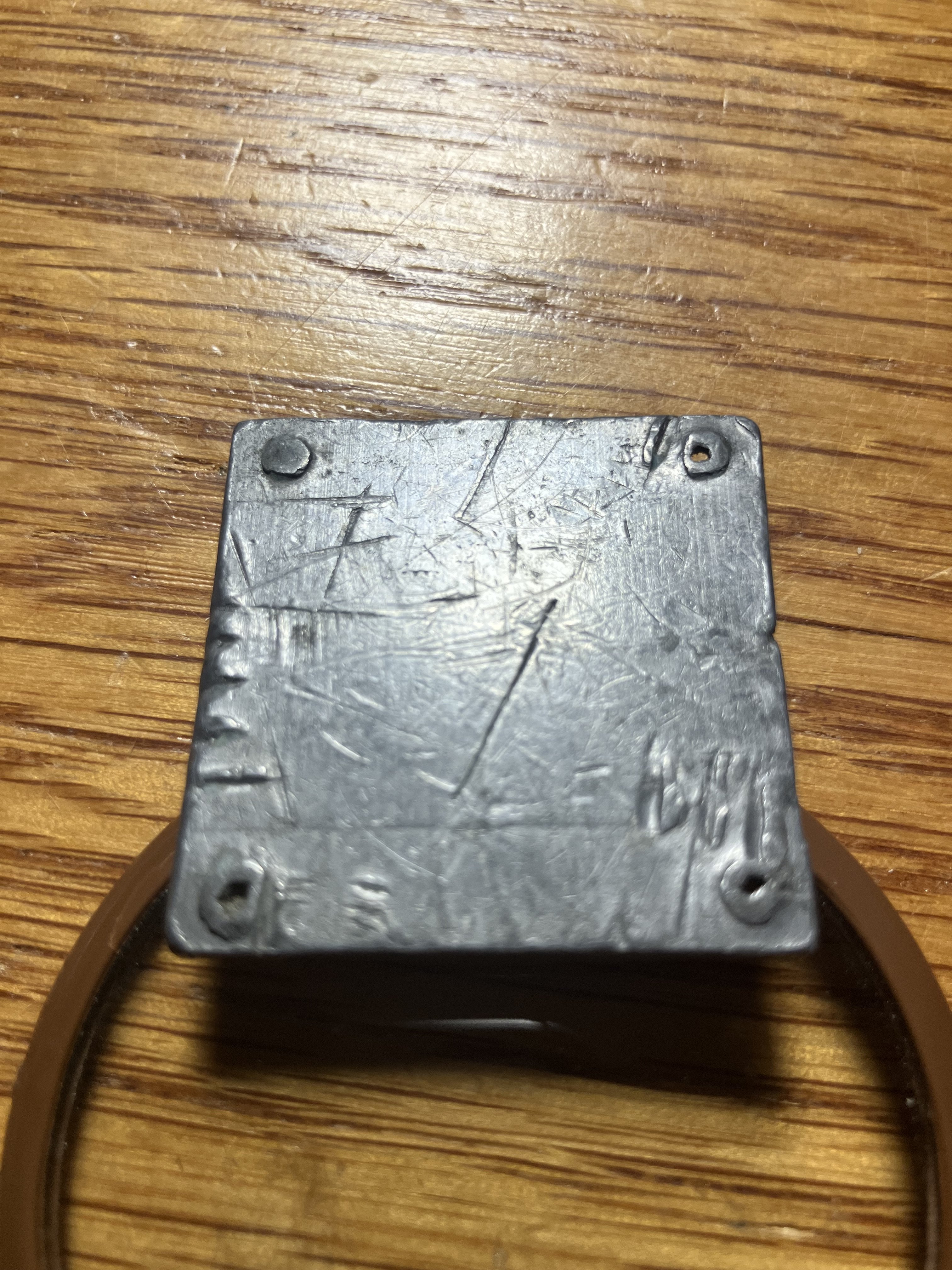
I have owned this for many years, fairly certain someone had it made to use as a business card stamp?
The “coin” is steel and bonded to a lead base and likely at one time attached to a wooden stamper.
The coin side has leftover blue and black ink remaining..
G.W. Ewing perhaps?
Thoughts?
12
Comments
King
@JBK @MsMorrisine
Thank you 🙏
Your technical skills are most appreciated!
That is extremely cool.
In honor of the memory of Cpl. Michael E. Thompson
@wallace
Correction!
@MWallace
Great piece @2windy2fish ! Definitely a numismatic treasure!
Nice
Fascinating. Looks like a counterfeiter's false die, but why is it signed?
AI analysis:
This appears to be a vintage letterpress printing plate (an electrotype or stereotype block) featuring the reverse design of a U.S. Seated Liberty Half Dollar.
Key Visual Features
• Reversed (Mirrored) Design: The lettering—"UNITED STATES OF AMERICA," "HALF DOL.," and the "O" mint mark for the New Orleans Mint—is engraved in reverse so that it reads forward when inked and pressed onto paper.
• Coin Design: The central motif is the heraldic eagle holding three arrows and an olive branch, matching the "No Motto" Seated Liberty Half Dollar reverse minted between 1839 and 1866.
• Added Script Text: Above the eagle, cursive script reading "J. W. King" (or "S. W. King") is engraved into the field, indicating it was likely a custom trade cut used in advertisements, catalogs, business cards, or letterhead.
• Mounting Base: The copper-faced metal shell is mounted onto a square metal backing with pre-drilled corner holes for tacking or securing it into a wooden printing block or press chase.
If you'd like to explore this further, let me know:
• The approximate dimensions (such as the diameter of the circular coin design)
• Whether it is mounted on wood or solid metal on the back
• What you'd like to know (such as how it was made, potential historical context, or collector interest)
DIMENSIONS UNKNOWN, NO BLOCK
Without the wooden mounting block, this unmounted electrotype plate is an intriguing crossover collectible for both printing historians and numismatists (coin collectors).
Historical Context & Purpose
• 19th-Century Advertising Cut: Between 1839 and 1866, the New Orleans Mint ("O" mint mark) struck Seated Liberty Half Dollars. During the mid-to-late 19th century, merchants, bankers, jewelers, and newspaper advertisers frequently used coin illustrations in print ads, price lists, and trade cards to signify value, currency exchange, or "50-cent" promotions.
• Custom Merchant Engraving: The cursive "J. W. King" (or "S. W. King") hand-engraved directly into the field above the eagle mirrors the real-world practice of coin counterstamping—where merchants stamped their names onto circulating silver coins as a form of guerrilla advertising. Having the name built into a printing plate allowed the merchant to repeatedly print their branded coin emblem onto paper ephemera.
• Electrotype Construction: Electrotypes were made by taking a wax or lead impression of an engraved master (or actual coin), coating it in graphite to make it conductive, and electroplating a thin shell of copper over it. That copper shell was then backed with molten lead/type metal (visible around the square flange) and given corner nail holes so a printer could tack it onto a type-high wooden block when ready to print.
Collector Appeal & Value Factors
Because it sits at the intersection of exonumia (coin-related items), early American advertising, and letterpress printing, pieces like this attract niche collectors:
• Unmounted Condition: Having no wooden block is very common for surviving plates, as printers often pried plates off wood blocks to save storage space or reuse the wood. It does not hurt its historical appeal, though a quick ink-pad test print on paper can make it display even better.
• Key Value Drivers: Collector value depends heavily on whether "J. W. King" can be tied to a documented 19th-century merchant, silversmith, watchmaker, or banker (especially in the New Orleans or Gulf Coast region, given the "O" mint mark), as well as the physical size of the plate (whether it is actual coin-sized at ~30.6 mm or a larger display cut).
• Typical Market Range: Generic 19th-century unmounted advertising electrotypes typically sell in the $25 to $75 range, while custom coin-themed cuts with identifiable merchant names or strong numismatic crossover appeal can bring $75 to $150+ among exonumia specialists.
If you'd like to dig deeper into this piece, let me know:
• If there are any maker's marks stamped on the back or edges of the metal
• What you'd like to do next (such as researching the "King" name in historical directories, cleaning/preserving the copper, or making an ink impression on paper)
Gary TheGasMan - Retired Hank Hill
Yes?
70% of people are stupid. I obviously belong to the other 40%.
That is cool Daryl! @2windy2fish
“We are only their care-takers,” he posed, “if we take good care of them, then centuries from now they may still be here … ”
Todd - BHNC #242
I honestly thought this would be right up your alley.
You normally love stuff like this.
I don't think it was a rubber stamp. I think a rubber stamp would ideally be opposite in relief, so that it would just print the letters instead of the field. Although this relief would be much easier to make from a coin.
Maybe an embosser? But why would you emboss paper with a coin image?
Usage to make tokens or counterfeit coins seems most likely.
.
That would never work as a counterfeiting die for stamping metal, even if it were steel, because it is too thin.
And I doubt that it is actually steel. Has it been tested with a magnet ?
My guess is that it is some type of white metal.
The ink is trapped in the recesses of the design (such as the letters).
The rest of the face is wiped clean of ink.
When applied to paper under pressure, the trapped ink adheres to the paper.
This is the basics of intaglio printing.
Here is my printing block with a half-tone image of a Clark Gruber "Mountain" $10.
It was used in the printing of an old book.
Yes, you are correct. I love this type of stuff. I wasn't sure what you were saying. Thank you for tagging me because I hadn't seen it until you did.

70% of people are stupid. I obviously belong to the other 40%.
What is it's size?
A possibility is it could have been used to press into a wax seal on letters.
70% of people are stupid. I obviously belong to the other 40%.
There was a C.W. King who published a book on "Early Christian Numismatics" in the 19th Century in England, illustrated by engravings not unlike these, but I cannot find anything that he did related to American numismatics. And that first initial does not look like a "C." Probably a dead end.
@dcarr You were correct, i just checked and it is not magnetic. Likely white metal with the lead backing.
@MWallace I don’t have a caliper to measure it’s exact size but it fits perfectly into a half dollar 2x2
The first letter looks more like an old style "G".
King George III was George William. Probably not that.
How about this?
https://pioneeramericanphotographers.com/2019/10/22/g-w-king/
70% of people are stupid. I obviously belong to the other 40%.
Plausible.
There was a silversmith G.W. King who operated in the mid 1800s out of New Jersey. This could have been a stamp used in some form of advertisement. The "O" mintmark seems odd for a New Jersey smith though.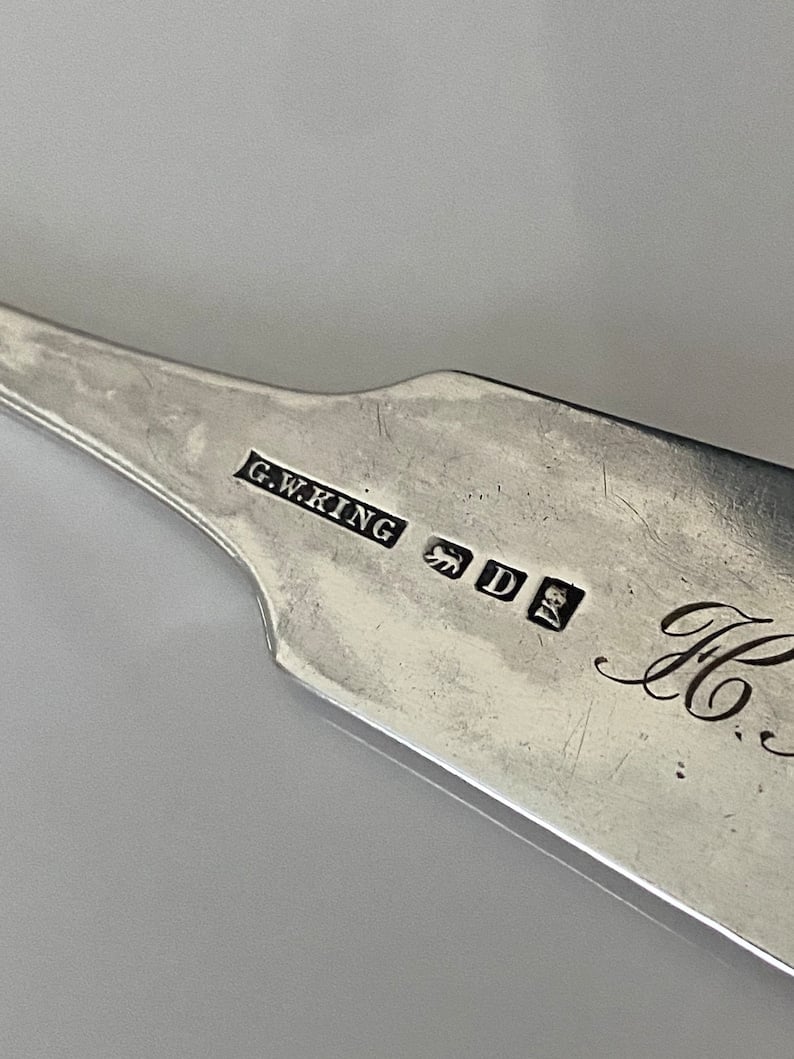
To me, it looks like one half of the dies used in embossing presses during the late 19th century.
Dead Cat Waltz Exonumia
"Coin collecting for outcasts..."