Options
Spanish cob - help needed
 Göttinger
Posts: 240 ✭✭✭
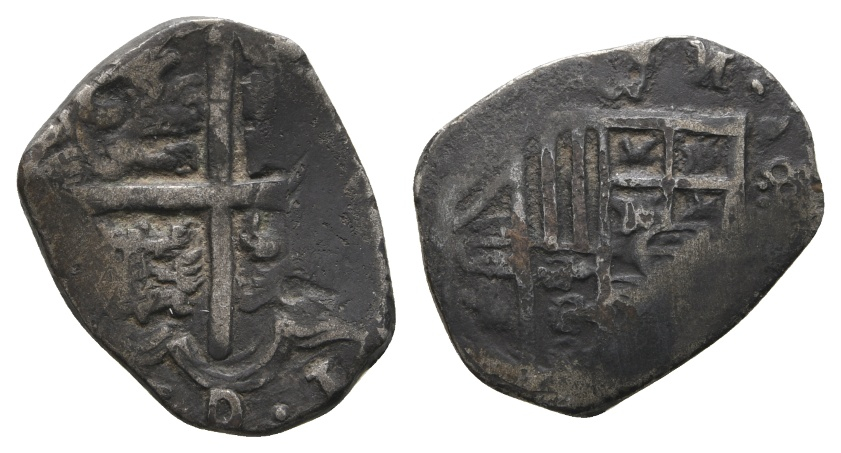
I recently found this coin, offered by a local dealer.
Unfortunately neither him nor me could identify it. Do you have any ideas?
The weight is around 7.2 grams, so it's possibly a 2 reales.
1
Comments
I've bought the coin a few days ago. Seems to be a early 1600's 2 Reales cob from the Spanish mainland.
It's my first cob, I payed 30€ (33 Dollars) for it. Not sure if it was a god deal, but I'll keep the coin as a conversation piece since it's a nice piece of history.
Preface: I’m not an expert
I have a lot of questions about this cob. It’s fairly overweight for a 2R, usually a 2 Reales is 6.75 grams or thereabouts, so that’s different. Perhaps a cut down coin from a larger denomination…maybe.
The things that I notice immediately are 1, the shield looks backwards. Usually the quadrant showing in the top right is located in the top left and visa-versa. Is it possible you inverted the image when posting? 2. The terminations on the cross are rounded ends. I think this shows up occasionally on Spain mainland or Bolivia Potosi, but for the most part, the cross has a design on the ends, sometimes it’s terminated with a “T” other times a flowery design, So that’s mildly funky.
The “N” is inverted. That does happen on occasion with Spanish colonial, but it supports my idea that maybe you’ve got the image flipped.
I see what looks like an 8 and a couple dots. Is it the denomination? Shouldn’t be, but why would there be an eight?
Might this be a counterfeit? Maybe. I’d like to look at it in hand. Plenty of people here would have more info. @realeswatcher @Sapyx
I'm BACK!!! Used to be Billet7 on the old forum.
I'd concur; the backwards-image is disconcerting. If that side of the coin really is backwards, then I'd lean towards counterfeit. If it's an inverted image, then the low weight could be explained by clipping.
Roman emperor Marcus Aurelius, "Meditations"
Apparently I have been awarded the DPOTD twice.
Definite contemporary counterfeit.
Very interesting. I'll take the coin to a place with a xrf-machine when I have the opportunity. Just to see how much silver actually is in this object. I'll keep you updated.
It might actually be worth more as a contemporary counterfeit. They have a following.
I'm BACK!!! Used to be Billet7 on the old forum.
Probably very little. Note the higher points of the shield (Austria bars, for example)... can clearly see where the silvering has come off.
=====
This is why proper photo orientation helps... I've corrected it - not as weird now, right? The shield/cross/lions & castles are not all that odd... the lettering that's visible is mainly jibberish and/or incorrect.
=====
Yes, usually base metal counterfeits like this would be light... and the piece kind of looks shaved down some from the relative design elements (then again, it's a counterfeit, so who knows... not the most exacting standards).
The exception would be if it's primarily lead... then that 7.2g weight would be close enough as a 2R (esp. considering other counterfeits were often much more off to the down side). Definitely could have been intended as a 4R and have been cut down, though.
@Göttinger... I see umlauts. Is this out of Germany or somewhere else in Europe? Definitely has a Central/East European or even Eastern Mediterranean feel to it from my observation over the years.
The design is imitating a homeland Spain proper issue (with the Portuguese escutcheon) - looks enough like a Toledo-style shield to guess that's the coin the forger was trying to copy... As such, it would almost certainly have been produced in the Old World, not the Americas, but it's not the type of counterfeit that I'd expect to see out of Spain itself.
@realeswatcher that DOES help, I’m not sure why I didn’t think of that. Even oriented correctly it’s got some weird stuff.
I'm BACK!!! Used to be Billet7 on the old forum.
Thanks for your reply. You are right, I'm German and located near Göttingen (so I choose "Göttinger" as my profile name).
Since this contemporary counterfeid coin appeared in northern Germany, it's very likely to have come here from mainland Spain. Probably during the 30-years-war, we had a lot of Spanish troops present during those times....