Home U.S. Coin Forum

A Few More Thoughts About War Nickels

cladkingcladking Posts: 29,827 ✭✭✭✭✭

I think I've been underestimating the number already destroyed. I'm basing this on a few observations such as the facts that now days so much of what's being melted are coins that were polished to go into the display cases sold to the general public. Almost none of what was being melted before 1980 contained such coins. This seems to imply it's down to the dregs now days.

If it's true that more than 80% (perhaps as much as 85%) are already gone then this casts everything in a new light because attrition has not affected these coins evenly. There are huge numbers of nice XF and better '43-P's surviving but coins like the '44-S suffered staggering attrition because almost the entire mintage wore out. This means that nice F and better '44-S has already suffered a 95% attrition and are still being destroyed. Perhaps the poster child of destruction is ironically enough the '43/2-P overdate. Almost the entire mintage went into circulation in '43/'44 and acquired extensive wear even before it was finally discovered in the early-'60's. Most coins being melted are not checked for the overdate because it is considered "common". They are in the bags being melted so the 25,000 that survive today will probably be whittled down significantly more.

Attrition has also affected the other varieties in this series unevenly so some common varieties have relatively low attrition and some scarce varieties have high attrition. Survivors will in some cases be almost always highly worn.

A lot of the henning counterfeits are being destroyed and these have been getting very popular. And there's a new book about them.

Collectors can have a field day with these coins.

tempus fugit extra philosophiam.
«134

Comments

  • CopperindianCopperindian Posts: 3,063 ✭✭✭✭✭

    Thanks for the interesting analysis! So my UNC 42-S & 44-D rolls should have good value, if not demand!

    “The thrill of the hunt never gets old”

    PCGS Registry: Screaming Eagles
    Copperindian
    Copperindian II
    Indy Eagles
    Gold Rush

    Retired sets: Soaring Eagles
    Copperindian
    Nickelodeon
    Early Walkers

    Successful transactions: redraider, winesteven, renomedphys, splitaces, oreville, ajaan, Cent1225, onlyroosies, justindan, blitzdude, DesertMoon, johnnyb, Heubschgold, SunshineRareCoins, ParadimeCoins, ndeagles, Southern_Knights, pcgsregistrycollector

  • cladkingcladking Posts: 29,827 ✭✭✭✭✭
    edited March 14, 2026 1:30PM

    These are probably the best two dates in the war nickel series (with the '42-P), but Uncs were always out of my price range so all of mine are ones I've pulled out of bags over the years and was able to clean up. I have no feel for the number of BU's that survive but back in the '60's the old timers were saying BU rolls were "pretty common". The only time attrition was high was briefly in 1979 when silver was sky high. A lot of times these rolls are skunked so they just get dumped into bags and a few of them can be restored to pristine by soaking etc. I would guess the '44-S is a little more common in BU rolls because of its low mintage but future pricing is going to depend a lot on the availability of XF/AU's and of VG and better so this date is underrated. There are few '44-S's in bags and most are AG or dogs. As the price spread between VG and Gem narrows the lower grades will be pulled up for this date and the other heavily circulated dates "42-P/ S, '44- D/S and '45-D. Just remember there will be bags and bags of circulated coins around for many years but these bags won't have much of the better coins.

    The '44-S is probably the best date in every grade except MS-60/ 63. In nice AU the '44-D might be better and gets a lot more attention now. In the old days a lot of '44-S's were held back because of the second lowest mintage in the series.

    To some extent the goalposts move a little as different coins are held back. But what I keep thinking is what if 85% have really been melted already and only about 10% of what's left is worth saving. This would sure make some of these coins tough including all the varieties and some dates as low as VG.

    tempus fugit extra philosophiam.
  • CryptoCrypto Posts: 4,094 ✭✭✭✭✭

    I have been fascinated by war nickels since the early 80s

  • cladkingcladking Posts: 29,827 ✭✭✭✭✭

    @Crypto said:
    I don’t really collect nickels but when I see a cheap interesting one I pick it up. This is where it has taken me centered around war nickels.
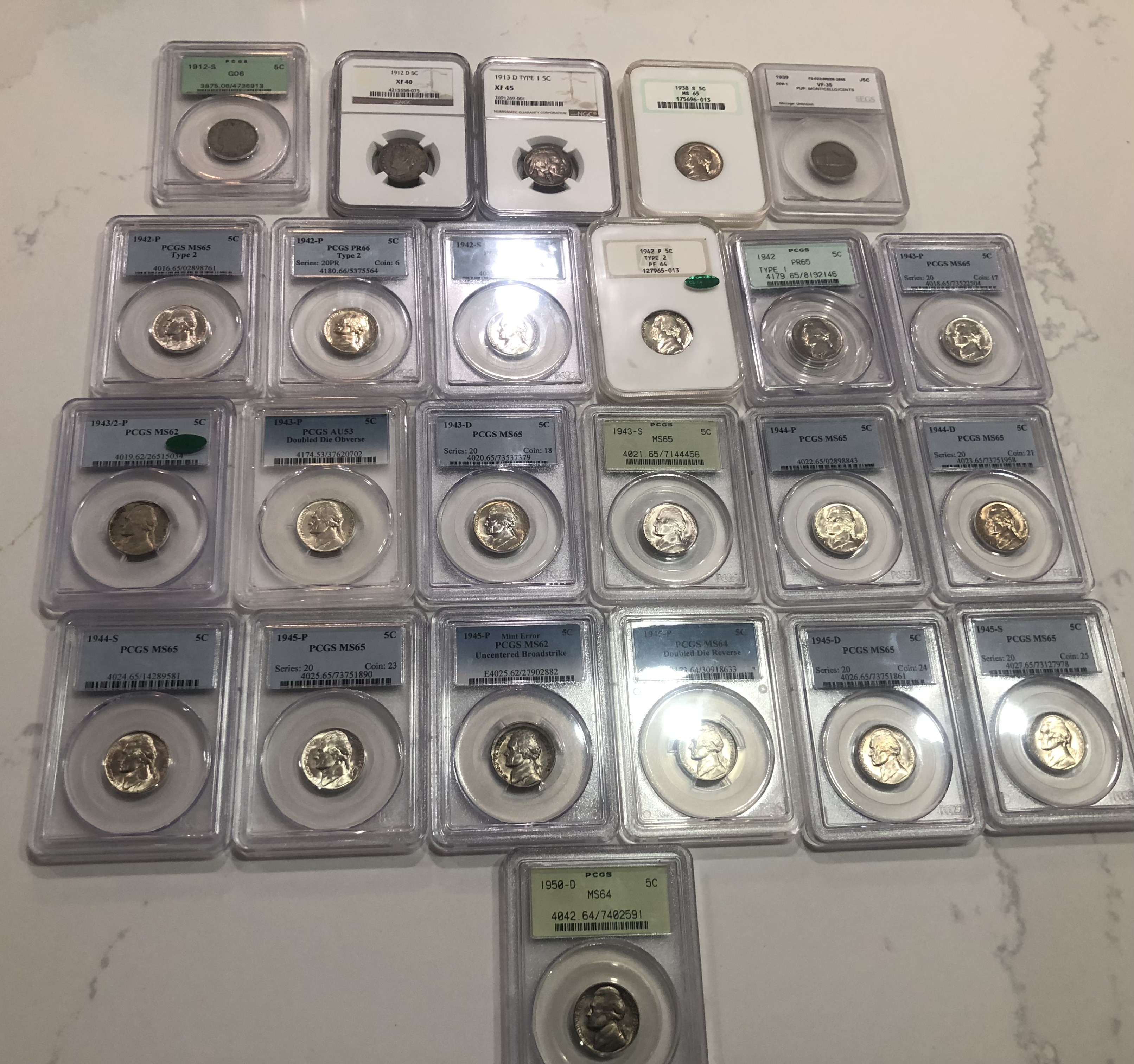
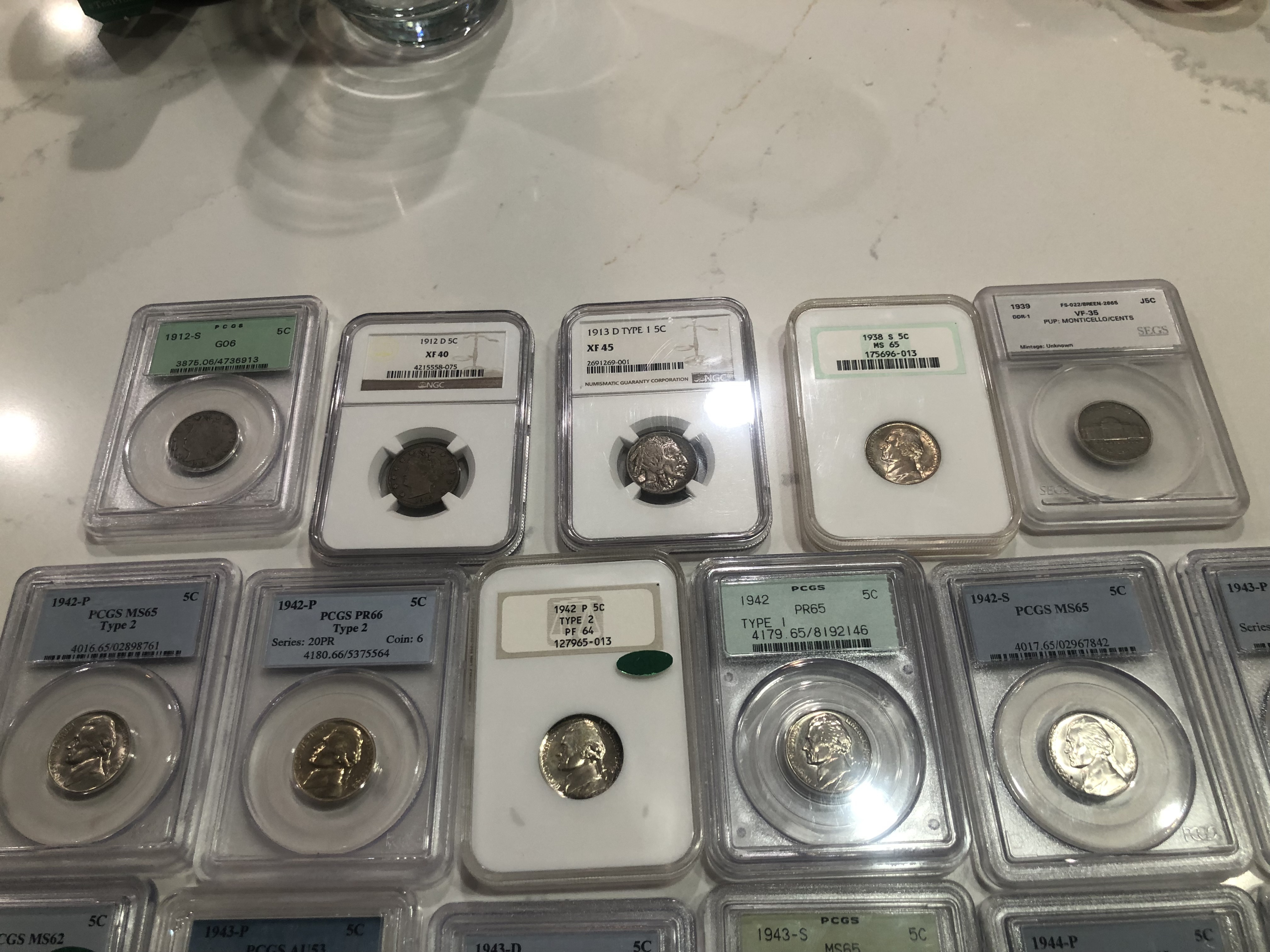
    I should start buying the common BU rolls when I see them close to melt.

    tempus fugit extra philosophiam.
  • CryptoCrypto Posts: 4,094 ✭✭✭✭✭

    @cladking said:

    @Crypto said:
    I don’t really collect nickels but when I see a cheap interesting one I pick it up. This is where it has taken me centered around war nickels.
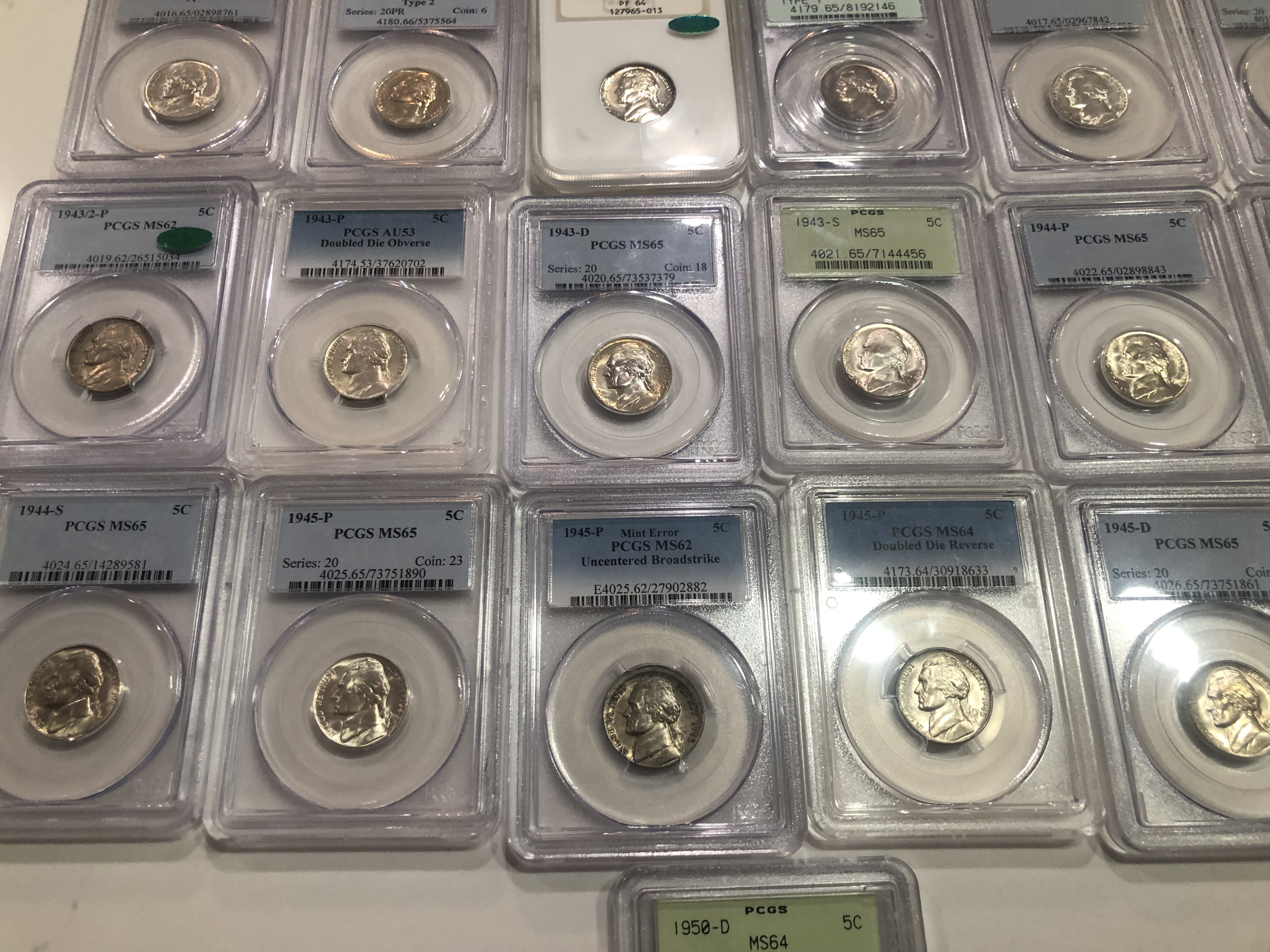
    I should start buying the common BU rolls when I see them close to melt.

    Well current melt is one thing but I agree. When I see commemoratives I’m interested in all one has to do is wait a bit after the hype dies down and you can find them at the basal value often under issue price. There will come a time they are some of the only completable precious sets out there. Will we be alive, maybe not but that day is coming

  • WCCWCC Posts: 3,159 ✭✭✭✭✭

    Here is the PCGS data:

    Here is partial NGC data, as they don't have a summary table and it doesn't fit in one screenshot:

  • CryptoCrypto Posts: 4,094 ✭✭✭✭✭

    I looked at a set in a capital holder but then saw a PCGS set on Ha.com cheap and pulled the trigger, I agree with @BillJones that chasing super grades or FSs is a waste

  • cladkingcladking Posts: 29,827 ✭✭✭✭✭

    @jfriedm56 said:
    Picked this error variety up at a local show awhile back. Cool doubled die.
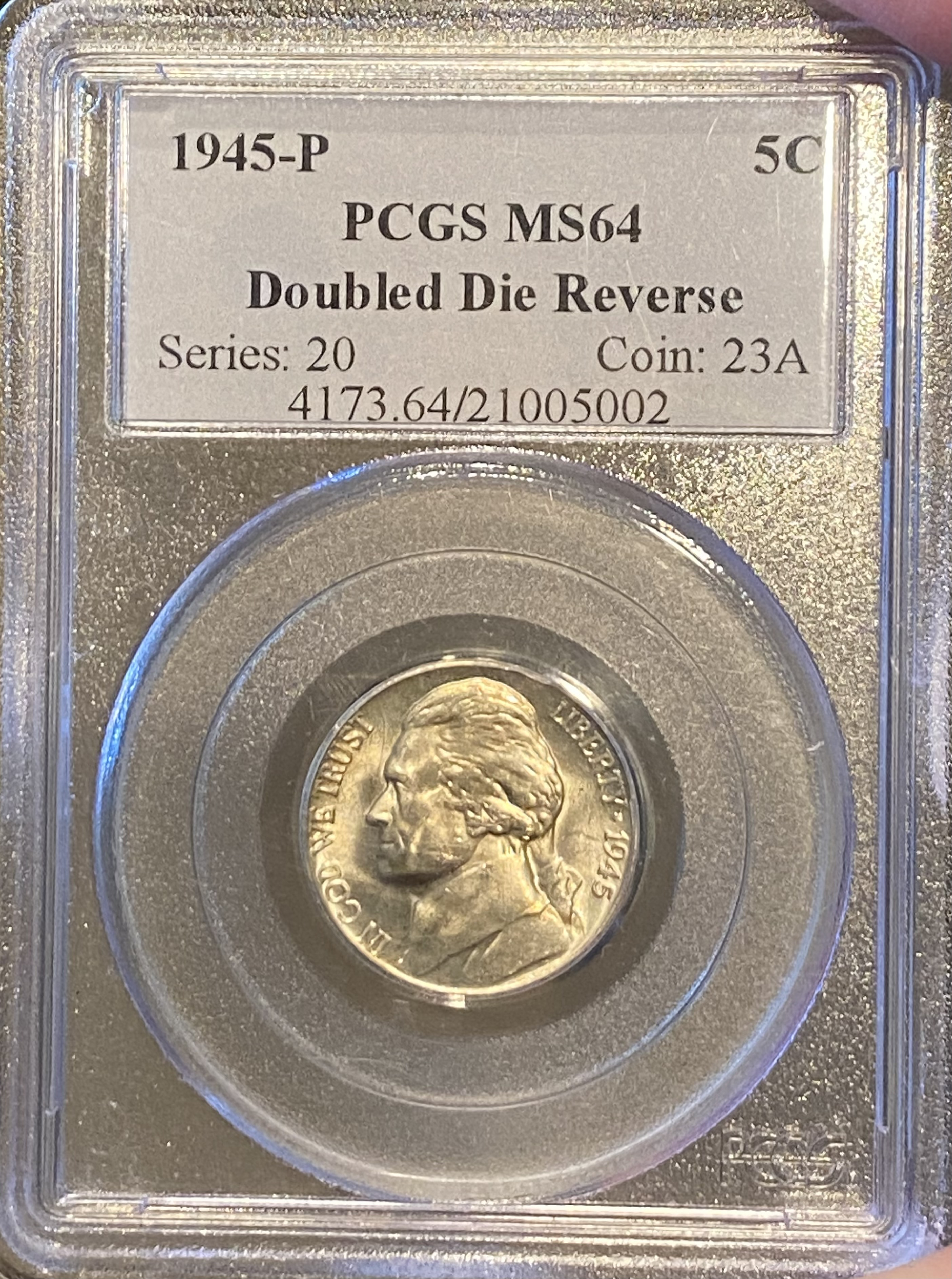
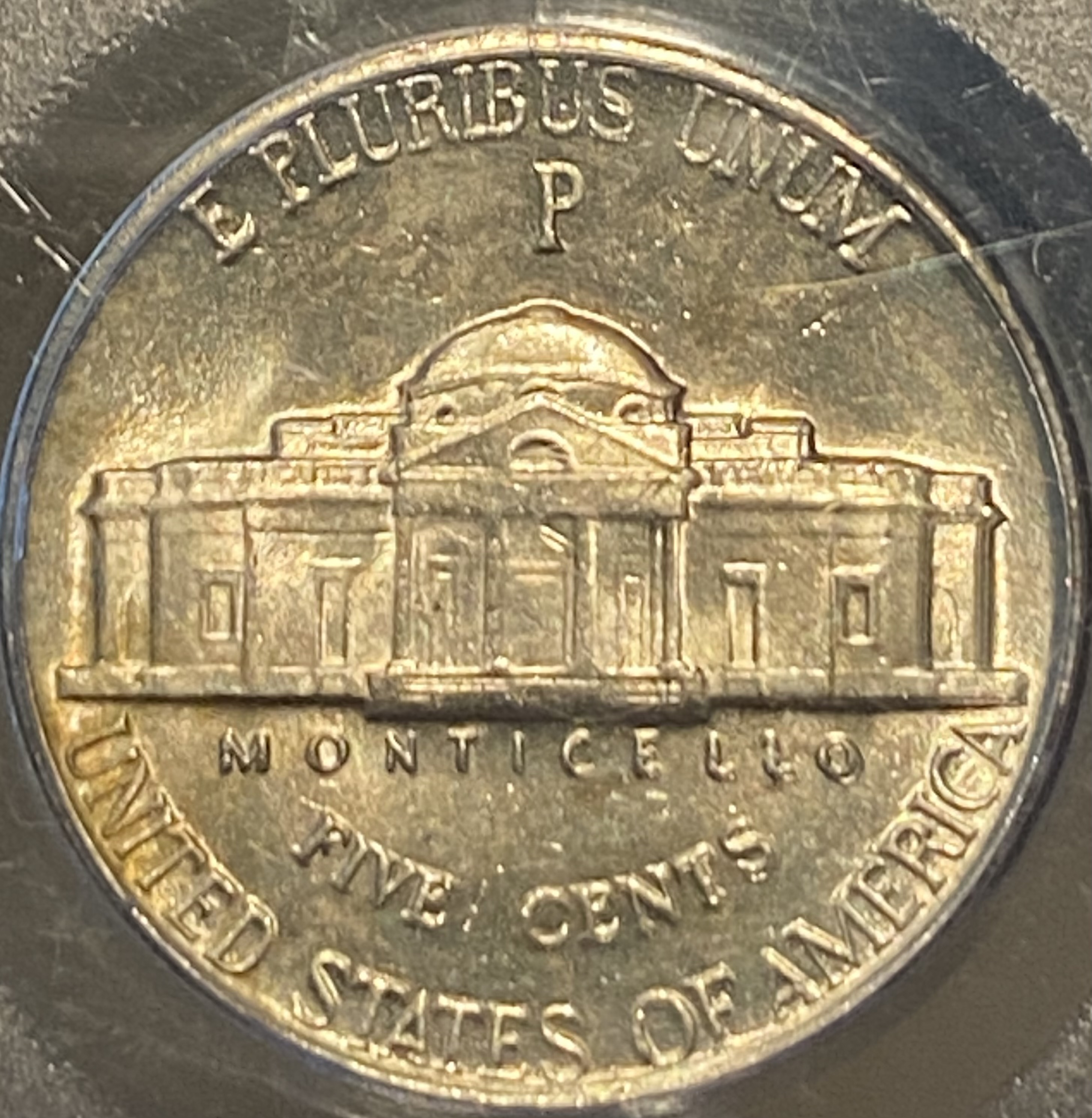
    I just recently started looking for this coin, I confess. It's so easy to be careless searching varieties and this is exactly the sort of variety likely to become very scarce when the rest of these get melted.

    I'm still looking for my first.

    tempus fugit extra philosophiam.
  • jfriedm56jfriedm56 Posts: 2,853 ✭✭✭✭✭

    @cladking said:

    @jfriedm56 said:
    Picked this error variety up at a local show awhile back. Cool doubled die.
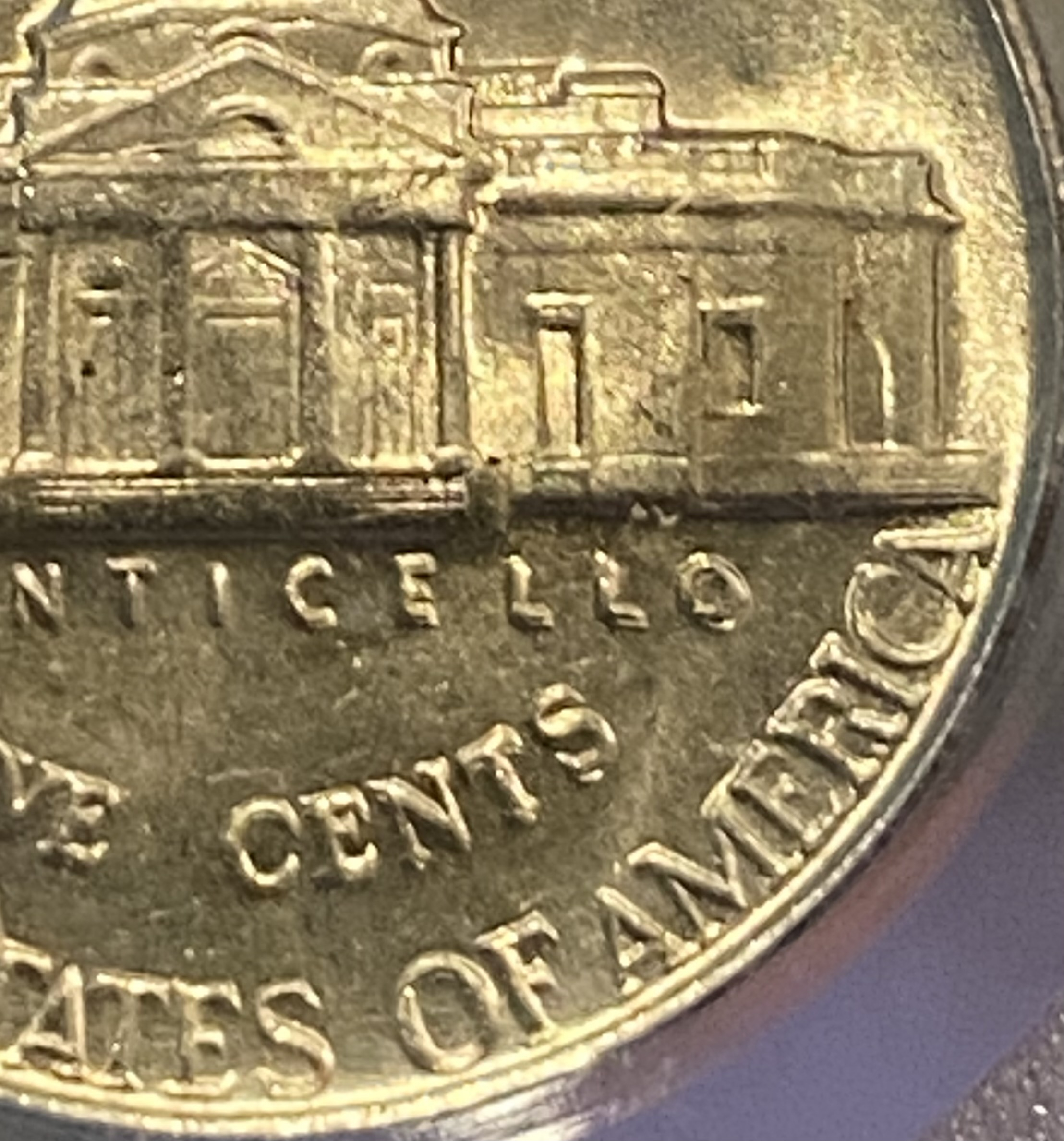
    I just recently started looking for this coin, I confess. It's so easy to be careless searching varieties and this is exactly the sort of variety likely to become very scarce when the rest of these get melted.

    I'm still looking for my first.

    Yeah, for a couple hundred dollars it’s a cool, visible doubled die on a silver War nickel.

  • ambro51ambro51 Posts: 14,307 ✭✭✭✭✭

    Amazing how nice these are in BU and then how they became dark ugly stinky things after 20-30 years of circulation

  • cladkingcladking Posts: 29,827 ✭✭✭✭✭

    @ambro51 said:
    Amazing how nice these are in BU and then how they became dark ugly stinky things after 20-30 years of circulation

    They are quite often nice attractive coins after a good cleaning. Of course most of them are heavily worn and cull but the nice VF and better coins often clean up pretty nice.

    They are much dirtier than most old retired coins.

    I think they wanted them to darken to remind people we were at war and tempus fugit.

    tempus fugit extra philosophiam.
  • ambro51ambro51 Posts: 14,307 ✭✭✭✭✭

    There were so many of these in circulation in the mid ‘60s I’d slide a whole roll of nickels out in my hand and pick out the buffalos from the old rounded rims and the war nickels by the color. Back then there was an immense flood is shiny new 1964s, flashy rims…

  • OverdateOverdate Posts: 7,306 ✭✭✭✭✭

    These started being melted around 1963, and I sold several rolls to smelters for pocket money during that time. (Postage rates were much cheaper then.)

    I would guess that between normal attrition and melting, more than half the war nickels had disappeared by the time 90% began being melted several years later. Contributing to the higher melt rate, then and over the subsequent 55+ years, was the fact that there was little demand from stackers, since the coins were only 35% silver and would have occupied much more space per ounce than the 90% coins.

    I think the 85% estimate of lost or melted war nickels might be too low. I wouldn't be surprised if survival rates are less than 10% for most dates. Since demand is nonexistent for worn war nickels from either stackers or collectors, I expect melting to continue for the foreseeable future.

  • cladkingcladking Posts: 29,827 ✭✭✭✭✭

    @Overdate said:
    These started being melted around 1963, and I sold several rolls to smelters for pocket money during that time. (Postage rates were much cheaper then.)

    I would guess that between normal attrition and melting, more than half the war nickels had disappeared by the time 90% began being melted several years later. Contributing to the higher melt rate, then and over the subsequent 55+ years, was the fact that there was little demand from stackers, since the coins were only 35% silver and would have occupied much more space per ounce than the 90% coins.

    I think the 85% estimate of lost or melted war nickels might be too low. I wouldn't be surprised if survival rates are less than 10% for most dates. Since demand is nonexistent for worn war nickels from either stackers or collectors, I expect melting to continue for the foreseeable future.

    There is a retail demand for them.

    I mentioned that there are a lot of shiny polished coins that are found in bags now days. These are coins that were polished to make the wall display sets that were so common in the '50's to '80's. These guys would polish anything except culls and anything worn smooth but now days retail demand is much more sophisticated. They want nice G or better all the way up to nice chAU. It remains to be seen how many of these markets survive higher silver prices but the coins are still being melted and most of what is melted is random. Scarce coins are being melted in the same ratios as common coins and this is going to make them quite elusive if it continues.

    Coins being melted have similar numbers of G+ '44-S and polished coins in them! No one is very likely to ever want the polished coins but a '44-S is needed in every complete Jefferson Nickel collection, every complete set of war nickels, and every set of wartime coinage, etc.

    I think we'll see the melting stop in only a very few more years because they're gonna just about be all gone. Sure, there will still be millions around in small and larger accumulations but these will probably be searched before they are destroyed.

    tempus fugit extra philosophiam.
  • wondercoinwondercoin Posts: 17,124 ✭✭✭✭✭

    “There is a retail demand for them.”

    It’s not retail demand. It’s wholesale demand, but at strong prices. The coins are given away as the “losing prize” in the lottery type games where folks are generally pursuing a gold coin of varying sizes. Since most of the “players” lose in their quest for a gold coin, they get a war nickel. They don’t want a war nickel and eventually many of these coins will likely just find there way back to coin shops when the “losing players” want to raise a few bucks.

    Wondercoin.

    Please visit my website at www.wondercoins.com and my ebay auctions under my user name www.wondercoin.com.
  • WCCWCC Posts: 3,159 ✭✭✭✭✭

    I'd guess the actual number existing in similar quality to the current NGC and PCGS populations isn't a small multiple. It's not like these coins are worth that much even in higher grades where the incentive to grade more than a low proportion is that high.

    Checking recent eBay sales, raw complete "BU" sets seem to be valued in the $100 to $200 range. Nicer ones (somewhat) more.

  • OverdateOverdate Posts: 7,306 ✭✭✭✭✭

    During the mania of 1963-64, rolls of nickels were being actively searched for keys and semi-keys. The 1943-D, and to a lesser extent the 1944-S, were both being pulled from circulation due to their mintage, not the fact that they were war nickels. Most anything with a mintage below 30 million was fair game.

    The premium on average circulated specimens of these two dates disappeared decades ago, but many likely continue to exist in hoards that were assembled beginning in the early 1960's. The remaining dates are probably being melted in proportion to their original mintage.

  • cladkingcladking Posts: 29,827 ✭✭✭✭✭

    @WCC said:
    I'd guess the actual number existing in similar quality to the current NGC and PCGS populations isn't a small multiple. It's not like these coins are worth that much even in higher grades where the incentive to grade more than a low proportion is that high.

    I think you're guessing wrong. You're right that graded coins are a multiple of total population but they are also the best of the best. You are also forgetting that most of this total population is in deplorable condition. I've seen a virtually perfect P-1 1943-P and a couple of dateless coins over the years. Nasty stains and uneven tarnish as well as frequent mutilation lie on top of a population that is dirty and tired out.

    The total number of attractive coins are the determinant of supply if future collectors acquire the coins through intent. These numbers are not a large multiple of graded populations. They aren't tiny compared to some modern clad coins (et al), but they are small compared to the number of potential Jefferson Nickel collectors.

    tempus fugit extra philosophiam.
  • cladkingcladking Posts: 29,827 ✭✭✭✭✭

    @wondercoin said:
    They don’t want a war nickel and eventually many of these coins will likely just find there way back to coin shops when the “losing players” want to raise a few bucks.

    Wondercoin.

    They'll exit the general population in all manner of ways but the rarity might be a direct trip to the coin shop. Many will be lost in all manner of ways.

    Thanks for the information.

    It's fun to watch what happens to coins.

    tempus fugit extra philosophiam.
  • CaptHenwayCaptHenway Posts: 33,627 ✭✭✭✭✭

    Fun fact: at the “official” silver price of $1.2929 an ounce, where the silver in a standard silver dollar was worth exactly one dollar, the warnix had over 7 cents worth of silver in them when first issued. However, the market price of silver was only about half of that.

    Numismatist. 54 year member ANA. Former ANA Senior Authenticator. Winner of four ANA Heath Literary Awards; three Wayte and Olga Raymond Literary Awards; Numismatist of the Year Award 2009, and ANA Lifetime Achievement Award 2020. Author of "The Enigmatic Lincoln Cents of 1922," Available now from Whitman or Amazon.
  • OverdateOverdate Posts: 7,306 ✭✭✭✭✭
    edited March 21, 2026 1:56PM

    @cladking said:
    . . . most of this total population is in deplorable condition. I've seen a virtually perfect P-1 1943-P and a couple of dateless coins over the years. Nasty stains and uneven tarnish as well as frequent mutilation lie on top of a population that is dirty and tired out.

    >
    Even in the early 1960's, typical war nickels showed much more wear than surrounding dates in the 1930's and 40's. With today's small premium between the highest and lowest circulated grades, there will likely be little or no demand by current and future collectors for any grade below VF. I expect that lower grades will continue to be melted for the foreseeable future.

  • WCCWCC Posts: 3,159 ✭✭✭✭✭

    @cladking said:

    @WCC said:
    I'd guess the actual number existing in similar quality to the current NGC and PCGS populations isn't a small multiple. It's not like these coins are worth that much even in higher grades where the incentive to grade more than a low proportion is that high.

    I think you're guessing wrong. You're right that graded coins are a multiple of total population but they are also the best of the best.

    NGC and PCGS have graded over 10,000 of each date/MM, with those graded MS-66 or higher several 000 each. There must be at least 00s of 000s of each date/MM in similar quality, as recent eBay sales demonstrate that MS-66 sell for somewhat more or even less than the cost of grading. This isn't a low number, except to you who continues to believe in an exaggerated collector base.

    @cladking said:

    You are also forgetting that most of this total population is in deplorable condition. I've seen a virtually perfect P-1 1943-P and a couple of dateless coins over the years. Nasty stains and uneven tarnish as well as frequent mutilation lie on top of a population that is dirty and tired out.

    It's evident from recent eBay sales that it is selling now down to at least mid-circulated quality. It still has a premium to the metal content. At higher silver prices, it eventually won't but then, these collectors will just stop buying it. That's what happens when the collector preference doesn't exceed the melt value. Happens with other coinage too.

    @cladking said:

    @WCC said:

    The total number of attractive coins are the determinant of supply if future collectors acquire the coins through intent. These numbers are not a large multiple of graded populations. They aren't tiny compared to some modern clad coins (et al), but they are small compared to the number of potential Jefferson Nickel collectors.

    You and I have a completely different definition of "large". I'm quite confident each and every date has at least 00s of 000s in similar quality to the TPG pops and an even larger multiple in lower UNC, potentially 1MM+. There is no future where the collector base for this series or even generally will ever come close to the numbers you have implied. Your mass market will never happen.

  • OverdateOverdate Posts: 7,306 ✭✭✭✭✭

    @WCC said:
    I'm quite confident each and every date has at least 00s of 000s in similar quality to the TPG pops and an even larger multiple in lower UNC, potentially 1MM+.

    >
    >
    There are fewer than 20 rolls of uncirculated war nickels (all dates) available on eBay at the moment. If there were nearly as many as you estimate, I would expect to see quite a bit more for sale there.

  • cladkingcladking Posts: 29,827 ✭✭✭✭✭

    @Overdate said:

    @WCC said:
    I'm quite confident each and every date has at least 00s of 000s in similar quality to the TPG pops and an even larger multiple in lower UNC, potentially 1MM+.

    >
    >
    There are fewer than 20 rolls of uncirculated war nickels (all dates) available on eBay at the moment. If there were nearly as many as you estimate, I would expect to see quite a bit more for sale there.

    He's doing the math wrong.

    If you start with the assumption that very few "modern" rolls have been checked for Gems this is where you'll end up. First off these aren't moderns so a significant percentage have been searched. Many of these come very nice so there aren't as many rejects as he's "calculating". And finally there is the fact that these coins are often skunked in the roll which then gets dumped into bags destined for the refinery. Most bags will have 30 or 40 skunked coins a few of which can be saved. This has been going on for many years and you'll see lots of skunked sliders as well as some AU-55's and 53's with severe tarnish.

    This overhang of circulated coins is just awful (all of them). If you ignore the common dates that are often seen in high grade only about 20% of the coins can be described as Good or better. But this number doesn't reveal the real problem which is the tough dates are grossly underrepresented. The same coins that are tough in BU rolls tend to be tough in G and better.

    Since millions of these coins will still be around for many years this caps the price that a '43-P can go at a very low level but even in the millions and millions of survivors in ten years the number of nice G and better '44-S's will be quite small and I doubt anyone has even started saving them yet.

    The entire mintage of some of these coins is being obliterated.

    This especially applies to the wholly unloved overdate. @CaptHenway reminded me of the actual course of events with this coin. I did not pay much attention to it until after the Coin World article and hadn't actually seen one earlier. Before the article I probably wouldn't have looked at one of these hard enough to notice the overdate. All of mine have come since. This coin has already been obliterated. The only reason there are any high grade coins is that there are a few in BU rolls. Almost everything found in circulation is VG or lower. Most of these were gone before anyone was looking and now they are being melted in nearly the same proportions as a worn out '42-P. Dependent on their incidence in BU rolls we might not be able to save even 5% of the mintage.

    tempus fugit extra philosophiam.
  • WCCWCC Posts: 3,159 ✭✭✭✭✭
    edited March 22, 2026 7:01AM

    @cladking said:

    @Overdate said:

    @WCC said:
    I'm quite confident each and every date has at least 00s of 000s in similar quality to the TPG pops and an even larger multiple in lower UNC, potentially 1MM+.

    >
    >
    There are fewer than 20 rolls of uncirculated war nickels (all dates) available on eBay at the moment. If there were nearly as many as you estimate, I would expect to see quite a bit more for sale there.

    He's doing the math wrong.

    There aren't that many rolls of any other 60's circulating coin on eBay either. Go look for yourself because I have. Does anyone really believe eBay is representative of the supply of BU 60's dimes and quarters? This coinage didn't circulate that long. Has the vast majority really been melted?

    As singles, these coins disproportionately aren't worth the bother of listing. Why would coins of such value be sold in much larger volume on eBay?

    Whether it's "millions", 00s of 000s, or even a lower number, it still has no bearing on the inference in your thread. In MS-66, these coins sell in the vicinity of the cost of grading in some instances as eBay proves. The world isn't at risk of "running out" of this coinage, and there is no credibility the collector base is going to increase as you're implying either. This coinage doesn't and never did have the collector preference you've implied. This coinage is as popular as it's likely ever going to be, as your 60's collecting model is obsolete and collectors never did prefer their circulating change.

    To give everyone another example, eBay lists in the range of 300 Mexico pillar dollars for all 40 dates. Yes, I know it's not a US coin but it's one actually worth the effort of selling with a much higher collector preference. For anyone who' is counting, that's 300 out of an original mintage estimated to be approximately 260MM with 1MM+ likely remaining. But even if only 00s of 000s, where are the rest?

    It's not on eBay or anyone's local B&M either. It's in a collection or "change jar", somewhere. I used pillar dollars as an example but it's no different for the vast majority of coins.

  • WCCWCC Posts: 3,159 ✭✭✭✭✭

    @cladking said:

    If you start with the assumption that very few "modern" rolls have been checked for Gems this is where you'll end up. First off these aren't moderns so a significant percentage have been searched. Many of these come very nice so there aren't as many rejects as he's "calculating". And finally there is the fact that these coins are often skunked in the roll which then gets dumped into bags destined for the refinery. Most bags will have 30 or 40 skunked coins a few of which can be saved. This has been going on for many years and you'll see lots of skunked sliders as well as some AU-55's and 53's with severe tarnish.

    Any "calculating" I do regardless of the coins is based upon assumptions which are far more accurate than yours. To start, I don't assume that "what you see is what you get" because I know that no one is in a position to observe the survival and quality distribution with the accuracy you claim and imply, and this includes you.

    I know the mintages weren't low, it was hoarded, and the number set aside wasn't low or else the TPG pops would be much lower. I don't claim to know how many were melted or set aside generically but also know that, given the scale of collecting shortly after, collectors didn't wait until decades after the coins entered circulation and didn't just set aside junk either. Yes, this means collectors at the time saw quality mostly better than you have. Except for a short time in 1980, given the historical value of an UNC and historical silver prices, I infer there would have been no reason to melt high quality silver war nickels in such large numbers either.

    .> @cladking said:

    This overhang of circulated coins is just awful (all of them). If you ignore the common dates that are often seen in high grade only about 20% of the coins can be described as Good or better. But this number doesn't reveal the real problem which is the tough dates are grossly underrepresented. The same coins that are tough in BU rolls tend to be tough in G and better.

    Since millions of these coins will still be around for many years this caps the price that a '43-P can go at a very low level but even in the millions and millions of survivors in ten years the number of nice G and better '44-S's will be quite small and I doubt anyone has even started saving them yet.

    The entire mintage of some of these coins is being obliterated.

    I'm not making any claims for circulated coinage. It has no market relevance since the supply doesn't constrain anyone from buying what they want. Anyone can buy a circulated war nickel on eBay now for $5 to $6. Anyone who can't afford that can't afford to collect at all in 2026.

  • jmlanzafjmlanzaf Posts: 40,295 ✭✭✭✭✭
    edited March 22, 2026 7:28AM

    @WCC said:

    @cladking said:

    If you start with the assumption that very few "modern" rolls have been checked for Gems this is where you'll end up. First off these aren't moderns so a significant percentage have been searched. Many of these come very nice so there aren't as many rejects as he's "calculating". And finally there is the fact that these coins are often skunked in the roll which then gets dumped into bags destined for the refinery. Most bags will have 30 or 40 skunked coins a few of which can be saved. This has been going on for many years and you'll see lots of skunked sliders as well as some AU-55's and 53's with severe tarnish.

    Any "calculating" I do regardless of the coins is based upon assumptions which are far more accurate than yours. To start, I don't assume that "what you see is what you get" because I know that no one is in a position to observe the survival and quality distribution with the accuracy you claim and imply, and this includes you.

    I know the mintages weren't low, it was hoarded, and the number set aside wasn't low or else the TPG pops would be much lower. I don't claim to know how many were melted or set aside generically but also know that, given the scale of collecting shortly after, collectors didn't wait until decades after the coins entered circulation and didn't just set aside junk either. Yes, this means collectors at the time saw quality mostly better than you have. Except for a short time in 1980, given the historical value of an UNC and historical silver prices, I infer there would have been no reason to melt high quality silver war nickels in such large numbers either.

    .> @cladking said:

    This overhang of circulated coins is just awful (all of them). If you ignore the common dates that are often seen in high grade only about 20% of the coins can be described as Good or better. But this number doesn't reveal the real problem which is the tough dates are grossly underrepresented. The same coins that are tough in BU rolls tend to be tough in G and better.

    Since millions of these coins will still be around for many years this caps the price that a '43-P can go at a very low level but even in the millions and millions of survivors in ten years the number of nice G and better '44-S's will be quite small and I doubt anyone has even started saving them yet.

    The entire mintage of some of these coins is being obliterated.

    I'm not making any claims for circulated coinage. It has no market relevance since the supply doesn't constrain anyone from buying what they want. Anyone can buy a circulated war nickel on eBay now for $5 to $6. Anyone who can't afford that can't afford to collect at all in 2026.

    About 15 years ago, a dealer friend of mine bought 20 BU rolls of War nickels from one estate. Genuine BU, everything we sent in graded 65 to 67. He gave them to me to search for varieties and we split the finds.

    While I'm sure some melting occurred, I think people (you know who you are) are vastly overestimating the amount. It has rarely been profitable to melt these because they are the worst source of silver in the US scrap heap. To wit, effectively none got melted in the run up to $117.

    All comments reflect the opinion of the author, even when irrefutably accurate.

  • WCCWCC Posts: 3,159 ✭✭✭✭✭

    @jmlanzaf said:

    @WCC said:

    @cladking said:

    If you start with the assumption that very few "modern" rolls have been checked for Gems this is where you'll end up. First off these aren't moderns so a significant percentage have been searched. Many of these come very nice so there aren't as many rejects as he's "calculating". And finally there is the fact that these coins are often skunked in the roll which then gets dumped into bags destined for the refinery. Most bags will have 30 or 40 skunked coins a few of which can be saved. This has been going on for many years and you'll see lots of skunked sliders as well as some AU-55's and 53's with severe tarnish.

    Any "calculating" I do regardless of the coins is based upon assumptions which are far more accurate than yours. To start, I don't assume that "what you see is what you get" because I know that no one is in a position to observe the survival and quality distribution with the accuracy you claim and imply, and this includes you.

    I know the mintages weren't low, it was hoarded, and the number set aside wasn't low or else the TPG pops would be much lower. I don't claim to know how many were melted or set aside generically but also know that, given the scale of collecting shortly after, collectors didn't wait until decades after the coins entered circulation and didn't just set aside junk either. Yes, this means collectors at the time saw quality mostly better than you have. Except for a short time in 1980, given the historical value of an UNC and historical silver prices, I infer there would have been no reason to melt high quality silver war nickels in such large numbers either.

    .> @cladking said:

    This overhang of circulated coins is just awful (all of them). If you ignore the common dates that are often seen in high grade only about 20% of the coins can be described as Good or better. But this number doesn't reveal the real problem which is the tough dates are grossly underrepresented. The same coins that are tough in BU rolls tend to be tough in G and better.

    Since millions of these coins will still be around for many years this caps the price that a '43-P can go at a very low level but even in the millions and millions of survivors in ten years the number of nice G and better '44-S's will be quite small and I doubt anyone has even started saving them yet.

    The entire mintage of some of these coins is being obliterated.

    I'm not making any claims for circulated coinage. It has no market relevance since the supply doesn't constrain anyone from buying what they want. Anyone can buy a circulated war nickel on eBay now for $5 to $6. Anyone who can't afford that can't afford to collect at all in 2026.

    About 15 years ago, a dealer friend of mine bought 20 BU rolls of War nickels from one estate. Behind BU, everything we sent in graded 65 to 67. He gave them to me to search for varieties and we split the finds.

    While I'm sure some melting occurred, I think people (you know who you are) are vastly overestimating the amount. It has rarely been profitable to melt these because they are the worst source of silver in the US scrap heap. To wit, effectively none got melted in the run up to $117.

    Recent sales on a raw UNC on eBay are $10+. Silver would have to be over $200 to even think about melting one, if they know anything about collecting or even basic economics.

    The most likely coins I believe to be observable for sale representative of the supply are 60's US circulating design key and semi-key dates (e.g., 09-S VDB cent, 16-D dime) plus generic Morgan and Peace dollars, plus generic pre-1933 gold. The reason being that this coinage is sufficiently common and with a high enough collector preference where the market value provides enough motivation to sell it in larger number. This doesn't apply to many other coins, if any at all.

    Maybe a few others are also evident in the wholesale market only dealers mostly see but I don't have any insight into that.

  • jmlanzafjmlanzaf Posts: 40,295 ✭✭✭✭✭

    @WCC said:

    @jmlanzaf said:

    @WCC said:

    @cladking said:

    If you start with the assumption that very few "modern" rolls have been checked for Gems this is where you'll end up. First off these aren't moderns so a significant percentage have been searched. Many of these come very nice so there aren't as many rejects as he's "calculating". And finally there is the fact that these coins are often skunked in the roll which then gets dumped into bags destined for the refinery. Most bags will have 30 or 40 skunked coins a few of which can be saved. This has been going on for many years and you'll see lots of skunked sliders as well as some AU-55's and 53's with severe tarnish.

    Any "calculating" I do regardless of the coins is based upon assumptions which are far more accurate than yours. To start, I don't assume that "what you see is what you get" because I know that no one is in a position to observe the survival and quality distribution with the accuracy you claim and imply, and this includes you.

    I know the mintages weren't low, it was hoarded, and the number set aside wasn't low or else the TPG pops would be much lower. I don't claim to know how many were melted or set aside generically but also know that, given the scale of collecting shortly after, collectors didn't wait until decades after the coins entered circulation and didn't just set aside junk either. Yes, this means collectors at the time saw quality mostly better than you have. Except for a short time in 1980, given the historical value of an UNC and historical silver prices, I infer there would have been no reason to melt high quality silver war nickels in such large numbers either.

    .> @cladking said:

    This overhang of circulated coins is just awful (all of them). If you ignore the common dates that are often seen in high grade only about 20% of the coins can be described as Good or better. But this number doesn't reveal the real problem which is the tough dates are grossly underrepresented. The same coins that are tough in BU rolls tend to be tough in G and better.

    Since millions of these coins will still be around for many years this caps the price that a '43-P can go at a very low level but even in the millions and millions of survivors in ten years the number of nice G and better '44-S's will be quite small and I doubt anyone has even started saving them yet.

    The entire mintage of some of these coins is being obliterated.

    I'm not making any claims for circulated coinage. It has no market relevance since the supply doesn't constrain anyone from buying what they want. Anyone can buy a circulated war nickel on eBay now for $5 to $6. Anyone who can't afford that can't afford to collect at all in 2026.

    About 15 years ago, a dealer friend of mine bought 20 BU rolls of War nickels from one estate. Behind BU, everything we sent in graded 65 to 67. He gave them to me to search for varieties and we split the finds.

    While I'm sure some melting occurred, I think people (you know who you are) are vastly overestimating the amount. It has rarely been profitable to melt these because they are the worst source of silver in the US scrap heap. To wit, effectively none got melted in the run up to $117.

    Recent sales on a raw UNC on eBay are $10+. Silver would have to be over $200 to even think about melting one, if they know anything about collecting or even basic economics.

    The most likely coins I believe to be observable for sale representative of the supply are 60's US circulating design key and semi-key dates (e.g., 09-S VDB cent, 16-D dime) plus generic Morgan and Peace dollars, plus generic pre-1933 gold. The reason being that this coinage is sufficiently common and with a high enough collector preference where the market value provides enough motivation to sell it in larger number. This doesn't apply to many other coins, if any at all.

    Maybe a few others are also evident in the wholesale market only dealers mostly see but I don't have any insight into that.

    I wasn't talking about melting BUs. I'm talking about melting VGs. It has rarely been economical... even at $117, none got melted.

    All comments reflect the opinion of the author, even when irrefutably accurate.

  • OverdateOverdate Posts: 7,306 ✭✭✭✭✭
    edited March 22, 2026 9:19AM

    @jmlanzaf said:
    While I'm sure some melting occurred, I think people (you know who you are) are vastly overestimating the amount. It has rarely been profitable to melt these because they are the worst source of silver in the US scrap heap. To wit, effectively none got melted in the run up to $117.

    >
    >
    Not so. Melting became profitable around 1962 when silver reached $1.29 per ounce, and smelters were paying 30 to 40 percent above face for war nickels. Roll searchers at the time, including myself, were setting aside war nickels and mailing them to the smelters. (Postal rates were much cheaper then.) This was during the time that 90% silver coins were still being struck, and years before it became profitable to melt them.

    Check out this article on the Numismatic News website:
    https://numismaticnews.net/collecting-101/war-nickels-loophole-in-melting-ban

    It's true that it's more expensive to melt war nickels than melting 90% silver coins. That's why war nickels trade at a lower percentage of their silver value than the 90% coins.

    It's probably also true that very few got melted in the run up to $117, but that was due to the sudden backlog that impacted all silver coins. During calmer markets, war nickels continue to be melted along with 90% and 40% silver coins.

  • OverdateOverdate Posts: 7,306 ✭✭✭✭✭

    @WCC said:
    I know the mintages weren't low, it was hoarded, and the number set aside wasn't low or else the TPG pops would be much lower. I don't claim to know how many were melted or set aside generically but also know that, given the scale of collecting shortly after, collectors didn't wait until decades after the coins entered circulation and didn't just set aside junk either. Yes, this means collectors at the time saw quality mostly better than you have.

    >
    >
    BU War nickels were likely "hoarded" less than standard nickels of the period - after all, there was a war going on and money was tight. During the roll boom of 1963-64, BU rolls of war nickels carried a considerable premium over their comparable non-war counterparts, reflecting the relative scarcity of BU war nickels. For example, BU rolls of 1941 Philadelphia nickels were about 1/3 the price of BU rolls of the higher-mintage 1943-P.

    The TPG pops likely reflect the popularity of war nickels as a subset of the complete series. For example, there are 446 full steps war nickel registry sets, compared to only 107 full steps registry sets for the complete series.

  • jmlanzafjmlanzaf Posts: 40,295 ✭✭✭✭✭
    edited March 22, 2026 10:55AM

    @Overdate said:

    @jmlanzaf said:
    While I'm sure some melting occurred, I think people (you know who you are) are vastly overestimating the amount. It has rarely been profitable to melt these because they are the worst source of silver in the US scrap heap. To wit, effectively none got melted in the run up to $117.

    >
    >
    Not so. Melting became profitable around 1962 when silver reached $1.29 per ounce, and smelters were paying 30 to 40 percent above face for war nickels. Roll searchers at the time, including myself, were setting aside war nickels and mailing them to the smelters. (Postal rates were much cheaper then.) This was during the time that 90% silver coins were still being struck, and years before it became profitable to melt them.

    Check out this article on the Numismatic News website:
    https://numismaticnews.net/collecting-101/war-nickels-loophole-in-melting-ban

    It's true that it's more expensive to melt war nickels than melting 90% silver coins. That's why war nickels trade at a lower percentage of their silver value than the 90% coins.

    It's probably also true that very few got melted in the run up to $117, but that was due to the sudden backlog that impacted all silver coins. During calmer markets, war nickels continue to be melted along with 90% and 40% silver coins.

    I said "rarely". In the last 25 years or so, the smelting price has largely been lower than the street price.

    All comments reflect the opinion of the author, even when irrefutably accurate.

  • CaptHenwayCaptHenway Posts: 33,627 ✭✭✭✭✭

    One of the traveling wholesalers who visited the shop 4-5 times a year buying our glorp did a lot of business with a certain refinery. He explained to me that.350 fine warnix and.400 fine clad halves needed to be refined twice, the first time to high grade it and the second time to reach .999 or better. He also said that his refiner hated dealing with the manganese.

    Numismatist. 54 year member ANA. Former ANA Senior Authenticator. Winner of four ANA Heath Literary Awards; three Wayte and Olga Raymond Literary Awards; Numismatist of the Year Award 2009, and ANA Lifetime Achievement Award 2020. Author of "The Enigmatic Lincoln Cents of 1922," Available now from Whitman or Amazon.
  • OverdateOverdate Posts: 7,306 ✭✭✭✭✭
    edited March 22, 2026 1:33PM

    @jmlanzaf said:
    I said "rarely". In the last 25 years or so, the smelting price has largely been lower than the street price.

    >
    >
    No, the street price of war nickels is almost always in a range that makes smelting profitable.

    Just as a random example, in November 2014 the bid price (street price) was around 15% below melt and the ask price was around 7% below melt. At the same time, by way of comparison, 90% silver coins were trading at 10% to 12% above melt.

    So in late 2014 it was profitable to melt war nickels, at a time when it would have been very unprofitable to melt 90% silver.

  • cladkingcladking Posts: 29,827 ✭✭✭✭✭

    @WCC said:

    @cladking said:

    @Overdate said:

    @WCC said:
    I'm quite confident each and every date has at least 00s of 000s in similar quality to the TPG pops and an even larger multiple in lower UNC, potentially 1MM+.

    >
    >
    There are fewer than 20 rolls of uncirculated war nickels (all dates) available on eBay at the moment. If there were nearly as many as you estimate, I would expect to see quite a bit more for sale there.

    He's doing the math wrong.

    There aren't that many rolls of any other 60's circulating coin on eBay either. Go look for yourself because I have. Does anyone really believe eBay is representative of the supply of BU 60's dimes and quarters? This coinage didn't circulate that long. Has the vast majority really been melted?

    As singles, these coins disproportionately aren't worth the bother of listing. Why would coins of such value be sold in much larger volume on eBay?

    Whether it's "millions", 00s of 000s, or even a lower number, it still has no bearing on the inference in your thread. In MS-66, these coins sell in the vicinity of the cost of grading in some instances as eBay proves. The world isn't at risk of "running out" of this coinage, and there is no credibility the collector base is going to increase as you're implying either. This coinage doesn't and never did have the collector preference you've implied. This coinage is as popular as it's likely ever going to be, as your 60's collecting model is obsolete and collectors never did prefer their circulating change.

    To give everyone another example, eBay lists in the range of 300 Mexico pillar dollars for all 40 dates. Yes, I know it's not a US coin but it's one actually worth the effort of selling with a much higher collector preference. For anyone who' is counting, that's 300 out of an original mintage estimated to be approximately 260MM with 1MM+ likely remaining. But even if only 00s of 000s, where are the rest?

    It's not on eBay or anyone's local B&M either. It's in a collection or "change jar", somewhere. I used pillar dollars as an example but it's no different for the vast majority of coins.

    So what you're saying is you can't imagine someday that popularity of war nickels can bottom out. No matter how few are left you can't imagine there aren't enough for all buyers. It's much the same with moderns except these were never popular while war nickels have already been collected for generations. They come in the coin shop with almost every jefferson nickel collection they buy as well as silver brought as scrap. Even after Even after I mention that many varietiers were never preserved and do not survive. I suggest there could be well fewer than a million '44-S nickels in G condition or better and this number continues to plummet year in and year out.

    You just paint them all as distressingly common just as you paint far far scarer moderns.

    tempus fugit extra philosophiam.
  • CaptHenwayCaptHenway Posts: 33,627 ✭✭✭✭✭

    One aspect of refining warnix it that it must be done exclusively with war nickels, which means that somebody must sit on them, taking market risk, until they have a large enough batch to justify doing a double melt.

    With silver-copper alloys you can throw any different fineness into the pot, with the understanding that if the composite net fineness is below a certain level the batch will have to be double refined.

    Numismatist. 54 year member ANA. Former ANA Senior Authenticator. Winner of four ANA Heath Literary Awards; three Wayte and Olga Raymond Literary Awards; Numismatist of the Year Award 2009, and ANA Lifetime Achievement Award 2020. Author of "The Enigmatic Lincoln Cents of 1922," Available now from Whitman or Amazon.
  • cladkingcladking Posts: 29,827 ✭✭✭✭✭

    @Overdate said:

    @jmlanzaf said:
    I said "rarely". In the last 25 years or so, the smelting price has largely been lower than the street price.

    >
    >
    No, the street price of war nickels is almost always in a range that makes smelting profitable.

    Just as a random example, in November 2014 the bid price (street price) was around 15% below melt and the ask price was around 7% below melt. At the same time, by way of comparison, 90% silver coins were trading at 10% to 12% above melt.

    So in late 2014 it was profitable to melt war nickels, at a time when it would have been very unprofitable to melt 90% silver.

    Everyone has been melting war nickels. Even the government melted millions back in the '50's before thewy gave up that there were just too many of them. Some might think collectors and dealers have them all but the fact is nobody really wanted war nickels so they don't exist any longer and they continue to be melted. Perhaps not many recently but this temporary until the refineries catch up.

    tempus fugit extra philosophiam.
  • jmlanzafjmlanzaf Posts: 40,295 ✭✭✭✭✭

    @Overdate said:

    @jmlanzaf said:
    I said "rarely". In the last 25 years or so, the smelting price has largely been lower than the street price.

    >
    >
    No, the street price of war nickels is almost always in a range that makes smelting profitable.

    Just as a random example, in November 2014 the bid price (street price) was around 15% below melt and the ask price was around 7% below melt. At the same time, by way of comparison, 90% silver coins were trading at 10% to 12% above melt.

    So in late 2014 it was profitable to melt war nickels, at a time when it would have been very unprofitable to melt 90% silver.

    And what was the cost of refining? You can't refine them at melt. That's the problem.

    All comments reflect the opinion of the author, even when irrefutably accurate.

  • cladkingcladking Posts: 29,827 ✭✭✭✭✭

    @jmlanzaf said:

    @Overdate said:

    @jmlanzaf said:
    While I'm sure some melting occurred, I think people (you know who you are) are vastly overestimating the amount. It has rarely been profitable to melt these because they are the worst source of silver in the US scrap heap. To wit, effectively none got melted in the run up to $117.

    >
    >
    Not so. Melting became profitable around 1962 when silver reached $1.29 per ounce, and smelters were paying 30 to 40 percent above face for war nickels. Roll searchers at the time, including myself, were setting aside war nickels and mailing them to the smelters. (Postal rates were much cheaper then.) This was during the time that 90% silver coins were still being struck, and years before it became profitable to melt them.

    Check out this article on the Numismatic News website:
    https://numismaticnews.net/collecting-101/war-nickels-loophole-in-melting-ban

    It's true that it's more expensive to melt war nickels than melting 90% silver coins. That's why war nickels trade at a lower percentage of their silver value than the 90% coins.

    It's probably also true that very few got melted in the run up to $117, but that was due to the sudden backlog that impacted all silver coins. During calmer markets, war nickels continue to be melted along with 90% and 40% silver coins.

    I said "rarely". In the last 25 years or so, the smelting price has largely been lower than the street price.

    Ya' gotta be kidding. You can't give away war nickels. Melt has even been claiming some common BU rolls. Remember coin dealers don't melt the junk; they melt what they have available. And you can't give away war nickels and even the Us government tried and failed to get them out of circulation. A few buyers have been paying over 80% of melt all along. You have the choice between sitting on them and shipping them for less than melt. I doubt many were sat on.

    tempus fugit extra philosophiam.
  • jmlanzafjmlanzaf Posts: 40,295 ✭✭✭✭✭
    edited March 22, 2026 5:25PM

    @cladking said:

    @jmlanzaf said:

    @Overdate said:

    @jmlanzaf said:
    While I'm sure some melting occurred, I think people (you know who you are) are vastly overestimating the amount. It has rarely been profitable to melt these because they are the worst source of silver in the US scrap heap. To wit, effectively none got melted in the run up to $117.

    >
    >
    Not so. Melting became profitable around 1962 when silver reached $1.29 per ounce, and smelters were paying 30 to 40 percent above face for war nickels. Roll searchers at the time, including myself, were setting aside war nickels and mailing them to the smelters. (Postal rates were much cheaper then.) This was during the time that 90% silver coins were still being struck, and years before it became profitable to melt them.

    Check out this article on the Numismatic News website:
    https://numismaticnews.net/collecting-101/war-nickels-loophole-in-melting-ban

    It's true that it's more expensive to melt war nickels than melting 90% silver coins. That's why war nickels trade at a lower percentage of their silver value than the 90% coins.

    It's probably also true that very few got melted in the run up to $117, but that was due to the sudden backlog that impacted all silver coins. During calmer markets, war nickels continue to be melted along with 90% and 40% silver coins.

    I said "rarely". In the last 25 years or so, the smelting price has largely been lower than the street price.

    Ya' gotta be kidding. You can't give away war nickels. Melt has even been claiming some common BU rolls. Remember coin dealers don't melt the junk; they melt what they have available. And you can't give away war nickels and even the Us government tried and failed to get them out of circulation. A few buyers have been paying over 80% of melt all along. You have the choice between sitting on them and shipping them for less than melt. I doubt many were sat on.

    You've got the calculation backwards. It's not that war nickels carry a high premium. It's that the cost of refining means they sell to refiners at much less than melt. See the Captains post. They need to be double refined. I don't think as many were melted as you think, for that reason.

    All comments reflect the opinion of the author, even when irrefutably accurate.

  • jmlanzafjmlanzaf Posts: 40,295 ✭✭✭✭✭

    Not that he will ever believe anything that didn't come out of his echo chamber, but...

    Prompt to ChatGPT5.2 (with NO prior assumptions): I'm looking for an estimate of the survival rate of the 35% silver U.S. nickels made during World War II. Can you estimate the percentage that have been refined? Please include reasoning and references.

    My best estimate is that roughly 80% to 90% of wartime 35% silver nickels still survive as coins or recoverable bullion lots, and about 10% to 20% have been refined. My single-number estimate would be about 15% refined, 85% surviving. That is an estimate, not a hard census, because I could not find any official government or industry tally of melted war nickels. (National WWII Museum)

    Here is the reasoning. The U.S. Mint struck more than 870 million silver nickels from 1942 to 1945. CoinWeek likewise describes the wartime issue as about 870 million Jefferson War Nickels. (National WWII Museum)

    We know a meaningful number were destroyed. Numismatic News says that from 1965 to 1967, war nickels sat in a loophole: melting bans covered 90% silver coins, but not the 35% silver nickels, and smelters “melted millions of them.” It also notes that in the first three quarters of 1980, about 16 million ounces of silver were recovered from melted coins generally during the silver spike. (Numismatic News)

    We also know later silver booms took out more. Greysheet says past silver booms resulted in “tens of millions” of generic 35% silver war nickels being melted. That wording matters: it argues against a trivial loss, but it does not support a claim that most were destroyed. (Greysheet)

    On the other side of the ledger, surviving supply is still plainly large. Major bullion dealers such as APMEX and JM Bullion still offer war nickels in 1,000-coin and 4,000-coin bags, and in smaller face-value lots, as routine inventory. That does not prove an exact survival figure, but it strongly suggests that the surviving pool is still enormous and liquid, not just a thin numismatic remnant. (APMEX)

    The economics also fit that middle-ground estimate. Each war nickel contains about 0.05625 troy ounce of silver by bullion convention. At the famous January 1980 silver peak of $49.45/oz, each coin had roughly $2.78 of silver in it, versus a face value of 5 cents, so refining absolutely made sense at those moments. But that kind of melt incentive existed mainly during spikes, not continuously for decades. (APMEX)

    So the cleanest conclusion is this: far more war nickels survive than have been refined, but the refined share is still material. I would frame it as 10%–20% refined, with ~15% refined as the most defensible midpoint. That implies roughly 700 to 780 million survivors out of the original 870 million-plus. (National WWII Museum)

    If you want, I can also turn this into a tighter 1-page numismatic note with footnotes and a brief discussion of how this compares with 40% halves and 90% junk silver.

    Category Silver per $1 face Melt Incentive Refining Ease Estimated Melted Estimated Surviving
    35% Nickels ~1.125 oz Low Poor 10–20% 80–90%
    40% Halves ~2.96 oz Moderate Moderate 25–40% 60–75%
    90% Coinage ~7.15 oz High Excellent 60–75% 25–40%

    All comments reflect the opinion of the author, even when irrefutably accurate.

  • cladkingcladking Posts: 29,827 ✭✭✭✭✭

    What people forget is how much dealers discount these when they buy them. They consider it dead money or an investment in silver. When dealers need money they sell what's lying around.

    Neither dealers nor collectors have these. Where do you think they all are? They made 750,000,000 of them. That's enough for every coin shop in the country (with their customer base) to have more than half a million but you still don't see them come in with collections. They come in a couple dozen at a time with every $1000 face (90%) they buy. Even more come in in nickel collections in some shops.

    You don't see them because they are gone. Most of what's left is common date in deplorable condition. Several millions sit in collections mostly as BU's (and circs in albums and folders) and the rest are unsorted and (mostly) unloved. War nickels in collections are usually stripped and the silver separated by dealers. Sales are poor. People don't go to the local shop to buy a nice XF '44-S. Dealers could provide these but there is no demand so they don't And the two or three that sit in every bag get melted with all the junk.

    tempus fugit extra philosophiam.
  • jmlanzafjmlanzaf Posts: 40,295 ✭✭✭✭✭

    @cladking said:
    What people forget is how much dealers discount these when they buy them. They consider it dead money or an investment in silver. When dealers need money they sell what's lying around.

    Neither dealers nor collectors have these. Where do you think they all are? They made 750,000,000 of them. That's enough for every coin shop in the country (with their customer base) to have more than half a million but you still don't see them come in with collections. They come in a couple dozen at a time with every $1000 face (90%) they buy. Even more come in in nickel collections in some shops.

    You don't see them because they are gone. Most of what's left is common date in deplorable condition. Several millions sit in collections mostly as BU's (and circs in albums and folders) and the rest are unsorted and (mostly) unloved. War nickels in collections are usually stripped and the silver separated by dealers. Sales are poor. People don't go to the local shop to buy a nice XF '44-S. Dealers could provide these but there is no demand so they don't And the two or three that sit in every bag get melted with all the junk.

    You should go to gun shows and survivalist shows.

    All comments reflect the opinion of the author, even when irrefutably accurate.

  • MasonGMasonG Posts: 6,844 ✭✭✭✭✭

    @cladking said:
    And you can't give away war nickels and even the Us government tried and failed to get them out of circulation.

    On another thread you said:

    " I suspect many were kept is storage because when I started collecting in 1957 there were XF and AU coins."

    If the government wanted them out of circulation, why were they releasing coins from storage into circulation?

Leave a Comment

BoldItalicStrikethroughOrdered listUnordered list
Emoji
Image
Align leftAlign centerAlign rightToggle HTML viewToggle full pageToggle lights
Drop image/file