Options
The 1942 Type 2 Jefferson nickel in Proof: does it matter if the steps aren't completely full?
 gscoins
Posts: 326 ✭✭✭
gscoins
Posts: 326 ✭✭✭
I am in the process of putting together a 1942 and earlier proof set. I need both 1942 nickels and have just begun to look around for PR 67 and up copies. I noticed a Type 2 (the silver coin) listed at GC and was a little surprised to see the steps weren't completely full (it had 5 steps, but the bottom one was intermittent). I have no expertise on these coins and therefore don't know if the lack of 6 steps is common with these silver coins. Can anyone offer any guidance/advice?
Thanks!
0
Comments
Great question. I must confess, as a Jeff guy and owner of quite a few of the 38-42 Proofs . . . I have never seen a proof yet that did not have full steps. Interesting, and somewhat 'rare' for a double-struck Proof to not get a full step impression. It is so uncommon that the TPGs and basic numismatic press does not even address 'full steps' as a designator on proofs due to the assumed automatic full step appearance.
I will be interested to see other replies . . . .
Drunner
Steps are not considered in grading proofs, much like FB and FBL.
I know there are some 1942 proof dimes that do not have full bands.
Collector, occasional seller
Agreed regarding Mercury dimes especially. In fact, I have a PCGS OGH 1942 PR66 Merc with gold CAC sticker that does not have full bands.
In honor of the memory of Cpl. Michael E. Thompson
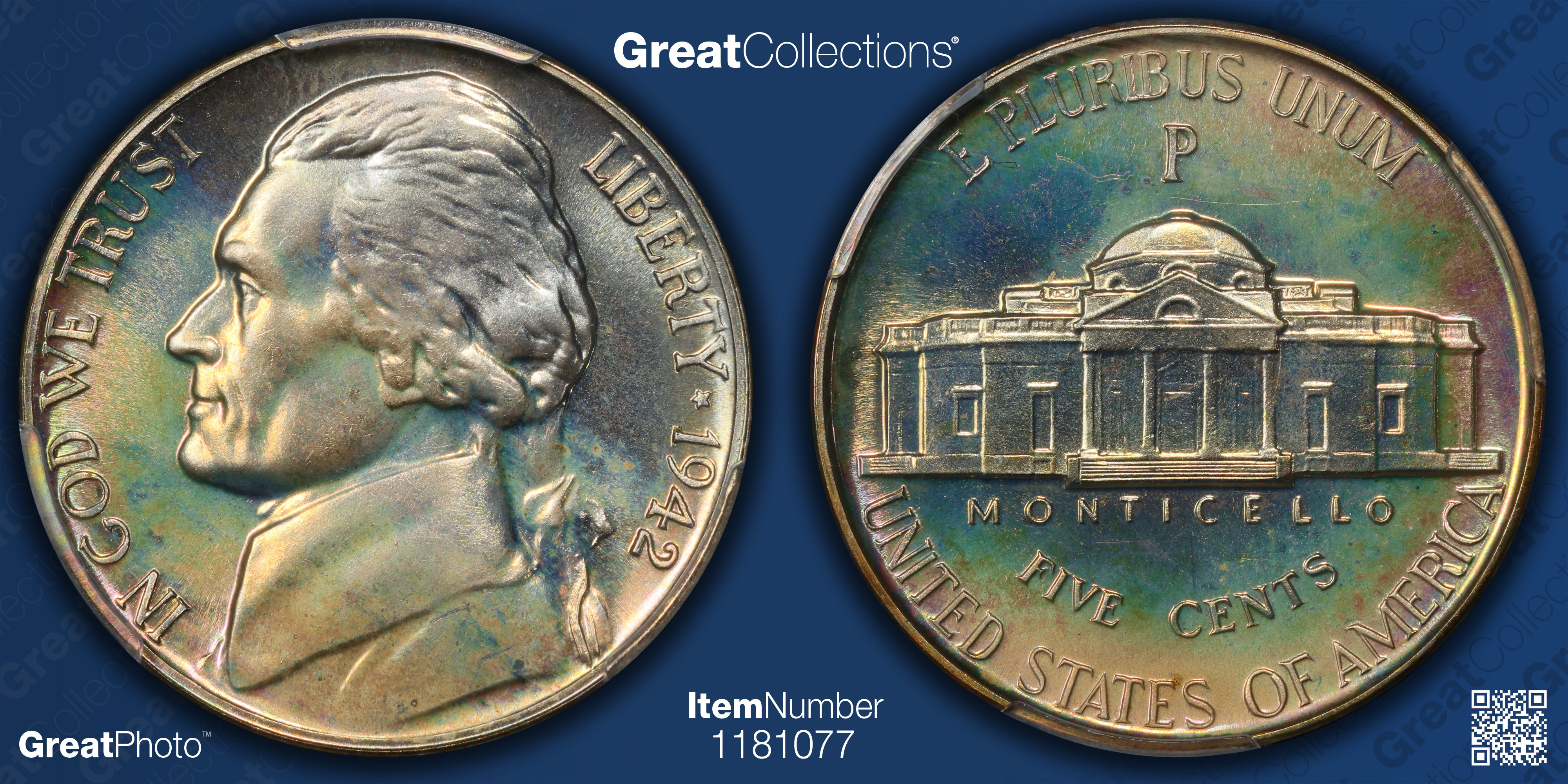
Here’s mine. My eyes (and maybe the photo quality) are not good enough to make a determination. You tell me.
Steve
My collecting “Pride & Joy” is my PCGS Registry Dansco 7070 Set:
https://www.pcgs.com/setregistry/type-sets/design-type-sets/complete-dansco-7070-modified-type-set-1796-date/publishedset/213996
Steve, that looks like FS to me.
Mark Feld* of Heritage Auctions*Unless otherwise noted, my posts here represent my personal opinions.
All of the Jefferson 6 full steps that I have are silver war nickels, and from looking at population information it seems like those were more common during that time, perhaps the silver was easier to strike well than the coins that have nickel. That would make sense because the Mohs hardness of nickel is substantially higher.
I love proof Silver nickels, I find my self buying them when I walk by
11.5$ Southern Dollars, The little “Big Easy” set
Steps don't count on the label for proofs, but they might count to a future buyer looking for fully and sharply detailed coin.
Keeper of the VAM Catalog • Professional Coin Imaging • Prime Number Set • World Coins in Early America • British Trade Dollars • Variety Attribution
they show up often enough, wait for one that is hammered
I’m probably in the minority, but as long as the strike is decent enough to properly display the design (I collect type), the only “full” designation I care about is the head on the SLQ. Minutiae on the reverse are of no interest to me.
Type 2 1942s are the most common Proof nickels of the series to show strike weakness on the steps. This is likely due to the alloy used and clogging of the dies, rather than insufficient strike pressure.
Coin Photography
I sincerely hope that looks better in hand
Not only do I agree with this, I actually think weak strikes are charming more so than full strikes. It reminds me of the time there was a mechinacal artistry and some veriblity to the minting process that is long gone to the identical computer products being kicked out these days
11.5$ Southern Dollars, The little “Big Easy” set
That's the classic PR68 look. Surprised it doesn't have the bean.
Coin Photography
indeed it does
toned war nickels are tricky to photograph
I'd love for flying al to have a chance at it
Send it my way, I'll do it for free. PM me if you're interested.
Coin Photography
The steps don't matter to me, but I'm not a Jefferson Nickel guy. I look for great Proof coin mirrors and attractive, original surfaces. I have always viewed this coin as a bit under rated given that it is a one year Proof type coin.
This one is graded PR-66.
No matter how you look at it, all those marks on Jefferson's profile will always say otherwise!
Leo
The more qualities observed in a coin, the more desirable that coin becomes!
My Jefferson Nickel Collection
Good luck with your endeavor. A lot of the early Jefferson proofs have been cleaned and graded. The fields will look etched, hazed, foggy and not have smoothed deep liquid-like mirrors. Going on 36 years with gathering up what I have. I'll get them all out and compare them to any new prospect I'm considering, otherwise, back it goes! I also like some frost on the devices. Compare them to the proofs of the 1950's to make sure they haven't been messed with. And avoid those with carbon spots which is also common on the early jeff proofs. Leo
The more qualities observed in a coin, the more desirable that coin becomes!
My Jefferson Nickel Collection
If your only criteria is PR67, why do you care if it is toned or has full steps?
If I were submitting that coin, it would grade PR64
Some people are obsessed with toning, even when it is unnatural or unattractive. Toning can drive up the slab grade even when the coin has marks that would indicate a lower grade.
I posted the coin image to show the strong strike
Along come the experts who are fooled by a coin image (first time that's occurred) LOL
FlyingAl is one of the few who understands proof toning, including war nickels
A lot of these comments fascinate me, since the coin has no visible marks that are not as struck. The "marks" on the bust are common for the Jefferson nickel series of this era, and comes from those points not being fully struck.
Any true collector/specialist of these Proofs would tell you almost immediately that the tone pattern on the PR68 above that many people here are calling unattractive is exactly what they want. I know I'd choose that coin in a heartbeat over a blast white 68. It's original haze from the cellophane they were packed in and it's a testament to that coin's history.
For example, this PR68+ CAC is probably among the highest graded out there. It is roughly on par with the coin posted earlier in this thread.
Coin Photography