Options
1827 Quarter Eagle in the the Stack's Sale
 earlyAurum
Posts: 796 ✭✭✭✭✭
earlyAurum
Posts: 796 ✭✭✭✭✭
I was shocked at many of the prices realized for some of the coins in the sale. In particular, this $2.5 1827 in PCGS MS62+ CAC sold for a whopping $138,000. CAC price guide has the coin worth $67,000 and PCGS has it at $77,500. I believe one in 64+ CAC sold for 144,000 just over 1 year ago. I saw the Stacks coin in hand at FUN. It's very nice but I did not think 138k nice. Wow!
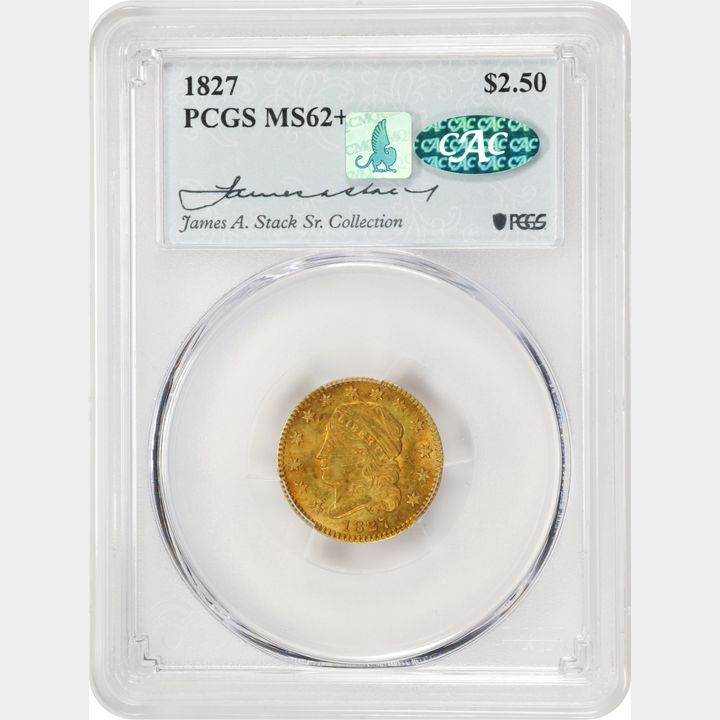
My question to folks here on the forum is, was this just a case of I had to have the coin or was it under graded? Also, does this event impact other similar coins of the type or was it just a super outlier? Will price guides change?
6
Comments
I don’t know. Many of these Stacks coins brought high prices as you mention. It’s a very desirable pedigree. And how many cac-approved MS+ coins are available? Missing the 64+ might mean that this one was a must-have for someone, even at a price approaching the higher grade result.
It has all the positives to attract strong bidding.
Attractive pedigrees among Stack Himself, including Eliasberg, George Clapp, John Glover Kellogg, Wayte Raymond, Thomas Elder, Hillyer Ryder, sales facilitated by Chapman and Mehl..etc
Rarities that are fresh and original, off the market for almost a century and provenance for some tracked back to the time of minting or shortly after. Not maxed out in the holders and many on the conservative side unlike other prominent sales. Some of these coins are a once in a generation opportunity and there aren’t many collections still out there that rival them.
Guides are essentially useless with a number of these coins, and 20k from the gold and silver stack gold from a few years ago has a lot more buying power now.
Founder- Peak Rarities
Website
Instagram
Facebook
Although Dan is correct about a lot of the coins in this sale (I see the 1850 Baldwin $10 brought $840k!), I think earlyAurum got it right on the 1827 quarter eagle.
Also interesting that the Stack 1798 half eagle small eagle PCGS MS 53 CAC went for less ($2.82M) than the Pogue coin (PCGS MS 55 unstickered) that sold last month for $3.0M.
"Look up, old boy, and see what you get." -William Bonney.
Got what right? He floated 4 questions.
All comments reflect the opinion of the author, even when irrefutably accurate.
EarlyAurum gets a lot right on early quarter eagles. This is his statement about the 1827 that I was referring to: “It’s very nice but I did not think 138k nice.”
I saw the coin and considered bidding on it but in the end chose not to at anywhere near that level. JMO and clearly a few others disagreed with earlyAurum and me.
"Look up, old boy, and see what you get." -William Bonney.
Dan is right, of course. I bid on a number of coins, and, in particular on the 50+ Norris which has a PCGS guide of $30k and a CAC guide of $20k. I bid $40.8k ($34k hammer) and was blown out of the water. The coin finished at $53k.
On top of the amazing condition and provenance of the coins which were mentioned is the nature of some of the bidders. Painting with a broad brush, most collectors who can easily afford a $50k-500k coin won't think twice about tossing on another $X amount of dollars because they want the coin. The exact same way as I might pay $1200 for a $1000 coin because I don't want it to get away.
The only difference is an extra zero or two. An extra $10k is just not germane in this situation.
chopmarkedtradedollars.com
Apologies, I sort of skimmed the bottom of the OP, and my comment was directed more at the latter half of the questiongraph, rather than this specific example. My generalization was focused more towards the coins that I was tracking and bidding on (most here could probably guess), but with respect to this individual coin I'll share my .02-
My personal preferences give more weight to color/skin/overall appearance than contact marks and luster, and a bit more emphasis on strike in my area of focus. This is somewhat antithetical to the established grading standards employed by the TPGs, which have typically rewarded luster and clean fields. If it were up to me, I might be a 63 on this coin, perhaps held back on the + for the '24 example. There's something about that irrefutably unmolested, glowing orange surfaces like this one that I can't resist. Given the option, I might even choose this one over the 64+ for my collection, and I've actually "downgraded" two coins in my set last year that had more character despite a lower technical grade.
In summary, my "assigned spread" between the two coins is less than what the guides suggest, and if you factor in the extremely relevant point made by ;@lermish above, I might very well stretch by a 20%+ margin over "market" to secure what I consider to be a coin I "need"...especially if I've been waiting for one like that to show up. Combine that with the other factors in my first comment, and then voila, here we are. Also consider that the 2024 sale was equivalent to ~53 ounces of gold, whereas this one is roughly half that amount ... not that using a gold-flation metric is a reliable way to price anything, but it's just something I've been using to rationalize my exuberant bidding in this session 😂
And @breakdown, believe it or not the Horseman's APR was not exactly one of the surprises for me, I had that one pegged at 3/4+ mil to begin with, honestly. There are some others towards the end that sold for multiples of their price guide, be it CPG or PCGS, that definitely exceeded expectations. The 11-D $10 was quite a result for a non-pioneer issue, but the pioneer issues had meaningless guide values going into this sale....so while I was impressed overall, I was hardly shocked. I actually appreciated seeing + designations being given to what appeared to be the most eye appealing or original examples, rather than just the "brightest for the grade" that I've seen the designation reserved for in the past.
Founder- Peak Rarities
Website
Instagram
Facebook
I was interested in the 1793 Chain Ameri. Cent in OGL PCGS EF-40, CAC that is in that sale. I asked for an estimate from Stacks”. The high estimate was around $130,000. That’s way over the catalog and previous results for an EF-40.
The issue was the coin was seriously under graded. It should have had a gold CAC sticker. I bid over the high estimate, but still finished back in the pack. That sale brought high prices.
What was the real grade of the coin? It my option it is a slab grade AU-50 or 53. Using EAC grading, it’s an EF-40. I think the winner over paid, but it doesn’t matter. It seems like the U.S. doesn’t mean as much as it once did.
I was thinking about the very high prices realized and it could be due to a number of reasons. Some of the reasons that I was thinking about 1 - cool to own a James Stack pedigreed coin, 2- those specific coins offered aren't around and not expected to be around in the near future, 3- more investors entering in the hobby, 4 - price guides aren't updated to current market prices, 5- collectors and investors are feeling wealthy so is ok to spend more on rare coins, 6- rare coiins are a good investment, 7- great marketing by auction houses and 8- some coins offered are undergraded? I am sure that there are more reasons but I am seeing some prices of coins increasing very quickly. Thoughts?
Strong.
.