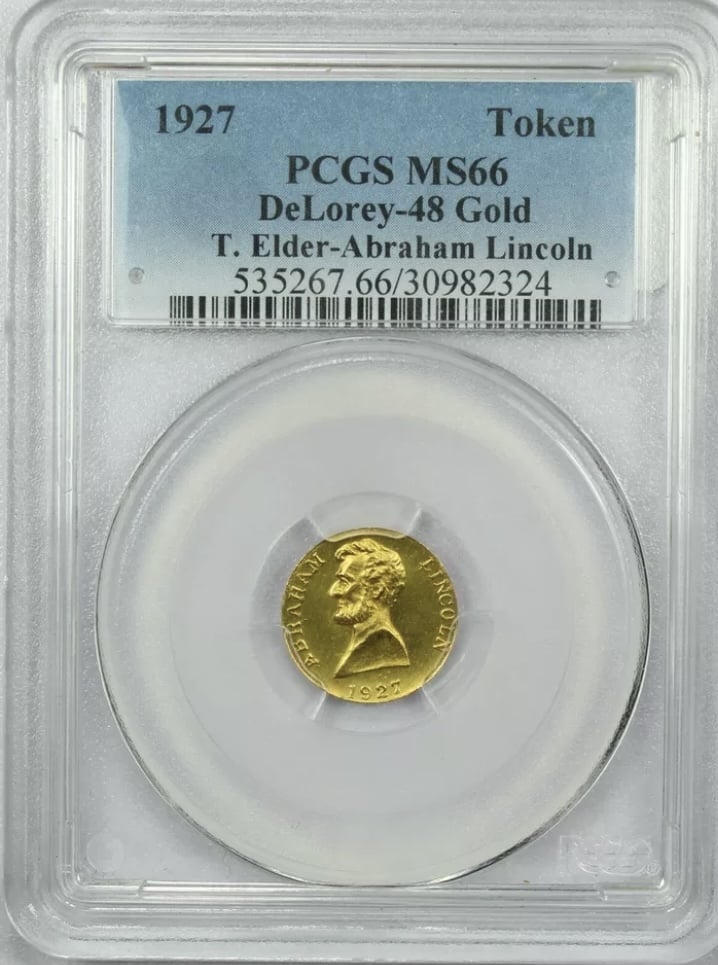
The Abraham Lincoln Token Thread…..Lets see it all!
 MEJ7070
Posts: 960 ✭✭✭✭✭
MEJ7070
Posts: 960 ✭✭✭✭✭
A recent discussion in another thread had me thinking that I’d love to see a specific home for “Lincolnalia” on these boards.
Personally, while I own a few commemorative tokens made after the assassination that I love, I find myself more drawn to political/campaign/CIvil War material that was produced during his political ascendency through his presidency.
By no means am I a true expert at all in this field, but I hope those with real expertise will feel free to make this their personal playground.
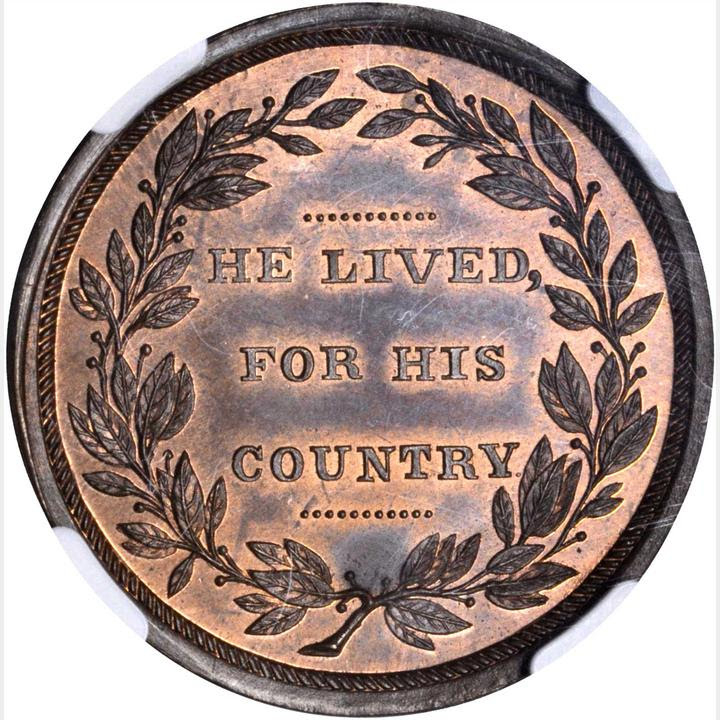
I’ll start with a piece I’ve shared a few times before……I’m a terrible coin photographer to begin with, but this particular example would likely be a challenging shoot even for the pros. Once I get through the Xmas season I need to find a real numismatic photographer to give this the glamour shots it deserves. The reddish/purple/blue hues are part of what makes this token special to me.
NGC MS 62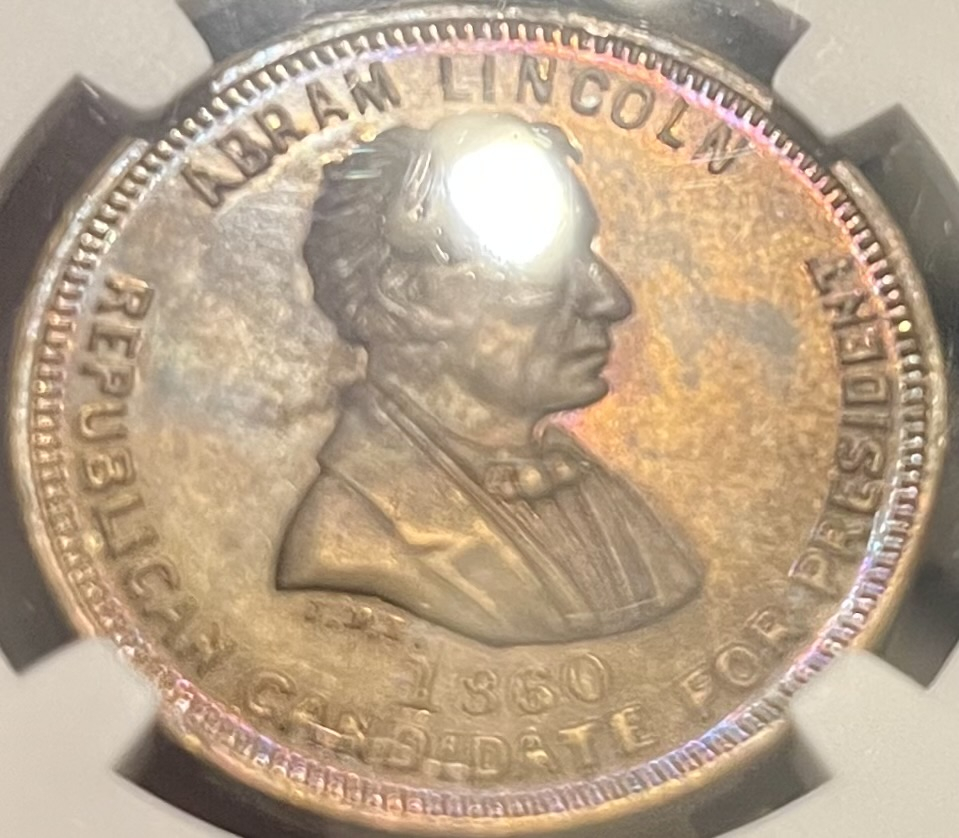
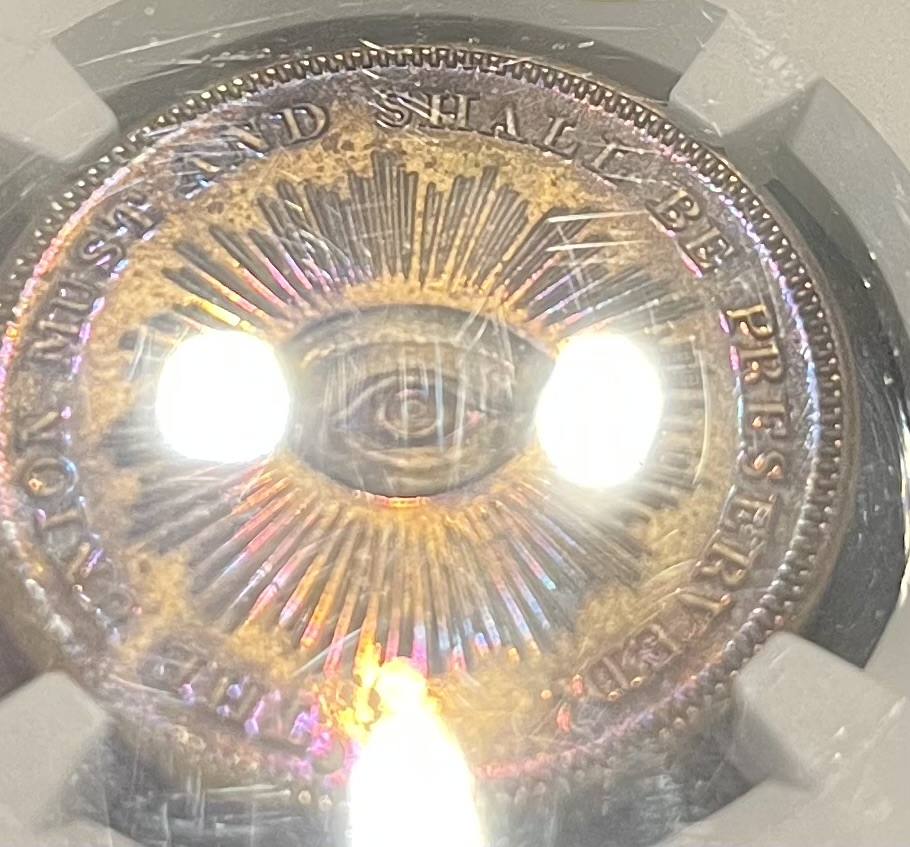
Would love to see what other collectors are enjoying. Raw, graded, common, rare, any theme from anytime……..Post em if you got em!
Comments
Shoot it outside in natural light.
Have many Lincoln medals, no tokens. . .look forward to seeing what pops up.
For most candidates who ran more than one time, figuring out the year can be tricky. For Lincoln it's rather easy. If the portrait has no beard, clean shaven, it's almost always an 1860 piece. If the portrait has a beard it 1864. Lincoln grew the beard after a young girl, Grace Godell, suggested he would look better with it after he was elected in 1860.
In 1860, the Lincoln campaign had two major issues or images. The "soft issue" was "Lincoln the rail splitter," the common man. Lincoln needed this issue to reach the voters because he was actually a very successful lawyer who was earning a good living. "Lincoln, the railroad lawyer who makes way more money than you do," would not have been a good look.
This piece was made by Chicago die sinker, Shubael Childs. It was one of the first.
Childs also made this one.
He used the same Linocln portrait to make this badge, which is not a token. This is a rare item.
The second issue, was slavery, of course. Lincoln could not have run as an abolitionist candidate and won. Also, as a lawyer, Linclon did not think that freeing the slaves was legal. It would require a vote of Congress, which was not going to happen in 1860. The voters were not ready for abolition. Insteat he ran on the concept of limiting slavery the states were it already existed. Slavery could not be extended to any new territories which had not become states. Here are two tokens which which present that position. The first piece was made by Joseph Merrium, the "Good for a scent" guy. The second was by Charles Lang from Wooster, Massachusetts.
This piece was issued after the election. It breaks "the Lincoln beard rule" because he had grown it when this piece was issued. It addresses the issue of Fort Sumter and restoring the Union. This piece is tough. It took me a couple years to win one in an auction.
1860 was the first year that photographs of the candidates on the political campaign items were widely distributed. There was a very small numbers of pieces issued in 1856. Most collectors don't know that the 1856 pieces exist. Here are all for of the 1864 candidates on ferotypes. The pictures were printed on thin pieces of iron. The chemicals were too strong for paper.
This is enough for now. I can post many more, but long posts get tedious.
There are more than 15 Lincoln Civil War token obverses and many more varieties with die combinations and metal variations than I want to collect.
The 1860 Civil War pieces fall into the so-called "Wealth of the South" Series which is endless and full huge rarities.
Here are a couple of them.
The Lincoln with the "President's House" on the reverse is the most common.
This one, with the Union shield on the reverse, is a bit more unusual. Given the fact that it's holed points to campaign use, although one can't be sure. Since coin collectors don't like holed pieces, some shy away from these pieces, BUT if you want a REAL campaign item, holed points in that direction.
Here is a complete obverse set, excluding all of the Wealth of South varieties, which almost impossible collect. When there are 10 or few pieces known, it gets hard. Some are rarer that that.
Fuld #124
Fuld #125 was made from #124 in a later die state.
Fuld #126 I have never seen this struck with Linclon's hair detail.
Fuld #127 The piece with the "OK" reverse is the most common Lincoln Civil War token. In the old days, you could buy these in red Uncirculated for $10. Those days are long gone.
Fuld #128 Many of the survivos of this variety have been soldered to a stick pin which runined them.
Fuld #129 This is a gold filled one, which was made to sell to 19th century collectors.
Fuld #130
Fuld #131 I have the obverse die which was used to strike this piece.
Fuld #131A Fuld's numbering system got jumbled up with new Lincoln varieties were discovered.
Fuld #132 This is the first of Lincoln / Johnson double headers.
Fuld #132A The Lincoln obverse wore out, and Lovet needed to make another one. Note that there are no designer's initials under the Lincoln bust. That is the diagnostic.
Fuld #133 All but two or three of these pieces are holded. This one still has its original coating of gold paint, as made. This is the only 1864 Lincoln token which brings up his "rail splitter" image. By then the voters were not the mood for a laugh. They wanted the war to be over.
Fuld #134 This variety #134 used with a store card. The Fulds listed this piece with the Lincoln varieties, but most people don't think that it's Lincoln. It's just an old man with a beard to them.
Believe it or not, what I have shown you only scratches the surface on the number of varieties there are to collect. I only went for the Lincoln die varieties.
@BillJones Awesome posts and really neat pieces. The knowledge you’re sharing is greatly appreciated. Any books you’d recommend with good information on the subject?
…….and the ferotype pieces are fantastic!!
Love Lincoln medals!
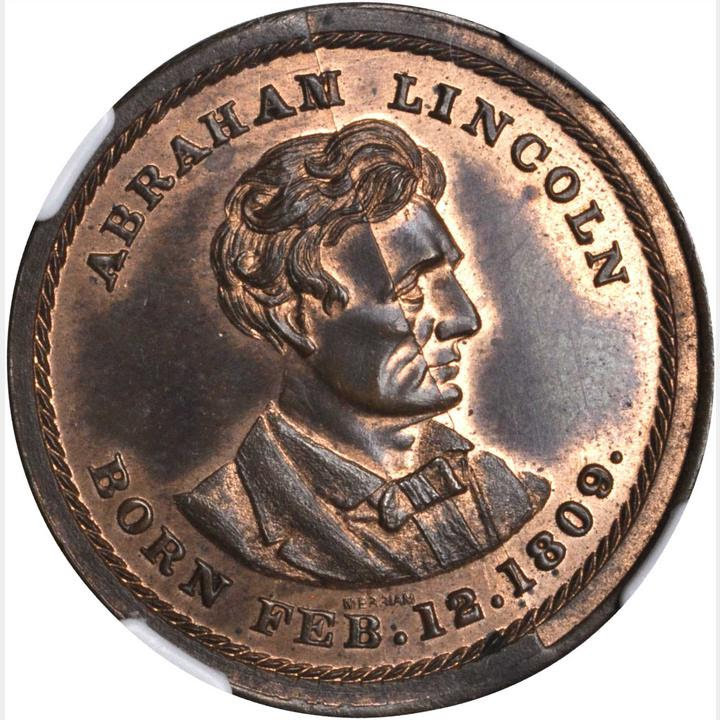
Here is a rare one, which uses dies from my favorite Civil War die sinkers, Joseph H. Merriam and John Adams Bolen:
Dead Cat Waltz Exonumia
"Coin collecting for outcasts..."
Regarding books, when I collected Lincolniana, Robert King’s “Lincoln in Numismatics” was my guide. Out of print for 60 or so years, so may be tough to find. My first version was a photocopy, made after I borrowed the original from the ANA library.
Copper post-assassination medal circa mid-late 1880s. This one was designed by Charles Morgan.
This medal dates to the post early 1970’s. These miniature medals didn’t come until that time period under Mint Director Mary Brooks.
Clearly, a numismatic “ niche “ that is both challenging to acquire, historically important and affordable. Every pirece is less than $1000 with most a few hundred $.
AND every piece far rarer than 99% of the slabbed coins on a major bourse floor.
Also, the vast majority of collectors of these dislike slabbing, preferring their Lincolnia raw !
Warning : these are tough to find and require contacts, attending major shows and “ opportunity only “
efforts. Not like coins where if you cant buy it from one dealer, another specimen is right around the bourse corner.
When a man who is honestly mistaken hears the truth, he will either quit being mistaken or cease to be honest....Abraham Lincoln
Patriotism is supporting your country all the time, and your government when it deserves it.....Mark Twain
Here is a 3 inch diameter, 19th century strike of the Lincoln medal that was shown earlier. Julian put this piece on the fly leaf of his book on 19th century medals as an example of great medallic art.
It is interesting to note that Lincoln was considered to be unattractive during his lifetime. When a critic called Lincoln "two faced," he quipped "If I had two faces, do you think I would be showing this one?" George McClellen campared him to an ape.
Let's do a few more Lincoln campaign tokens.
This one presents his rail splitter image and mentions protective tariffs. Lincoln greatly admire Henry Clay who based his presidential campaigns around the tariff.
The Wide Awakes were a para military marching group which started in Hartford, Connecticut. They held torchlight parades in the major cities. This dime sized token mentioned them.
And here is their token which shows them in their oil capes they worn to protect their clothing from lamp oil. This one is in nickel plated brass.
This one does not have a great slogan, "The right man in the right place," but it is quite scarce. I wanted to collect all of the Lincoln portait varieties which appear on the tokens. This is a tough one.
This one summed up Lincoln's goals for his second term. This is not easy to find.
This "Long my it wave" token was issued by William Key of Philadelphia. I have the obverse die. This is one of three dies used to strike a Civil War token, which are known to have survived.
Well there you go then. Genuinely appreciate the correction. Certainly not here to put bad info out into the stratosphere.
Are we at least talking about a replica of a Morgan design? My source for this particular piece is generally excellent and someone I’ve worked with for over 20 years.
Wasn’t expensive at all but was definitely offered to me as what I described it.
Apologies to the forum for the crappy info!
It is said that Lincoln had acromegaly which would explain his facial and hand features as he grew older.
However, history attributes his change in appearance over the 5 yrs of his presidency to the extreme stress and long hours and dealing with the prospective loss of half his country and draft riots as the cause of his physical deterioration. Had he not been assassinated early in his 2nd term, one wonders if he’d survive the turmoil following the Confederacy defeat.
The collection of Washington tokens and medals is perhaps overshadowed by that of Lincoln, perhaps because of his connection to the Civil War and slavery. Revolutionary War events are not so well known nor is George Washington’s involvement.
Yes, it’s a George T. Morgan design. Bill showed a 19th century example. Unlike coins, the US Mint can continue to strike these non-congressionally authorized medals without any limit. And so the Lincoln medal, in the 3 inch size has almost consistently been available from the US Mint since that time. Various features will indicate the era in which it was struck.
In the 1970’s Mary Brooks initiated a miniature presidential medal series, which were medals with the same design as the original 3 inch medals, but instead struck with a 1 5/16 inch diameter. That’s what yours is. I believe Lincoln, Washington, Jefferson, and FDR are the most common and mintages may be in the hundreds of thousands for sure.
The mint offered most all of its old medal designs with the “yellow bronze” finish until the mid 1980s, I believe. The newer ones are easy to distinguish from the 19th century strikes although I have seen a few pieces which coin doctors tried make them look like the older and usually much more valuable pieces. I’ll post photos later.
Illinois Watch Company Lincoln Essay Medal by Whitehead - Hoag:
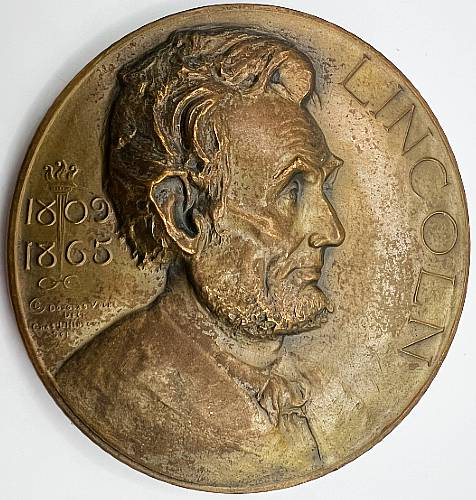
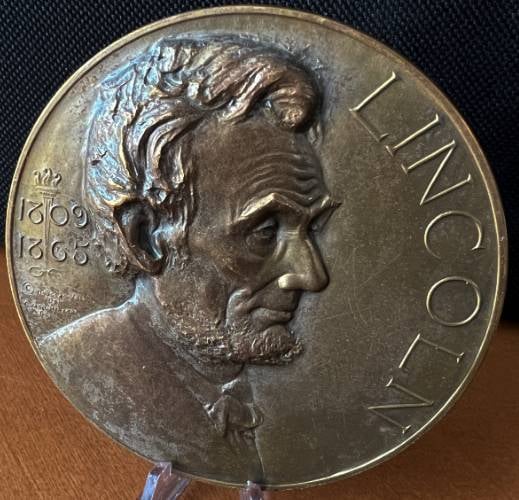
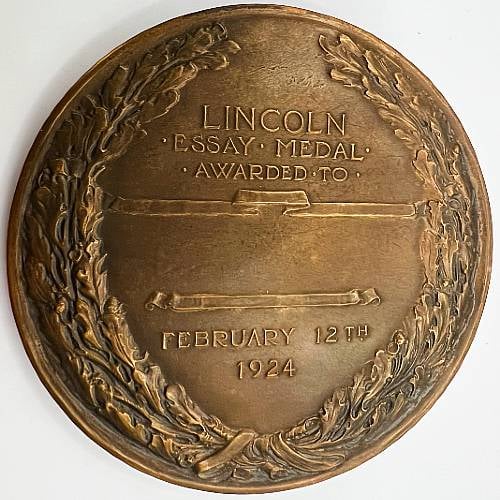
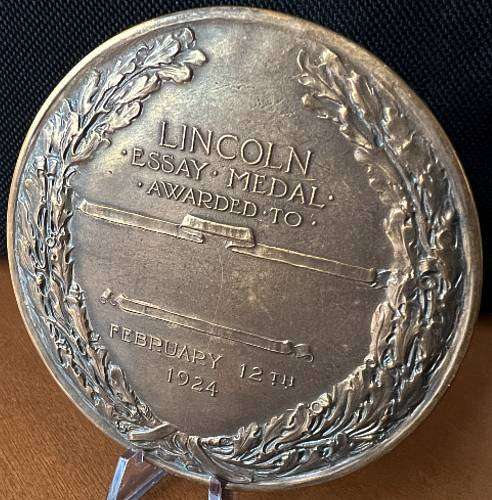
The Illinois Watch Company of Springfield awarded medallions -- struck by Whitehead & Hoag of Newark, NJ -- beginning in 1924, to hundreds of high school students who won the Lincoln Essay Contest.
Here is a 19th century Jefferson Indian peace medal in bronze. This one was struck with the original reverse die which was used for the pieces Lewis and Clark distributed to the Indians. The die is broken. The pieces Lewis and Clark distributed were hollow because the first mint could not strike a medal which was that big.
Here is modern "yellow bronze" example of the Jefferson medal.
This is modern Nathanel Greene medal which was "fixed" by a coin doctor to look old.
And here is a 19th century strike of the Greene medal.
One more Lincoln medal:
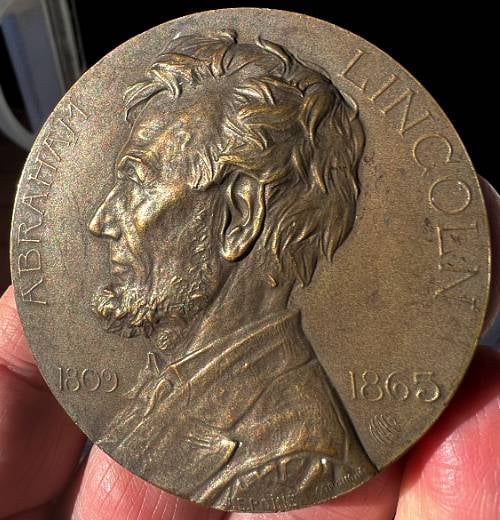
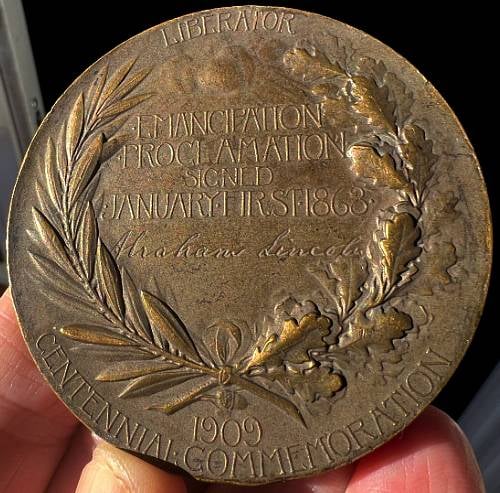
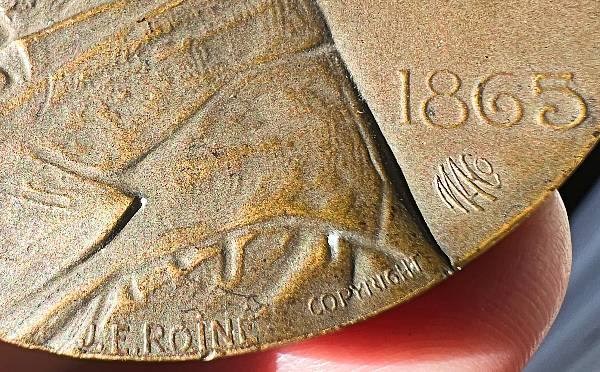
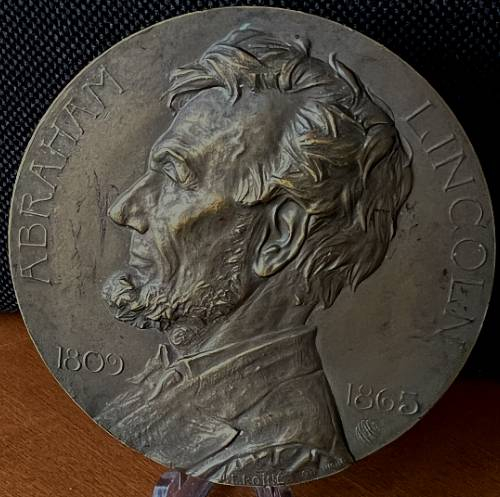
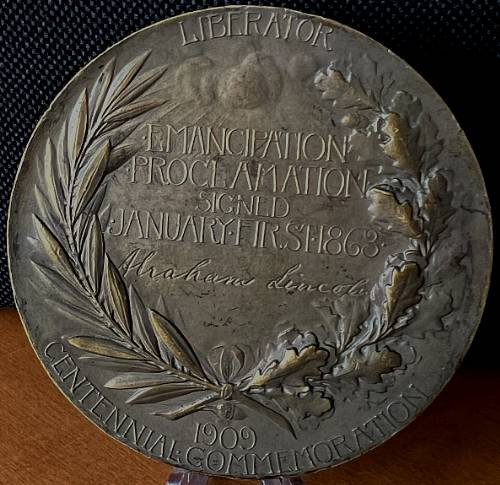
Commissioned by the American Numismatic Society for the 1909 Centennial of Lincoln's birth, this 2.5 inch bronze MACO medal was produced by French-American sculptor Jules Edouard Roine (1857 - 1916) . It has a smooth edge. A stylized "MACO" logo appears on the obverse, adjacent to the artist's signature and the word "COPYRIGHT."
Victor David Brenner showed an example of this medal to Theodore Roosevelt, and the Lincoln Cent followed.
Pop 3/0