Nice Write Up - 1907 Saint-Gaudens Double Eagle, High Relief, Wire Rim Variant
 1630Boston
Posts: 14,156 ✭✭✭✭✭
1630Boston
Posts: 14,156 ✭✭✭✭✭
President Theodore Roosevelt was pleased with the privately commissioned design by Augustus Saint-Gaudens for his inaugural medal, and equally unimpressed with the official medal produced by Chief Engraver Charles Barber. In a letter to the artist, he thanked him by stating:
"My dear fellow, I am very grateful to you, and I am very proud to have been able to associate you in some way with my administration. I like the medals immensely; that goes without saying, for the work is eminently characteristic of you. Thank Heaven, we have at last some artistic work of permanent worth done for the government!"
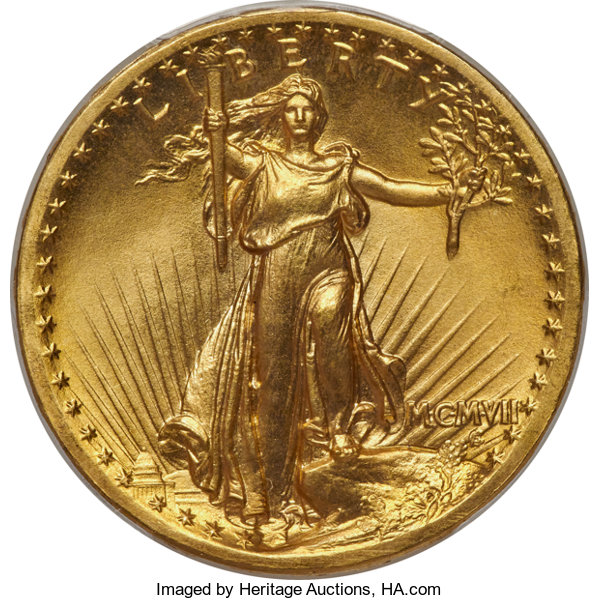
It was a small, logical step for Roosevelt to next commission Saint-Gaudens to redesign the nation's coinage, a subject he brought up over dinner at the White House in January 1905. Saint-Gaudens had a backlog of commissions at that time, but this request delivered by the president himself forced coinage designs onto the sculptor's calendar, even if some of work had to be given to assistants in his studio. While the designs were completed prior to the sculptor's death in early August 1907, it was not until the fall of that year that production actually began. Production began to move forward when the president sent a letter to Secretary of the Treasury George Cortelyou and stated: "I do not want to wait about those new coins." Chief Engraver Barber had his vacation at Oyster Bay, Long Island interrupted, and High Relief twenties began to be produced the following month.
The three-dimensional, sculptural high relief of Saint-Gaudens' iconic design caused many problems in production. To completely bring up the details of the design, each coin had to be struck three times on the medal press, with the planchet annealed between each strike. On average, it took about 12 minutes to strike each coin. By working overtime shifts and using up to three presses at a time to produce the coinage, the Philadelphia Mint succeeded in striking 12,367 acceptable High Relief double eagles by the end of the year, a large enough production total to satisfy President Roosevelt.
The coins produced from August through mid-December show a thin fin, or Wire Rim, around the circumference of the coin. This feature was the result of metal being extruded through the small gap between the dies and the collar during striking. The Wire Rim had two practical disadvantages for regular-issue coinage. First, the Wire Rim made the coins difficult to stack for counting purposes, an important disadvantage for clerks and bank tellers. Even worse, the thin fin would quickly wear down in normal use, causing the coins to be underweight after a short time in circulation. Mint Director Frank Leach was particularly concerned about these problems and Mint personnel worked hard to eliminate the fin by adjusting the diameter and upset angle of the planchets. By mid-December they were able to strike High Relief double eagles with a Flat Edge, which were struck for the remainder of the year. Accordingly, about 70% of High Relief double eagles are of the Wire Rim variety.
Because of the special nature of the coins, none were destroyed in assay testing. After selected specimens were sent to VIP's and Treasury officials, most of the coins were sent to Subtreasuries for distribution, but almost all examples were bought by clerks and managers there, who either saved them as souvenirs or resold them at a profit to coin dealers. Very few ever reached the general public, making the concerns about stacking and wear in circulation moot. Initially, the High Reliefs commanded significant premiums from collectors, but the novelty soon wore off and the supply of high-quality specimens was more than adequate to meet demand. Prices quickly returned to normal and only rose significantly after the Gold Recall of 1933, when collecting double eagles became widely popular as one of the few legal means of investing in gold in this country. Today, collectors prize High Relief double eagles of both types equally, for the undeniable beauty of the design.
David Akers (2012) Comments:
The 1907 Extremely High Relief (also called Ultra High Relief) double eagle was arguably the most beautiful coin ever struck by the U.S. Mint. It was the faithful implementation of Augustus Saint-Gaudens' original Standing Liberty design even though both Henry Hering, Saint-Gaudens' assistant, and Charles Barber, the Chief Engraver of the Mint, knew perfectly well that such a coin could never be minted for general circulation. Saint-Gaudens had been commissioned by President Theodore Roosevelt to design a U.S. double eagle, which would match or exceed the beauty of the best Greek and Roman coins from 2,000 years earlier, many of which had very high relief portraits on deeply dished fields. Despite their concerns about the practicality of the design, Hering and Barber ordered some trial pieces to be struck, each of which took nine blows of the dies for the design to strike up fully. The resulting coins, technically patterns, were as beautiful as President Roosevelt and Saint-Gaudens himself envisioned, but pressing demands for large quantities of the new coins required immediate revisions to the design.
The next step in the process of bringing to reality the Saint-Gaudens design for general circulation was to reduce the relief to a more practical level while retaining as much of the original Greek type relief as possible. The result was this so-called High Relief issue. Unfortunately, this revision was just not enough because each coin required at least three blows from the dies to strike up properly. Furthermore, the coins had to be visually inspected by hand due to the high rate of rejection from a quality control standpoint. Obviously, this was an unacceptable situation when millions of coins were expected to be produced in a timely fashion. Only 12,367 pieces of the new High Relief design were minted until another decision was made to abandon the idea of ever having high relief devices on dished fields for a coin of which very high quantities would be needed.
The majority of High Relief double eagles are this Wire Rim variety (perhaps as many as 75%-85% of the total mintage) and, because the coins were so beautiful and different from anything previously seen by the public, they were largely saved and cared for, meaning that many exist today that are of gem or superb uncirculated quality.
From HA
Successful transactions with : MICHAELDIXON, Manorcourtman, Bochiman, bolivarshagnasty, AUandAG, onlyroosies, chumley, Weiss, jdimmick, BAJJERFAN, gene1978, TJM965, Smittys, GRANDAM, JTHawaii, mainejoe, softparade, derryb, Ricko
Bad transactions with : nobody to date
Comments
@1630Boston.... Thanks for the detailed history of this great coin. It will be of interest to gold collectors of all levels. Cheers, RickO
Great write up.
I love this part of the quote from the President
"Thank Heaven, we have at last some artistic work of permanent worth done for the government!"
Successful transactions with : MICHAELDIXON, Manorcourtman, Bochiman, bolivarshagnasty, AUandAG, onlyroosies, chumley, Weiss, jdimmick, BAJJERFAN, gene1978, TJM965, Smittys, GRANDAM, JTHawaii, mainejoe, softparade, derryb, Ricko
Bad transactions with : nobody to date