Options
I've searched diligently for years, and this Shield 5c is only the second mint-state example that I'
 IGWT
Posts: 4,975 ✭
IGWT
Posts: 4,975 ✭
What makes this coin particularly hard is the pairing of a die from obverse hub A with a die from reverse hub IIc (commonly referred to as the rev. of '70, although it appears first in '69). There are a total of 4 hub pairings for '69 -- an important transitional year in the Shield 5c series -- and this pairing isn't even the scarcest.  And what's really sweet is that it's probably the strongest 64 that you could ever hope to see.
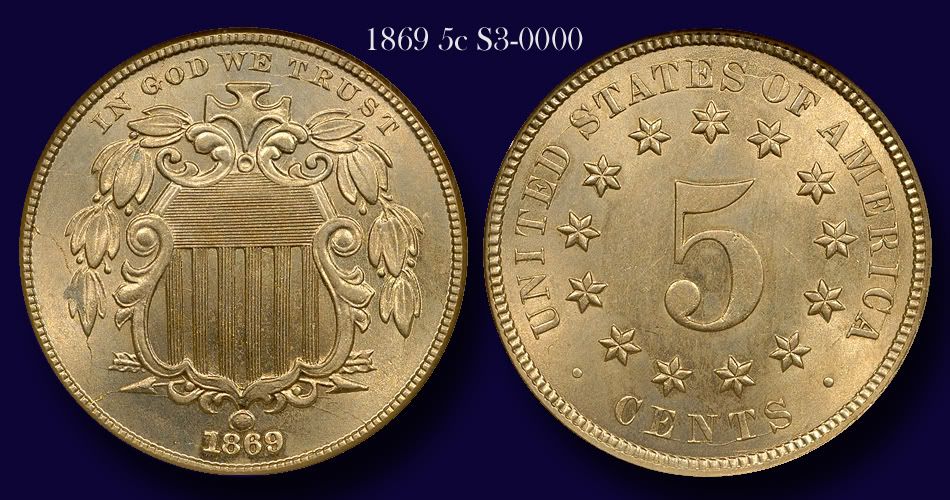
And what's really sweet is that it's probably the strongest 64 that you could ever hope to see. 0
Comments
...
greg
www.brunkauctions.com
Thanks for the kind words. Edited to add: There's no need to seek certification at a higher grade . . . well, at least not for 20-30 years.
<< <i>send back in......that's a lock 65
greg >>
Good advice.
...
<< <i>Is that a slight die crack along the bottom lettering on the reverse? >>
As is common throughout the series, there are die cracks all over this coin.
<< <i>send back in......that's a lock 65
greg >>
That coin isn't a lock 65. That's the trouble with people. They think they can tell the grade of the coin just by looking at the photographs. It didn't grade 65 the first time, did it? So how could it be a lock 65? There could be hidden hairlines or something. Who knows?
Do you mean for the date 1869, or for the die marriage?
Thanks, Wayne!
-- There could be hidden hairlines or something. Who knows? --
I do. There are no hidden hairlines. As I wrote, it's a very strong 64, and I have certainly seen coins graded 65 in both major TPG holders that aren't as nice as this coin. And, as I said, I don't give a hoot about the grade that the TPG chose to assign.
-- Do you mean for the date 1869, or for the die marriage? --
Hi Steve -- I explained in my second post to the thread (sorry for burying it) . . . I'm referring to the hub pairing.
Collecting the five different major types for 1869 (the four hub pairings Lou mentioned plus the 1869 narrow date) is a major project in itself. Only two of the hub pairings are common. The narrow date is not that hard to find, but I wouldn't call it common.
The two ways that an old hub can be paired with a new hub (old obverse, new reverse or new obverse, old reverse) are both hard to find, especially in nice condition. Lou is showing here the old obverse with the new reverse. The new obverse with the old reverse is, IMO, much harder to find than even the coin Lou showed. I have found 4 or 5 of the latter in 20 years, with only one of them being mint state.
http://www.shieldnickels.net
<< <i>Respectfully, I am impressed with you find. Sincerely, John Curlis >>
Mr. Curlis, may I point out you have a typo in your response. Respectfully, Herbert J. Matheis
The fact that a coin didn't grade 65 the first time doesn't by any means keep the coin from grading differently the 2nd or even 3rd time. Not grading a certain grade the first time doesn't preclude a coin from being a lock for the next grade up. Graders can get it very wrong the first time and even the 2nd time in. As an example I can offer up a gem 1882 seated half I submitted in 2003 that came back MS65 the first time. It was in fact a lock MS66 imo and the grade was very disappointing....and a potential $2000 loss to me. Next time in it was graded MS67. In fact most of that entire submission was just sent right back in and most everything went up at least 1 pt.
Lock 65 really only pertains to what the marketplace perceives the coin to be, not just 3 graders at one specific minute in time. And an auction environment is one of the better places to find out what the marketplace thinks about a coin, not the surrounding plastique.
I would agree that it's a crap shoot to determine if a coin will upgrade based on just a photo. But given a good enough photo, it's not that hard to determine which coin probably can not upgrade as negative features are fairly easy to score. The 1869 nickel shows some slight rev luster grazes that could be typical for either a 64 or a 65 coin. Luster often drives the final grade and photos of coins often hide the true strength or weakness of the luster. I recall a flawless 1882 shield nickel I had with 1980's ANACS papers as 65AAA. The coin was as struck yet it never received a higher grade than MS65 which was most puzzling to me. I could only surmise that the luster was not blinding enough and that the die cracks were treated the same as "disturbances."
roadrunner
rr, despite your eloquently offered response, I have to agree with the comment that elicited your post. Too often, coins are referred to as lock upgrades when they are simply PQ for the grade. A "lock upgrade" is a coin that is either incorrectly under-graded (as opposed to being at the high end for the grade), or a coin in an old holder that was graded using standards that differ from today's. One might find a green tag holder, for example, that is a lock upgrade (although they aren't necessarily, of course). But it is much more rare to find a coin in a newer holder that can be called a lock. People often underestimate the incredible extent to which coins are submitted over and over.
Further, I also agree that way too many folks believe they can offer accurate grade opinions based on images. It is perhaps more possiblein the circulated grades, wherein the grade is most likely dictated by the amount of wear. But as you get up into AU and beyond, it becomes considerably more difficult to grade from images. In particular, splitting hairs between 64-65-66-67 can often be impossible from images.
Much of course depends on the image quality, the lighting, and the resolution. IGWT's images are, in general, excellent.
I have an 1884-S Morgan in a PCGS MS62 holder. Everyone has told me that it is a lock 63, and even a 64. No less a pair of experienced luminaries than David Akers and Ed Milas both graded the coin 64. Yet after three tries (submitted in the holder) at PCGS, the coin is still a 62. I sent it in for Presidential review, and the comment came back: "Toning a little dark and negitive [sic]" ... the coin is neither darkly toned, nor a 62, nor should toning prevent the coin from being accurately graded ... yet all the proclamations of "lock 63" and "strong shot 64" did nothing to elevate the coin from a 62 holder !!!
Best,
Sunnywood
Sunnywood's Rainbow-Toned Morgans (Retired)
Sunnywood's Barber Quarters (Retired)
Are those die polishing marks around the date? Is this common among shield nickels? I know there are several repunched dates in this series.
Garrow
I'm happy to use this coin to discuss grading, but focusing on its condition overlooks the importance and rarity of the hub pairing as discussed earlier. It's significantly harder than, say, an 1868 with the reverse of '68, or (as Howard notes) the Tall Date logotype of 1869, and no less important than either of them in the Shield 5c series.
And here's a little rant: I just read another thread reporting that the 2009 Redbook will list the high- and low-leaf Wisconsin 25c. The 1869 5c Tall Date is an example of the kind of variety that deserves to be listed in the Redbook. I'm not going to say that the high- and low-leaves don't merit listing . . . but, their inclusion -- while important varieties in classic series go begging for attention -- demonstrates that lobbying and commercial interests apparently play as much of a role in the Redbook as numismatic significance.
Every shield set should also have a Missing Leaf coin. They are easiest to find for 1866, so I think it should be a basic variety for that year.
For the proofs, every serious collection must include the 1867 No Rays Proof with the prototype reverse - most likely representing the original delivery of early February 1967, these differ quite obviously from the remaining No Rays proofs of the year which have the regular issue reverse hub.
Best,
Sunnywood
Sunnywood's Rainbow-Toned Morgans (Retired)
Sunnywood's Barber Quarters (Retired)
b. Like bust material, is it possible to distinguish between all die marriages
c. who held/holds the largest collection by variety, and what percent is it of being complete.
Thanks
Ron
b. Like bust material, is it possible to distinguish between all die marriages
c. who held/holds the largest collection by variety, and what percent is it of being complete.
Collecting Shields by die marriage would take a Herculean effort, and I can't imagine any single collector accomplishing a die-marriage set for even a single year. Let's remember that mintages for 1866-1868 total about 74,500,000 nickels. The working dies lasted on average for 20,000 strikes at most. The math shows that the die makers would have had to produce no fewer 3,700 die pairs for just those three years. And, while it would be possible to differentiate among all obverse dies based on date placement (and by using the engraved leaf for obv. A), all elements of the reverse dies were hubbed, making it extremely difficult to distinguish one reverse die from another. Although the large number of dies makes collecting by die marriage impossible as a practical matter, the myriad die varieties, e.g., doubled or tripled dies and repunched dates, provide wonderful collecting possibilities. While there are hundreds of die varieties, there are very few examples of each, and you can spend a lifetime searching without nearing completion.
It sounds strange, but Shield collectors focus on hub marriages as opposed to die marriages, i.e., the focus is on the hubs that were used to press the dies. Three obverse hubs and four reverse hubs were used to press dies that were used to strike Shields for circulation. The various combinations of those hubs -- as reflected in the dies used to strike the coins -- are the "marriages" or "pairings" to which the OP refers. By the way, IIRC, QDB made an error in reporting the pairings in his Guide Book to Shield and Liberty Nickels. If you have any interest in pursuing Shields, I highly recommend visiting the website of Howard Spindel (CU Forum member howards) here.
As for who has the largest or most complete set, I have my suspicions, but I wouldn't feel comfortable sharing the information. There's one fellow, for instance, who focuses heavily on 1868, and I believe he has hundreds, if not thousands, of Shields from just that one year of issue. As you can imagine, each collector has different goals, and we collect in different ways. So, percentage of completion is merely a matter of what one has set out to accomplish. Also, unlike JRCS, for example, our club census is completely anonymous . . . the emphasis is on the collective holdings of club members, not on what any one collector might own.
Shield Nickel Type set
http://www.shieldnickels.net
I find this number a bit too low to believe. I would guess 100,000 as average, 200,000 at most.
Many of the die crack seen on Shield nickels are circular rather than radial. I think that mostly circular die cracks are due to improper heat treatment, while radial cracks are from die fatigue.
What do you think? Are all the die cracks seen on Shield Nickels due to die stress?
I find this number a bit too low to believe. I would guess 100,000 as average, 200,000 at most.
I can’t claim to have performed the research myself, but instead rely upon credible research performed by others. We know that Henry Linderman, during his first of two stints as Director of the Mint, complained in his first annual report (1867) that the nickel panchets “had worn out the Mint’s machinery and broken an enormous number of dies.” D. Taxay, The U.S. Mint and Coinage at 246 (1966). “Because of the hardness of the coinage metal, the limits on the diameter of the coin and technology of the period, the [Shield Nickel] dies lasted for only 10,000 to 15,000 coins per die pair.” E. Fletcher, The Shield Five Cent Series at 16 (1994). Noted numismatic researcher Bob Julian has conducted extensive research of relevant documents at the National Archives and “reports that ‘the average number of 5-cent coins from each pair of dies was well under 15,000.’” G. Peters & C. Mohon, The Complete Guide to Shield & Liberty Head Nickels at 4 (1993) (quoting R.W. Julian). QDB also relies upon Julian’s research in writing that “somewhat fewer than 20,000 impressions for the 1866 and 1867 With Rays type improving to about 20,000 to 21,000 for the Without Rays nickels of the earlier years, and rising to about 26,000 by 1882.” Guide Book at 72 & n.19 (citing personal communication with Julian in June 2005).
If these folks are wrong on die life, then I am as well.
Many of the die crack seen on Shield nickels are circular rather than radial. I think that mostly circular die cracks are due to improper heat treatment, while radial cracks are from die fatigue. What do you think? Are all the die cracks seen on Shield Nickels due to die stress?
I don't know; but, given the hurried pace of die production, I wouldn't be surprised if a fair number of dies cracked during the annealing process. Regardless of the cause of failure, however, it seems that the length of service would be relatively short.
greg
www.brunkauctions.com
Nope. Rick was just plain wrong in his guess (the data often take people by surprise); and, in any event, the overall rate of failure isn't affected by irregular swapping of obverse and reverse dies. For example, if each individual die lasted 100,000-200,000 strikes, it isn't possible that the production from any particular die pair would be limited on average to only 10,000-15,000 coins.
When the series started, hand-made prototype dies were used to strike coins. These dies are identifiable by the raised center dot - the reverse imprint of the incuse center dot caused by a layout compass. There were precisely three of these - one obverse, one With Rays reverse, and one No Rays reverse. The latter die is the one used to strike most of the J-507, and the small number of 1867 No Rays proofs delivered in early February 1867.
Once in production, the dies were impressed directly from the hubs, without an intermediary working hub and master die. This situation continued until 1869. When the "Reverse of 1867" hub was replaced in 1868, in order to improve the striking definition on the stars, a problem occurred. The new 1868 hub was poorly heat treated, and was embrittled as a result. Consequently, the working reverse dies impressed directly by this hub exhibited increasingly many chipped and broken letters. This results in the fascinating broken letter varieties with the Reverse of 1868 hub. The hub started chipping almost immediately, with the result that pristine examples of this hub with no broken letters are quite rare. Perhaps only the very first die impressed from this hub had no broken letters.
After the 1868 reverse hub failed, the Mint went back to the 1867 hub, while they began work on a new one, which we call the "Reverse of 1870." Because of the lessons learned in 1868, it was now decided to use a four-tiered system instead of a two-tiered system. Instead of making the (incuse) working dies directly from the hub (which had the devices in relief), the Mint now switched to a system of master hub (relief) - working hub (incuse) - master die (relief) - working die (incuse). The proof of this new system occurs in 1870. Once again, the letters began to break, and there are 1870 nickels with up to six broken letters on the reverse. However, this time, it was not the hub itself that was breaking, but rather the master die. The die was discarded, and a new master was fashioned - FROM THE SAME HUB. So the broken letters problem disappears, but the subsequent production is still from the exact same hub design. That can only be done in a four-tiered system.
So I think it was because of the failure of the 1868 reverse hub, that the Mint adopted the four-tiered system that remains in use today (as far as I know). The difficulty in producing these coins forced the Mint to become innovative and improve its quality control substnatially.
The "Reverse of 1870" hub was first used to make working dies in 1869, with the result of a very small number of 1869-dated nickels being paired with one or more reverse dies made from the "Reverse of 1870" hub.
Best,
Sunnywood
P.S. Just as the repair of the broken letters in 1870 proves the use of a four-tiered system, I can also prove that a two-tiered system was in use previously. The key is the "missing leaf" varieties. The first production obverse hub had one leaf missing. Because a hub has the devices in relief, they couldn't add the missing leaf to the hub. So instead, they had to carve one into every single working die. Occasionally they forgot, and so we get the "missing leaf" varieties. Every single obverse die has a unique hand-carved leaf, and they are all different. Had there been a four-tiered system in use, the extra leaf could have been carved into the working hub (which is incuse), and there would never have been any missing leaf dies, or dies with many different styles of hand-carved leaves.
Sunnywood's Rainbow-Toned Morgans (Retired)
Sunnywood's Barber Quarters (Retired)