Options
Is there a tiny star in the knob at the top of the 2 of the 1832 half dimes?
 LanLord
Posts: 11,765 ✭✭✭✭✭
I have been discussing with a few of our highly respected halfdime experts about something that I am seeing on a couple
1832 halfdimes I have.
Both are LM5 die marriages, one AU50, the other AU55, but unfortunately my images aren't overly clear or convincing.
With a 16X loupe it definitely looks like something other than just a divot in the knob at the top of the numeral 2.
Cladiator will be looking for some other images to see if they confirm or not what I believe I am seeing.
Anyone else with good close-ups please chime in.
BTW, I have looked at the 2 in a couple 1829 halfdimes and there is no divot, much less a star.

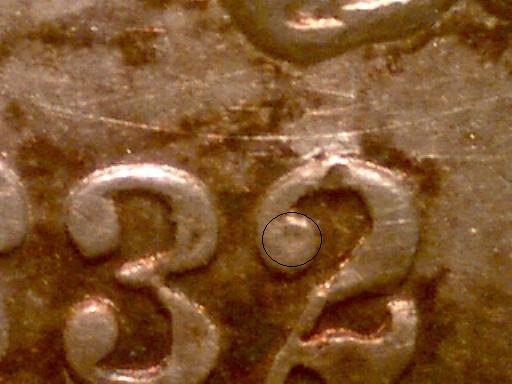
1832 halfdimes I have.
Both are LM5 die marriages, one AU50, the other AU55, but unfortunately my images aren't overly clear or convincing.
With a 16X loupe it definitely looks like something other than just a divot in the knob at the top of the numeral 2.
Cladiator will be looking for some other images to see if they confirm or not what I believe I am seeing.
Anyone else with good close-ups please chime in.
BTW, I have looked at the 2 in a couple 1829 halfdimes and there is no divot, much less a star.
0
Comments
The authors of the half dime book (Logan and McCloskey) couldn't include all knowable information in "Federal Half Dimes 1792-1837" but they sure did a heck of a job. It might be that one or both authors knew about this anomaly (if it really is one...we're just speculating right now, right?), but figured it too insignificant or not limited to certain die marriages and therefore not "diagnostic" -- really we don't know.
I'd be interested in seeing more closeup photos or truview photos of half dimes
Notice that the "star" appears much more obvious than the
two images I posted first. The close-up here is an LM4
so the "star" is not confined to the LM5.
This one is less star like, but certainly gives us more to look at.
I couldn't find a single one of the LM1's with the divet in the 2.
Seemed just about all of the LM5's and LM7's had it though. Below are pics with four examples of each die marriage that has the divet.
The emission order chart confirms that the LM1 was the first use of the 1832 Obv. Die #1, the LM5 was the second use and the LM7 was the third and final use. So the divet either occured very late in the coining of the LM1, in between the time the LM1 and LM5 were made or very early during the coining of the LM5.
Your guess is as good as mine as to what the hell caused it. I was unable to find a photo large enough and high quality enough to really make out the details solidly.
Here are pics of some of the Heritage coins where you can plainly see the divot.
The LM4 was made with Obv. die #3 and the only other half dime to have that obverse is the LM3, struck before the LM4. I'm kind of pooped now so I'm not gonna tackle the Heritage research on these two marriages but maybe someone else can?
Lanlord, I think what were seeing here is two completely different issues. It may turn out that they occured in very near the exact same way but different none the less.
I think it may be time for "The Boss" to check this out so without further ado I will light the beacon...
Thanks for the Heritage posts with pictures.
I have also PM'd mr.halfdime, hopefully we'll get some input from him soon.
LanLord's post was very interesting, and called attention to something that I had never seen before. Although I can only speculate, it is my also belief that Russ Logan also never saw the indentation in the ball of the numeral 2 punch on the 1832 Obverse 1 die, or at least never thought it significant. While the half dime book was being written, we had numerous lengthy conversations about just this sort of thing, but I do not recall this ever being mentioned.
After seeing your beacon, I placed several high end AU examples of the 1832 LM-1/V10, LM-5/V8, and LM-7/V9 die marriages under the stereo microscope, under 60x magnification and high intensity light, and studied them closely. As you mentioned, these are the (only) three uses of the Obverse 1 die, in chronological order of their use, so presumably we should be able to see a progression, or deterioration, of the diagnostic.
From the tone of the earlier posts, there seems to be an assumption that this phenomenon is somehow intentional, or a purposeful design element, somewhat like the scalloped star point used by John Reich on the Capped Bust half dollars. Although the star 13 scalloped point used on the Bust halves has evolved from mere idle curiosity, through speculation, to a proven fact through the extensive research conducted by Ivan Leeman, Edgar Souders and others, I am afraid that this 'dent' on the numeral 2 punch may be just that - a dent.
It is generally considered that the numeral punches used at the Mother Mint at this time were not made by John Reich. There are some accounts of numeral punches being contracted outside of the Mint, by other engravers. One account that I found states that the numeral punches for the Capped Bust half dimes were made by Christian Gobrecht, who was at the time a junior engraver, and had not yet taken over the Chief Engraver's responsibilities from William Kneass. Remember that the numeral punches were made in actual size; there was no means to use a reducing lathe or other device to fabricate the numeral punches in larger-than-life size and somehow reduce them later. That makes them a little bit smaller than 10 pt. typewriter character size (remember typewriters?). Imagine trying to fabricate a tiny numeral punch in cold steel (certainly it would have been annealed at the time, but steel nonetheless), working in a cold and dimly lit workspace, without the aid of optics or magnification, and creating a numeral punch that would satisfy the critical eye of a twenty-first century numismatist, armed with high quality magnification and digital cameras, and to make that punch stand up to repeated blows with a hammer while striking the date into multiple steel dies. It is an almost impossible task, yet they did a pretty good job in my opinion.
It would seem likely that, in the relatively 'large' area of the knob or ball of the 2 punch, an indentation or divot could develop that would not be so detracting as to require that the numeral punch be retired or discarded. There are several other examples of numeral punches within this series and others that suffered more severe damage, but were continued in use. Remember also that the numeral punches were struck into the working dies. The numeral was raised, or in relief, on the punch, making the numeral incuse in the die, so that it would be in relief on the struck coin. Therefore, the face of the numeral punch would appear exactly as the numeral appears on the struck coin.
After studying about a dozen examples of this obverse die, in all three die marriages, I can state that I did see what is pictured in this thread on all examples. Surprisingly, I did not see a distinct or discernible progression of deterioration of that dent, however. In other words, if I had only that 'dent' to make a determination, I would not have been able to arrange the examples I studied in proper emmission order. My earliest example was an EDS of the 1832 LM-1/V10 (from the William A. Harmon collection), which presumably should have shown the strongest evidence of the feature, but it looked rather nondistinct, merely as a dent. On several examples, it appeared simply as a 'dent', while on others it appeared as a triangle with one point aiming down, and on one it even appeared like an arrowhead with a square area along one side of the triangle, like the part of an arrowhead directly opposite the point.
It is my belief, without seeing additional information or conclusive proof to the contrary, that this is just an anomoly in the numeral punch, and that it was not intentional, nor is it any sort of engraver's trademark or signature. I find it interesting that I should read this post only minutes after reading a query on the JR Newsletter about what is inside the clasp on the obverse of reeded edge Capped Bust half dollars, and the suggestion that it might be the letter "M", or perhaps a stylized "JR" for John Reich.
There is still much to be learned from the study of these intriguing little pieces of our American heritage, and it is particularly significant to now have forums such as this where multiple collectors can share what they have and what they see, in real time, and share opinions. There was no such medium of communication when Newlin first wrote of the United States half dimes in 1883, nor when Dr. Daniel W. Valentine wrote his book in 1931. It was not even in wide use when Russ Logan and John McCloskey collaborated on their masterful book in the late 1980's and early 1990's. I can easily see how it would have greatly helped our effort, and perhaps provided even more information.
BTW: I had started a post here sometime ago about just the following (only I was discussing the stylized letter in all bust coins):
It is my belief, without seeing additional information or conclusive proof to the contrary, that this is just an anomoly in the numeral punch, and that it was not intentional, nor is it any sort of engraver's trademark or signature. I find it interesting that I should read this post only minutes after reading a query on the JR Newsletter about what is inside the clasp on the obverse of reeded edge Capped Bust half dollars, and the suggestion that it might be the letter "M", or perhaps a stylized "JR" for John Reich.
I'll see if I can search for it and TTT it.
Thank you again for all that information.