Options
So-called dollar beauties and oddities
 jonathanb
Posts: 4,163 ✭✭✭✭✭
jonathanb
Posts: 4,163 ✭✭✭✭✭
This is the last of my posts from my big pile of exposition stuff -- a consolidated post of items related to So-Called Dollars.
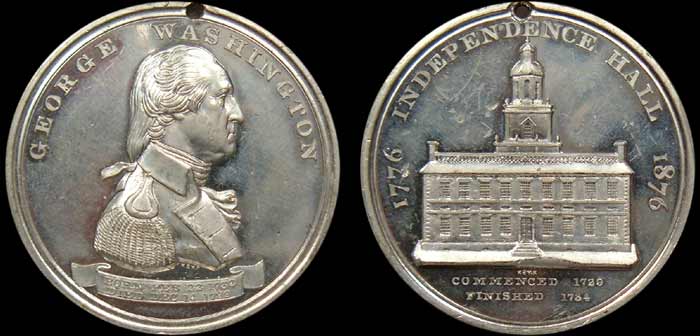
This one isn't all that rare, but it isn't common either, and this condition is fabulous.This is listed as HK-41 (as a So-Called Dollar) or as Baker-392B (as a Washington medal). There are lots of Washington medals within the So-Called Dollar series.
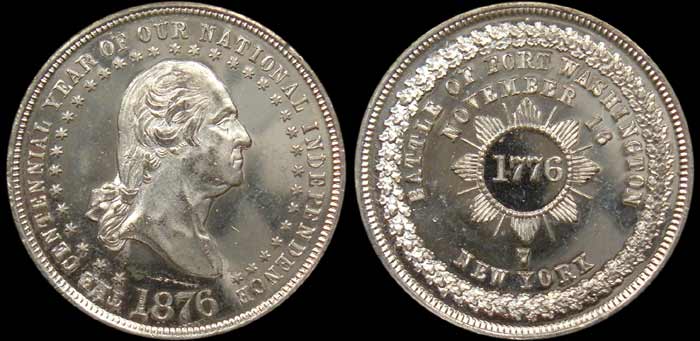
And speaking of Washington-related So-Called Dollars, another: HK-110/Baker-446B. This is part of a series of medals called the 'Eight Battles' Dollars, all with similar designs , struck by George Lovett. This on, obviously, is #7 in the series. As with the previous piece, this isn't particularly notable for rarity, but it's in very nice condition.
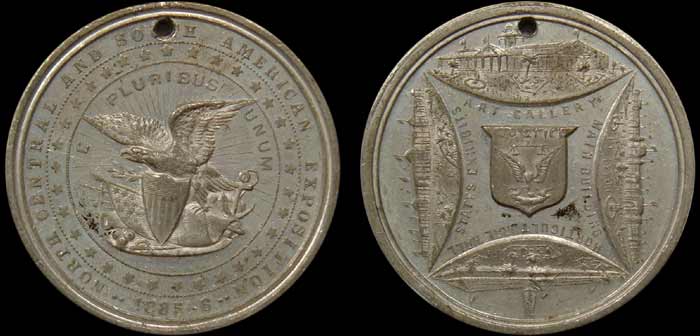
This one isn't listed in Hibler-Kappen, but it probably should be. It seems to have been issued for the North Central and South American Exposition of 1885-6:
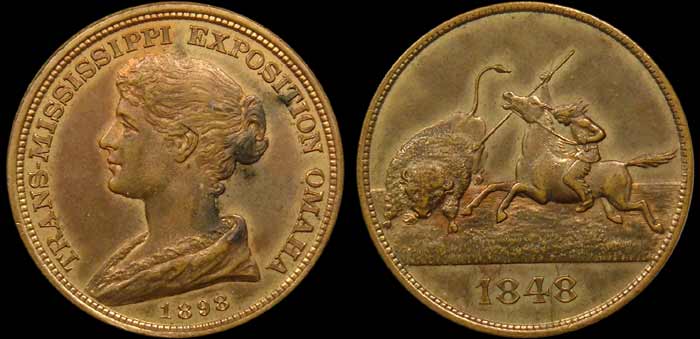
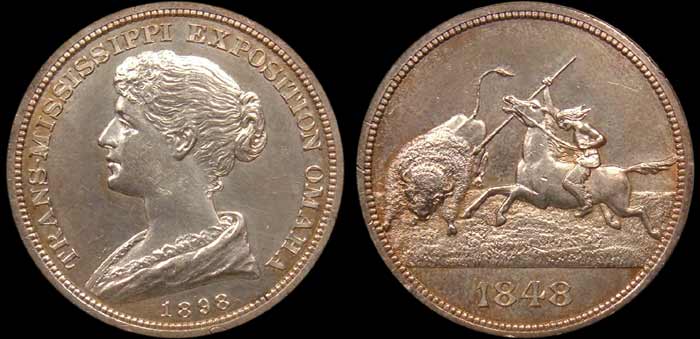
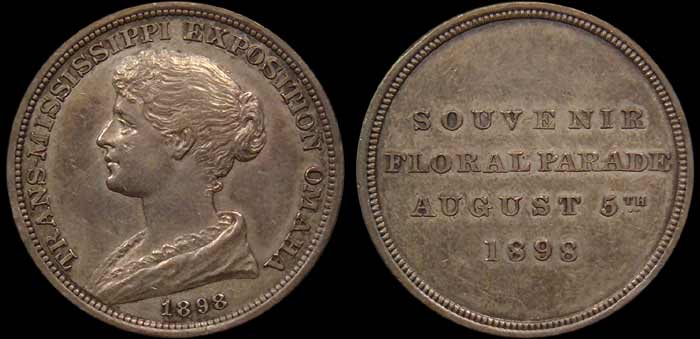
These next three were among the few pieces that were pictured well enough that I knew what I was getting before I bought. Or at least, that's what I thought. The first two are the Official Medal of the Trans-Mississippi and International Exposition (1898, Omaha, Nebraska) in brass (HK-283) and silver (HK-281). The third one I assumed was a duplicate silver example, until I turned it over. This piece is unlisted in Hibler-Kappen. I don't know anything about this event, but a silver medal from a one-day event has got to be a Good Thing, especially given its close tie to a listed So-Called Dollar.
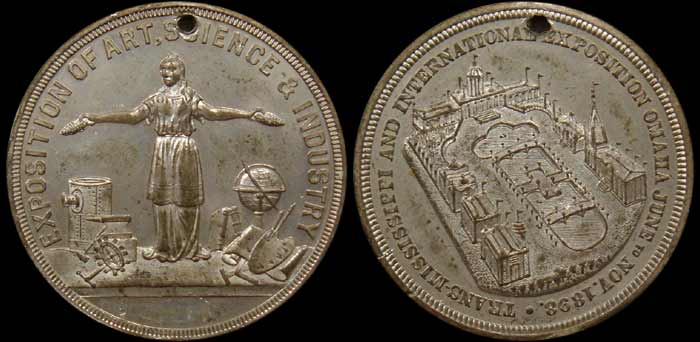
This one isn't particularly noteworthy in itself, but I wanted to post a picture because the picture in Hibler-Kappen is wrong, and I didn't realize it until I had this piece in hand. In H-K, the reverse is pictured with a 45-degree rotation, and the picture itself is so dark that you really can't make out any details, so the central image looks like an undecipherable building of some sort. It makes a whole lot more sense when pictured in the correct orientation.
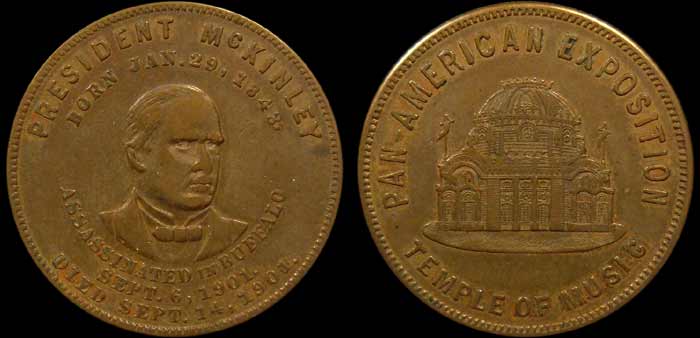
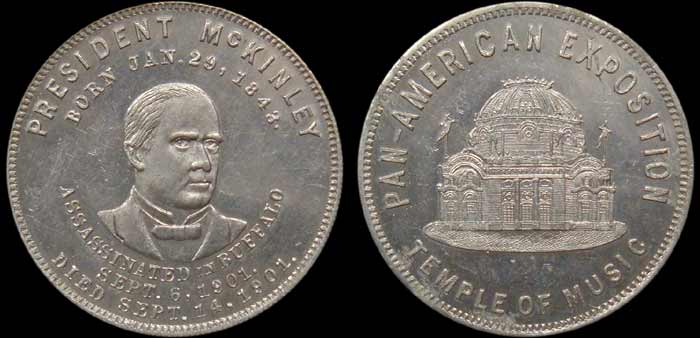
Of these next two, the first one is HK-290, a President McKinley Assassination Dollar in brass. The second one is clearly the same design, but in aluminum. It's unlisted in Hibler-Kappen in anything other than brass:
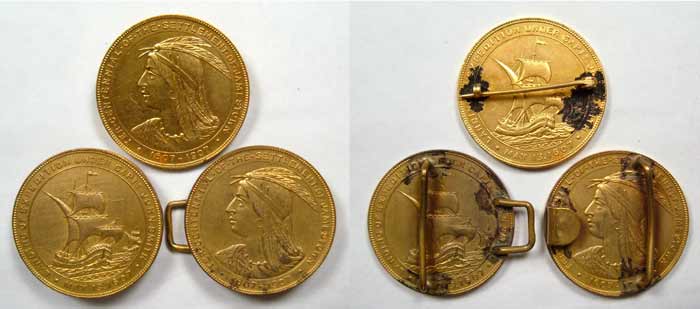
These items started off life as HK-327, Official Medals of the Jamestown Tercentennial Exposition of 1907. Someone got creative and converted them into a brooch and a two-part belt buckle. The modifications are quite solid, and the buckle likely could be used as a buckle today.
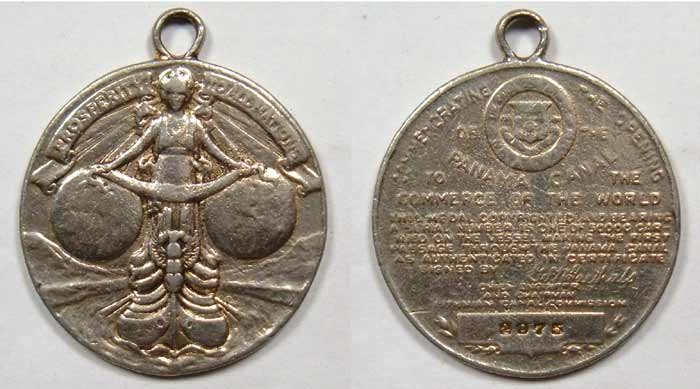
Like with the previous, this one started off as a So-Called Dollar. This was a So-Called Dollar in commemoration of the Panama Canal Completion -- some 50,000 bronze medals of this design were carried on the first ship through the canal; this one is/was serial number 2975. Unfortunately someone attached a crude loop and plated the whole thing, and it's fairly worn to boot. This medal is fairly valuable, or would have been fairly valuable in its original state. Fortunately for me, I also got an unmolested on in the same group.
Here is a run of State Fund Dollars, produced for the Panama-Pacific Exposition of 1915. As Hibler-Kappen explains, "Several states issued medals in advance of exposition as one means of raising funds for exhibition purposes; usually sold for $1." A few of the State Fund Dollars are extremely common; the Oregon dollar (HK-411) typically sells for less than $20 even in nice condition. In contrast, I saw a Tennessee dollar (HK-413) on eBay for the very first time just this week, and I don't think I've ever seen a North Carolina dollar (HK-410).
Given how common it is, I was surprised not to find any examples of the Oregon dollar in this grouping.
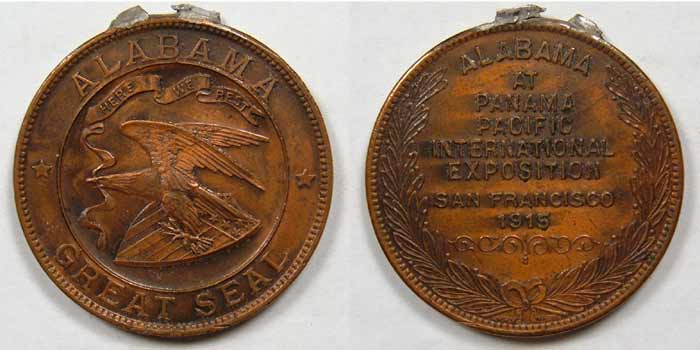
The first item here is the Alabama dollar (HK-402) It is quite rare, and it's a crying shame that someone not only decided to solder something to this one, but then went and mangled even the soldering.
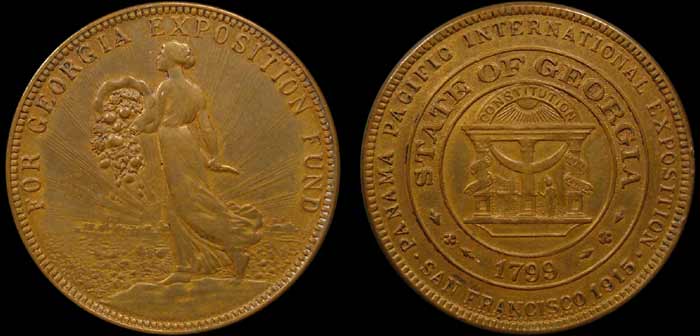
The Georgia dollar is as rare as the Alabama dollar, or maybe rarer. This is an unusually nice example.
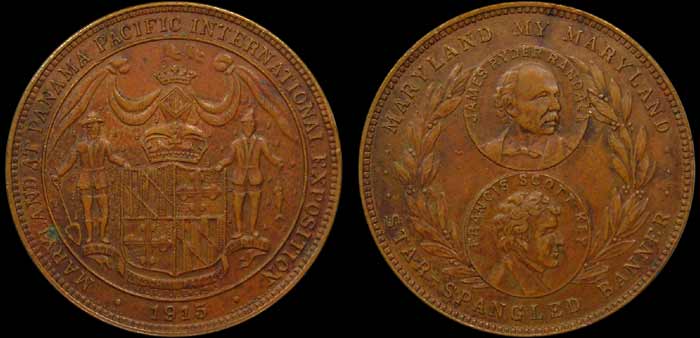
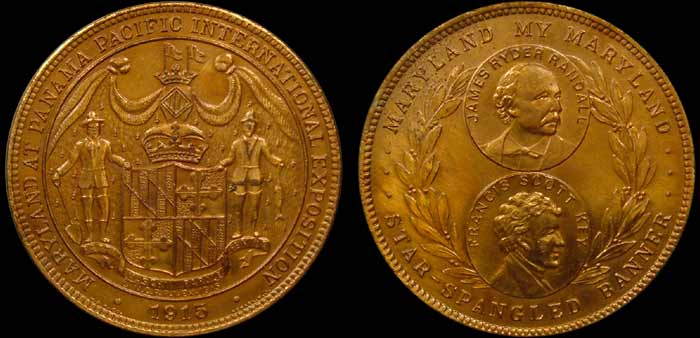
The Maryland dollar (HK-407) is also extremely rare, in the same league as HK-402 and HK-405. The first piece below has seen a little circulation and maybe has a little surface corrosion, but is still a very nice piece that I was very pleased to see. The second example is a jaw-dropper. If it isn't the finest known, I'd love to see a better one. (The coin in hand is even nicer than the picture.)
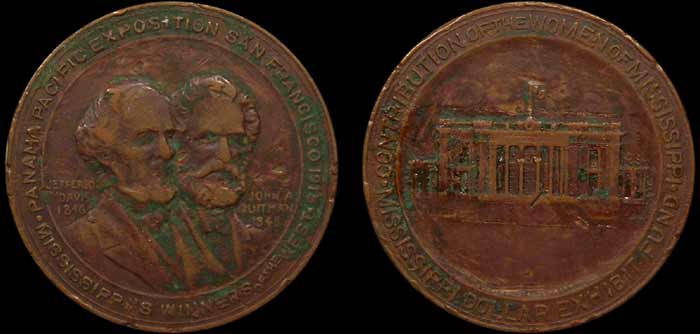
The Mississippi dollar (HK-408) is one of the rarest in the series, and is a 'keeper' even in this crappy condition.
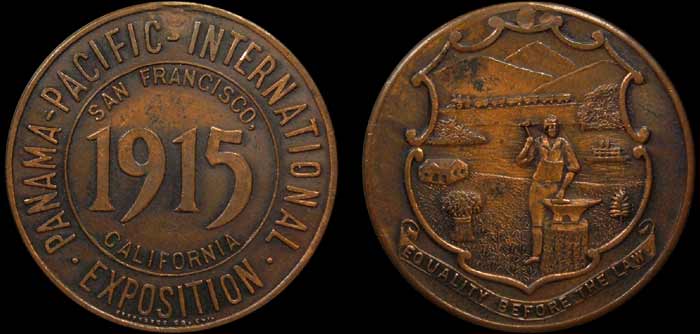
And finally, this is a Baroque Shield Dollar, HK-419. It was issued with a hole, and unfortunately someone not only plugged the hole but did a rather lousy job of it. I guess they mis-understood the old saying and decided that since this one was Baroque, they would fix it.
...and that is enough. In all I kept 41 So-Called Dollars from that grouping, and passed on 20 others. These have been some of the ones that were more noteworthy for one reason or another. I hope you enjoyed viewing these pieces.
jonathan
This one isn't all that rare, but it isn't common either, and this condition is fabulous.This is listed as HK-41 (as a So-Called Dollar) or as Baker-392B (as a Washington medal). There are lots of Washington medals within the So-Called Dollar series.
And speaking of Washington-related So-Called Dollars, another: HK-110/Baker-446B. This is part of a series of medals called the 'Eight Battles' Dollars, all with similar designs , struck by George Lovett. This on, obviously, is #7 in the series. As with the previous piece, this isn't particularly notable for rarity, but it's in very nice condition.
This one isn't listed in Hibler-Kappen, but it probably should be. It seems to have been issued for the North Central and South American Exposition of 1885-6:
These next three were among the few pieces that were pictured well enough that I knew what I was getting before I bought. Or at least, that's what I thought. The first two are the Official Medal of the Trans-Mississippi and International Exposition (1898, Omaha, Nebraska) in brass (HK-283) and silver (HK-281). The third one I assumed was a duplicate silver example, until I turned it over. This piece is unlisted in Hibler-Kappen. I don't know anything about this event, but a silver medal from a one-day event has got to be a Good Thing, especially given its close tie to a listed So-Called Dollar.
This one isn't particularly noteworthy in itself, but I wanted to post a picture because the picture in Hibler-Kappen is wrong, and I didn't realize it until I had this piece in hand. In H-K, the reverse is pictured with a 45-degree rotation, and the picture itself is so dark that you really can't make out any details, so the central image looks like an undecipherable building of some sort. It makes a whole lot more sense when pictured in the correct orientation.
Of these next two, the first one is HK-290, a President McKinley Assassination Dollar in brass. The second one is clearly the same design, but in aluminum. It's unlisted in Hibler-Kappen in anything other than brass:
These items started off life as HK-327, Official Medals of the Jamestown Tercentennial Exposition of 1907. Someone got creative and converted them into a brooch and a two-part belt buckle. The modifications are quite solid, and the buckle likely could be used as a buckle today.
Like with the previous, this one started off as a So-Called Dollar. This was a So-Called Dollar in commemoration of the Panama Canal Completion -- some 50,000 bronze medals of this design were carried on the first ship through the canal; this one is/was serial number 2975. Unfortunately someone attached a crude loop and plated the whole thing, and it's fairly worn to boot. This medal is fairly valuable, or would have been fairly valuable in its original state. Fortunately for me, I also got an unmolested on in the same group.
Here is a run of State Fund Dollars, produced for the Panama-Pacific Exposition of 1915. As Hibler-Kappen explains, "Several states issued medals in advance of exposition as one means of raising funds for exhibition purposes; usually sold for $1." A few of the State Fund Dollars are extremely common; the Oregon dollar (HK-411) typically sells for less than $20 even in nice condition. In contrast, I saw a Tennessee dollar (HK-413) on eBay for the very first time just this week, and I don't think I've ever seen a North Carolina dollar (HK-410).
Given how common it is, I was surprised not to find any examples of the Oregon dollar in this grouping.
The first item here is the Alabama dollar (HK-402) It is quite rare, and it's a crying shame that someone not only decided to solder something to this one, but then went and mangled even the soldering.
The Georgia dollar is as rare as the Alabama dollar, or maybe rarer. This is an unusually nice example.
The Maryland dollar (HK-407) is also extremely rare, in the same league as HK-402 and HK-405. The first piece below has seen a little circulation and maybe has a little surface corrosion, but is still a very nice piece that I was very pleased to see. The second example is a jaw-dropper. If it isn't the finest known, I'd love to see a better one. (The coin in hand is even nicer than the picture.)
The Mississippi dollar (HK-408) is one of the rarest in the series, and is a 'keeper' even in this crappy condition.
And finally, this is a Baroque Shield Dollar, HK-419. It was issued with a hole, and unfortunately someone not only plugged the hole but did a rather lousy job of it. I guess they mis-understood the old saying and decided that since this one was Baroque, they would fix it.
...and that is enough. In all I kept 41 So-Called Dollars from that grouping, and passed on 20 others. These have been some of the ones that were more noteworthy for one reason or another. I hope you enjoyed viewing these pieces.
jonathan
0
Comments
Thanks for sharing.
In regards to the Omaha - Floral Parade piece - I also have one of those. Yours in now the thrid one I have seen. I saw one sell on eBay about 2 or 3 years ago now for well over $200. Yes, I also assume it is a very rare piece. I'll try and scan and post a pic of it laterzz..
I said I would send pictures of the newest acquisition - The Charbneau Dollar - I have included it in the picture with the previous one I own. The latest is the one on the right.. seems to be in better shape than the one I owned already.. I was pleased...
Here are some pics... or at least links to them...
https://us.v-cdn.net/6027503/uploads/oldattachments/charb_f1.jpg
https://us.v-cdn.net/6027503/uploads/oldattachments/charb_r1.jpg
My Charbneau's
My Charbneau's (R)
John
Evergreen, Colorado
cadmanco
John
Evergreen, Colorado
cadmanco
Four Portraits HK-420
Pan Pac HK-399
HK-1
- Marcus Tullius Cicero, 106-43 BC
I also got a Four Portraits Dollar in this group, but it has a little wear, and these plated pieces just don't look that good when the plating is worn through. Yours is nice.
Cadmanco, it took me a little while to put my finger on what was strange about your pictures. For the obverses, the high points on the left piece are light and the high points on the right piece are dark. It makes them look like negative images of each other. I can't think of any way that could be an accident of the photography, so I assume that's really how they look? Here are cadmanco's pics:
My HK408 is pretty crappy too:
I really like these two...
Definitely not a photo trick... with those charbneau's... They were scanned side by side...
The one on the left has tarnished/toned some in the fields, whereas the one on the right seemed to have more original luster
in the fields, but the high points had tarnished/toned...maybe some scuffing from being stored... Just the way they were....
John
Evergreen, Colorado
cadmanco
I'd give you a weight on my 399, but it's been slabbed by NGC.... (deducting the plastic weight....not...)
I liked your Lovettt's Battle dollar...Sharp looking piece.... I've got a complete set of them, in Bronze... a little rarer than the white metal pieces, which are also rare... I purchased the bronze set on eBay about 4 years ago, in the original box.... They are some of my favorite so-called's.. I have (4) of the white metal pieces and would like to complete that set as well..... The silver set is basically impossible....
You can seen most of my Lovett's Batlle dollars here....
My So-Called Registry Set on NGC
Currently have my HK-408 (Mississippi piece) out for slabbing at NGC... can't wait to see how that one comes back.... These are tough pieces, and especially in the higher grades...
Your "baroque" piece was interesting too... I'd never seen one with the hole filled.... Brrroke!!! LOL... The one I have is holed... without a hole these are real tough....
John
Evergreen, Colorado
cadmanco
<< <i>Am I correct in saying these "So-called dollars" are not really US Coins? >>
There are a few cases that you don't have to stretch the definition of "coin" very far to
include various tokens and medals. There are "municipal trade tokens" issued by city or
state governments for use as money in a limited area or for a limited time. There are "tax"
tokens issued by government authority and frely circulated as money. There have been
numerous items issued by quasi-government authority and treated like money or its equiv-
alent.
In the strictest sense they are not coins but then an argument can be made that many
things we think of as coins don't really have all the attributes of coins.
There was another Eight Battles piece in white metal that looked very similar to mine and closed on eBay tonight at $79. I'm sort of surprised it didn't go higher. Someone may have gotten a good deal.
A complete set in silver would really be something. Reuniting eight different R8 pieces? That's tough. Based on the notations in Baker, it looks like Garrett may have had all eight in silver, but that's definitely a tough set to do.
jonathan