Options
PVC Damage on a 2005 Marine Corp Proof
 relayer
Posts: 10,570 ✭
From NCS...
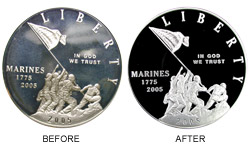
The Dangers of PVC Residue
One of the most common and destructive residues encountered on a coin is the plasticizer PVC. The chemical, PVC, makes plastic softer and more pliable and is frequently added to the make up of popular coin holders such as flips. The problem with PVC is that under certain environmental conditions and through the effects of time, the plasticizer will come out of the plastic and collect on the surface of the coin inside the PVC-laden holder. If this residue is allowed to sit on the surface and fester long enough, it will eat into the surface of the coin resulting in a certain type of environmental damage known as PVC etching. Even for new coins, PVC residue can be bad news.
To combat the ill-effects of PVC, both NCS and NGC recommend submitting your coins in what is referred to as “hard” flips. Hard flips are those that have not been treated with the plasticizer PVC and have a harder more brittle texture than do the “soft” flips that have PVC added to their make up. Flips are intended as a short-term storage option. When selecting a flip for short-term storage, such as those used to submit your coins for professional conservation and grading, choose those with a stiff feel that are free of dangerous plasticizer residues. Even very short periods of storage, such as the time for a package to be delivered through registered mail, can have a negative impact.
A recent submission of modern commemorative coins came to the attention of NCS and points out a problem seen too often. All of the coins had been shipped in the PVC-laden “soft” flips. In a short time, these coins had developed the first stage of PVC contamination. All the coins—the recent 2005 Marine Corps issues—had acquired a hazy residue hiding the fields. This residue presents a problem for both the coin’s long-term stability and its ability to grade. With such a hazy PVC residue, the coin would not be able to grade as high as it would otherwise. Removal of the PVC residue allowed the coin to realize its true potential.
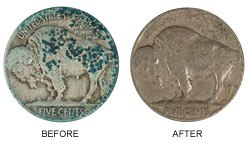
This 1924 S 5c is a prime example of the irreversible damage that can happen when a PVC residue is left on a coin’s surface. As PVC contamination advances, the haze on the coin’s surface becomes thicker and green in color. The thick green oily residue is the most destructive PVC contamination. The reverse of this coin was grossly affected by a PVC residue that, once removed, left visible pits all over the surface of the coin.
Even the newest and freshest coins can be adversely affected by PVC. A PVC haze can prevent a coin from grading out as much as it could in the short-term and if left to become more severe could cause irreversible damage to a coin’s surface.
The Dangers of PVC Residue
One of the most common and destructive residues encountered on a coin is the plasticizer PVC. The chemical, PVC, makes plastic softer and more pliable and is frequently added to the make up of popular coin holders such as flips. The problem with PVC is that under certain environmental conditions and through the effects of time, the plasticizer will come out of the plastic and collect on the surface of the coin inside the PVC-laden holder. If this residue is allowed to sit on the surface and fester long enough, it will eat into the surface of the coin resulting in a certain type of environmental damage known as PVC etching. Even for new coins, PVC residue can be bad news.
To combat the ill-effects of PVC, both NCS and NGC recommend submitting your coins in what is referred to as “hard” flips. Hard flips are those that have not been treated with the plasticizer PVC and have a harder more brittle texture than do the “soft” flips that have PVC added to their make up. Flips are intended as a short-term storage option. When selecting a flip for short-term storage, such as those used to submit your coins for professional conservation and grading, choose those with a stiff feel that are free of dangerous plasticizer residues. Even very short periods of storage, such as the time for a package to be delivered through registered mail, can have a negative impact.
A recent submission of modern commemorative coins came to the attention of NCS and points out a problem seen too often. All of the coins had been shipped in the PVC-laden “soft” flips. In a short time, these coins had developed the first stage of PVC contamination. All the coins—the recent 2005 Marine Corps issues—had acquired a hazy residue hiding the fields. This residue presents a problem for both the coin’s long-term stability and its ability to grade. With such a hazy PVC residue, the coin would not be able to grade as high as it would otherwise. Removal of the PVC residue allowed the coin to realize its true potential.
This 1924 S 5c is a prime example of the irreversible damage that can happen when a PVC residue is left on a coin’s surface. As PVC contamination advances, the haze on the coin’s surface becomes thicker and green in color. The thick green oily residue is the most destructive PVC contamination. The reverse of this coin was grossly affected by a PVC residue that, once removed, left visible pits all over the surface of the coin.
Even the newest and freshest coins can be adversely affected by PVC. A PVC haze can prevent a coin from grading out as much as it could in the short-term and if left to become more severe could cause irreversible damage to a coin’s surface.

My posts viewed
 times
since 8/1/6
0
Comments
Check my ebay BIN or Make Offers!!
Cartwheel
Cartwheel's Showcase Coins
<< <i>How in the heck could PVC develop so quickly on a coin? If it is PVC, you could have just soaked it in acetone to remove it.
Cartwheel >>
Try an experiment
I say used cheap proof coins, because it really is easier to see the haze on a proof than just a random circ coin...
42/92
PVC is a relatively inert, hard rigid normally opaque plastic that is transparent when processed into the very thin sheets used to make the flips. It is NOT a chemical used to make plastics softer. They are confusing the plasticizer and the plastic. The oily plasticizer IS NOT PVC, and the oily film believe it or not is NOT in itself hamful to the coin. (Although the oil film can dull the reflectiveness of a proof finish. But it dulls it by interfering with the light, not by doing anything to the coin itself. Remove the film and everything is fine.)
What causes the damage is a combination of factors. As PVC ages, or in higher temperatures, it outgases Hydrogen Chloride gas. The oily plasticizer film can absorb this gas. The film is also hydroscopic absorbing water vapor from the air. This water vapor combines with the Hydrogen Chloride and creates Hydrochloric acid, an extremely powerful corrosive. And the oil HOLDS this corrosive acid in contact with the metal of the coin. Usually it attacks the copper in the alloy forming Copper Chloride which is green in color. This is the source of the color in the "green slime"
Since they confuse the oil with the plastic the services will bounce any coin with a visible oil residue as having PVC contamination. Even coins that have neve been in a PVC holder. Oil films can also come from lubrication oils used on the dies at the mint and they can come from other plastic holders where the oils are used as a release agent to seperate the plastic from the mold.