Options
New Orleans 1849 Assay of Moffat Bars
 RogerB
Posts: 9,009 ✭✭✭✭✭
This table is self explanatory. 
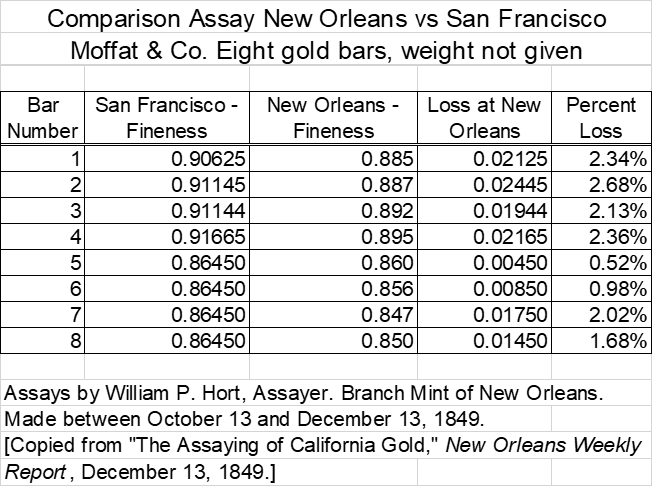
3
Comments
Interesting that they were consistently off. I mean if one or two had been a bit wrong I might say yeah, so what, but their assayer (Moffat's) was not very good at his job.
Interesting.
Interesting table, though pulling one newspaper clipping covering eight bars over a two-month window still leaves a few open questions. Without the bar weights, stamped dollar values, or total volume of Moffat gold New Orleans received, it’s hard to see the full picture, especially if those were just a handful of small $16 bars or odd-weight bars.
The fineness figures themselves also raise questions. Bars 1–4 carry individual five-decimal San Fran figures (0.90625–0.91665),. However, Bars 5–8 all carry the exact same 0.86450 stamp while their New Orleans values vary from 0.847 to 0.860. That looks more like batch stamping than individual assays.
New Orleans officials were also under heavy political pressure in late 1849 (Democratic holdovers faced intense pressure from the new Whig administration as well as merchant complaints over slow payouts). Because the 1837 Mint Act set strict limits on melting losses, they had to approach assaying unrefined California gold cautiously. By comparison, when Eckfeldt and DuBois assayed Moffat & Co.’s $10 coins at Philly, they came out at $9.977, within 0.23% of face value. That is a pretty big difference compared to --roughly estimated--a 0.5% to 2.7% shortfall on those eight early bars.
It is an interesting historical data point, though it alone does not dispositively answer the issue of Moffat's overall accuracy, or lack thereof.
This thread needs pictures.
Ex-Donald Bently
chopmarkedtradedollars.com
Moffat melted native California gold which varied in purity from about 0.840 to 0.910. The private assayers did their best with inadequate balances, impure chemicals, and contaminated samples. They also frequently omitted silver that was part of CA native gold. Also, in 1849 nobody realized that platinum was also common in CA gold. Only after British complaints did US assayers take the extra steps to account for and eventually remove platinum, iridium and osmium. New Orleans Mint assays are more accurate also because of using French (Laurent-Jean Chaudet) assay methods (as at all US Mints); Moffat did not have this technique.
No assay of that era was accurate to 5 decimal places -- 3 was about it with any level of consistency. US Mint assays when performed by 2 mints on the same sample (as when a depositor challenged an assay) seem to be mostly within 0.001 or 0.002 +/-. Don't confuse Eckfeldt's results with the 8 bars mentioned in the 1849 article. These were bars, not coins; coinage gold was regulated to some extent by mixing native fineness to get approx 0.887+.
The San Francisco commercial working standard for native gold dust was $16.00 per Troy oz. through 1849.
My point in bringing up the coins was that if Moffat & Co. had to mix native gold with higher-purity gold to hit a regulated ~0.897 coinage fineness, they would have needed an accurate starting assay just to know what to add.
Think mention of coins relevant as it does tend to show capability for accuracy.
"Capability for accuracy...." Maybe; but maybe capability for consistency of inaccuracy, or capability for accuracy when making coin alloy of which there was no need in bars.
Don't place too much blame on them for doing what they could with what they had.
The Mint Treasurer does not seem too concerned in the article - possibly because the Mint paid for gold according to their own assay, not what was stamped on the bars.
Setting aside your points on 1849 assay limits and coin alloying, neither "consistency of inaccuracy" nor the Treasurer's mindset is shown in the posted chart. Inferring both stacks a lot onto 8 (maybe 5) bar assays. Hence "capable"—I brought up the coins simply to illustrate why that single chart is not sufficient in itself to draw firm conclusions.
jch22 - you seem to be reading a lot into the little table. The NO Mint treasurer's interest seemed to be informing not making any conclusion except what was obvious from a casual test on 8 bars. Western coin and bars were of casual interest and convenience back East. This was a period when the first eastern miners (GA, NC, SC, AL,VA) were returning home with large quantities of native gold (mostly bars and some coin, some dust). Their placer mining experience gave them a large advantage over others, so they scraped up all they could and left the floating dredges, water cannons and early hard rock work to others.
(BTW - this is the article than mentions New Orleans Mint assay of Miner's Bank $10 -- 1 coin, Oct 16, 1849. It appears to be the only known source for this information.)
Here's the opening section of the article. Hope this is helpful.
The Assaying of California Gold.
The following communication, on the subject of the titles and fineness of California gold, has been kindly sent us by Mr. John R. Macmurdo, Treasurer of the Branch Mint of New Orleans. It is quite important:
BRANCH MINT NEW ORLEANS, Dec. 13, 1849.
Editors Delta: Believing that you are interested in knowing the precise value of the coins and bars stamped at San Francisco, I now present you with the result of such assays as I have had occasion to make, up to the present time.
On the 16th of October, I assayed one ten-dollar gold piece, coined at San Francisco, nearly a fac simile of the United States gold eagle: weight, 258 grains; title, 8881 millièmes of gold, 60 ditto of silver, and the balance copper; value, $9 78. This is the only coin, in which art has been resorted to, in making an alloy, that I have seen.
Also, on the same day, one ten-dollar piece of the Miners’ Bank of San Francisco: stamp very different from that of the United States; weight, 259 grains; title, 866 millièmes of gold; 105 ditto of silver; value, $9 65.
As, with the exceptions alluded to, these coins appear to be made of California gold, unchanged, except in melting and being cast into ingots, we may expect the title to vary as much as that of the gold in different localities, the range of which is from 860 to 910 millièmes. Hence, no surprise should exist at a difference of title, rendered in the same mint, or of titles as compared with those in other mints.
Eight bars, of different sizes, stamped Moffat & Co., San Francisco, have been carefully assayed. They were evidently cast from the gold as found in its natural state of alloy.
[Followed by the table in first post.]
I am seeing a familiar pattern:
1) Vague Opening (Ambiguitas): Posting a table as "self explanatory" implies it needs no explanation—while omitting the context required to interpret it.
2) Moving the Goalposts (Mutatio elenchi): Each reply changes what the table is supposed to show—from clear evidence on its own which requires no explanation, to an example of 1849 assay limits, and finally to just a "casual test" of "casual interest".
3) Appeal to Authority (Argumentum ad verecundiam): Answering questions about sample size and missing weights with technical lectures ("Don't confuse...") leans on authoritative framing to completely avoid addressing the missing data.
4) Red Herrings (Ignoratio elenchi): Introducing extrinsic tangents—Chaudet assay methods, osmium/iridium, returning Southern miners, floating dredges, water cannons, and a Miner's Bank coin—adds trivia while avoiding the core evidentiary gap.
5) Delayed Context (Suppressio veri): Sharing the article's intro two days later—where the Treasurer explicitly states "no surprise should exist at a difference of title"—confirms why the standalone table wasn't self-explanatory in the first place.
6) Reversing the Critique (Tu quoque): Pointing out why the chart is inconclusive gets framed as "reading a lot into" it, even though the uncontextualized opening left the numbers open to interpretation. and the actual speculative leaps (like guessing the Treasurer's mindset) came in the OP's replies.
Leading with the final characterization—unrefined bars in their "natural state of alloy" of "casual interest"—rather than "self explanatory" would have clarified the scope from the start and much shortened this discussion