Options
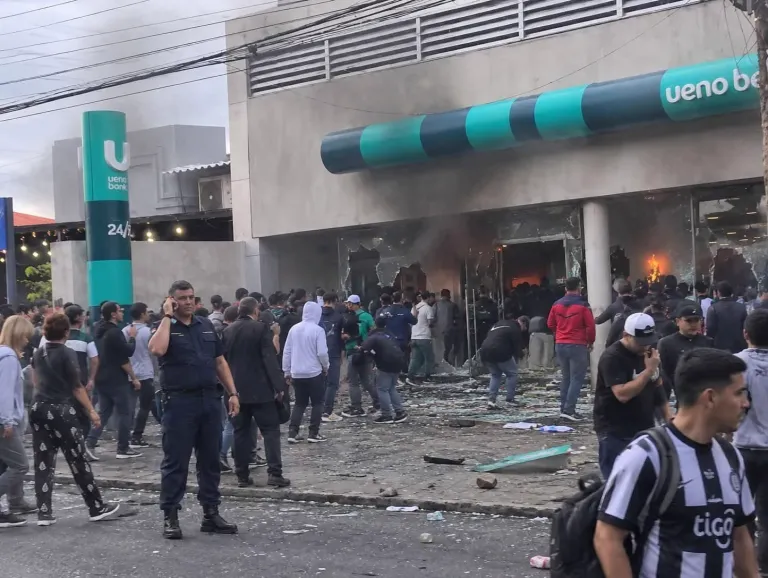
Paraguay’s MASSIVE Banking Collapse
 derryb
Posts: 38,707 ✭✭✭✭✭
this is what happens when banks loan out to much money
60% of Paraguay’s adult population completely lost access to their accounts. Imagine waking to that surprise!
As of June 30, 2026, the US's FDIC’s Deposit Insurance Fund (DIF) has a balance of $161.1 billion. Total deposits in U.S. commercial banks stand at $19.77 trillion. Fractional banking calls for fractional insurance. LOL
Bank depositers fail to realize that they are loaning money to a bank when they make a deposit.
Got gold?
Governments can print currency. Only the people can print faith in it — and they’re running low on ink.
0
Comments
A bank that held less than half the capital that it was required to hold - for 60% of the population?
In the context of David Rogers Webb's book "The Great Taking" this means that 60% of the population just got robbed of at least 1/2 of their money (probably more than 1/2) and it will probably be a year or two before they get anything back.
The laws are on the books - it isn't your money in the banks. It's money that you've "loaned" to the bank, and they can legally gamble with it any way they want until the regulators step in. By then, it's too late.
Can it happen here? The laws are already on the books. You might have a little bit better odds in Vegas.
I knew it would happen.
Bank deposits should be considered an investment in that bank. Monitor that investment and that bank's performance. Financial news is a good source. Reports from regulators not always a good source.
Governments can print currency. Only the people can print faith in it — and they’re running low on ink.
Thanks for sharing. It's amazing how much news I have received here over the years.
soon the president of Paraguay will be in prison, he was in kahoots with the banks board for quite a while.
Successful BST:here and ATS, bumanchu, wdrob, hashtag, KeeNoooo, mikej61, Yonico, Meltdown, BAJJERFAN, Excaliber, lordmarcovan, cucamongacoin, robkool, bradyc, tonedcointrader, mumu, Windycity, astrotrain, tizofthe, overdate, rwyarmch, mkman123, Timbuk3,GBurger717, airplanenut, coinkid855 ,illini420, michaeldixon, Weiss, Morpheus, Deepcoin, Collectorcoins, AUandAG, D.Schwager, blu62vette, morgan13, torinoCobra71, JWP, promethius88,
Paraguay Ousts Its President As His Daughter's "Tax The Poor" Shirt Goes Viral
Governments can print currency. Only the people can print faith in it — and they’re running low on ink.
https://www.ft.com/content/1407c45e-9765-44cc-95ce-4c5a9dc93fc2?syn-25a6b1a6=1
Quite the flood.
Knowledge is the enemy of fear
Hello everyone, how is the forum doing? Greetings to all the great people here. Since I live here in South America, I wanted to share a detailed account of what has been happening in our neighboring country, Paraguay, regarding the recent banking crisis.
To give you some background, ueno bank wasn’t very well known before and didn’t have many traditional clients. However, right after President Santiago Peña took office, political influence changed everything. Taking advantage of the financial troubles of another legacy institution called Visión Banco, ueno bank absorbed it, instantly capturing a massive portion of the country's depositors.
Peña never distanced himself from the banking group's management. In fact, he appointed Carlos Carvallo—who was heavily linked as an executive and shareholder in the financial group—as the head of the Central Bank, which was supposed to regulate them. They engaged in illegal practices, granting massive, irregular loans to their own partners and associated companies, which completely bled the bank's liquidity. Now, it appears a vast amount of that money has been moved outside of Paraguay, leaving millions of everyday citizens in complete despair, distress, and ruin.
Currently, Peña has been impeached and removed from office by Congress, and he is now under house arrest facing criminal investigation. He actually tried to resign first, but Congress rejected his resignation to ensure he wouldn't avoid justice. To be honest, seeing this unfold in Paraguay brings back a very bitter sense of nostalgia for me here in Ecuador, as our country went through a very similar banking collapse in the past. This is my report from over here in South America!
@ricarf2386
Excellent information. Thanks.
DPOTD-3
'Emancipate yourselves from mental slavery'
CU #3245 B.N.A. #428
Don
This is Fraud 101. Has nothing to do with normal banking operations.
They stole pension assets, had sweetheart loans, and didn't have the right capital.
No wonder Josef Mengele hung out there.
Fraud 101 is when the bankers or brokers can "legally" use your money to gamble on derivatives or worthless bonds, but if they lose the bet, suddenly your money isn't your money anymore when you are bailed in and you become an unsecured creditor who is last on the list for resolution.
I knew it would happen.
Wasn't your money anymore the moment you loaned (deposited) it to the bank. You only hold a paper or digital claim on the money until the bank either gives it back to you (if they have it) or the failing bank legally keeps it because depositers become the first creditors to fund a bank that fails. Of course your FDIC insurance will cover you until its money runs out. Size of bank failure determines if everyone gets their money back. FDIC currently hold 161.1 Billion in its insurance fund to cover the $19.8 Trillion in US bank deposits.
Governments can print currency. Only the people can print faith in it — and they’re running low on ink.
FDIC currently hold 161.1 Billion in its insurance fund to cover the $19.8 Trillion in US bank deposits.
And of course, the next step would be that Congress will authorize a few $trillion in emergency spending to fill the gap. The fake money will be keyboarded into existence to bail out the banks as usual.
But not before every depositor is wiped out completely.
The laws were changed about five years ago. It's all "legal" now.
I knew it would happen.
The same laws apply to stock brokerages (and insurance companies - who are loaded up with bonds in a rising rate environment). You don't own the stocks in your account. You are only a "financial beneficiary" whatever that means. That includes ETFs, mutual funds, individual stocks and bonds as well.
You don't own the assets. If the Mag 7 fail, it's a distinct possibility that they will drag down the entire financial system, including the banks. Gov.com will be 3 steps behind and you can bet that what comes next won't be what you expect.
I knew it would happen.
Banks, large contributors to political candidates, realized they were completely exposed to a bank failure. They lobbied for and got the change in law that gave them a claim to depositor funds in bank failures.
Governments can print currency. Only the people can print faith in it — and they’re running low on ink.
It's difficult to determine who is at the top of the totem pole - the bankers, foreign governments, the military industrial complex or the tech companies. It's a fascinating thing to watch.
I knew it would happen.
That doesn't happen in the U.S. and any other modern banking country which is subject to Basel II/III regulations or something similar.
Your entire "gamble on derivatives or worthless (?) bonds" is ridiculous. You might just as well accuse a bank of taking the $$$ and going to Vegas or Macau.
That's historically excellent coverage.
Bank capital ratios and loan/asset quality are at the best levels since the 1950's. Read or see Mike Mayo, who's been covering the sector for 35 years and has been bearish for YEARS when appropriate.
Our banking system is the envy of the world.
Explain how this situation materializes. You're conjuring up armageddons out of nothing.
It's clear you don't believe banks should exist or simply don't understand how banks operate.
There was no such law change. You are misinformed or making stuff up.
Laws were overridden to reward unions and other unsecured creditors monies they were not entitled to in the Detroit bankrupty, 2008-09 Financial Crisis, and the Butch Lewis Pension Embezzlement Act.
Yes, you do. Your statement is 100% false.
It is, for limited bank failures. Just hope you never see a run on the banks. This is precisely why FDIC was created - a marketing scam to convince depositors their money is safe, and it works!
What were they in 2008? All it takes is compounded default on its commercial loans. These loans are up to 10 times the deposits on hand and are heavily dependent on the state of the economy. Banks are simply over leveraged and hope their Ponzi continues.
The world doesn't realize that our banking system has protected itself by making depositors creditors of the bank who are the first to fund bank failure.
Governments can print currency. Only the people can print faith in it — and they’re running low on ink.
Agree 100%. If your B/D is honest (and their auditors & regulators auditing) your 'fully paid for" securities are held in a segregation account at DTCC. Nobody can touch it if something goes wrong, not the failed B/D or creditors. SIPC will send you your securities to whatever new B/D you wish. Now I know some 'securities' are not DTCC/custodian eligible, but this is probably 1% of the overall brokerage assets. Agree stop making stuff up you do not understand.
Explain how this situation materializes. You're conjuring up armageddons out of nothing.
There was no such law change. You are misinformed or making stuff up.
Your statement is 100% false.
What is your opinion of David Rogers Webb's book, "The Great Taking"? If you have no idea what I'm talking about, perhaps you would do well to find out.
I knew it would happen.
Who the hell is the guy ?
No, I never heard of him or his book. Sounds like another Armageddon+Consipracy book designed to separate people from their $$$, like Rosland Capital.
Nobody is saying the financial system is perfect, but it's the best it's been in my lifetime. Leverage -- the key in 2008-09 -- has been DRAMATICALLY cut back (from about 22x to 10x).
Oh Good Grief: "...Webb argues that central banks, financial institutions, and governments have orchestrated a decades-long setup to trigger a global debt crisis and legally confiscate all private and public financial assets. According to the thesis, this is the final stage of a globally synchronous debt-accumulation super-cycle."
I'l wait for the movie version.
Who the hell is the guy ?
No, I never heard of him or his book.
It figures. He's more credentialed and more experienced than you could ever hope to be.
Don't say that you were never advised that the securities laws have all been changed. I'm truly stunned that you have no idea who Webb is and what his book is about. I'm shocked that someone like you who purports to be a financial expert is so unaware.
I knew it would happen.
.
I would be interested in an elaboration of who actually owns what, when a stock is sold short by one party and the party on the other side of the transaction is buying.
.
He appears to have overstated his credentials, since his investment management experience started with CompuServe which is a Transfer Agent.....oversold his investment management experience........gives no performance data or credentials (i.e., MBA or CFA).....and lists having scheduled a phone call with George Soros as somethign worth noting. I met with and talked to Peter Lynch @ Fidelity for 10-15 minutes but I never thought about putting that on my resume.
He left a firm in 2002 or 2003...formed something called Verus....and that firm went bankrupt in 2004.
Sorry, I see nothing that puts him in the league of Ray Dalio or Thomas Peterffy, guys who are perma-bears on certain topics, but who clearly have the gravitas and success to at least merit being listened to.
a bank run grows like a wildfire. It makes account holders in other banks to want to withdraw and hold their own money until reality becomes fear. Remember that weekend late night meetings in 2008 were aboout keeping the wildfire from starting when the banks and markets opened on the next monday. There's a reason they didn't just say "just let FDIC and SPIC cover the losses."
I believe in keeping my money in a well run local credit union. I do understand that, thanks to fractional lending of up to ten times the deposits on hand, large banks, in competition with one another, are steadily walking on thin ice to make as many loans as possible to make the stockholders happy. A game of Musical Chairs applies to banks as well as any other ponzi operation. When your bank fails because they made bad loans do you want to be the last one looking for a chair when the music stops? It's called a "run on the bank" for a good reason. It starts from a small spark such as inside informtion that soon becomes outside information. This why they call it a bank run; it'a not much different the rush for a seat when the music in Music Chairs stops.
Just one example: By late 2026, total AI-related debt issuance and borrowing alone had reached roughly $450 billion to $500 billion. Major banks all hold a piece of this debt. What happens when the projected estimated profits fall far short of the estimates? What happens when the value of a major supplier of AI chips (NVIDIA?) falls drastically?The cracks are already starting to show.
Banks are starting to smell the smoke and are are now begining to offload the AI data center debt they just underwrote
Governments can print currency. Only the people can print faith in it — and they’re running low on ink.
When sold short, the B/D borrows from a lender, either internal or external. The B/D puts up the cash market value of the borrowed security from the short sale delivery proceeds with the lender. The short is marked daily and cash is exchanged as needed. If the B/D goes belly up, the lender has the cash collateral.
.
Company "A" is public and ownership is traded in the form of stock shares.
Entity "B" owns some of those shares. So Entity "B" is a part owner of Company "A".
Broker/Dealer "C" wants to sell short that stock. So they borrow some shares from Entity "B". In this manner, Entity "B" does not have to actually sell their shares.
But for Broker/Dealer "C" to sell short, they have to have a counter-party (a buyer).
Along comes Person "D", who thinks they will obtain partial ownership of Company "A" by purchasing from Broker/Dealer "C". But Person "D" does not actually own anything because Entity "B" never actually sold the shares. All Person "D" has is a contract with Broker/Dealer "C" as the counter-party.
.
Shares can only be borrowed and shorted if not fully paid for, such as in a margin account so in your example Entity B did not fully own the shares. Entity C can be forced to buy back those shares however if Entity B wishes to sell them and other shares are not available to be shorted.
Person D is irrelevant to your scenerio.
Knowledge is the enemy of fear
..
Knowledge is the enemy of fear
.
In your scenario, who actually owns the shares that are being lent/borrowed ?
The whole point of this is that the end buyer (Person "D") might think they are obtaining actual ownership of a company when buying shares. But they might not have any actual ownership.
.
The broker/dealer owns them until the Entity B pays for them in full.
If Person D fully pays for the shares then he owns them. No one else, just him.
It would be Entity B that did not own the shares, otherwise Entity C would not have been able to borrow them in the first place.
Knowledge is the enemy of fear
.
OK. But then why would Broker/Dealer "C" need to "borrow" the shares if they already own them ?
And now you have two different claims on the same shares by Entity "B" and Person "D".
Suppose Person "D" does actually receive the shares (becomes the actual owner of them).
What happens if Entity "B" then pays off their margin balance ?
.
This is your scenario, i have no knowledge of C's intentions.
There are not 2 claims. B pledged his shares in the margin account.
Then C would find other shares--maybe from E. If none were available then they may have to go into the market and buy shares, thus closing out the short position. This is what causes a short-squeeze.
Knowledge is the enemy of fear
.
Trading on margin certainly has disadvantages. I certainly wouldn't do it.
You are setting yourself up as a target to get "stopped out" of your trade.
.