2001-P Sacagawea Dollar – Improper Annealing, Alloy Mix, or Environmental Toning?
 ricarf2386
Posts: 289 ✭✭✭
Dear forum members,
I have seen several threads here talking about improper annealing and how it has resulted in a very particular color on coins—for example, on the Trump dollar.
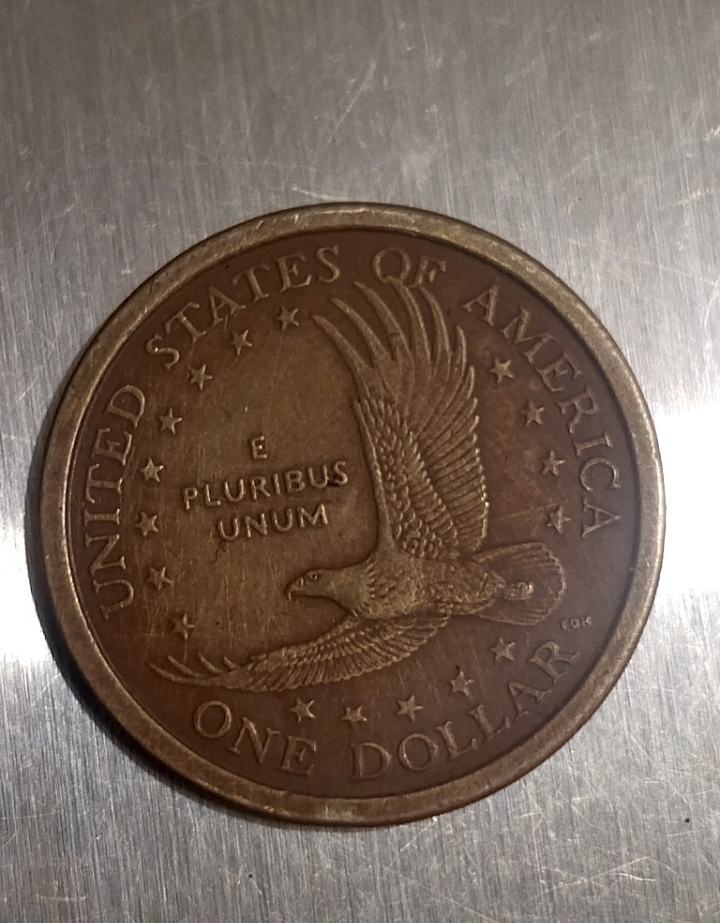
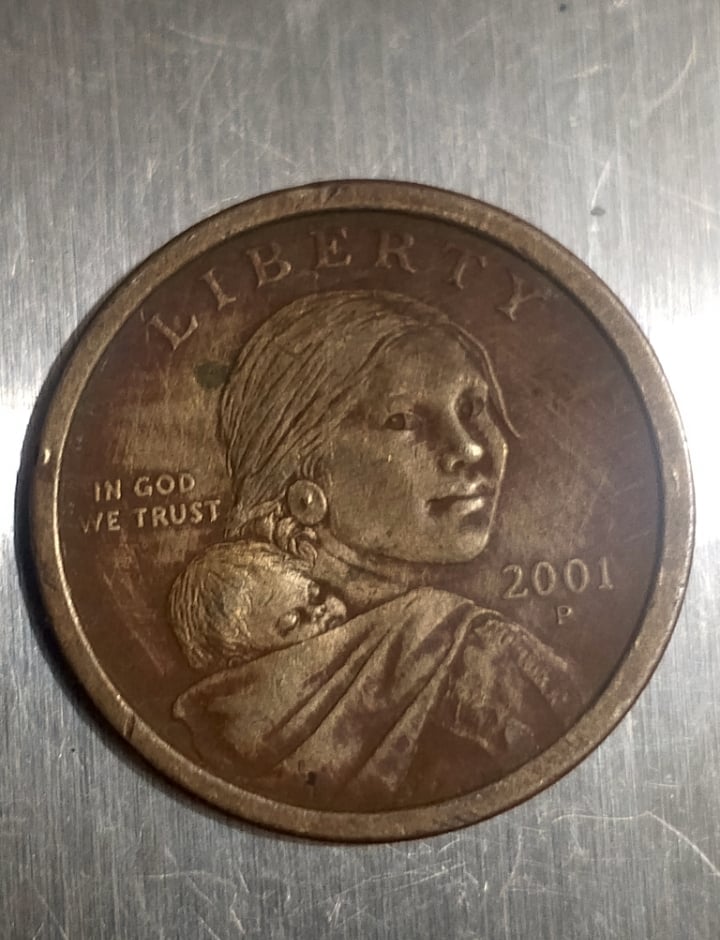
I recently found this 2001-P Sacagawea Dollar with a golden-copper color on both faces, while the edge is completely copper-colored. I have already come across several of these coins among Sacagawea and Presidential dollars, but I really liked this one because of how the copper color is distributed across it. I have nicknamed this coin "Sacagawea on a Dark Night."
My question is: could this specific shade be caused by environmental factors, or is it an improper annealing error, or perhaps because the materials were not mixed properly (improper alloy mix) during its manufacturing?
Thank you for your comments and guidance!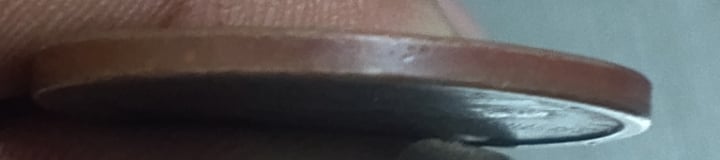
Comments
Environmental damage.
This
Great question - to be determined in my next paper due for publication in May/June 2027.The Sacagawea's are a bit more complex than Black Beauties and outer clad layer higher denomination coinage from Dimes to Dollar which are Improperly Annealed in a Cu/Ni binary alloy. Hold onto to it and wait for my study to be completed. Here is the current working model in my paper: For a brown Sacagawea dollar, SEM/EDS can help distinguish improper annealing from environmental damage by comparing oxygen levels, Cu/O ratios, and the presence of contamination elements such as sulfur (S) and chlorine (Cl). If the brown color resulted from improper annealing, the surface would typically show elevated oxygen associated with copper oxidation and a progressively lower Cu/O ratio as the color darkens. The oxidation should be relatively uniform across affected areas and generally follow a logical color progression from gold to brown. Sulfur and chlorine would usually be absent or present only at trace background levels.
Environmental damage often produces a different signature. Corrosion caused by soil exposure, moisture, salts, PVC residues, or atmospheric pollutants may show localized oxygen enrichment accompanied by elevated sulfur and/or chlorine. Chlorine is particularly important because it can indicate active copper chloride corrosion, while sulfur may reflect sulfide formation from environmental contaminants. In these cases, SEM imaging may also reveal pitting, etching, crusts, or irregular surface deposits rather than the more uniform oxide film expected from improper annealing.
A useful working approach will be to compare Cu/O ratios, S levels, and Cl levels between brown areas and any normal-colored areas on the same coin. A brown surface showing primarily increased oxygen and a decreasing Cu/O ratio, with little sulfur or chlorine, would favor an improper-annealing origin. In contrast, significant sulfur and chlorine enrichment combined with corrosion features and irregular deposits would strongly support environmental damage rather than a Mint-produced oxidation effect.
Go to the Eric P. Newman Portal and type SEM/EDS into the search box and see my previous papers with SEM/EDS. The last paper published also in Mint Errors News in October, 2026. With the assistance of Michigan State University's Materials Laboratory at their Tech Center you should have your answer. These SAC pieces start off looking like gold or with a golden color (hue) so the overall oxidation color pathway is similar to Cu/Ni issues however there are some surprising twist and turns due to its manganese content in the outer layer. Currently assembling background information. This project will take six to eight months and currently into MONTH (3). Its complex but I do see the light at the end of the tunnel. Great question.
You can always send it to me for evaluation. I have a reddish/brown disturbed surfaces example already locked in for full SEM/EDS analysis which includes Map Sum Summary (assay)/Microstructure and Point & ID Analysis. I will take a look if your specimen is worthy for this study. Will need to examine it in hand.
A good initial clue is glossy + discolored = Annealed; Porous/pitted + Discolored = PMD. However some advanced IA errors have peeling, disturbed raised surfaces with partial glossy fields. A stereo microscope here is invaluable.
Thank you for your input, your answer is within the expected range according to my question.
Hello, friend. I really like it when a topic sparks this much interest, and I can see you have very extensive research on the subject. I can detail what I observe directly on the coin: this particular dollar, at some point, had a uniform brownish-copper color. The two possibilities I am considering are either that it came out of the Mint like this, or that at some point it was submerged in some liquid and took on this tone. If we look at both sides, the eagle reverse still maintains that brown color across its entire surface; on the other hand, on the Sacagawea obverse, the friction from circulation has been uncovering the original golden color on the highest points. The coin has not seen much circulation, as it still retains all of its fine details intact, both on the eagle and on Sacagawea.
If I were in the United States, I would gladly send it to you for an in-depth study like the one you are conducting, so you could use it as a reference—whether as a Mint error or environmental damage—and add it to your research. I would be thrilled to give it to you for your study without seeking any benefit or expecting anything in return; in other words, I would happily gift it to you.
OK. Thanks for your comment. This being said if you do send it to me for research studies I can PayPal your postage just include your PayPal ID in the envelope. Its up to you and I am forming an Appendix Pictorial overview of about 3 dozen pieces due to the complexity of this study so it would minimally go in there. If you are up on Ebay sell it there I may place a bid. It does look porous more than glossy. As someone said determining if something is IA after its circulated can be difficult and especially from a photo. All copper looking SACs now do capture my interest as worthy study examples.
It's environmental damage. If you can't see that I don't know why you think you are qualified to write any kind of paper.
But, that's just the opinion of someone who has never written a "paper". 🤷♂️
With IA errors its always good to keep an open mind with photos, lighting, optics, quality of picture, etc. it does look pretty bad JBK.
@colonialjohn < @SlickCoins
Well off to the NGC Forum. Thanks guys.
does the edge show layers?
No, it does not show any layers. The copper color predominates 100% across the entire edge of the coin. Here is the photo so you can see it: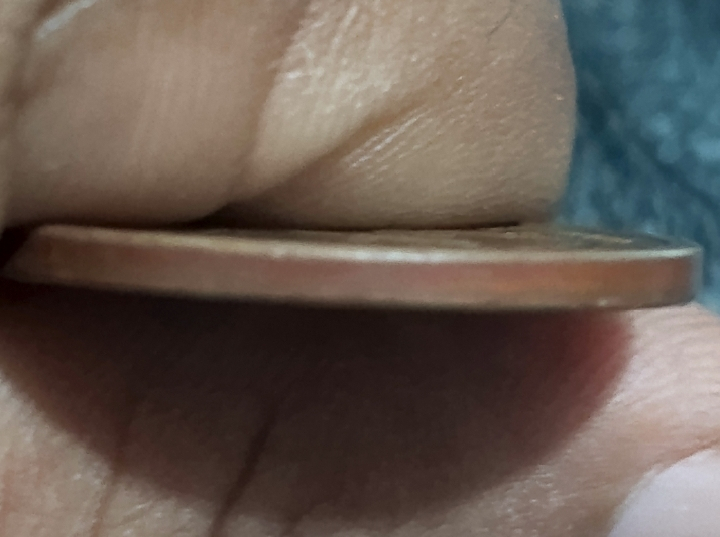
a better made counterfeit
In this case no, the coin is indeed genuine. Both the weight and the design details are completely legitimate and match standard minting specifications.
the coloring is "man made"
I am completely certain that the coin is genuine. I have come across several coins with this same coloration and all of them have been authentic, both Sacagawea and Presidential dollars. It is likely a specific process or environmental reaction that occurs in certain coins over time, causing them to take on that tone.
I imagine there isn't a thorough study on how these coins change after so many years of heavy daily circulation, especially since they circulate so intensively here in Ecuador and only a couple of other places like El Salvador and Puerto Rico.
I set this particular coin aside simply because I liked how the background looked and how it made Sacagawea stand out. In this thread, I will continue adding photos of similar coins as they come across my hands, since, as I mentioned, I keep finding them regularly with this exact toning.