Request for ideas from members
 RogerB
Posts: 8,958 ✭✭✭✭✭
Finally, I am getting to completion of the successor to 2013's book From Mine to Mint.
From Mine to Mint 2 follows the trail cut in From Mine to Mint _in 2023 by exploring U.S. Mint processes, operations, equipment and procedures, rather than describing specific coins. This approach is intended to make manufacturing and distribution information readily available, and thereby allow collectors to better connect their coins to the How, Why, and When of manufacturing. There is little overlap between the two books. _From Mine to Mint 2 is not a rewrite or revised and enlarged edition of FMTM; it is not the same laundry detergent in a “new and improved” package. It is a completely independent volume whose contents reveal a somewhat different origin than FMTM.
The content of From Mine to Mint 2 is built around questions posed by collectors and dealers. These are, for the most part, seminal questions that almost never get asked – or answered – yet are fundamental to American coinage. Possibly this is because of reluctance by inexperienced collectors, or it might originate with the inability of advanced numismatists to provide an answer; or maybe it’s just not on our minds amid the bustle of grading, buying and selling. In researching From Mine to Mint 2 I actively solicited topics from collectors via discussion boards, coin club meetings, casual conversations at coin shows, and follow-up to emails received. Quite a few people were reluctant to be identified, primarily, according to their comments, out of potential embarrassment at the question's seeming simplicity or not already knowing the answer. That, in truth, should not be a legitimate cause for omitting many contributors – a question, no matter how basic it might seem, is a handle by which we open the door to knowledge and understanding.
This approach led to some unexpected subjects, one of which became Chapter 1 of this book: “Why did the U.S. Mint remain in Philadelphia when the rest of the Federal government moved to Washington City in 1800?” Other common questions were, “How did someone get a job at a mint,” and “How were coins distributed,” or “What did other mints think of the U. S. system,” or “How did they repair the presses?” A common thread connecting collector questions was that almost all were either rarely seen in print, or most frequently, simply not known.
So, here I am asking CU members if they have any final subject they'd like me to explore? I can't promise what might make it into the book -- after all it's over 500 pages already -- but I'll try to include subjects of wide interest that are only rarely found in published sources.
Comments
PS: I'm looking for questions about How, Why, Who, When as they relate to US Mint operations.
If this is old ground, then I am okay to be embarrassed.
I've not read the first FMM book but I've always been curious about the workers experiences - how they were found, paid, treated, and fired (especially when theft was discovered). Did they have to pay back monies taken, what pipelines did they create to funnel select coins to others. Maybe boring for some, but a Day in the Life or worker stories shared with others about their lives.
"She comes out of the sun in a silk dress,
running like a water color in the rain...."
FMTM to you
once coined. the processes to get them into the banks back the and the federal reserve now.
outside of new materials, what kind of test strikes do they do and why?
they have the salaried artists and the artist infusion program.
somewhere in the process is artistry. they select internal people(?) and how do they seek submissions from the aip?
a die beaks it must make a sund and the stop it, inspect coins, replace die or both dies... then what about dies going to end of life. do they have a hard cut-off o is it quality decided?
Perhaps it's overdone or was covered in your first book but the Pittman Act, coin minting and mining decisions during and due to the Great Depression (and publics reaction to same), and history of the use of precious metals leading up to 1965 and clads has always piqued my curiosity. Events such as improper prep or use of dies leading to New Orleans being the red-headed step child are interesting. Thanks for your efforts.
USAF veteran 1984-2005
The FMTM2 looks like it will cutoff around the late 1930s, but most will be earlier. (After 1938 a lot of archival information "dries up." It's not that so much is lost, it's more that much was not saved beyond the superficial results. The same continues to this day -- detailed info about modern commems, for example, is missing most of the conversation between sponsors/beneficiaries and mint representatives; the CCAC minutes are scrubbed into mush as are CFA. Nearly all of the back-and-forth discussions and messages for Boy/Girl Scouts, state quarters, etc., etc. are gone. I won't go further -- but there is a huge gap.
The experiences and lives of ordinary workmen, adjusters and other employees is nearly nonexistent. They played no named role - only work titles. A few things appear such as individual incidents -- injuries, drunkenness, layoffs, RIFs. But there's almost no systematic data; and only a few snippets of personal stories survive. Much like the pocket notebooks foremen and managers carried, workmen's activities were routine and discarded. []NOTE: These were called "diaries" and bought at local stationers or 5 & 10s.]
I have some material, and I've reserved a section called "Snips and Clips" for available 1 or 2 page items like you suggest.
MsMorrisine --
These are good subjects, but require too much space for FMTM2. I've covered most of it in the essay included in the CD "Silver Dollars Struck Under the Pittman Act of 1918," the book on INCO and Gould private experimental pieces, and chapters in "Saudi Gold and other Tales from the Mint."
The reopened New Orleans die situation is discussed in FMTM - the core problem was found to be improper annealing caused by trying to push too many planchets through old equipment.
As to mine origin ( if not already covered in Vol..1) …… be great to see the contribution of the enslaved, including enslaved women addressed and recognized, even in abbreviated form given space constraints. See, e.g., Ann Marsh Daly, “Every Dollar Brought from the Earth”: Money, Slavery, and Southern Gold Mining, 41 J. Early Republic 551 (2021) (explaining the transition to advanced lode mining heavily utilized enslaved women, who became recognized experts in the highly technical, hazardous chemical processes required to refine gold); Ann Marsh Daly, The Matrix of Value: Gold, Slavery, and the American State, 1790–1860 (2025) (examining the structural links between Southern gold extraction and the operations of the Charlotte and Dahlonega branch mints); David Williams, The Georgia Gold Rush: Twenty-Nine-Bumper Crop, 62 S. Cal. Q. 127 (1980) (detailing how the transition from surface panning to deep-lode shaft mining in the American South created severe labor shortages that investors resolved by extensively leasing enslaved workers from plantations); Fletcher M. Green, Gold Mining: A Forgotten Industry of Antebellum North Carolina, 14 N.C. Hist. Rev. 1 (1937) (providing a foundational historical overview of the North Carolina gold belt and documenting the early economic reliance on enslaved labor forces for heavy excavation and panning).
Thanks. I'm working with original documents for the book. There are a few letters referring to race, and several concerning a New Orleans Mint proposal to hire slaves to do the heavy work. (Mint management was completely opposed. The director had previously complained about the laziness and sloppy work of NO Mint employees. After the Civil War there were attempts to hire only on merit, but the politicians had other ideas. However, until 1913 the Treasury was one of the largest government employers of "colored people" - many in white collar and management positions. William McAdoo segregated Treasury with Pres Wilson's full support, installed all the accoutrements of "separate but imaginary equal," and showed how to corrupt the national government with his "Southern charm."
OK, I have one that I'd love an answer to. I don't think an answer actually exists. I'd love to be wrong about that!
It's "well known" that dies went into and out of the Mint fairly regularly during the later have of the 1800s. Julian writes that "many of the dies used prior to 1869 were privately owned and used indiscriminately with other dies outside the mint" (p. 97).
I think that statement is true, and I discussed some of the reasons I think so in my recent book. There's plenty of circumstantial evidence. Despite that, I've never seen anything that I consider to be firm evidence, and I've looked at all of the excellent records I could find on the NNP.
I know that the Mint did contract work, striking medals for people using dies produced outside of the Mint. I also know that the Mint (and Mint employees) sometimes produced dies for people outside of the Mint. Some of those dies were used to strike pieces within the Mint. Some of them, mainly the ones associated with specific organizations, were returned to those organizations and later used to strike similar medals outside of the Mint.
I've also found several "pieces de caprice" where US Mint dies were paired together in strange ways even in cases where there's no hint that those particular dies ever left the Mint. I think I've posted images of all of those, here and/or in E-Sylum.
There's plenty of handwaving: "Oh, those guys in Philadelphia all knew each other, and they did stuff off the books all the time". And like I said, I believe it.
It sure would be nice to have some hard evidence about the movement and sharing of dies in that period, so I don't have to believe it on faith!
jonathanb -
Yep, it's an interesting and mysterious subject. Finding clear contemporary references is difficult. As you are aware, the first 40 years of operation produced a lot of defective and condemned dies. Julian refers to these in your quote and also as "old iron." (See the 1802 mint inventory excerpt, below.)
The iron included discarded dies, machine parts, broken cart axles - anything made of iron. This was sold by the pound to local blacksmiths and scrap brokers without regard to visible designs on dies. Various curious people acquired usable dies by hunting through the scrap. Several letters refer to use of old dies as paper weights and door stops, only later discovered to be real coin and medal dies.
There are letters referring to medal dies being owned by organizations but kept at Philadelphia for safekeeping. Others mention organizations sending award dies for production and then returning them to the owners for storage.
Routine die defacing seems to have begun in the 1820s and become routine by 1840, with special dies, particularly those used for Master Coins and diplomatic exchange, being saved and carefully preserved.
I don't have enough material on this subject to make a meaningful chapter in FMTM2, but I'll be glad to share any materials I have with you. Send me a PM about this if you wish.
Roger, not for your book but do you have any idea why Elizabeth Jones was forced out (resigned) of the mint? Was it the election of a new administration, ie, President Clinton? I thought she was incredibly gifted, head and shoulders above John Mercanti, who in turn was head (but not shoulders ) above his successors.
Very interesting subjects.
Ill have to buy the book when it comes out as I like to read.
I am curious to know more about the subject of planchet manufacturing and preparation.
I know some were washed prior to being minted but I dont know why or when it was put into practice. I would also like to know what was used.
My favorite year to collect is 1921 and its obvious these planchets were washed due to spotting on Morgans but why?
I suspect to remove contaminants.
Ive also wondered how the reading was produced.
Simple questions, I know but I am still curious.
Thank you for your efforts.
Student of numismatics and collector of Morgan dollars
Successful BST transactions with: Namvet Justindan Mattniss RWW olah_in_MA
Dantheman984 Toyz4geo SurfinxHI greencopper RWW bigjpst bretsan MWallace logger7 JWP BruceS bigjpst
JWP PROMETHIUS88
Jonathan,
It is completely understandable why a paper trail for regular coinage dies leaving the mint is so hard to find, as the records simply reflect how the law was set up during the period Julian mentioned (later half 19th century).
Under the Mint Act of 1837, these dies were strictly federal property, and the Chief Coiner had to log the physical destruction of every single pair. See Act of Jan. 18, 1837, ch. 3, § 26, 5 Stat. 136, 140; see, e.g., Records of the Bureau of the Mint, Nat'l Archives Record Group 104, Entry 17 (Annual Statements of Dies Destroyed, 1864–1869).
Because using these dies outside would be a federal crime, a paper trail is unlikely to exist in official records. Mint records were designed to track legal compliance. An employee would be highly unlikely to make a record of committing a federal crime. So it may not be a matter of a gap in research, but rather that the official documentation was simply never generated.
Mark - I have only speculations. It might be that she wanted a better career than the Mint could offer. I'm aware of several people over the past 8-10 years who have turned down mint positions or contracts because they offered insufficient pay or fractured authority.
jch22 - Most of your comments are covered in FMTM2.
A few bits and pieces: Prior to about 1865 die custody was not a clearly defined subject. One of Longacre's persistent complaints was that he could not maintain an accurate list of dies and their status, because he had to rely on data from the Chief Coiner's Dept. It was not until 1881 that the director issued a clear order for chain of custody. Also, remember that it was the mid-1850s before the Engraver began supplying working dies, adding mintmarks, etc. Previously, the Engraver initially made all working dies, then from matrices, and then only the hubs. The Coining Dept actually made working dies (plus some pattern dies).
Owning a mint die that had been sold as scrap was not technically illegal until 1837 or 1857 or several other possible dates. The Mint director used verbal pressure and his assumption of confiscatory authority to take and destroy old dies from several collectors' Estates. Dir Kimball tried this on the Linderman collection and failed; Dir Andrew made a similar attempt in 1910. Confiscation of Joseph Mickley's old dies/hubs was delayed until he died - he was too helpful to the Mint before then. Here's the list of old dies, none of which were actually illegal to own.
Lathe lines on coins! How significant it is finding/locating them on a coin struck 30 years later after the Master Hubs were created. I like to think that such a coin with lathe lines was made shortly after the Hubs were made subtracting all the time the Hubs sat in storage. But adding up all the times the Master Hubs were actually used in production, maybe for a day in total time! The length of time that expired, moving the Hubs forth and back to storage only to make one set of new Master dies that lasted 8 to 10 years! What, a couple hours?
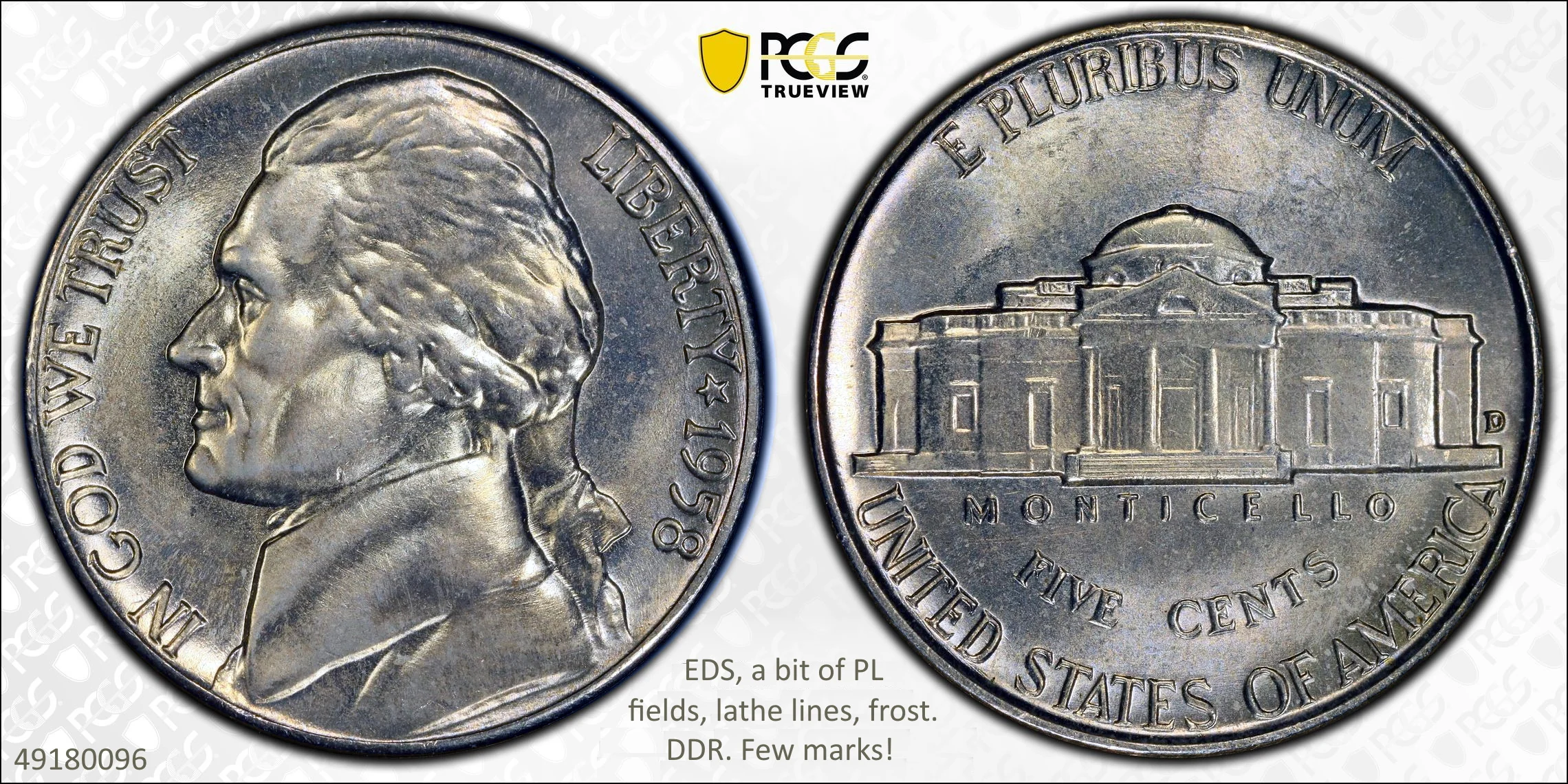
Here's a 1958-D Jeff with lathe lines galore on the obverse! How is that possible? After 20 years of the US Mint making Jefferson nickels?
But maybe, some need an education on what exactly are, "lathe lines."
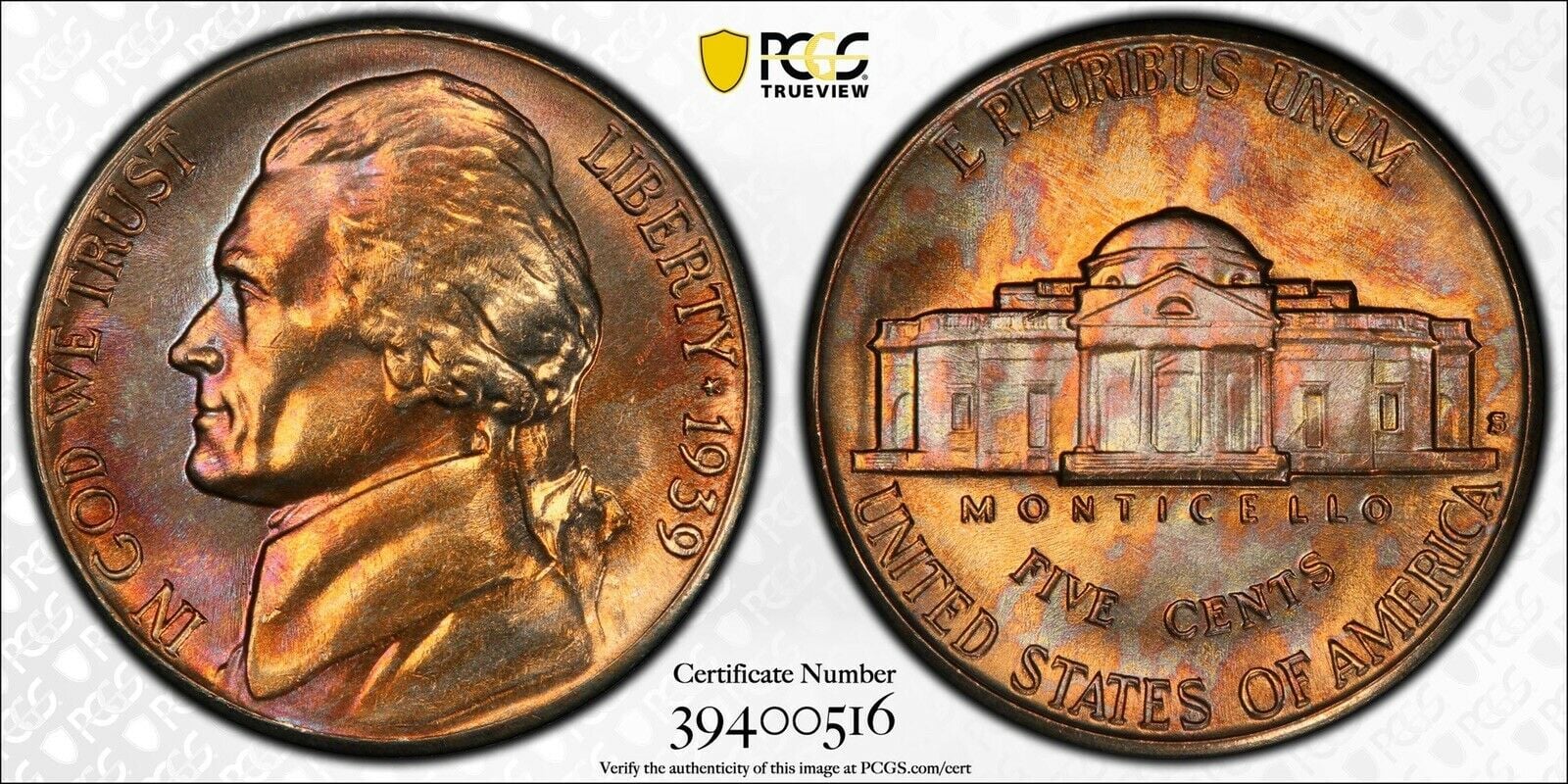
And a second suggestion; The importance of maintaining a height or depth measurement difference from the center of a coin on out to the peripherals/rims of the 8 1/2 inch clay molds the sculptors had to maintain in their creations of images in their designs of a coin. That coins could not be made with a flat end of a die. That a degree of a curviness end of the die had to be maintained to properly strike coins. The following link discribes the requirement more thoroughly. Which gave VEDS coins a bowl shape/spoon-like appearance! The deeper, the better! The reason why we see die polish lines all along the peripherals of a coin.
http://www.felixschlag.com/
Be sure to blow these photos up on a laptop and not your tiny phone screen to get the whole picture! lol
Leo
The more qualities observed in a coin, the more desirable that coin becomes!
My Jefferson Nickel Collection
A friend of my brother and I, more so of my brother due to age, was allowed to pick through and gather stuff; uniforms, hats, guns, swords and a cannon, bayonets etc of a mass storage of what was left of the Gen. Custer massacre. Stored for years in a building in Rock Island County, IL. Years later, a museum paid $225,000 to his widow to be displayed. So, over time, stuff gets moved out to somewhere until someone decides to scrap it or have it taken away. Our friend was a member of a Civil War reenactment group. So somehow someone knew him and connected him up with the fate of all that stuff. But a lot of stuff is sitting somewhere in some landfill under dirt. It doesn't really deteriorate much as studies have shown from digging it back up to see how the decomposing factor is coming along. Unfortunately, much of it gets recycled, though, if it's not in too bad of condition. But there's a possibility, if one can trace the whereabouts as to where something may have ended up. Likely in some ravine close to the city back in the 1830"s? How hard could that be found?
Leo
The more qualities observed in a coin, the more desirable that coin becomes!
My Jefferson Nickel Collection
Roger,
My response was primarily intended to alert Jonathan that there may be a very good reason why his exhaustive search did not turn up a paper trail. Thought putting that in context would be helpful to researchers. Your reframing of the issue to focus on the Mint's internal "sloppiness" actually proves that argument.
Once the Mint Act of 1837 codified dies as government property, unauthorized removal was made a federal crime. A rational person, be it an employee or official, would not write down or log their own crime.
While it is known dies escaped the Mint, the sole point raised is that systemic administrative failure might explain why management missed the activity. If an official record of such non-compliance was actually generated, a mint administration and its employees would have to be sloppy to the point of reckless to formally document one’s own commission of a federal offense
Roger, is it safe to assume that you have read this? If not let me know and i’ll send you a copy (i have 2)
Pertinent information…
2windy2fish --
Thanks for your kind offer! Evans, in its many editions, was a nice 19th century summary and sold at the Mints by guides until about 1885 when the director decided staff were to pushy with visitors and stopped all souvenir medal and book sales. It's fun to read through any of the editions. I have several copies around here someplace.
Very intriguing stuff here!

"Jesus died for you and for me, Thank you,Jesus"!!!
--- If it should happen I die and leave this world and you want to remember me. Please only remember my opening Sig Line.