Options
Joe Jackson game used bat?
 kevper
Posts: 24 ✭
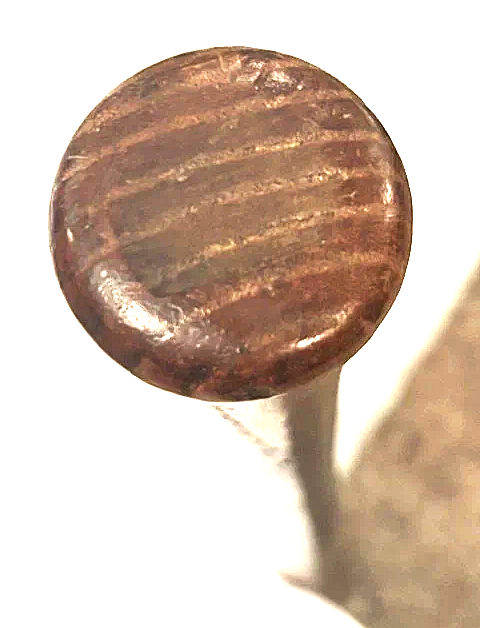
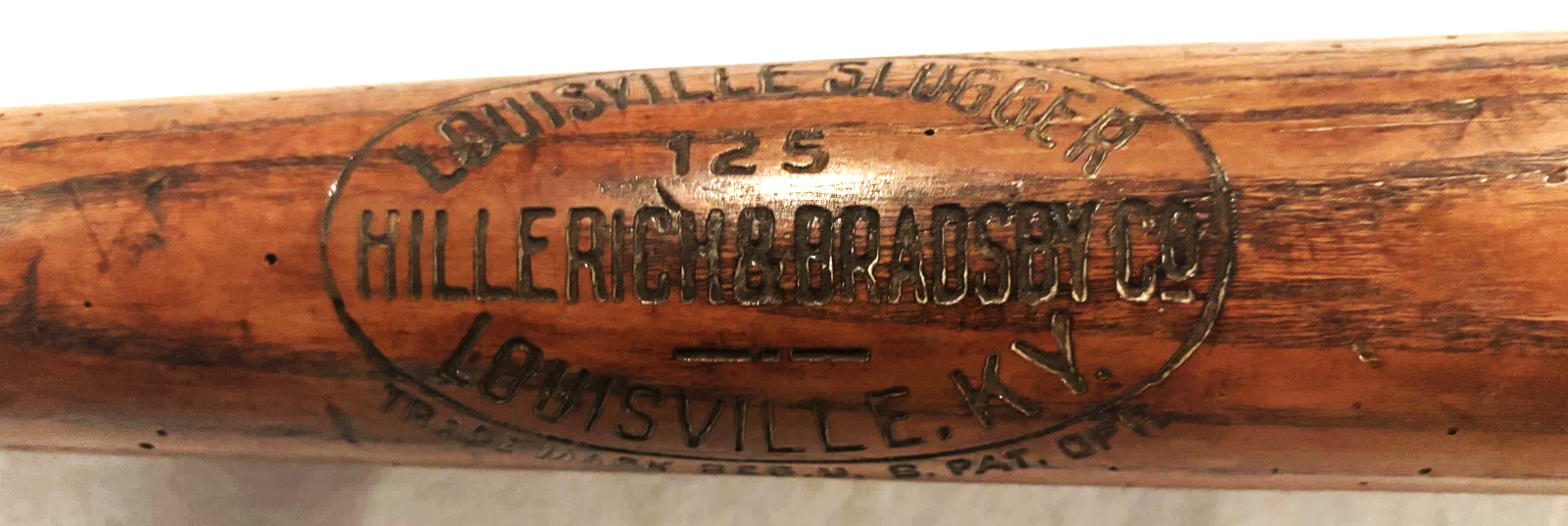
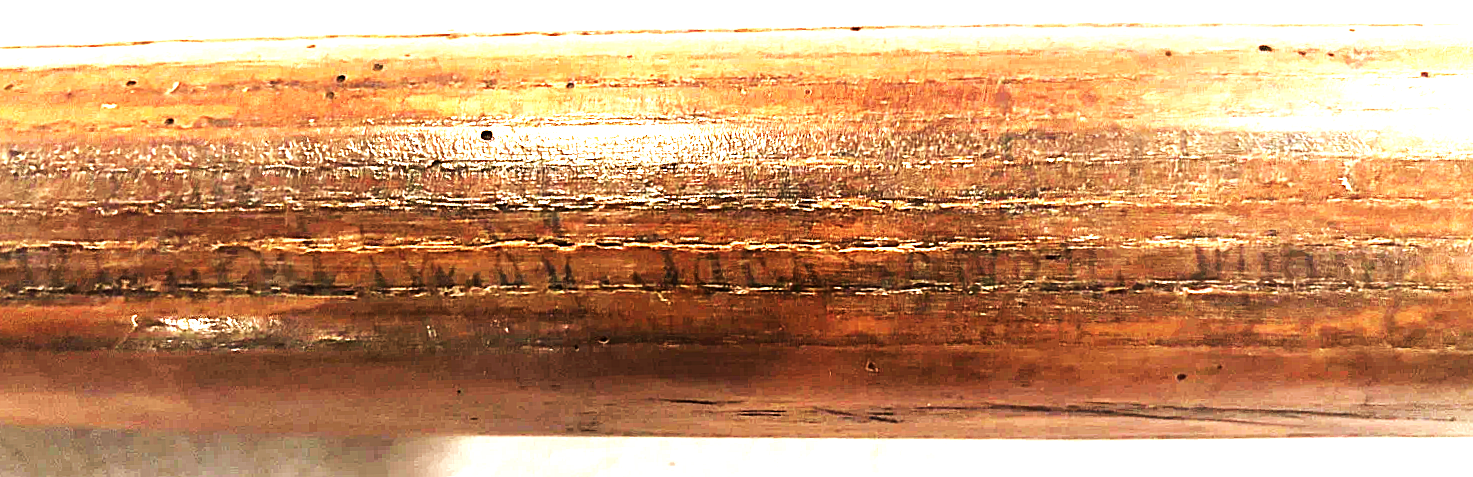
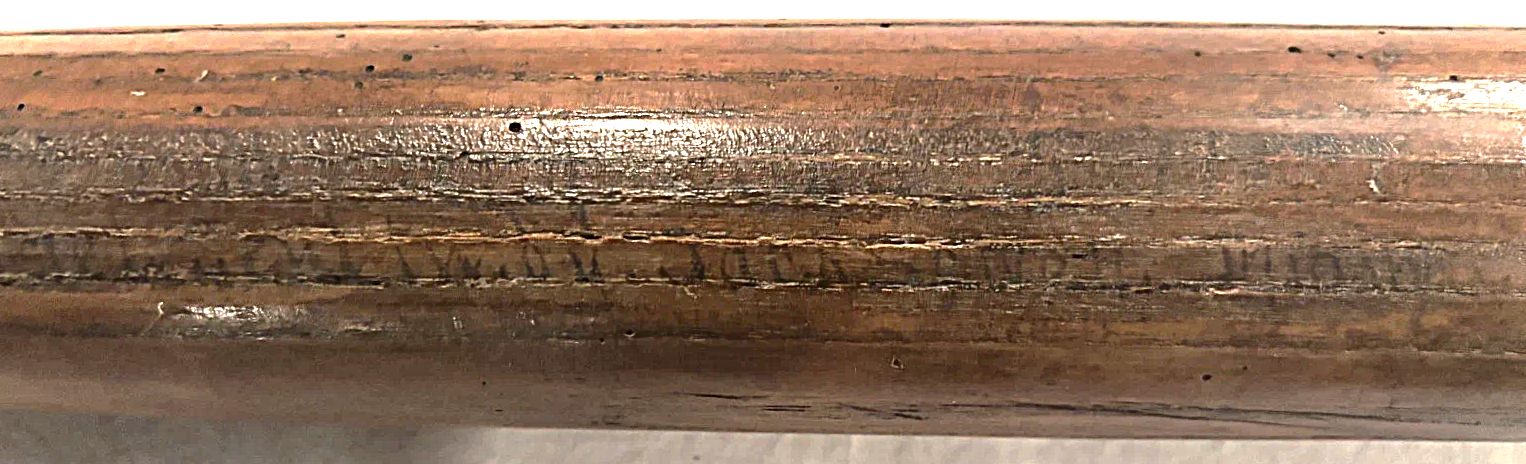
I have recently acquired a 1917-21 era dash-dot-dash H&B bat. It's 35.75" long and currently weighs 44.7 ounces. It is blank barreled but contains two lines of side writing. The most interesting part of the side writing reads "Sent.in.by.Jackson". I believe that I furthermore can make out a date of 5-31-21 in the side writing. The bat has a thick handle and a significant amount of tobacco juice on the handle. A few pictures are attached. More pictures are available.
Are there any bat experts out there who have access to Joe Jackson's PBOR from H&B? Any opinions on this bat will be appreciated.



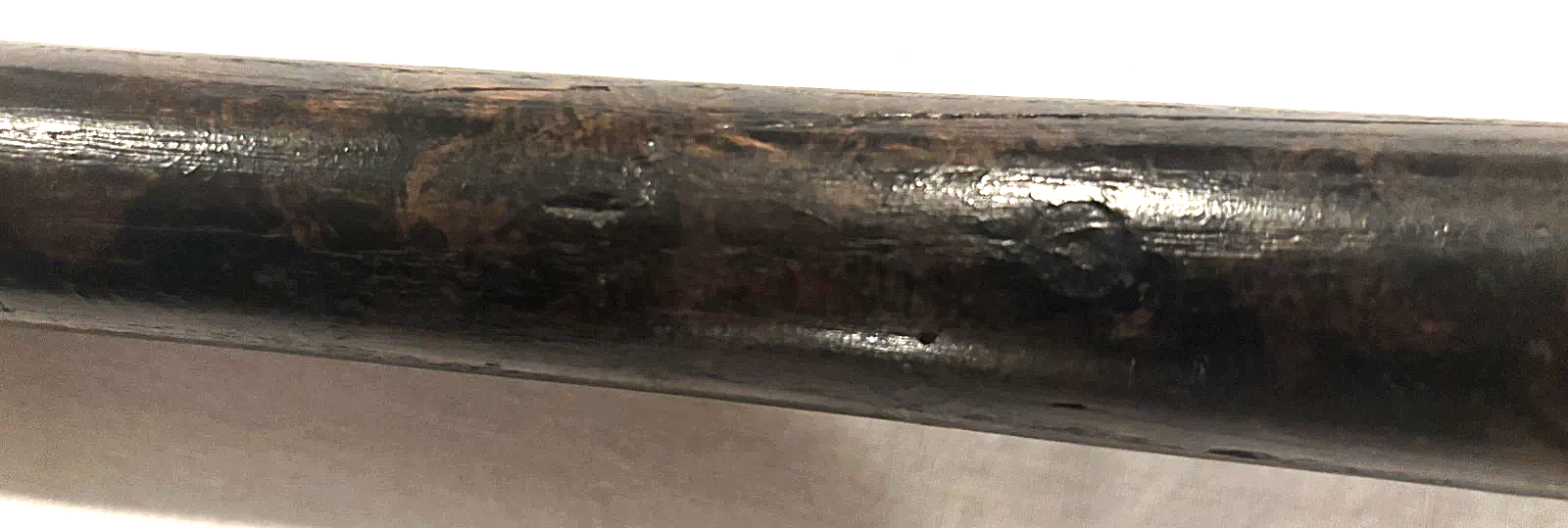
0
Comments
Send it to PSA.
https://psacard.com/probatfacts/star-players/joe-jackson/1653
https://kennerstartinglineup.blogspot.com/
AI's take.
Based on the provided photos, this bat is definitely not a game-used Shoeless Joe Jackson bat.
While it is a genuine vintage baseball bat with historical interest, the manufacturer's stamps clearly show it was manufactured decades after Joe Jackson's major league career ended.
Why it is not a Joe Jackson Game-Used Bat:
The center oval stamp features "HILLERICH & BRADSBY CO" with the full line "TRADE MARK REG. U.S. PAT. OFF." curved cleanly underneath the oval. In the middle of the oval, you see the catalog designation 125. According to Louisville Slugger official dating guidelines, this exact oval and trademark placement was utilized between 1916 and 1933.
The close-up images of the barrel show the factory stamp: "MADE BY HILLERICH & BRADSBY CO." followed by standard retail text (likely patent details or a retail model identifier, rather than a player signature).
Joe Jackson's career effectively ended in 1920 due to his lifetime ban following the 1919 Black Sox scandal. Furthermore, throughout his entire professional career, Jackson famously refused to use Louisville Slugger bats in games. He custom-ordered his bats from a local woodworker named Charley Ferguson, who crafted his legendary, dark-stained custom hickory bats known as "Black Betsy." Jackson never used a standard light-finish corporate Louisville Slugger in an MLB game.
What is this bat?
This is a standard 125-grade retail store model bat produced between 1916 and 1933. The "125" doesn't mean it belonged to a player; it was simply Hillerich & Bradsby's catalog number for their highest tier of retail store wood.
While it lacks multi-million dollar sports memorabilia value, a pre-Depression era Louisville Slugger 125 store-model bat in solid condition is still an excellent piece of American baseball history, typically valued by collectors between $100 to $250 depending on the specific player endorsement or model stamped on the end.
i believe that true Jackson gamers are exceedingly rare.
George Brett, Roger Clemens and Tommy Brady.
Thank you for the comments, ArtVandelay and craig44. It's true that authenticated Joe Jackson gamers are exceedingly rare and very high priced.
Concerning AI's take that was posted by ArtVandelay. I am an experienced vintage game used bat collector. There are several things that AI has gotten wrong in their assessment. It seems that AI has pulled quite a bit of their info from the Keyman Collectibles website. The info Steve has provided on his website is valuable and much appreciated, but it is incomplete in some ways.
Specifically, in 2007 Vince Malta published "A Complete Reference Guide to Louisville Slugger Professional Player Bats". This guide is considered the go-to reference for Hillerich & Bradsby bats, especially vintage ones. Of immediate consideration is that this guide differentiates the 1916-1933 center branding into several shorter eras. The C-3A and C-3B dash-dot-dash center brands, according to page 14 of this guide, date from 1916-1922. I have seen this same bat era commonly referred to as 1917-1921. So AI's statement that "the manufacturer's stamps clearly show it was manufactured decades after Joe Jackson's major league career ended" is 100% incorrect.
Furthermore, the fact that the bat is side written as well as the fact that there are not inch marks stamped into the knob end of the bat both tell us that this is not a retail (store) model bat. Another detail that AI seems to have gotten wrong is that "throughout his entire professional career, Jackson famously refused to use Louisville Slugger bats in games. He custom-ordered his bats from a local woodworker named Charley Ferguson, who crafted his legendary, dark-stained custom hickory bats known as "Black Betsy." Jackson never used a standard light-finish corporate Louisville Slugger in an MLB game." I don't even know where to begin when addressing this statement. I'll just say emphatically that this statement is incorrect. Of the 19 Joe Jackson game used bats (or those possibly attributed to Joe Jackson) that I have found references to, 17 have been Louisville Slugger bats, whereas one was a 1926-33 Kren's Special and another was the Spalding "Black Betsy" bat.
I hope you don't find my response to be rude or unappreciative. Given the potential value of this bat, I feel it is important to clarify misinformation. Thank you again for your input. If anyone has access to Jackson's professional bat ordering records (PBOR), please let me know.
My initial thoughts are that "Jackson" is a fairly common last name and I really can't see Shoeless Joe using a 45 oz bat...
IMF
Great thread and comments. I hope it is the real deal.
Did some digging on this one because the AI answer bugged me. A few things it got wrong, and one thing I think is the real story.
Where the AI missed:
The part I think matters most is the side writing itself. "Sent in by" is the factory logging a bat that came back to Louisville to have copies made. So the real question isn't whether Jackson swung this bat, it's whether a Jackson sent one in on 5-31-21. The timing is interesting. Comiskey released him in March 1921, the trial started the last week of June, and during the trial he was playing weekend games at White City in Chicago with Risberg, Gandil, Williams and Felsch. Sending in a bat at the end of May fits a guy getting ready to play somewhere.
What cuts the other way:
If anyone has the 1921 H&B ordering records, a Jackson entry around the end of May with a spec close to 35.75/45 would make this very interesting. Until then I'd call it a great side written bat with a heck of a story, not a Jackson gamer yet.
Research provided by Euler - better AI. Unlike some other AIs, this one read the footnotes. No bats were harmed, but one chatbot was mildly embarrassed.
Thanks for the feedback. Still hoping to find someone with access to Joe Jackson's PBOR from 1919-1921.
Some attributes about the bat that support it being a Joe Jackson gamer - the thick handle, the cleat marks, and the thick black tobacco juice residue covering the handle. Each of those attributes are known Joe Jackson traits.
Regarding the weight, 44.7 ounces is a bit heavy compared to known Jackson gamers. But 39.2-42.3 ounce bats are the norm for the high-end in-career authenticated Jackson gamers presently in the hobby.
Same as with bgr's comments - no bats, balls, gloves, or helmets were harmed in the forming of my comments.
say, hypothetically, this is in fact a Jackson gamer. without photo-matching, how could it be proven that Joe Jackson ever used it in a MLB game? there is clearly no provenance or we wouldnt be having this discussion.
George Brett, Roger Clemens and Tommy Brady.
I'd like to point out that AI is not reliable at all. It cannot think, when you ask it something specific it just makes things up or uses bad information.
Llamas and alpacas are camels. They aren't like camels, or related. They are camels. When was anyone going to tell me this?! How long had Bill Nye been holding out on us?
I'm no expert on bats. But, none of those attributes link this bat to Joe Jackson. There were tons, thousands, tens of thousands, hundreds of thousands maybe, of guys playing baseball back then. There are supposed to be more than 15 million people in the US now who play baseball. I dont think you can say for certain that any mark on this bat is a cleat mark. Even if you could say this bat had cleat marks, that wouldn't get you any closer to proving anything. Tons of guys chewed tobacco back then too. I would think many of them would have used tobacco juice for grip if that was a thing. I also don't know that you can place the writing on the bat in the period.
What did they use to write on the bat?
@craig44 that's the right question, and the side writing actually narrows it. Jackson's last big league game was in late September 1920 - Comiskey suspended the eight on Sept 28 after the grand jury testimony. So if this is his bat and it was sent in on 5-31-21, it can't be a 1921 MLB gamer. Best case it's a bat he used through 1920 and shipped back so Louisville could turn copies for whatever he was playing next. That's still a big deal, but it's a different claim than "game used in the majors," and the side writing date is what makes it provable or not. Without the order records, I don't think anything else on the bat gets you there.
@CardGeek the factory side writing was done in grease pencil when a returned bat was logged in, owner and date on the barrel. Comparing the hand and format against other H&B side written bats from 1920-21 would at least tell you whether the writing is factory and period, which is step one.
@RiveraFamilyCollect you're right that it can't think. We don't need it to think, we need it to reason - start from sources, show every step, and land on a conclusion you can check. The AI answer that kicked this off skipped all of that and just asserted. My post above was AI-assisted too, but it had to show where each claim came from, the stuff it couldn't back up got cut, and the rest got checked against the Sotheby's and Christie's catalogs and the trial timeline. That's the difference between an answer and an argument. And it doesn't need to be perfect to beat the humans - that was always a low bar. This hobby has been running on confident guesses for a hundred years. Trust, but make it cite.
For vintage baseball bats, side writing has long been considered a reliable form of provenance. The only type of provenance that beats side writing is an authentic letter or picture or related document that states the complete history of the bat.
The grade of a vintage bat is generally a measure of how certain we can be that the bat was actually used by a given player. Grades of 7 or higher (out of 10) generally are considered solid belief that the bat was used by the player it is attributed to. Of course, the higher the grade, the stronger the belief (and the bigger the price). Photo matching is awesome, but finding a photo match on vintage bats is far more difficult than it is for present-day bats. I'll pay a big finders fee to anyone who finds a photo match to my bat.
I will be shipping this bat to John Taube (PSA/DNA) in the near future. He is a highly knowledgeable and experienced bat expert whose opinion is well respected throughout the hobby. Before doing so, I'm trying to find Joe Jackson professional bat ordering records (PBOR). I was hoping one of the long-time bat experts might have those records.
Thanks again for the feedback. Feel free to ask any questions you might have.
So you're saying that they authenticate stuff like this based on, "We think maybe he could have possibly used this bat?"
That writing could have been put there 60 years ago. I played with it in Photoshop to enhance the writing. I could bring out some of the writing. I couldn't see what you say it says though. It must look much better in person.
I'm also not sure how you could photomatch something like this. The staining would be changing as the object was used. Or do you mean just a picture of him using a similar bat?
I should have added that for vintage bats, the bat's dimensions and various player attributes are analyzed thoroughly to see if the bat matches documented factory records and/or specific player attributes that are known to exist on other documented game used bats of the given player. Some of the attributes include the presence or absence of cleat marks, pine tar, tobacco juice, handle tape, where on the bat the most use is evident, the type of wood used to turn the bat, the size and type of knob on the bat, the thickness of the bat at various places along the bat, and still other attributes, too. So, a lot goes into determining whether or not a vintage bat was used by the player in question. It's not just a bunch of uneducated guesswork.
None of those attributes, or even any combination of those attributes, would limit that bat to having been used by Joe Jackson though.
This is nowhere near my wheelhouse, but I find it fascinating. I hope you are able to find the ordering records!
Yeah - post the results good or bad please. Bon chance.
Although I'm not 100% certain, I'm fairly confident that Miami in on the right-hand end of the bottom line of side writing. Through research I learned that Joe Jackson played winter ball in the Miami area from December 1920 to March 1921, before heading back to the Chicago area to work on his legal issues and strategy. Given the heavy use displayed on the bat, it's very reasonable to think that Jackson used this bat during the 1920 regular MLB season (and maybe even in 1919), then continued using it during the winter ball games in South Florida, and finally sent it to H&B to be a model for the turning of new replacement bats.
Another word on the top line of the side writing that I'm fairly confident about is Price. That word could be part of a local retailer's name where the bat was shipped from the retailer back to H&B in Louisville. Or it might reference Jim Price, a lawyer who was instrumental in helping Ban Johnson get the Black Sox case brought to court. Or maybe something altogether different. I'm really hoping John Taube will, with his more sophisticated equipment, be able to decipher more of the side writing.
Where did you get it?
@CardGeek:
I agree that the identifiable attributes of this bat do not yet provide definitive proof that it's a Joe Jackson gamer from his MLB playing days. But the more attributes that line up, the higher the probability of the bat being a Joe Jackson gamer. So far, nothing I've analyzed causes me to reject the idea that this is the real thing. In fact, everything fits together nicely for the bat to be a grail of Joe Jackson gamers. John Taube will be the final authority regarding the authentication of the bat. He will analyze the bat at an even deeper level. I hope he can read some more of the side writing, beyond what I have found. And maybe he has Jackson's PBOR.
I wouldn't even trust AI to make the deductive reasoning for you. If the AI is saying Joe never used a Louiville slugger but Kevper is right and 17/19 bats were Sluggers then the AI wasn't even worth reading in the first place.
Llamas and alpacas are camels. They aren't like camels, or related. They are camels. When was anyone going to tell me this?! How long had Bill Nye been holding out on us?
AI isn't making that statement on it's own. It's quoting some source. If you ask it, it will tell you what it's sources are.
Did you know that currently there are only four Joe Jackson side written game used bats? But of these four bats, only one is authenticated as being a factory documented game used bat used by Jackson during his MLB career. This one is the PSA GU10 bat that sold for $2.01 million via Heritage in August 2024.
Another one is the 1925-28 H&B bat, PSA GU7, that sold for $25,000 in November 2019 via Hunt Auctions. But the side writing on that bat is so faded that it is no longer readable. The third one is the 1916-22 H&B blank barreled bat that sold for $21,600 in February 2019. It was ungraded. The side writing on that bat is quite faded, but still readable is that the bat was returned by F.M. The auction listing suggests that F.M. may have been a barnstorming teammate of Joe Jackson after Joe's MLB career was over. The last of the known side written Joe Jackson bats is the 1914-15 H&B 40K bat that sold via Heritage Auctions for $27,500 on February 2025. The side writing on that bat is too faded to read, and remnants of a shipping label are on the barrel end of the bat.
@RiveraFamilyCollect
You’re not wrong that you shouldn’t blindly trust AI results. It makes mistakes and it sources bad information or misses necessary input altogether. I would say to continue being a skeptic but to not dismiss it. It’s great at pulling information together for analysis for research projects like this. It doesn’t answer the question but it can point you in the right direction.
Definitely true. AI often has to correct itself when you point out errors, but it's a great place to start.
I asked about dating grease pencil. AI said:
Forensically dating grease pencil writing is generally not possible. Unlike fluid inks, which contain volatile chemical solvents that dry and evaporate over a predictable two-year window, grease pencils (also known as china markers) are composed of hardened wax and non-reactive pigments. Because wax does not go through a measurable chemical drying or aging process, standard forensic document techniques like gas chromatography/mass spectrometry (GC/MS) cannot track its precise age.
again, I ask, without either photo-matching or ironclad provenance, how could we ever know that Joe Jackson ever used this bat in an MLB game?
say it is a true game issued bat, with lots of wear/use, how could you ever know it was Jackson who contributed to that use?
without ironclad provenance or photo-matching, we are only left with opinions. those opinions may be from PSA or some other expert, but they are simply opinions.
the bat can be radio carbon dated, scientifically checked for ink/grease etc. but none of that can prove that Joe Jackson ever swung that bat.
George Brett, Roger Clemens and Tommy Brady.
and based on the quality of the opinion people would ascribe a value... is this like day one or something? Did I miss a reboot?
uh huh. it is like all of the vintage "autographed" cards that have come out of the woodwork in the last 15 or so years. many of those are encased in plastic with an official "opinion" that people have ascribed value to.
I wonder how many of those were actually signed by the person depicted...
George Brett, Roger Clemens and Tommy Brady.
Craig44,
Sure, it would be awesome to have full-color video and a first-hand statement from a player that the bat was used in a certain game(s). In fact, we do have all of that and more for modern game used/worn equipment. But the Jackson bat is from a vastly different era. Back then, collecting sports memorabilia and other equipment was not a popular practice. Nowadays, those vintage items carry a hefty price tag. Equipment authenticators speed a lot of time analyzing each piece to see how closely the piece matches known exemplars. Many things factor into the comparisons. The more the similarities, the stronger the belief that the piece was used/worn by a given player. For vintage equipment, seldom is there 100% irrefutable proof that the piece in question is game used/worn by the player in question. Again, modern equipment doesn't suffer from that same issue because collecting equipment has become so popular that every notable piece is fully documented before becoming available to collectors. Back to the vintage items. Collecting them is very popular. Since we seldom know with 100% certainty all of the history of the piece, do you propose that we just block the authentication and collecting of vintage equipment? John Taube is excellent at his chosen line of work. He objectively analyzes every identifiable variable, describing the key details in a Letter of Authenticity, and quantifies his overall expert opinion with a number grade. High certainty earns a high grade. Doubts and/or anomalous attributes lead to a lower grade. Craig44, you seem to be attacking the authentication process. Do you have a plan for a more accurate and better system? I'm confident that many collectors of vintage bats (and other equipment) understand that fully documented records seldom exist and we must put trust in the analysis and professional opinions (based on quantifiable evidence) of expert authenticators.
I am well aware of the amount of forged autographs that exist in the sports memorabilia hobby/business. And you're right, many of those come with COAs from 15+ years ago. With autographs, just like any other category, it's important to assess the trustworthiness of the company that wrote the COA. If the company no longer is in business, be careful and do your due diligence before buying. But the most trustworthy companies maintain (and even grow) their reputation over a long period of time. Same thing with equipment authenticators. The trustworthy ones have a solid reputation built over years of reliable and honest work.
I reject the notion that we should lower standards because something is old or difficult to authenticate. Or because we need to lower the authentication standards or else we would not have any examples of a certain athletes equipment or autographs.
yes, i reject the current authentication process. John Taube may be the greatest researcher of vintage sports equipment in history. He may be able to pinpoint when a bat left the factory, who it was shipped to, perhaps even who it belonged to.
but... without photo-matching (I suspect that could be tampered with) or iron-clad provenance, even Mr. Taube cannot say that Joe Jackson ever swung that bat in a MLB game. He can "think" Jackson did, but he cannot "prove" it.
does that mean that true game used vintage sports memorabilia is EXCEEDINGLY rare, or even non existant for most athletes? It sure does. Using poor/weak authentication standards to give a range of "we think" this piece may have possibly been used in a game provides only false security to potential purchasers of said equipment.
George Brett, Roger Clemens and Tommy Brady.
I didnt mean to insinuate that COA's from 15+ years ago were suspect, I mean to say that there seems to have been a massive influx of vintage "signed" cards in the last 15 or so years.
The trustworthiness of an authentication company is important, but certainly does not mean they are accurate. at all. All of the major authenticators have been beaten: PSA, BGS, SGC, grad, JSA. all of them.
All they can offer is an opinion. the forgers are too good. I wouldnt even consider purchasing an autographed vintage card. "authenticated" or not. they may have fantastic reputations, but they are just not good enough.
George Brett, Roger Clemens and Tommy Brady.
@craig44 are you in the vintage memorabilia game? This stuff is not in my lane, but it would seem if the method of authentiating an item like this without photo-matching is an accepted practice in the vintage memorabilia market, so be it. I would imagine most people in that space are in tune with the nuances of that space and are not going to just buy an item without doing some homework themselves.
@kevper I hope you can find the info you're looking for. I can see how the investigation side of this can be fun.
@craig44 I'm with you that certainty isn't on the table. Where we part ways is the jump from "it's only an opinion" to "it's worthless." Most of what we pay for runs on expert opinion when proof isn't available: art attribution, appraisals, a doctor reading a scan, a jury. Nobody gets proof there either. They get a judgment from someone who has seen thousands of examples, and that beats a guess.
"All of them have been beaten" is true, but every test gets beaten. Any test makes two kinds of mistakes: passing a fake (false positive) and failing a real one (false negative). A mammogram has both and we still use it, because it's right far more often than chance. Turn the screws to never pass a fake and you reject a pile of genuine signatures. Loosen them and more fakes get through. No authenticator gets either number to zero. The question isn't whether they've been beaten, it's how often, and a forger occasionally getting past PSA doesn't make PSA a coin flip.
Authentication isn't selling proof, it's moving the odds and pricing the risk. The market already shows this. The same vintage signed card sells for one price raw, another with a defunct-company COA, and a much higher one in a PSA/DNA or JSA slab. That gap is what buyers think the opinion is worth, and buyers who share your doubts discount accordingly.
Authenticators are also strongest at saying no. They can't prove a signature is real, but they can prove plenty are fake: ink that didn't exist yet (a Sharpie signature from a guy who died before 1964), a hand that doesn't match the period exemplars, a signature that sits on top of wear the card picked up later.
The 1-10 bat scale is actually the honest version of this, because it publishes the uncertainty instead of hiding it behind a yes/no. Not buying vintage autos at all is a fair call for your own money. In this framing you've set your tolerance for false positives to zero, which is the same as calling every signature a fake. That's one way to never be fooled, but you'll also never own a real one.
Well said, brg.
@bgr you mention, "Authentication isn't selling proof, it's moving the odds and pricing the risk."
well, according to Merriam-Webster, Authentication is the process of proving that someone or something is real, genuine, or who they claim to be.
Steve Grad cannot "prove" or authenticate that Babe Ruth signed a 1933 Goudey card. John Taube cannot prove or authenticate that Joe Jackson swung that bat in an MLB game. you have to remember, the market "wants" these items to be real. collectors want to believe in these autos and vintage GU.
why do you think there are so many more "autographed" vintage sports cards now than there were just 10-15 years ago? I have been in the card game for 40 years now. Cards have been seen as "investments" since at least the mid 80s. signed vintage was not seen 20, 30, 40 years ago. at least, very very rarely. if they were legit, these cards would have been coming out of the woodwork back in the 80s and early 90s when "discoveries" were common on the news. the market is being flooded now, because they are being produced now. and "authenticated" no less.
As far as this statement, "No authenticator gets either number to zero. The question isn't whether they've been beaten, it's how often, and a forger occasionally getting past PSA doesn't make PSA a coin flip."
Steve Grad himself would disagree. He stated back in June on his own Facebook page that "The FBI says more than half of all signed memorabilia is fake. So… is yours?"
over half would in fact make getting bad autos past PSA actually worse than a coin flip as the statement does not qualify that "more than half" percentage as either raw or authenticated autos.
we are in agreement that certainty is definitely not on the table. As authentication is the process of proving an item is real or genuine, perhaps the "authentication" companies need to change the description/title of what it is they are actually doing, as they are generally unable to "authenticate" vintage items by definition. an opinion is not authentication, no matter who's opinion it is or how badly the market wants it to be.
George Brett, Roger Clemens and Tommy Brady.
Well, a lot of the guys on vintage sports cards have or had been signing since the mid 80s. Guys who played in the 50s are still signing today. There may even be guys from the 40s signing?
There is no signature on this bat to authenticate. There is huge incentive to take a bat worth a few hundred dollars and fake it. The side writing has been documented on other bats and the information is out there for people who want to fake it to see. I have no doubt it's a period bat.
To say it was game used is a huge leap that is impossible to make. I don't even think you could do it with photo matching. The writing is supposed to have been made at the factory. So that certainly wouldn't show up in any game photo.
Has it been in somebodies closet for 80 years or something? This is something that would have been coveted even in the 1960s-70s. Probably even earlier. There are a good number of Antiques Roadshow episodes where someone had been going through their parents closet and found a huge stash of cards. Even signed cards.
I know, broken record.
Regarding craig44's quote of Steve Grad's comment that more than half of all signed memorabilia is fake - such a statement may be true when considering all unauthenticated signed items, but it's highly unlikely that more than 50% of authenticated signed items are fakes. And when I say authenticated items, I mean authenticated by the very few trusted and respected present-day authenticators. You probably recall the proliferation of fake autographed memorabilia with COAs from questionable companies that entered the hobby around 20-30 years ago. I think that today's informed buyers know that they should avoid those pieces.
To refresh the original purpose of this thread - if anyone out there is in contact with one of the long-time bat experts, please share with them the details of my vintage side written bat. I'm still hopeful that I can find the H&B PBOR or shipping records for Joe Jackson.
BTW, the patina and faded side writing on the Jackson bat would be nearly impossible to forge. I'm very confident the bat is a period bat used by a professional player whose last name was Jackson, then returned to the H&B factory for duplicate bat(s) to be turned. And several attributes of my bat closely match other known (and authenticated) Joe Jackson exemplars. Hoping John Taube has better equipment that will help him to read some of the side writing that is unreadable to the naked eye.
For myself I follow this:
If I don't see, I don't buy.
to revisit Steves quote, there was no qualifier as to whether the FBI was speaking about "authenticated" or raw autographs.
at any rate, a very large percentage of "authenticated" autographs are no good. there is no "science" behind it. no university degree in it. do you remember the SGC vintage autograph fiasco from 2018? they got beat so bad they left the "authentication" space entirely.
to believe that just because a vintage auto is slabbed or "authenticated" by PSA, JSA, Grad etc is nothing more than a belief. Faith if you will.
George Brett, Roger Clemens and Tommy Brady.
the HOFers from the 33 goudey set were mostly gone by 67 when jimmie foxx died. ruth went in 48, gehrig in 41. back then, the most common things to have autographed would have been baseballs (Ruth signed a TON of those) and blank autograph books that were sold at the time.
tobacco era HOFers were also gone very early. Cobb died in 61 I think. most of them were gone by the 50s.
until 10-15 years ago, it was heavily frowned upon to have valuable cards signed. it was actually considered defacing. on the rare occasion it was done, it would have been an off condition or heavily OC copy. it just was not something that was done. I remember a Mantle quote from when he was presented a 52 topps to sign and he actually questioned whether the person was sure as the card was very valuable and it was such an uncommon request.
George Brett, Roger Clemens and Tommy Brady.
I don't really like seeing people get high grade things signed. Cards, Comics, whatever.
There are a good number of guys who didn't die early. The average lifespan is much longer these days. I know what you mean though.
It’s not lost on me that the argument on opinions being suspect is being supported by an opinion.
@CardGeek
It’s not for everyone and for a long time it was frowned upon. I got my start at a show in Racine, WI where I got to meet Hank Aaron and Mickey Mantle and since then I’ve been working to create my own One of Ones.
explain to me how one could objectively prove that bat was swung by Joe Jackson in a MLB game.
George Brett, Roger Clemens and Tommy Brady.
Would you get your PSA 10 52 Topps Mantle signed? Would it still be a PSA 10? What if you didn't like the signature after it was signed? What if the auto grade came back a 7? I realize the odds of getting your Mantle signed at this point are real low. But, hey, maybe! They're doing amazing things with medicine these days.
@craig44 fair enough on the definition, but a dictionary records how a word gets used. It doesn't settle an argument, and most words have more than one sense. You can usually find the one that fits your side... I'd rather not play that game. The hobby uses "authentication" as a term of art, the same way "Gem Mint" doesn't mean the card is perfect and "Mint" doesn't mean it came from the Mint. Courts are a better reference than Webster's anyway. Under the Federal Rules of Evidence, authenticating an item means producing evidence "sufficient to support a finding that the item is what the proponent claims it is." Sufficient to support a finding, not proof. That's exactly what PSA, JSA and Taube are selling, and every buyer knows it.
On the rest:
The Grad quote doesn't carry what you need it to. "More than half of all signed memorabilia is fake" has no qualifier, as you said yourself, and most of the junk out there is raw or riding on a mail-order COA. You can't take a number about the whole market and pin it on slabbed items. It's also a little ironic. Grad makes his living authenticating autographs, so he's the last guy who thinks his opinion is a coin flip.
And the "they're all being made now" argument is an opinion too. It's a reasonable one, but it's built on the same kind of inference you won't accept from Taube. Prices went up, attitudes about signing cards loosened, and estates and collections surface when the money's there. More supply doesn't by itself say forgery.
As for the gauntlet... nobody in this thread claimed Joe Jackson swung this bat in an MLB game. kevper asked whether anyone had Jackson's H&B order records so he could check the side writing. I already said I don't think it can be a 1921 MLB gamer, since Jackson's last big league game was September 1920. So there's nothing here to prove. The open question is whether "Sent in by Jackson, 5-31-21" lines up with an H&B record, and that's checkable.
You set the bar at photo-matching or ironclad provenance, then said photo-matching could be tampered with. A standard nothing can pass isn't a standard, it's a verdict. By that rule there's no game-used vintage anything... which is a fine position for your own wallet, but it isn't what this thread is about.
Sufficient to support a finding. You mean like, beyond a reasonable doubt.