Options
Does anyone have more info on the “Baltimore Hoard of 1934” and the upcoming book on this by Len Aug
 Longacre
Posts: 16,720 ✭✭✭
I was reading the new issue of The Asylum, and toward the back it gave bios on the NBS candidates for office (it seems like it is a very political time of year for numismatists). I read the background on Len Augsburger, and I am always interested in learning that people have “real jobs” in very prominent companies. In the bio, I came across an interesting comment. It said:
“He has delivered several ANA presentations, including the story of the Baltimore Hoard of 1934, which was given at the 2003 Baltimore ANA. This is now a book length effort which has been accepted into the publishing queue at the Maryland Historical Society.”
I forgot to check my QDB Coin Treasures and Hoards book last night, so hopefully someone here can help with these questions:
(1) What was contained in the Baltimore Hoard of 1934?
(2) What interesting stories are related to this hoard to be the subject of a full-length book?
(3) When will the book be published/available? It sounds really interesting.
(4) What does it mean that the book has been accepted into the “publishing queue at the Maryland Historical Society”? Does the MHS only publish a book or two a year, and is there some sort of nomination/acceptance process to publish a book for the MHS? How exclusive is this process?
(5) Why wasn’t the book considered for the numismatic mainstream and published by a regular numismatic publisher? I am sure Whitman could have assisted with whipping out the book in a matter of weeks, and coordinating the printing in China, including delivery by China slow boat. I am just curious about the Maryland Historical Society approach to the book.
Always took candy from strangers
Didn't wanna get me no trade
Never want to be like papa
Working for the boss every night and day
--"Happy", by the Rolling Stones (1972)
Didn't wanna get me no trade
Never want to be like papa
Working for the boss every night and day
--"Happy", by the Rolling Stones (1972)
0
Comments
Yeah, what a bummer.
Doggedly collecting coins of the Central American Republic.
Visit the Society of US Pattern Collectors at USPatterns.com.
Blaze Starr?
Free Trial
I firmly believe in numismatics as the world's greatest hobby, but recognize that this is a luxury and without collectors, we can all spend/melt our collections/inventories.
eBaystore
<< <i>It was a group of gold coins found by a couple of youths. >>
They dug tunnels under an old house, and found an old cache of gold coins. When word got out, everyone with a pick and shovel started digging up the place but found very little. The two boys came back after the place was pockmarked and found another large cache. One of the kids met with an untimely death......I think the disposition of ownership was also settled in court.
There ya go.
Doggedly collecting coins of the Central American Republic.
Visit the Society of US Pattern Collectors at USPatterns.com.
Ray
As to publisher, the multiple historical peer reviews state historical associations impose can be daunting. The Maryland Historical Society thought it was important enough to publish, and at least to me, that places Len's work on a higher level of authority than just a commercially published book. The work of researching then telling the story in a coherent manner is not something that can be “whipped out in a manner of weeks” if it is to be done well.
I don’t know the publication date but Len’s book will be well worth the wait!
Roger W. Burdette
No publication date yet. The MdHS peer review committee has accepted it and publishing is now pending schedule and funding issues. Donations, anyone
If anyone is interested in the short version, see the article in Rare Coin Review #150, the ANS or ANA library can probably make a copy on request. QDB has an entry in his Hoards book on the subject, and there are comments in Breen too (I believe in the double eagle section).
The MdHS has a considerable numismatic heritage -- in 1854 they published a booklet of coins and medals in their collection, and later famed collector Mendes Cohen was an influential president of the insitution. Len joins a proud tradition.
The book will not have a chance to hit my shelf when it comes out -- it goes right into the briefcase for reading.
It's going to be a fine book and I suspect there is the possibility of connecting a couple of coins in current collections to the hoard.
My editor located some dynamite photographs of the hoard in the University of Maryland collection last week.
-- And, a super way to integrate the Maryland Historical Society into the ANA show. Maybe the ANA will reach out to MHS and see how to put some of the MHS materials on display at the show.
So is Len taking everyone to a lunch-launch to celebrate?
<< <i>I have signed a contract with the Maryland Historical Society. The book will be launched at the summer ANA in Baltimore.
My editor located some dynamite photographs of the hoard in the University of Maryland collection last week. >>
Didn't wanna get me no trade
Never want to be like papa
Working for the boss every night and day
--"Happy", by the Rolling Stones (1972)
http://www.harrybassfoundation.org/basscatalogs/BASSSALE2/b2-2-p.htm
"A widespread interest in double eagles arose in the mid-1930s, when gold coins were absent from circulation and their desirability was recognized.
On August 31, 1934, two young boys, described as poor and underprivileged, were playing in the cellar of a house at 132 South Eden Street, East Baltimore, rented by the father of one of the boys. Henry Grob, age 15, and his companion, Theodore Jones, 16, came upon a cache of gold coins. After a brief discussion as to what should be done, the lads took the treasure to the local police station and turned the find over to the authorities. Later, the boys said that they had "held out" some of the pieces, and these were subsequently added to the first group. One newspaper account put the amount as 3,558 coins with $11,425.50 face value. All were dated before 1857. Meanwhile, at the police station some of the patrolmen "tried their hand at cleaning them with coal oil [kerosene] and vinegar," a procedure definitely not recommended by numismatists!
Multiple claims were filed for ownership. For the rest of 1934 and into May 1935 the matter was in the courts. Meanwhile, although the gold coins were to have remained undisturbed pending the outcome, the family of one of the finders sold $185 worth for face value. Judge Eugene O’Dunne of the Second Circuit Court of Baltimore eventually awarded proceeds from the entire find to the two teenagers, negating an offer by the two ladies who owned the house to give the boys 24%. To finally settle the matter, the court mandated that the coins be sold at auction. The sale was held on May 2, 1935, at the Lord Baltimore Hotel downtown, with Perry W. Fuller serving as auctioneer. About 100 attended including a few out-of-town dealers and many local curiosity seekers. Grouped into 438 lots and casually described (most pieces were simply called "very fine") in a printed catalogue, the hoard realized $19,558.75.
The star of the sale was a "very fine" 1856-O double eagle at $105 which went to a Virginia numismatist, setting a record for a rare mintmark issue of the denomination. A copy of the sale listing was later studied by Walter Breen, who compiled inventory from it. The following double eagles were included:
1850-dated double eagles: 92 pieces • 1850-O: 5 • 1851: 79 • 1851-O: 10 • 1852: 47 • 1852-O: 2 • 1853: 27 • 1854: 12 • 1855: 6 • 1855-S: 12 •1856: 1 • 1856-O: 1 [prized as a rarity] • 1856-S: 23"
I'm pretty interested in what happened to the two boys.
Also, who were the "two ladies who owned the house"?
Thanks,
Chris
Edited to add the question:
As this was during the time of the Great Depression, did the boys and the boys' families experience a better life?
Thanks,
Chris
Len's book is filled with information on the Baltimore hoard and corrects a lot of the confused material on the web. I read an early draft and it was excellent. Since then Len has made a lot of refinements, improvements and accessed additional information. When the MSHA edition is out I think you'll find it well worth the wait.
Unfortunately, the boys didn't enjoy a better life because of the find, but I'll let Len tell the story in his book.
When and where can I buy the book?
Thanks,
Chris
Forum was the Asylum.
Camelot
It will be available at the ANA next summer.
Now we need to get Bear to write a book about Coinalot
The last installment was only a few days ago. It's highly enjoyable reading!
Didn't wanna get me no trade
Never want to be like papa
Working for the boss every night and day
--"Happy", by the Rolling Stones (1972)
In the meantime, if anyone has an antidote for Longacre Frenzy, it might be a good time to send some along
Brothers, although I haven't read it yet, I believe there is an article about the hoard in the latest issue of "The Numismatist".
<< <i>Brothers, although I haven't read it yet, I believe there is an article about the hoard in the latest issue of "The Numismatist". >>
Yes. Good article in the May issue of the Numismatist and it goes into quite a bit of detail.
Worry is the interest you pay on a debt you may not owe.
"Paper money eventually returns to its intrinsic value---zero."----Voltaire
"Everything you say should be true, but not everything true should be said."----Voltaire
Just keep you shorts on until the ANA and you can buy a copy and have the author autograph it during the convention.
(Note: Other authors will also be there signing books at the ANA-sponsored book signing table. There'll be a schedule out soon.)
<< <i>The Numismatist article is nice, but it's only a short article. Len's book is a tremendous, carefully researched essay on this fantastic hoard of gold. Just the archive photos will be worth the cover price!
Just keep you shorts on until the ANA and you can buy a copy and have the author autograph it during the convention.
(Note: Other authors will also be there signing books at the ANA-sponsored book signing table. There'll be a schedule out soon.) >>
Thanks for the update!!! Hope to attend and get some of these.
Didn't wanna get me no trade
Never want to be like papa
Working for the boss every night and day
--"Happy", by the Rolling Stones (1972)
Some of the numismatic booksellers may have it, too.
Check out the Southern Gold Society
I won it in Jeremy's charity auction and plan to start reading tonight (after the hockey game).
I expect to beat Longacre for the honor of the first official book review on the forum.
Thanks, Len.
<< <i>I have the book in-hand.
I won it in Jeremy's charity auction and plan to start reading tonight (after the hockey game).
I expect to beat Longacre for the honor of the first official book review on the forum.
Thanks, Len.
Lucky you! Can't wait to get a copy....
<< <i>
<< <i>I have the book in-hand.
I won it in Jeremy's charity auction and plan to start reading tonight (after the hockey game).
I expect to beat Longacre for the honor of the first official book review on the forum.
Thanks, Len.
Lucky you! Can't wait to get a copy.... >>
I can't wait until this friggin' hockey game is over.
<< <i>I have the book in-hand.
I won it in Jeremy's charity auction and plan to start reading tonight (after the hockey game).
I expect to beat Longacre for the honor of the first official book review on the forum.
Thanks, Len.
So you're the guy who was running up my bids.
I was willing to bid any amount to get the book, but I was traveling at the time, and the auction ended when I was out of the office.
Didn't wanna get me no trade
Never want to be like papa
Working for the boss every night and day
--"Happy", by the Rolling Stones (1972)
Keeper of the VAM Catalog • Professional Coin Imaging • Prime Number Set • World Coins in Early America • British Trade Dollars • Variety Attribution
<< <i>I also received an early copy of the book. I haven't had the chance to start in on it yet, though. Should have time to start tomorrow, I think. >>
Didn't wanna get me no trade
Never want to be like papa
Working for the boss every night and day
--"Happy", by the Rolling Stones (1972)
This just in from the E-Gobrecht:
Paperback copies can be ordered from Amazon.com at http://www.amazon.com/gp/product/0938420976/ref=pe_5050_9254250_pe_snp_976 while hardbound
(priced at $30) and deluxe leather-bound editions can be ordered directly from Len at Amazon at leonard_augsburger@hotmail.com.
Check out the Southern Gold Society
Johns Hopkins University Press, who is handling the marketing and distribution, has started accepting (and filling) orders for the card cover version at:
http://www.press.jhu.edu/books/title_pages/9873.html
Hardbound and deluxe versions (as well as the card cover version) will be available at the ANA at table 921.
Last week I located, at the National Archives in College Park, the Universal newsreel from 1935 covering the story. It will also be on display at the ANA.
<< <i>Johns Hopkins University Press, who is handling the marketing and distribution, has started accepting (and filling) orders for the card cover version at: >>
Is that the Johns Hopkins Press based in Bangalore or the one in Beijing? It certainly cannot be an American press nowadays.
Didn't wanna get me no trade
Never want to be like papa
Working for the boss every night and day
--"Happy", by the Rolling Stones (1972)
Longacre - one stupid joke too far over the line.
10 Yard penalty and forfeiture of posession.
Check out the Southern Gold Society
<< <i>
Is that the Johns Hopkins Press based in Bangalore or the one in Beijing? It certainly cannot be an American press nowadays.
Wiseacre
Johns Hopkins University Press is based in Baltimore and is America's oldest university press, founded in 1878.
***********WARNING********************* OLD Thread Alert!!!
Just saw this recent AG WEB article and am just now learning about the Baltimore Coin Hoard.
Love these stories and also love some of the old posters(some still posting) in this resurrected thread from May 2007, originally posted by our beloved Longacre.
Young finders of the legendary Baltimore Hoard: Theodore Jones, left, and Henry Grob.(Photo public domain)
From AG WEB................
In 2018, when five jars of coins, brimming with the heft of gold and chime of silver, were dug from the dirt of an old Tennessee farmhouse, the discovery spoke volumes: Buried treasure still exists.
What else is hidden beneath farmland or tucked in rafters of forgotten barns? Plenty and then some, according to recent history: Saddle Ridge Hoard, Baltimore Hoard, Great Kentucky Hoard, Vermont Yankee Hoard, Montana Hoard, and more.
“Forgotten or hidden caches really are out there,” says Kyle Dunbar, a well-respected coin and precious metals dealer in Nashville. “People don’t realize it, but burying wealth is not just a practice of the past. It’s happening now.”
Concealed beneath a fieldstone wall, the five jars of coins in the Tennessee hoard ranged from the late 1800s to the early 1900s and included an abundance of pre-1933 gold. Their discovery, made by the most improbable alignment of erosion, sun, and vantage point, was a formula of coincidence. Or was it? Does a treasure pick its own time to talk?
AG WEB Link
From google.
1934
Key Details
• The Discovery: While digging in the basement, the boys unearthed two copper pots containing gold coins dating from the 1830s to the 1850s, with a face value of $11,425.50.
• Honest Action & Legal Battle: The boys initially turned the coins over to the police. Because of competing claims from the property owners and other parties—and complicated by the strict gold ownership restrictions of the era under Executive Order 6102—Baltimore's Judge Eugene O'Dunne ruled in favor of the teenagers.
• The Auction: The collection was sold at public auction on May 2, 1935, at the Lord Baltimore Hotel through Perry W. Fuller, fetching a total of $19,558.75 across 438 lots (including a rare 1856-O double eagle that sold for $105).
• A Second Hoard: In 1935, the boys found a second cache of gold coins valued around $10,000 at the same location, though portions of it were later lost in a burglary. Henry Grob tragically passed away from pneumonia in 1937 at age 17.
When a man who is honestly mistaken hears the truth, he will either quit being mistaken or cease to be honest....Abraham Lincoln
Patriotism is supporting your country all the time, and your government when it deserves it.....Mark Twain
The Baltimore Hoard (Courtesy Len Augsberger)
While Secret Service agents learned of golden caches through a variety of means, they did not have to work hard at all to hear of the Baltimore Hoard, for it was plastered on the front pages of the local newspapers, and if somehow that escaped attention, it lingered in the Baltimore City court system a good while longer. The Baltimore Hoard came to light on August 31, 1934, at 132 S. Eden Street, an old neighborhood in east Baltimore.
Theodore Sines, age 14, and his friend Henry Grob, 15, were playing in the cellar of the building where Theodore and his mother rented an apartment, when the two unearthed a bucket containing thousands of United States gold coins, all minted between 1834 and 1856. The treasure represented about $20,000 face value, but only certain portions of the find were ultimately inventoried. The two boys, without fathers and destitute, immediately became minor celebrities in the Baltimore limelight, as the public and government alike lined up to get a piece of the action.
Figure 24. Discovery of the hoard made the boys local celebrities. The crush of movie cameras and reporters at the Baltimore Eastern Police Station must have been exciting and daunting. (Baltimore News & Post archive)
Their first brush with the law was fortuitous. The families debated whether to take the coins to a bank or to the police. The families were not experts on U.S. gold policy. Like much of the public, they had some sense that holding gold was illegal, but the nuances which allowed one to hold rare gold coins as a collector were outside their purview. By chance, the coins went to the Baltimore City police, the right decision, as it put control of the hoard in the hands of the Baltimore judiciary instead of the federal government. Had the coins gone to a bank, they would have been immediately exchanged, or “redeemed” in Secret Service parlance, for U.S. currency. The families thus emerged victorious from round one.
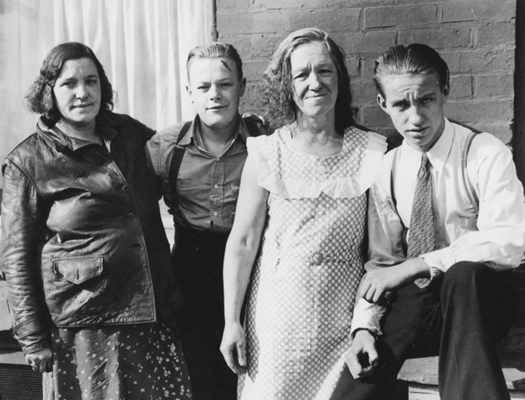
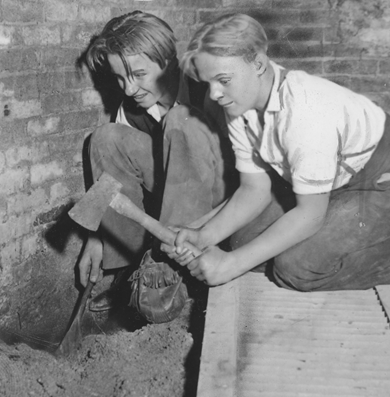
Figure 25. Ruth Grob, Henry Grob, Bessie Jones, and Theodore Jones pose for the camera not long after the gold discovery. Right, Theodore and Henry recreate their discovery in the building cellar. (Baltimore News & Post archive)
Surrender of the coins to police custody was a curious affair. The first batch weighed in at $7,882 face, and sometime later the same evening a second group came in at $3,542 face. The families had a little explaining to do about the second part. “We didn’t know what would happen, so we decided to hold out a little,” the boys said. “We need it. We had planned to give it to our mothers, but when you told us that we would get it back [following the initial surrender] we decided to turn it all in.” The boys “had decided that honesty was the best policy,” the Baltimore Sun observed. Later, strong evidence pointed to yet another, third, part of the hoard which not disclosed at the time, but remained in the families for their personal use. “My father was living like Rockefeller,” was how a son of Theodore put it many years later.
Predictably, litigation quickly commenced. The strongest claims to the hoard came from two elderly sisters who owned the apartment house, and from the descendants of Andrew J. Saulsbury, who had lived in the house in the 1860s and 1870s. The Saulsbury’s had the harder problem, for the burden of proof fell to them, to demonstrate to a legal standard that Saulsbury had buried the gold. Saulsbury was a wealthy merchant, dealing in soap, candles, and real estate, known to have handled much gold coin. He was a Southern sympathizer at a dangerous time, and his family had been harassed by the Union military. Saulsbury died suddenly in 1873, at a young age, and only a few others besides Saulsbury had lived in the house since 1856 (the last date on the coins). Indeed, these other inhabitants of 132 S. Eden were later found at other locations in Baltimore city directories, and surely they would not have moved out of at 132 S. Eden without taking their gold. The Saulsbury descendants thus argued that Andrew J. was the most likely depositor of the hoard. In February, 1935, Judge Eugene O’Dunne ruled out the Saulsbury family, considering their claim plausible but not meeting the necessary legal burden of proof.
The two sisters who owned 132 S. Eden, Elizabeth French and Mary Findlay, argued that the children had been trespassing in the cellar, since the rear portion of the cellar where the gold was found was normally gated. O’Dunne heard conflicting testimony on this point. The landlord, who of course worked for the Findlay-French contingent, held that the rear portion of the cellar was locked, but under close questioning from Harry O. Levin, attorney for the children, was forced to waffle. Obviously, the landlord had not stood constant guard in the dingy cellar. He was a busy man with other properties to manage. A tenant in the building testified that the rear of the cellar was sometimes accessible. He had seen another tenant chopping wood in the area, and further averred that he himself had replaced electric fuses located in the back cellar. Judge O’Dunne was not sufficiently convinced to call the boys’ exploration an act of trespass, and thus ruled against the ladies Findlay-French in February, 1935. Although the boys’ families had won “round two” of the legal battle, the war was far from over.
While the litigants plotted their appeals to the Maryland State Court, the Secret Service took note of the proceedings and made their own play. A Baltimore Secret Service agent asked Judge O’Dunne to exchange the gold for federal currency, “…so that it will cause no more trouble.” O’Dunne, with some idea that the coins had numismatic value, refused, going so far as to not even divulge the location of the bank box which held the gold. O’Dunne was a cantankerous fellow, and had no problem standing up to the G-men for a cause in which he believed. “Possession itself is sometimes a strong factor in law,” he wryly observed. The Secret Service backed off and the gold remained in control of the court.
The Findlay-French sisters and the Saulsbury descendants all appealed to the Maryland state level as everyone expected. Meanwhile, all parties were amenable to a public auction of the gold held by the Baltimore City court, and this was conducted on May 2, 1935, by Perry Fuller at the Lord Baltimore Hotel. Fuller’s sixteen page sale catalog is itself today a collector’s item, with a recent example selling for $137. The sale, representing about $11,500 face value, attracted about $19,500 in bids (surviving accounts of the sale present some inconsistencies – Fuller’s “bid book” has not been located by the author). The mega-coin, an 1856-O double eagle, with perhaps 30 surviving specimens, sold for $105. The bulk of the hoard was sold for bullion value or for slight premiums. As such, the Secret Service might rightfully have claimed that much of the gold in fact had no numismatic value. The earlier contretemps with O’Dunne may have influenced their thinking, not to mention that public sympathy sided with the children. The sale proceeds were held by the Baltimore City court system and promised to the children when they turned 21. Until then, the boys were allowed the interest on the accounts.
Shortly after the sale, in July, the Maryland Court of Appeals ruled against the Saulsbury and Findlay-French families by the narrowest of margins. A four-to-four tie vote upheld the lower court decision of Judge O’Dunne. The Saulsbury family gave some thought of going to court yet again, based on certain procedural issues coming out of the appellate decision, but the expense and vagaries of the judiciary deterred them:
**In reopening the case the costs alone (besides fees and bonds) would run pretty close to $500, - AND, you know Scotch feelings course the veins of the Saulsburys. So, as far as I am now advised, there will be no further action….I have heard them [acquaintances] discourse vehemently and, of course, profanely upon the asininity of judges and law. **
The Findlay-French clan felt otherwise, and filed a motion for re-argument with the Court of Appeals. But if the Findlay-French family had not kept the case alive, the events of September, 1935, surely would have.
Figure 26. Theodore and Henry show off their gold hoard carefully guarded by Baltimore police officers Lieut. Daniel Pfenning, and Sergt. Gustav Lample. On the table in front of Henry are remains of the metal can that originally held the coins. (Baltimore News & Post archive)
On Labor Day, 1935, the mother and step-father of Theodore Sines reported a theft from their apartment at 132 S. Eden Street. The family had been robbed, they said, of $3,100 cash and $500 face in gold coins. The money represented a “second find” of gold said to have occurred sometime around May, 1935, although an exact date was never supplied. The boys claimed they felt “lucky” and decided to have another crack at the cellar, at which point a second treasure can was supposedly unearthed from the gold-bearing soil. The story was not received with much credibility. One of the Saulsbury family explained:
******Everyone, from the police lieutenant on up (or down) believes that the boys did not make a second find but that they hold [sic] out some from the first…the police lieutenant thinks this so-called burglary was only a collusive device inspired to insure some little nest-egg in case the decision were altered by the Court of Appeals. ******
In other words, the police felt that nothing was stolen at all, that the Sines’ had perhaps cached the cash and gold elsewhere and used the theft as a cover story to convince the authorities that nothing remained. Regardless of what remained, a good deal had certainly been spent, as one of the Saulsbury attorneys noted:
…both families purchased automobiles over the summer, and have bought new clothes, had frequent parties, and given every indication of having plenty of money to spend.
Whether or not the currency and gold was truly stolen, it was clear that the currency came from selling gold coins, and the buyers of $2,500 face were identified as the brothers Yale and Eli Merrill, local Baltimore businessmen. The entire cast of characters shortly found themselves once again in the courtroom of Judge Eugene O’Dunne.
O’Dunne enjoined all parties from any transactions involving the gold, and as it happened the Merrill brothers retained the $2,500 face, which was turned over to their attorney Simon Sobeloff (later attorney general for the United States). Sobeloff presented the coins in court, to which O’Dunne remarked, “The worst has happened. The lawyers have them already.” After much testimony, O’Dunne ruled that there was indeed a second find, and basically told everyone to take it to the Maryland Court of Appeals, which of course was already working on the motion for re-argument from the first wave of litigation. The Saulsbury’s dropped out at this point, leaving any claims to the Findlay-French ladies. Understandably, the Saulsbury’s had little love for O’Dunne:
He is long on character, but too much affected by an overwhelming desire for public showmanship and the attendant applause for his ‘impartial’ championing of the underdog. Hence, he threw his whole weight to the boys…
The Merrill brothers, who had purchased the $2,500 face for $3,105, settled out of court with the Findlay-French family for $500. With $3,000 invested in the case, plus the fees for Sobeloff, they probably still did quite well, as the coins were worth $4,000 based on the bullion value alone. The Sines and Grob families had sold the gold cheaply, hoping to keep the matter quiet. Michael Merrill, son of Yale, today a coin dealer in Baltimore, retains two coins from the Baltimore hoard, 1850 and 1851 double eagles.
The Maryland Court of Appeals next weighed in on the matter in April, 1936, dismissing all claims to the “first” pot in favor of the boys, but noting that the “second” pot would constitute a separate action which could be re-litigated. The Findlay-French family, who apparently had quite an appetite for the protracted legal fight, took it all back to the Baltimore City courts to try again on the “second” pot. Judge Samuel K. Dennis mercifully put an end to the war of golden buckets in December, 1937, ruling that the circumstances regarding any “second” find did not differ appreciably from the first.
It was a bad end for just about everyone concerned. Before the conclusion of the litigation, Theodore Sines was imprisoned for multiple traffic offenses, recklessly driving the family automobile purchased with the proceeds of the gold. Henry Grob caught pneumonia in the summer of 1937 and tragically died at the age of 18. Theodore seemed to shape up following the prison smackdown, and honorably raised a family in Baltimore while working in the steel industry. The proceeds of the 1935 auction sale, held by the Baltimore City court until the boys reached the age of 21, were ultimately split between Henry’s mother, Theodore, court custodians, and attorneys. Theodore Sines passed away from cancer in 1977.
Coins attributable to the Baltimore Hoard are today elusive. None were preserved by the Sines and Grob families. Most of the coins were treated as bullion in the secondary market, and provenance was not important. A recent estate sale in Maryland contained many coins from the same era, with a fabric similar to what one might expect for buried coins. “Based on circumstantial evidence, we all believed that the coins were from the Baltimore Hoard, but we had no proof,” noted a longtime coin dealer who attended the sale. Aside from the two Merrill coins noted above, a third appeared in Stack’s Americana sale, of September 2010, lot 3625. The sale catalog described the coin:
_1856 G$1 Upright 5. MS-63 (PCGS). Partially brilliant with blushes of intermingled blue-green, violet, and pink. Many orders rarer in Uncirculated grades than the type with slanting 5 in the date. This was originally accompanied by a slip of paper stating it was acquired from Tom Elder in the 1930s and was from the famous Baltimore Gold Hoard…Acquired by Dave [Bowers] many years ago for its historic value.
_
In spirited bidding, the Bowers coin sold for $4,600, establishing a substantial premium for the Baltimore Hoard provenance.
Fantastic research and images on the Baltimore Hoard, @RogerB.
Thank you.