Of course the original, real Greek Parthenon is located on the Acropolis of Athens in the capital city of Athens, Greece. It sits atop the rocky, fortified hill of the Athenian Acropolis, overlooking the city of Athens. It sits alongside other ancient structures like the Erechtheion and the Temple of Athena Nike. The Greek Parthenon was built between 447 BC and 432 BC (with the main structure finished by 438 BC).
The aerial view of the interior of the Greek Parthenon today. The Parthenon is in such ruins primarily because of a catastrophic gunpowder explosion in 1687 during a war between the Republic of Venice and the Ottoman Empire. For over 2,000 years after its completion in the 5th century BC, the Parthenon remained largely intact, even as it transitioned from an ancient temple to a Byzantine church, a Catholic cathedral, and an Ottoman mosque. During the Morean War, Ottoman forces used the Parthenon as a military powder magazine and shelter, believing their opponents would not shell such a historic landmark. On September 26, 1687, Venetian artillery led by General Francesco Morosini fired a mortar shell that struck the building, detonating the stored gunpowder. The blast blew out the central walls, destroyed the roof, toppled 28 columns, and shattered much of the interior sculpture. In the early 19th century (1801–1803), Thomas Bruce, the 7th Earl of Elgin, removed a large portion of the remaining surviving marble sculptures and friezes (known as the Elgin Marbles) and shipped them to Britain, further fragmenting the monument's artistic integrity. During a late-19th-century restoration campaign led by architect Nikolas Balanos, iron clamps were inserted without protective lead coatings. When the iron rusted and swelled from rainwater, it cracked and damaged the ancient marble blocks, necessitating ongoing modern interventions. Extensive, long-term stabilization and reconstruction efforts led by the Acropolis Restoration Service have been underway since 1975 to preserve what remains of the structure.
The first known photograph of the Greek Acropolis Parthenon, taken in October 1839 by French businessman and amateur daguerreotypist Pierre-Gustave Joly de Lotbinière. This photo was taken in Autumn (October) 1839—just two months after the public announcement of the daguerreotype process.
Here's something for you on Halloween. This is one of the eeriest nature photos you'll ever see. This real, unedited photograph shows the West Kamokuna Skylight in Hawaii Volcanoes National Park on the island of Hawaiʻi. The photo was captured on April 1, 1996, by volcanologist Dr. Laszlo Kestay for the U.S. Geological Survey (USGS). The opening is a skylight—a collapsed section of a roof over an active underground lava tube carrying molten rock from the Puʻu ʻŌʻō eruption toward the ocean. The crinkled, rope-like pāhoehoe lava flow surrounding the pit is a natural geological formation. Because of the lighting and the way the cooling crust froze around the hole, it creates a striking optical illusion (pareidolia) that resembles a mass of intertwined, writhing human bodies tumbling into a fiery pit. This photo is often dubbed the "Gates of Hell".
I'll tell you what, the Greek Parthenon is the setting for some of the most beautiful and stunning images you'll ever see when the moon makes an appearance.
Another one of the Seven Wonders of the ancient world was the Lighthouse of Alexandria in Egypt. The Lighthouse of Alexandria was commissioned by Ptolemy I Soter, one of Alexander the Great’s generals who became the ruler of Egypt, and was completed during the reign of his son, Ptolemy II Philadelphus, around 280–247 BC.
The actual architect and engineer behind the design was Sostratus of Cnidus, whose name was famously inscribed on the structure itself. The original Lighthouse of Alexandria (also known as the Pharos of Alexandria) does not stand as an intact building today. It was gradually destroyed by a series of major earthquakes between the 10th and 14th centuries. However, physical remnants of the ancient wonder still survive in two main ways:
• In the Mediterranean Seafloor & Citadel: Thousands of fragmented stone blocks, columns, statues, and massive granite slabs from the lighthouse lie submerged in Alexandria's Eastern Harbour, near the Citadel of Qaitbay. In fact, many of the original stones from the collapsed lighthouse were reused in the 15th century to build the citadel itself.
• Recent Underwater Recoveries: French and Egyptian archaeological teams (such as the CEAlex / PHAROS project) have mapped thousands of pieces underwater using photogrammetry. Most notably, researchers recovered 22 giant granite and limestone blocks—weighing up to 80 or 90 tons each, including ancient doorway and pylon fragments—to aid in conservation and digital 3D reconstruction efforts.
This is probably pretty close to what the Lighthouse of Alexandria looked like in it's day.
Excellent post about the Lighthouse of Alexandria from The Prehistoric World on Facebook and a photo of the 80-90 ton blocks from the original lighthouse being raised from the ocean floor by archaeologists.
"For centuries, it guided ancient ships safely into the busy port of Alexandria. Now, after lying broken and forgotten beneath the sea for over 700 years, the mighty Lighthouse of Alexandria is rising once more. Built in the third century BCE during the reign of Ptolemy II, this towering marvel once stood more than 330 feet high, making it one of the tallest human-made structures in the world. Recognised as one of the Seven Wonders of the Ancient World, it was an architectural and technological achievement unlike any other of its time.
The lighthouse stood strong for over 1,600 years, surviving countless storms and invasions, until it finally collapsed during a devastating earthquake in 1303. Its ruins sank into the Mediterranean, lost to history until 1968 when they were first rediscovered by divers. But only in recent years has real progress been made in retrieving its massive remnants. Archaeologists have now successfully recovered 22 of its largest pieces from the seafloor, including door frames, foundation stones, and other architectural elements. Some of these blocks weigh as much as 80 tons, offering an awe-inspiring glimpse into the engineering brilliance of ancient Egypt.
Each stone tells a story of craftsmanship, ambition, and resilience. These pieces are more than relics they are the physical echoes of a world that once watched the lighthouse’s beacon blaze across the sea. Researchers believe the recovered fragments could help reconstruct parts of the monument, whether digitally or in museum displays, allowing modern viewers to truly appreciate its scale and grandeur.
Fun fact: The Lighthouse of Alexandria was not only a guide for sailors but may also have used polished bronze mirrors to reflect sunlight during the day and fires at night, creating a beam visible for miles out to sea.
A stunning image of a diver swimming over the submerged ruins of the Lighthouse of Alexandria at the Eastern tip of the Pharos peninsula in the harbor of Alexandria, Egypt (near Qaitbay Fort).
This image shows the Citadel of Qaitbay (Fort Qaitbey), a 15th-century defensive fortress located on the Mediterranean coast in Alexandria, Egypt. The citadel sits on the eastern tip of Pharos Island, built upon the foundations and using the ruins of the ancient Lighthouse of Alexandria. Built in 1477 AD by Sultan Al-Ashraf Sayf al-Din Qaitbay, the stronghold features thick limestone walls, cylindrical corner towers, and a historic mosque inside. It was designed as a key fortification to protect Egypt's northern coastline from Ottoman and European naval threats. The Citadel of Qaitbay stands exactly where the Lighthouse of Alexandria once stood.
Stunning aerial view of Alexandria Port and the Eastern Harbour in Alexandria, Egypt, featuring the curved coastline of the Corniche and the historic site of the Citadel of Qaitbay on the western spit.
There are an enormous amount of underwater ruins at Alexandria. The remnants of ancient royal quarters, temples, and maritime structures that sank into the Mediterranean Sea over the course of centuries due to severe earthquakes, tidal waves, and coastal subsidence. Cleopatra's Palace / Royal Quarter (Antirhodos Island / Portus Magnus) is submerged in the eastern harbor of Alexandria at a depth of about 5 to 8 meters. This area contains the remains of marble-floored palaces, the private quarters of Cleopatra VII, the Temple of Isis, granite sphinxes, colossal statues, and ceremonial gateways. Thonis-Heracleion is submerged about 6.5 km off the coast in Abu Qir Bay, this was a major ancient port and religious center (home to the grand Temple of Amun) sitting submerged under 30 to 45 feet of water. Canopus is another submerged ancient residential city and port found in Abu Qir Bay, containing ruins of temples, sphinxes, and statues (such as artifacts tied to the god Serapis). The Ptolemaic Dynasty (Greek rulers of Egypt starting with Ptolemy I Soter in 323 BC following its foundation by Alexander the Great in 331 BC) built the city of Alexandria, the royal palaces, the Lighthouse, and many of the Hellenistic-Egyptian temples. Older port cities like Thonis-Heracleion date back even further (around the 8th century BC or earlier), built by native Egyptian civil powers long before Alexander the Great established Alexandria. The discovery of Alexandria’s underwater ruins happened in stages, but the first detailed description and scientific identification of the submerged port structures was made by French engineer Gaston Jondet in 1916. While local fishermen had long known that things were hidden beneath the waves, Jondet accidentally exposed the massive, ancient harbor facilities of the old port during construction work on the modern harbor. Gaston Jondet’s discovery was a complete accident born out of a modern infrastructure expansion project.
In 1910, Jondet was working as a chief engineer for the Egyptian Ports and Lighthouses Administration. He was tasked with supervising the enlargement and dredging of Alexandria’s Western Harbor to accommodate larger modern ships. During the maritime construction work near the area of Ras El-Tin, Jondet noticed unexpected anomalies just beneath the surface of the water. As teams cleared the seabed and worked near the reefs, they struck colossal, uniform stone blocks—some weighing as much as 60 tons each. Looking down into the water from the harbor edge and survey boats, Jondet realized these weren't random natural rock formations or ordinary reefs. The massive stones were explicitly squared, dressed, and meticulously laid out in massive linear walls, jetties, and breakwaters. Recognizing the historic magnitude of what his modern engineering project had run into, Jondet paused to systematically survey and map the structures. In 1916, he published his ground-breaking findings, revealing that they had exposed a massive, ancient harbor system—often referred to as the "Ancient Port of Pharos"—which actually predated Alexander the Great's arrival in the region. The photos of the submerged ruins are fascinating, like something out of an Indiana Jones film. So without further ado, let's take a plunge into the past.
Cleopatra VII and Mark Antony were two of the most powerful and captivating figures of the ancient world. Their political alliance and romantic partnership reshaped the history of the Mediterranean, marking the definitive end of the Roman Republic and the birth of the Roman Empire. Cleopatra (69–30 BC) was the Queen of Ptolemaic Egypt and the last active pharaoh of an independent Egypt. Despite ruling Egypt, she was ethnically Macedonian-Greek, descended from Ptolemy I Soter, one of Alexander the Great's top generals. Unlike her predecessors, Cleopatra took the time to learn the Egyptian language and embraced native religious customs, which made her deeply popular with her people. She spoke at least nine languages and was a brilliant, highly educated politician. She faced fierce civil wars at home against her siblings for control of the throne. To secure her power, she expertly weaponized Egypt's vast wealth and grain supplies to forge alliances with Rome’s most dominant men—first with Julius Caesar (with whom she had a son, Caesarion) and later with Mark Antony. Mark Antony (83–30 BC), known in Latin as Marcus Antonius, was a brilliant but volatile Roman general and statesman who rose to power as the right-hand man of Julius Caesar, you might say he was Caesar's enforcer. He proved himself a fierce military commander during Caesar’s conquest of Gaul and the subsequent Roman civil wars. After Julius Caesar was assassinated in 44 BC, Antony delivered a famous funeral oration that turned the Roman public against the assassins. Antony co-founded the Second Triumvirate—a three-man dictatorship with Marcus Lepidus and Octavian (Caesar’s adopted heir) to hunt down Caesar's killers and split up the Roman world. Antony took control of Rome's wealthy eastern provinces, which eventually brought him directly into Cleopatra’s orbit. When Antony summoned Cleopatra to Tarsus (modern-day Turkey) in 41 BC to question her loyalty to Rome, she famously arrived on a magnificent golden barge dressed as Aphrodite, the goddess of love. Antony was instantly captivated.
Their subsequent relationship was equal parts genuine passion and calculated geopolitics. Cleopatra needed Rome’s military might to safeguard Egypt and expand her territory, while Antony needed Egypt's immense wealth to fund his military campaigns against the Parthian Empire. Together they had three children. Their bond proved to be their undoing. Back in Rome, Octavian utilized ruthless propaganda to depict Antony as a weak-willed traitor who had abandoned his Roman values for an exotic foreign queen. This culminated in a massive Roman civil war. Following their crushing naval defeat at the Battle of Actium in 31 BC, Octavian's forces invaded Egypt, leading both Antony and Cleopatra to commit suicide in Alexandria in 30 BC. Egypt was subsequently annexed, becoming a province of the new Roman Empire. The story of Cleopatra and Mark Antony is one of the most famous love stories in history, many books and films have been made about it. Cleopatra and Mark Antony lived in Alexandria, Egypt, which served as the capital city of Cleopatra’s Ptolemaic Kingdom. The ruins shown in the image are the remnants of Cleopatra's submerged royal palace quarter, which was located on the island of Antirhodos in Alexandria's eastern harbor before it was submerged by earthquakes and tidal waves centuries later. Cleopatra ruled from her lavish harbor palace where she and Mark Antony spent years together, conducting state affairs and hosting extravagant banquets. During their time together in Alexandria, the couple famously formed a notorious, high-society drinking and dining club known as the Amimetobioi (The Society of Inimitable Livers), dedicated to pursuing the ultimate heights of luxury, theatrical pranks, and epicurean indulgence. After their disastrous military defeat against Octavian (the future Emperor Augustus) at the Battle of Actium in 31 BC, a despairing Mark Antony built a secluded, solitary retreat on a jetty in Alexandria's harbor which he named the Timonium (after the famous Greek misanthrope Timon of Athens), where he briefly isolated himself from society. The submerged ruins of Cleopatra's royal palace and the ancient royal quarter are located in the Eastern Harbour of Alexandria, Egypt, within the historic area of Portus Magnus and around Antirhodos Island, situated roughly 5 to 8 meters (16 to 26 feet) underwater in the Alexandria harbor.
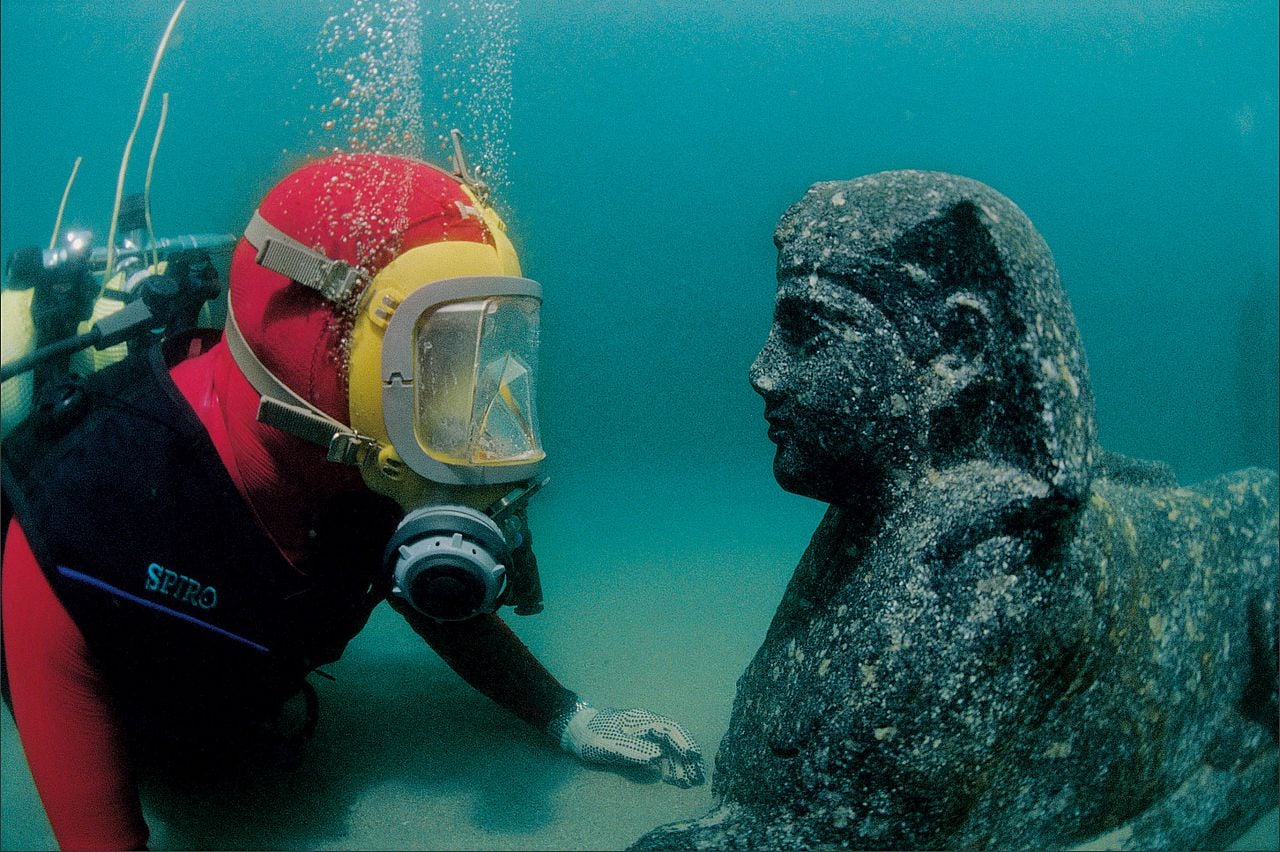
A diver eye-to-eye with a sphinx made out of black granite. The face of the sphinx is believed to represent Ptolemy XII, father of the famous Cleopatra VII. The sphinx was found during excavations in the ancient harbour of Alexandria.
A diver hovering over the remains of the sunken palace of Cleopatra. We can see what seems to be remains of red granite pillars and columns from the ancient times.
Diver checking an old bowl, most likely used to store food or water in ancient Egyptian times. Canon PowerShot S110, Nauticam housing, Inon wide angle wet lens and dome, ambient light.
The body of a Sphinx (head was separated) found near Cleopatra’s shrine. You can see the body of the lion, including the crease and curve of the thigh on the right side.
This granite head (80cm) is attributed to Caesarion (Ptolemaios XV), son of Cleopatra VII and Julius Caesar. It is part of a statue of about 5 metres in height and dates from the 1st century BC. It was found in Alexandria’s ancient harbour opposite the Island of Antirhodos.
Papyriform pink granite column which belonged to a colonnade of a building that was originally in Memphis. The names of Thoumosis IV, II and Sety Merenptah are still visible.
Life sized statue of a priest holding an Osiris-Canopus jar in veiled hands (1st century BC) found on the site of temple of Isis on the sunken royal island of Antirhodos in Alexandria's Eastern Harbour.
View of the remnants of an ancient Roman shipwreck discovered in the ancient port of the Island of Antirhodos after the removal of sediment. The analysis of the in mud well preserved wooden remains and of parts of the cargo shows that this ship might date back to the 1st century BC. Within the general grid of the site a metallic frame is positioned with squares of 50 cm x 50 cm, to help the archaeologist writing down the data.
A ceramic bowl that dates from the 1st century BC - 1st century AD. Its shape suggests that it may have been used for divination rituals. To this day, the inscription ‘DIA CHRESTOU O GOISTAIS’ remains open to various interpretations.
Statue of an ibis in white limestone from the Ptolemaic period. This effigy of the sacred animal of the egyptian god Thot must have stood in a religious building, not far from the banks of the eastern port.
A silicon-soaked cloth is taken below the surface, placed on the inscribed block and overlaid with a thin sheet of lead, which is then gently hammered by the diver. The lead is held in place by straps to ensure uniform pressure during the polymerisation period. Eighteen hours later demoulding reveals the inscription on the silicon membrane.
The image shows a diver inspecting the Stele of Thonis-Heracleion, an ancient black granite stone slab submerged in the ruins of the lost Egyptian port city of Thonis-Heracleion (also known as Heracleion) near Alexandria.
Comments
Yes, it's insane, but there is a full scale replica of the Greek Parthenon in Nashville, Tennessee.
Of course the original, real Greek Parthenon is located on the Acropolis of Athens in the capital city of Athens, Greece. It sits atop the rocky, fortified hill of the Athenian Acropolis, overlooking the city of Athens. It sits alongside other ancient structures like the Erechtheion and the Temple of Athena Nike. The Greek Parthenon was built between 447 BC and 432 BC (with the main structure finished by 438 BC).
Check out this photo of the Greek Parthenon at night.
Illustrations demonstrating what the Greek Parthenon was like in it's prime.
What the Greek Parthenon looked like on the inside.
The aerial view of the interior of the Greek Parthenon today. The Parthenon is in such ruins primarily because of a catastrophic gunpowder explosion in 1687 during a war between the Republic of Venice and the Ottoman Empire. For over 2,000 years after its completion in the 5th century BC, the Parthenon remained largely intact, even as it transitioned from an ancient temple to a Byzantine church, a Catholic cathedral, and an Ottoman mosque. During the Morean War, Ottoman forces used the Parthenon as a military powder magazine and shelter, believing their opponents would not shell such a historic landmark. On September 26, 1687, Venetian artillery led by General Francesco Morosini fired a mortar shell that struck the building, detonating the stored gunpowder. The blast blew out the central walls, destroyed the roof, toppled 28 columns, and shattered much of the interior sculpture. In the early 19th century (1801–1803), Thomas Bruce, the 7th Earl of Elgin, removed a large portion of the remaining surviving marble sculptures and friezes (known as the Elgin Marbles) and shipped them to Britain, further fragmenting the monument's artistic integrity. During a late-19th-century restoration campaign led by architect Nikolas Balanos, iron clamps were inserted without protective lead coatings. When the iron rusted and swelled from rainwater, it cracked and damaged the ancient marble blocks, necessitating ongoing modern interventions. Extensive, long-term stabilization and reconstruction efforts led by the Acropolis Restoration Service have been underway since 1975 to preserve what remains of the structure.
The Greek Parthenon is a very popular tourist attraction. I have family members that have actually visited the Parthenon.
The first known photograph of the Greek Acropolis Parthenon, taken in October 1839 by French businessman and amateur daguerreotypist Pierre-Gustave Joly de Lotbinière. This photo was taken in Autumn (October) 1839—just two months after the public announcement of the daguerreotype process.
Wicked shot of the Parthenon during a nighttime storm.
By the way, it's my favorite time of the year, Happy Halloween!
Here's something for you on Halloween. This is one of the eeriest nature photos you'll ever see. This real, unedited photograph shows the West Kamokuna Skylight in Hawaii Volcanoes National Park on the island of Hawaiʻi. The photo was captured on April 1, 1996, by volcanologist Dr. Laszlo Kestay for the U.S. Geological Survey (USGS). The opening is a skylight—a collapsed section of a roof over an active underground lava tube carrying molten rock from the Puʻu ʻŌʻō eruption toward the ocean. The crinkled, rope-like pāhoehoe lava flow surrounding the pit is a natural geological formation. Because of the lighting and the way the cooling crust froze around the hole, it creates a striking optical illusion (pareidolia) that resembles a mass of intertwined, writhing human bodies tumbling into a fiery pit. This photo is often dubbed the "Gates of Hell".
I'll tell you what, the Greek Parthenon is the setting for some of the most beautiful and stunning images you'll ever see when the moon makes an appearance.
A Strawberry moon over the Parthenon.
Another one of the Seven Wonders of the ancient world was the Lighthouse of Alexandria in Egypt. The Lighthouse of Alexandria was commissioned by Ptolemy I Soter, one of Alexander the Great’s generals who became the ruler of Egypt, and was completed during the reign of his son, Ptolemy II Philadelphus, around 280–247 BC.
The actual architect and engineer behind the design was Sostratus of Cnidus, whose name was famously inscribed on the structure itself. The original Lighthouse of Alexandria (also known as the Pharos of Alexandria) does not stand as an intact building today. It was gradually destroyed by a series of major earthquakes between the 10th and 14th centuries. However, physical remnants of the ancient wonder still survive in two main ways:
• In the Mediterranean Seafloor & Citadel: Thousands of fragmented stone blocks, columns, statues, and massive granite slabs from the lighthouse lie submerged in Alexandria's Eastern Harbour, near the Citadel of Qaitbay. In fact, many of the original stones from the collapsed lighthouse were reused in the 15th century to build the citadel itself.
• Recent Underwater Recoveries: French and Egyptian archaeological teams (such as the CEAlex / PHAROS project) have mapped thousands of pieces underwater using photogrammetry. Most notably, researchers recovered 22 giant granite and limestone blocks—weighing up to 80 or 90 tons each, including ancient doorway and pylon fragments—to aid in conservation and digital 3D reconstruction efforts.
This is probably pretty close to what the Lighthouse of Alexandria looked like in it's day.
Excellent post about the Lighthouse of Alexandria from The Prehistoric World on Facebook and a photo of the 80-90 ton blocks from the original lighthouse being raised from the ocean floor by archaeologists.
"For centuries, it guided ancient ships safely into the busy port of Alexandria. Now, after lying broken and forgotten beneath the sea for over 700 years, the mighty Lighthouse of Alexandria is rising once more. Built in the third century BCE during the reign of Ptolemy II, this towering marvel once stood more than 330 feet high, making it one of the tallest human-made structures in the world. Recognised as one of the Seven Wonders of the Ancient World, it was an architectural and technological achievement unlike any other of its time.
The lighthouse stood strong for over 1,600 years, surviving countless storms and invasions, until it finally collapsed during a devastating earthquake in 1303. Its ruins sank into the Mediterranean, lost to history until 1968 when they were first rediscovered by divers. But only in recent years has real progress been made in retrieving its massive remnants. Archaeologists have now successfully recovered 22 of its largest pieces from the seafloor, including door frames, foundation stones, and other architectural elements. Some of these blocks weigh as much as 80 tons, offering an awe-inspiring glimpse into the engineering brilliance of ancient Egypt.
Each stone tells a story of craftsmanship, ambition, and resilience. These pieces are more than relics they are the physical echoes of a world that once watched the lighthouse’s beacon blaze across the sea. Researchers believe the recovered fragments could help reconstruct parts of the monument, whether digitally or in museum displays, allowing modern viewers to truly appreciate its scale and grandeur.
Fun fact: The Lighthouse of Alexandria was not only a guide for sailors but may also have used polished bronze mirrors to reflect sunlight during the day and fires at night, creating a beam visible for miles out to sea.
More 80-90 ton blocks from the original Lighthouse of Alexandria are raised from the ocean floor.
A stunning image of a diver swimming over the submerged ruins of the Lighthouse of Alexandria at the Eastern tip of the Pharos peninsula in the harbor of Alexandria, Egypt (near Qaitbay Fort).
This image shows the Citadel of Qaitbay (Fort Qaitbey), a 15th-century defensive fortress located on the Mediterranean coast in Alexandria, Egypt. The citadel sits on the eastern tip of Pharos Island, built upon the foundations and using the ruins of the ancient Lighthouse of Alexandria. Built in 1477 AD by Sultan Al-Ashraf Sayf al-Din Qaitbay, the stronghold features thick limestone walls, cylindrical corner towers, and a historic mosque inside. It was designed as a key fortification to protect Egypt's northern coastline from Ottoman and European naval threats. The Citadel of Qaitbay stands exactly where the Lighthouse of Alexandria once stood.
Stunning aerial view of Alexandria Port and the Eastern Harbour in Alexandria, Egypt, featuring the curved coastline of the Corniche and the historic site of the Citadel of Qaitbay on the western spit.
There are an enormous amount of underwater ruins at Alexandria. The remnants of ancient royal quarters, temples, and maritime structures that sank into the Mediterranean Sea over the course of centuries due to severe earthquakes, tidal waves, and coastal subsidence. Cleopatra's Palace / Royal Quarter (Antirhodos Island / Portus Magnus) is submerged in the eastern harbor of Alexandria at a depth of about 5 to 8 meters. This area contains the remains of marble-floored palaces, the private quarters of Cleopatra VII, the Temple of Isis, granite sphinxes, colossal statues, and ceremonial gateways. Thonis-Heracleion is submerged about 6.5 km off the coast in Abu Qir Bay, this was a major ancient port and religious center (home to the grand Temple of Amun) sitting submerged under 30 to 45 feet of water. Canopus is another submerged ancient residential city and port found in Abu Qir Bay, containing ruins of temples, sphinxes, and statues (such as artifacts tied to the god Serapis). The Ptolemaic Dynasty (Greek rulers of Egypt starting with Ptolemy I Soter in 323 BC following its foundation by Alexander the Great in 331 BC) built the city of Alexandria, the royal palaces, the Lighthouse, and many of the Hellenistic-Egyptian temples. Older port cities like Thonis-Heracleion date back even further (around the 8th century BC or earlier), built by native Egyptian civil powers long before Alexander the Great established Alexandria. The discovery of Alexandria’s underwater ruins happened in stages, but the first detailed description and scientific identification of the submerged port structures was made by French engineer Gaston Jondet in 1916. While local fishermen had long known that things were hidden beneath the waves, Jondet accidentally exposed the massive, ancient harbor facilities of the old port during construction work on the modern harbor. Gaston Jondet’s discovery was a complete accident born out of a modern infrastructure expansion project.
In 1910, Jondet was working as a chief engineer for the Egyptian Ports and Lighthouses Administration. He was tasked with supervising the enlargement and dredging of Alexandria’s Western Harbor to accommodate larger modern ships. During the maritime construction work near the area of Ras El-Tin, Jondet noticed unexpected anomalies just beneath the surface of the water. As teams cleared the seabed and worked near the reefs, they struck colossal, uniform stone blocks—some weighing as much as 60 tons each. Looking down into the water from the harbor edge and survey boats, Jondet realized these weren't random natural rock formations or ordinary reefs. The massive stones were explicitly squared, dressed, and meticulously laid out in massive linear walls, jetties, and breakwaters. Recognizing the historic magnitude of what his modern engineering project had run into, Jondet paused to systematically survey and map the structures. In 1916, he published his ground-breaking findings, revealing that they had exposed a massive, ancient harbor system—often referred to as the "Ancient Port of Pharos"—which actually predated Alexander the Great's arrival in the region. The photos of the submerged ruins are fascinating, like something out of an Indiana Jones film. So without further ado, let's take a plunge into the past.
Cleopatra VII and Mark Antony were two of the most powerful and captivating figures of the ancient world. Their political alliance and romantic partnership reshaped the history of the Mediterranean, marking the definitive end of the Roman Republic and the birth of the Roman Empire. Cleopatra (69–30 BC) was the Queen of Ptolemaic Egypt and the last active pharaoh of an independent Egypt. Despite ruling Egypt, she was ethnically Macedonian-Greek, descended from Ptolemy I Soter, one of Alexander the Great's top generals. Unlike her predecessors, Cleopatra took the time to learn the Egyptian language and embraced native religious customs, which made her deeply popular with her people. She spoke at least nine languages and was a brilliant, highly educated politician. She faced fierce civil wars at home against her siblings for control of the throne. To secure her power, she expertly weaponized Egypt's vast wealth and grain supplies to forge alliances with Rome’s most dominant men—first with Julius Caesar (with whom she had a son, Caesarion) and later with Mark Antony. Mark Antony (83–30 BC), known in Latin as Marcus Antonius, was a brilliant but volatile Roman general and statesman who rose to power as the right-hand man of Julius Caesar, you might say he was Caesar's enforcer. He proved himself a fierce military commander during Caesar’s conquest of Gaul and the subsequent Roman civil wars. After Julius Caesar was assassinated in 44 BC, Antony delivered a famous funeral oration that turned the Roman public against the assassins. Antony co-founded the Second Triumvirate—a three-man dictatorship with Marcus Lepidus and Octavian (Caesar’s adopted heir) to hunt down Caesar's killers and split up the Roman world. Antony took control of Rome's wealthy eastern provinces, which eventually brought him directly into Cleopatra’s orbit. When Antony summoned Cleopatra to Tarsus (modern-day Turkey) in 41 BC to question her loyalty to Rome, she famously arrived on a magnificent golden barge dressed as Aphrodite, the goddess of love. Antony was instantly captivated.
Their subsequent relationship was equal parts genuine passion and calculated geopolitics. Cleopatra needed Rome’s military might to safeguard Egypt and expand her territory, while Antony needed Egypt's immense wealth to fund his military campaigns against the Parthian Empire. Together they had three children. Their bond proved to be their undoing. Back in Rome, Octavian utilized ruthless propaganda to depict Antony as a weak-willed traitor who had abandoned his Roman values for an exotic foreign queen. This culminated in a massive Roman civil war. Following their crushing naval defeat at the Battle of Actium in 31 BC, Octavian's forces invaded Egypt, leading both Antony and Cleopatra to commit suicide in Alexandria in 30 BC. Egypt was subsequently annexed, becoming a province of the new Roman Empire. The story of Cleopatra and Mark Antony is one of the most famous love stories in history, many books and films have been made about it. Cleopatra and Mark Antony lived in Alexandria, Egypt, which served as the capital city of Cleopatra’s Ptolemaic Kingdom. The ruins shown in the image are the remnants of Cleopatra's submerged royal palace quarter, which was located on the island of Antirhodos in Alexandria's eastern harbor before it was submerged by earthquakes and tidal waves centuries later. Cleopatra ruled from her lavish harbor palace where she and Mark Antony spent years together, conducting state affairs and hosting extravagant banquets. During their time together in Alexandria, the couple famously formed a notorious, high-society drinking and dining club known as the Amimetobioi (The Society of Inimitable Livers), dedicated to pursuing the ultimate heights of luxury, theatrical pranks, and epicurean indulgence. After their disastrous military defeat against Octavian (the future Emperor Augustus) at the Battle of Actium in 31 BC, a despairing Mark Antony built a secluded, solitary retreat on a jetty in Alexandria's harbor which he named the Timonium (after the famous Greek misanthrope Timon of Athens), where he briefly isolated himself from society. The submerged ruins of Cleopatra's royal palace and the ancient royal quarter are located in the Eastern Harbour of Alexandria, Egypt, within the historic area of Portus Magnus and around Antirhodos Island, situated roughly 5 to 8 meters (16 to 26 feet) underwater in the Alexandria harbor.
A diver eye-to-eye with a sphinx made out of black granite. The face of the sphinx is believed to represent Ptolemy XII, father of the famous Cleopatra VII. The sphinx was found during excavations in the ancient harbour of Alexandria.
The remains of a red granite pillar or perhaps a tower.
An old vase or amphora laid against other remains of Cleopatra’s palace.
Part of a broken vase/container with side handle, found among the relics of the sunken palace of Cleopatra.
A diver hovering over the remains of the sunken palace of Cleopatra. We can see what seems to be remains of red granite pillars and columns from the ancient times.
Diver checking an old bowl, most likely used to store food or water in ancient Egyptian times. Canon PowerShot S110, Nauticam housing, Inon wide angle wet lens and dome, ambient light.
The body of a Sphinx (head was separated) found near Cleopatra’s shrine. You can see the body of the lion, including the crease and curve of the thigh on the right side.
The head from the Sphinx.
This granite head (80cm) is attributed to Caesarion (Ptolemaios XV), son of Cleopatra VII and Julius Caesar. It is part of a statue of about 5 metres in height and dates from the 1st century BC. It was found in Alexandria’s ancient harbour opposite the Island of Antirhodos.
The granite head of Caesarion (Ptolemaios XV) is raised from the sea floor by a recovery team.
Papyriform pink granite column which belonged to a colonnade of a building that was originally in Memphis. The names of Thoumosis IV, II and Sety Merenptah are still visible.
Life sized statue of a priest holding an Osiris-Canopus jar in veiled hands (1st century BC) found on the site of temple of Isis on the sunken royal island of Antirhodos in Alexandria's Eastern Harbour.
View of the remnants of an ancient Roman shipwreck discovered in the ancient port of the Island of Antirhodos after the removal of sediment. The analysis of the in mud well preserved wooden remains and of parts of the cargo shows that this ship might date back to the 1st century BC. Within the general grid of the site a metallic frame is positioned with squares of 50 cm x 50 cm, to help the archaeologist writing down the data.
White marble torso of Hermes discovered in the southern branch of the Island of Antirhodos in Alexandria harbour.
A ceramic bowl that dates from the 1st century BC - 1st century AD. Its shape suggests that it may have been used for divination rituals. To this day, the inscription ‘DIA CHRESTOU O GOISTAIS’ remains open to various interpretations.
Statue of an ibis in white limestone from the Ptolemaic period. This effigy of the sacred animal of the egyptian god Thot must have stood in a religious building, not far from the banks of the eastern port.
A silicon-soaked cloth is taken below the surface, placed on the inscribed block and overlaid with a thin sheet of lead, which is then gently hammered by the diver. The lead is held in place by straps to ensure uniform pressure during the polymerisation period. Eighteen hours later demoulding reveals the inscription on the silicon membrane.
The image shows a diver inspecting the Stele of Thonis-Heracleion, an ancient black granite stone slab submerged in the ruins of the lost Egyptian port city of Thonis-Heracleion (also known as Heracleion) near Alexandria.
The Stele of Thonis-Heracleion after being recovered from the sea floor.