Something Special, or Just Another Corroded 1795 C-2a Lettered Edge Half Cent?
 coinloverjon
Posts: 103 ✭✭✭
From my October Penny-Wise article October 2026
The Rare But Not Very Pretty Corner
By Jon Truskey
Something Special, or Just Another Corroded 1795 C-2a Lettered Edge Half Cent?
In early 2020, after hearing about the existence of several examples of the 1795 C-2a L.E Half Cent on a thin planchet, I decided to look for one for my collection. Ronald P. Manley in his book, The Half Cent Die State Book 1793-1857, on page 45 talks about some of these:
“R. Tettenhorst has speculated that some lettered edge ‘trial pieces’ may have been intentionally minted at (or near) 84 grains to test the striking performance at the lower weight (Penny-Wise, Vol.XXXII, NO. 2, 1998, pp. 64-69) He has identified three specimens of 1794 C-9 weighing less than 90 grains (specifically 80.7, 85.6, and 87.2 grains). In addition, he has noted the 77.3 grains Brobston-Cohen 1795 C-1 specimen and three thin planchet specimens of 1795 C-2a (with individual weights of 81.1,81.6 and 88.9 grains). No other 1794 varieties have thus far been identified with specimens below 90 grains.” [Emphasis added].
I saw two examples of C-2a’s sold at the September 2011 Goldberg Sale 65, lots 128 and 129. Both were worn, corroded and listed as AG3. They were also listed as 1795 C-2a/b, Rarity7+. The a/b designation was something I had not seen before. Did this indicate something in between thick and thin planchets or a lettered edge thin example?
Lot 128 was 89.2 grains and lot 129 was 82.1 grains. I found a similar C-2a L.E. in October of 2020. My example is also corroded and worn, but no more than the two from the Goldberg Sale. At 87.6 grains it is also in the weight range of both groups mentioned, and below the 90-grain cutoff some have agreed to. Is this another “trial piece,” “a/b” example?
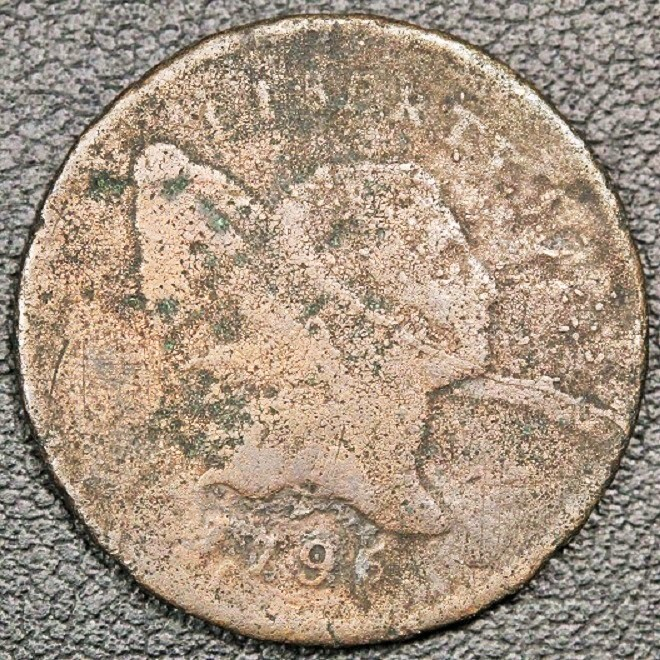
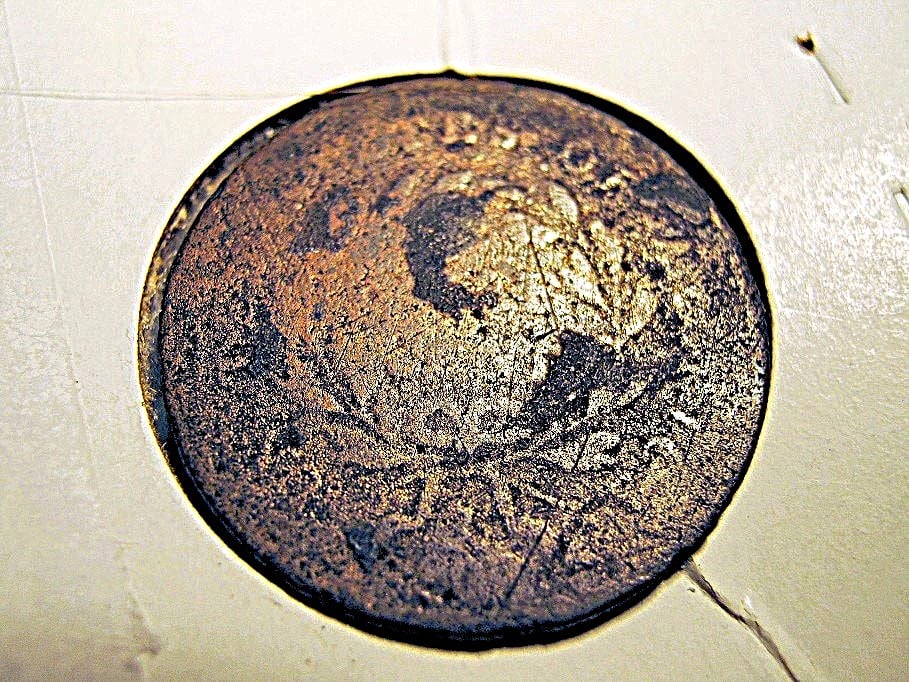
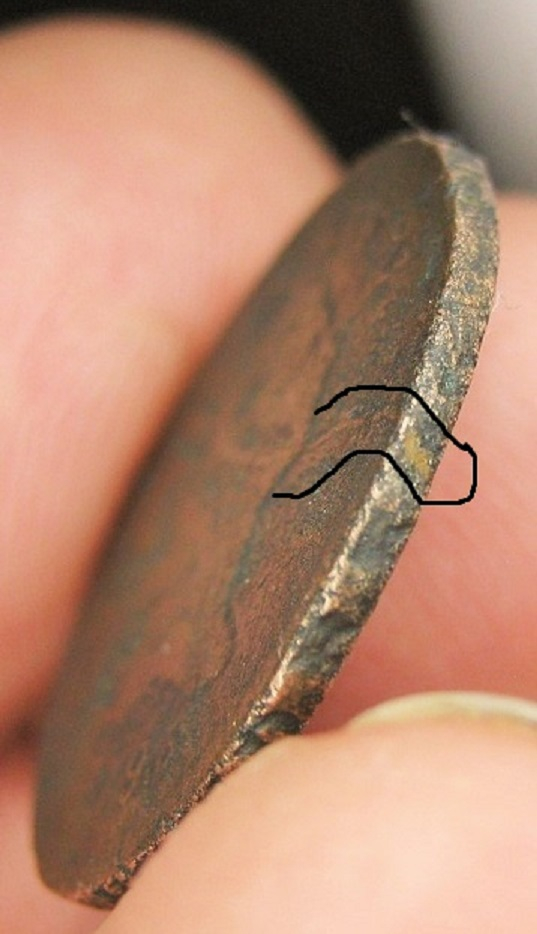
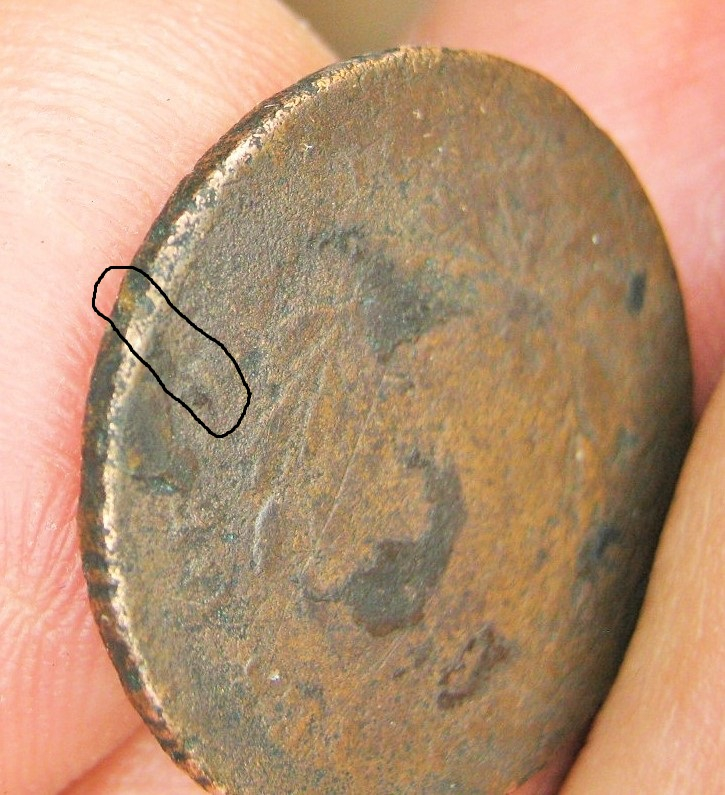
Another interesting feature of this piece is the different color streak running across the face of Miss Liberty. The streak enters her chin from the rim then emerges from the cap to the rim on the other edge. It can also be seen on the face side of the coin’s edge and partially on the reverse as shown in the photos above. I think it looks like a sliver of a dissimilar metal imbedded in the coin. Some think it might be corrosion due to another object making contact with the coin if it were buried in the ground at some point. Unfortunately, I do not know its history.
I remember reading about impurities in some of the mint’s copper in Walter Breen’s Encyclopedia of United Stares Half Cents 1793 -1857, on page 468, called homogeneity. If foreign matter were trapped in the metal, it could form streaks and discoloration. When observed in hand the streak is more of a bronze color than the obverse picture shows. The edge photo shows its true color.
Curious if it was a different material imbedded in the original planchet, I went to a local pawn shop that buys and sells gold and silver and jewelry to see if they could offer any leads in determining what it was. They have a device used determine silver and gold purity, and I thought perhaps it could tell me something about other metals that might be present in this example. They could not but pointed me in the right direction.
They mentioned that the owner of a scrap metal yard nearby had a device called a Thermo Scientific handheld XRF (X-ray fluorescence) analyzer. It works by emitting a primary X-ray beam from an internal tube into a sample. This energy knocks inner-shell electrons loose. When outer-shell electrons drop down to fill those empty spaces, they release secondary, fluorescent X-rays that act as a unique elemental fingerprint. The owner was excited to help since he had never seen a Liberty Cap Half Cent and was also curious about its composition.
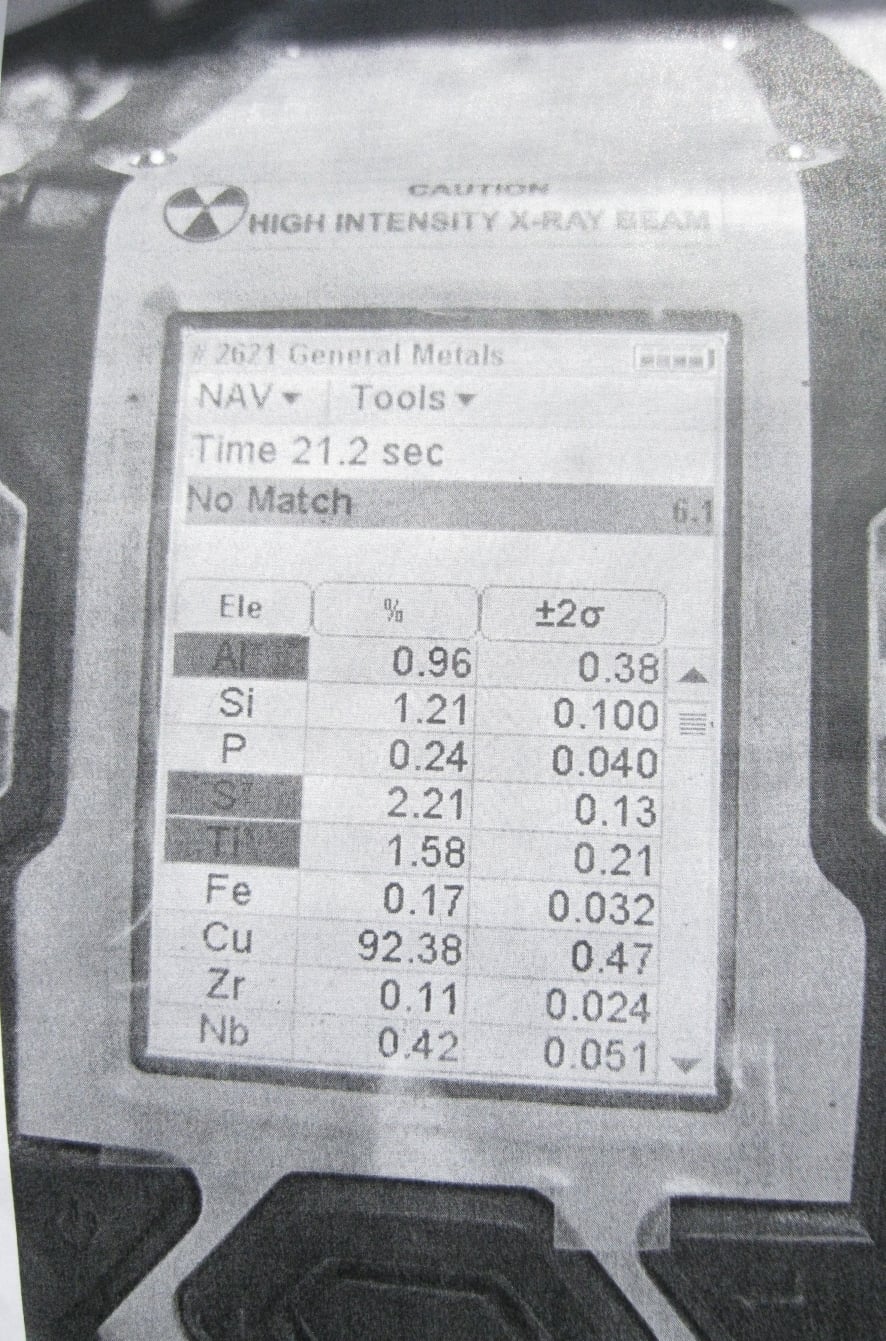
The early cents and half cents were supposed to be 100% copper, however from my internet research 98 to 99 percent was the best 18th century smelting techniques allowed. His machine showed my coin at only 92.38 percent copper. Does the other 7.62 percent represent the streak, perhaps of some sort of imbedded metal? Or was the coin’s copper contaminated throughout and surface contact with another metal was the cause of the streak after all?
Breen, on page 14, mentions that the only purity test done before 1860 was malleability. The metal, when heated red hot and hammered thin, should not split. How accurate that test was percentage wise is anybody’s guess.
Does it matter where on the coin the analyzer was placed? It was centered over the streak during my test. Would it read differently in another location on the coin, depending on the X-ray beam’s width? What is the beam’s width? Now I have several more questions and no real answers. I may have to impose on my new scrap yard friend again to address them in another article.
Comments
.
Suggestion....Find yourself a professional metallurgical lab not a "scrap metal dealer" to do an elemental analysis of the half cent. XRF results are only as reliable as the technician who maintains, calibrates and uses the equipment.
Copper cents and half cents were struck on common plate copper used for ship cladding, among other things. It was not sold by legitimate businesses as "100% copper" (the common term was "pure copper" really meaning 'a lot more copper than anything else, maybe.'). Boulton and Crocker Brothers were more consistent than others, but there's been no systematic investigation of American copper alloy for cents or half cents.