eBay's not the only place publicly listing counterfeits for sale, just more visible...
 JDark
Posts: 83 ✭✭✭
JDark
Posts: 83 ✭✭✭
Many discussions on the rampant counterfeits on eBay in the past, but they seem to be trying to reign it in with their new authenticity guarantee program.
I have often noted I go to eBay to find the latest "fake of the day" and new examples to write attribution articles on but lately have seen fewer so-called higher end fakes on site. Maybe a good sign going forward.
They have also been more receptive imho removing reported bad listings, as I and several others I talk with are having positive results reporting counterfeits there.
Since their policy is "no counterfeits be sold" I believe the following listing from a major auction house would have been removed from their forum had it been reported currently:
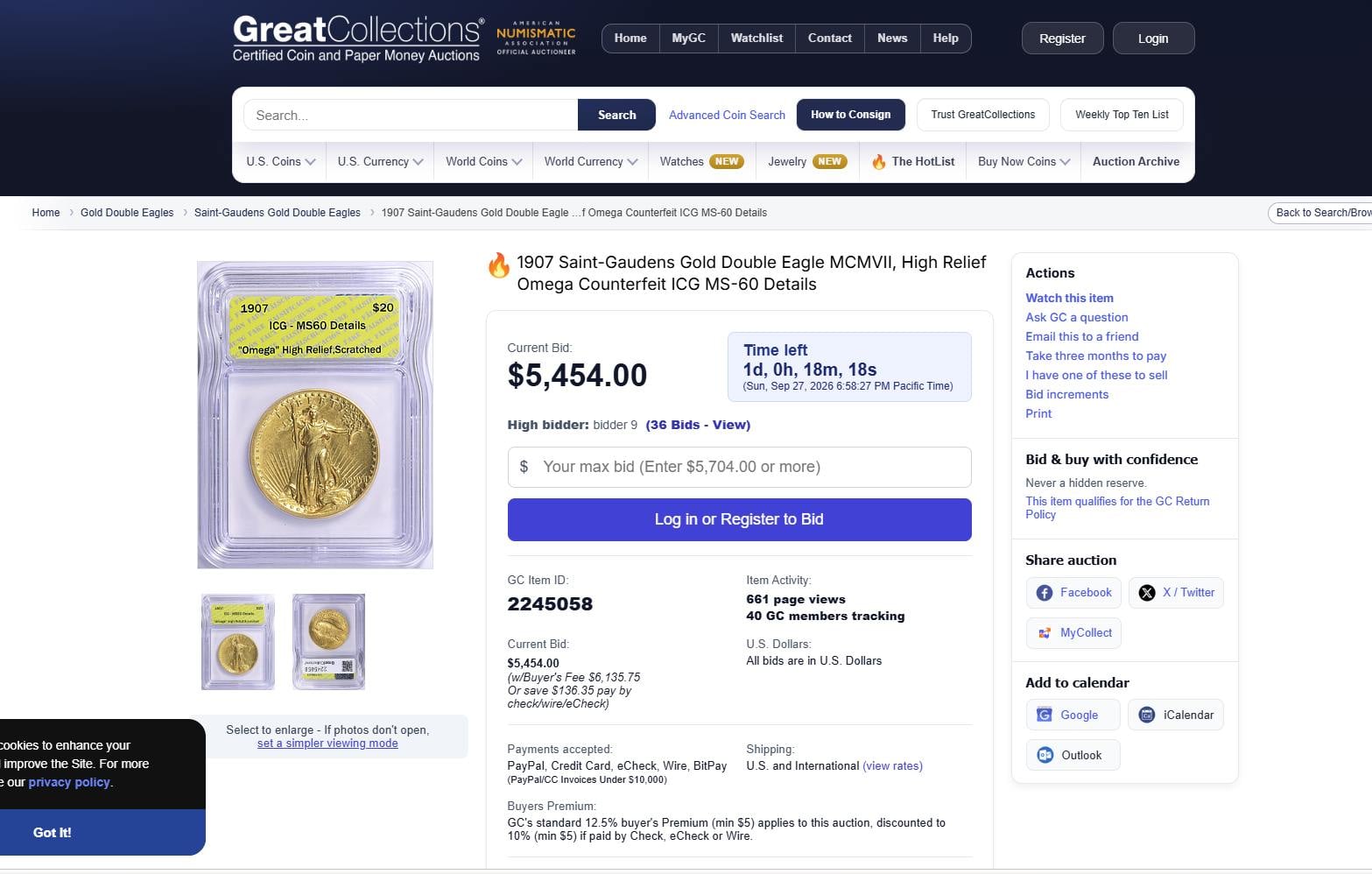
It is surprising to me that someone in a leadership role in the Anti-Counterfeiting Education Foundation would allow this counterfeit to be listed in GC's auction, but I guess it is the best place to maximize the value of this particular fake. I must admit I would like to have one in my collection...
But I am curious how others in this forum view it in regard to allow such a public offering. The link to the current auction is:
Comments
It's listed and holdered as a counterfeit. Fine by me.
chopmarkedtradedollars.com
and really gold so the listing seems fine as it is a collectible counterfeit
I'm not one to raise a ruckus. I personally have a some concerns with such things, including Dan Carr fantasies, modern Chinese reproductions, modern Colombian counterfeits, and the Omegas and Henning nickels. That said, I also tend to just live and let live.
I will say that theleast problematic is probably the Henning nickel. If passed off as real, it would only be worth a nickel. The Colombian fake Sacs are also going to only be worth $1 if passed as real, so they don't represent a threat to the market.
The Omega is a different story. While the counterfeit, sold as a counterfeit, well sell for more than melt, it would likely sell for more if passed as a genuine high relief. As such, it represents more of a threat to the market and should not be allowed to be sold.
And with one twist of a vise, it is no longer holdered or marked as a counterfeit.
All comments reflect the opinion of the author, even when irrefutably accurate.
IMO I think that all counterfeit coins and items should be marked as counterfeit or copy "on the coin itself" as some do and not just have it identified on the holder only. 😎
🇺🇸 Harlequin
harlequinnumismatic@gmail.com
Home of the Americana Collection of USA silver coins
Genuine coins with issues can be cracked out and sold raw at a higher value as well.
Of course. But they aren't counterfeit. The question was about counterfeits. They are illegal for a reason.
All comments reflect the opinion of the author, even when irrefutably accurate.
Ecuador adopted the US dollar and the Sacagawea dollar coin is very popular there because it depicts what looks like a native Ecuadorian woman. Unfortunately, it's being heavily counterfeited to the point that the Ecuadorian government invited the FBI to come down there to help them put a stop to the counterfeiting.
Worry is the interest you pay on a debt you may not owe.
"Paper money eventually returns to its intrinsic value---zero."----Voltaire
"Everything you say should be true, but not everything true should be said."----Voltaire
Yes, but your argument was that it could potentially be cracked out, misrepresented and sold for more. Counterfeits aren't unique in that respect.
Unique to the extent that a counterfeit is the topic of this post.
Yes. But or Ecuadorian friend said that a lot of counterfeits are coming from Colombia which is why i mentioned them.
All comments reflect the opinion of the author, even when irrefutably accurate.
But the thread is about counterfeits. I could have mentioned 1000 other threats to the market, but I was trying to stay on topic. The fact that you can crack out anything isn't germane to the issue of counterfeits that are "properly labeled".
All comments reflect the opinion of the author, even when irrefutably accurate.
Stick to issues that only apply to counterfeits then. Let's try to stay on topic.
Gotta love the petty bickering that has nothing to do with the post...
Auction is slated to end today and is currently approaching $6K; I think it will sell for much more in the end: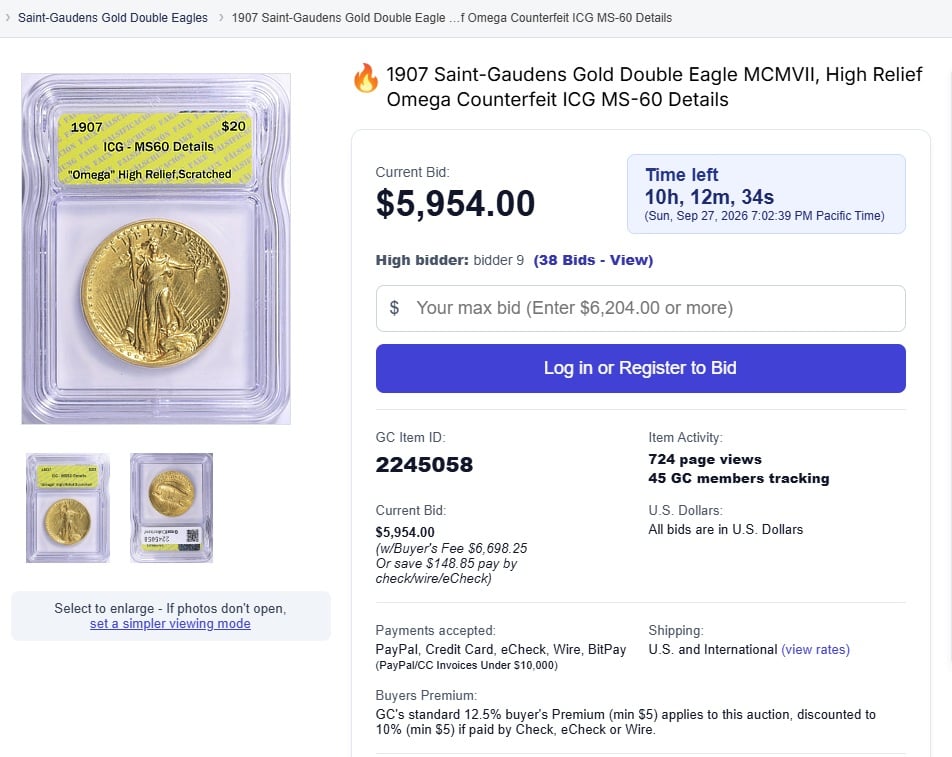
Fair enough. I will drop the argument about it.
I would imagine the bidders are interested in it as a counterfeit. Do you think anyone is bidding with the intention of passing it off as real?
Great question; both are very valuable; the secondary market is always my concern when a counterfeit is sold...
I swear I remember GC auctioning at least one other omega counterfeit in the past, so I tried to find it in their auction archives to see what the final price was. No results. I'm thinking GC likely purged any sales of counterfeits like this from their archives. If anyone else remembers that sale or what the price was, please feel free to share. This could even be the same coin, but I didn't think to take notes at the time.
There are certain counterfeits that the numismatic community regard as "legitimate collectables" in their own right, and are prepared to pay a premium above what they'd pay for a garden-variety modern Chinese fake, or even more than what a genuine coin would cost. Henning nickels, Omega US gold, Machins Mills halfpennies and Roman fourees all come to mind.
In effect, these are all counterfeits that, if themselves counterfeited and sold to collectors, would be fraudulent. Making your own fake Henning nickel, or even modifying a genuine nickel to make it look like a Henning, and then selling it as an "authentic Henning nickel", would be fraudulent, and something that the numismatic community would be intent on preventing or restricting.
ICG is thus certifying this Omega gold as a "genuine" Omega, and not a modern fake (or a modified genuine coin) that is pretending to be an Omega. The owner can thus be confident that it is (a) made of good gold, and (b) was actually made by the mysterious and enigmatic Omega Man.
The fact that (some) collectors actually want to own certain counterfeits and are prepared to pay real money to own an "authentic" counterfeit is indeed one of the more bemusing aspects of our hobby. It is also one of the oldest, as Pliny the Elder observed to his astonishment:
Roman emperor Marcus Aurelius, "Meditations"
Apparently I have been awarded the DPOTD twice.
That is correct, my friend. In the beginning, the production of these counterfeit dollar coins was entirely based in Colombia. There was a major raid back then that seized around $500,000 in both finished coins and ready metallic blanks.
However, not too long ago, authorities conducted a raid right here in Quito and dismantled a local counterfeiting ring. They were striking 25 and 50-cent pieces, along with Presidential, Susan B. Anthony, and Sacagawea dollars. Interestingly, a Colombian national was arrested at the scene.
So, practically all the counterfeits moving here in Ecuador either come directly from Colombia, or the counterfeiters themselves have relocated to our country to run their operations locally.
There's a big difference between selling a world-famous old-time counterfeit like an Omega double eagle or a Henning nickel and selling a piece of modern Chinese crap meant to fool eBay. This difference is evidenced by a major TPG slabbing these coins as recognized, named counterfeits. They are recognized as special.
I have no problem with GC or any major auction house selling a famous, named counterfeit in a labeled TPG slab.
You want there to be a difference. There really isn't. You could buy a modern counterfeit as a hole filler or for fun, not just to fool a buyer. BUT, you could also use it to fool a buyer. The same is true of your "old-time counterfeit". You can choose to collect them for their historical value. However, you could also use it to fool a buyer. A Henning nickel would be useless to fool someone, as it would sell for more as a Henning. That is not necessarily true of the Omega high relief.
You want to think of it as different. But a counterfeit is a counterfeit.
All comments reflect the opinion of the author, even when irrefutably accurate.
Yeah, a well-known Omega in a genuine TPG slab clearly labeled for what it is is the same as a poorly made Chinese fake coin in a fake slab. Yeah, right.
I know you like to argue minor points ad infinitum, but your answer completely ignores my point that these coins are in genuine TPG holders telling the world what they are. That point makes it ok for me that an auction house is selling it clearly labeled for what it is. The difference is that one of these is being honest about what is in the holder and is therefore ok to sell, and one of these is intending to deceive and is therefore not ok to sell.
Sold for $9843.75. I thought @TrickleCharge asked a great question- is a genuine high relief worth more than the winning bid was for this counterfeit?
The holder is irrelevant. If I want to sell it as real, I break it out of the holder.
Not all Chinese fakes are bad fakes. There are some that are quite convincing.
The fact that a counterfeit is a counterfeit is hardly a minor point.
All comments reflect the opinion of the author, even when irrefutably accurate.
Yes. You could break it out and potentially profit from the fraud. Though surprisingly many people don't seem to want to acknowledge that fact.
All comments reflect the opinion of the author, even when irrefutably accurate.
Your argument is irrelevant to the topic of the thread. The thread is about a major auction house selling a TPG holdered, clearly labeled counterfeit.
You can go make your argument in a thread about a major auction house that cracked the coin out and is selling an Omega as real.
That's a silly argument. And what if the buyer is planning on cracking it out and using it for fraud? Then the auction house is enabling the fraud by distributing counterfeits.
I assume, then, that you approve of the sale of Chinese counterfeits as long as they are sold as counterfeits.
All comments reflect the opinion of the author, even when irrefutably accurate.
I asked on my FB page about values of genuine US mint examples and received this from a friend:
As I have said, I am always interested in a potential 2ndary market for things like this...
Keep in mind it is a details coin because of the scratches. Not sure how that would affect value if someone were to try passing it off as real. I suppose it's possible to get lucky and sneak it into a genuine details holder at one of the TPGS. It's hard to price it if sold as a genuine, raw coin with scratches.
I'm told that it's okay to sell these now. It's properly marked. So, no harm, right?
All comments reflect the opinion of the author, even when irrefutably accurate.
Interesting side note. I did not request a PCGS slab in the image. I asked ChatGPT for a "plastic case" and it chose a PCGS slab. Congratulations to the PCGS marketing team.
All comments reflect the opinion of the author, even when irrefutably accurate.
If I was the PCGS marketing team, I'm not sure I'd consider it a win when someone asks AI for a picture of a counterfeit in a holder and the first TPG it thinks of is PCGS.
But then, that's just me.
Lol. I didn't ask for a counterfeit coin. I just added counterfeit to the label. But apparently "PCGS slab" is synonymous with a coin in a "plastic case"..
All comments reflect the opinion of the author, even when irrefutably accurate.
How ironic that cert number is for a PCGS $20 gold coin ...
...
I especially like the 5 prong gasket.
Pretty coin, though. No?
All comments reflect the opinion of the author, even when irrefutably accurate.
To appeal as a counterfeit to me, it needs to have some interesting history behind it.
The coin itself isn't counterfeit. Probably.
All comments reflect the opinion of the author, even when irrefutably accurate.
There are a lot of very interesting platinum contemporary counterfeits. Usually Spanish colonial coinage but some US.
BTW, as mentioned, I don't have a problem with counterfeits being sold as counterfeits despite potential down-market issues. And they are sold other places as well. Partial lists from two notable auction houses, Stacks Bowers and Heritage.
chopmarkedtradedollars.com
I've always been intrigued by the platinum Spanish counterfeits. And, as I said earlier, i don't really care what people choose to do. I do, however, wish they were consistent. You can't logically consider the Omega to NOT be a problem and then complain about a modern counterfeit being a problem. You certainly can WANT the Omega and not want the Chinese coin. But to say that one is okay to sell and the other isn't just isn't reasonable.
All comments reflect the opinion of the author, even when irrefutably accurate.
P.S. a few years ago, Stacks sold a small collection of gold-plated platinum counterfeits of 19th century Spanish gold. I was interested and contacted NGC, PCGS, and ANACS to find out if any of them would slsb them. They all refused even though they were not US nor legal tender anywhere in the world. They are mostly consistent, with the possible exception of Machin's Mills.
All comments reflect the opinion of the author, even when irrefutably accurate.
I actually love and collect many contemporary counterfeits and own a $3 Omega fake. I would love to own one of the $20's, but that was not the intent of the post...
Yes, I have seen other counterfeits listed previously in other auction forums- one famous one was an elephant token sold on SB's site as a copy. It was then sent to PCGS and certified as one of the highest graded known until I wrote a Coin Week article on them as fakes. I actually have that one now raw in my collection. I always consider the 2ndary market when I see fakes listed for sale; maybe just me.
I personally have an issue with someone trusted to aid the Hobby in ridding it of counterfeits sell one in his forum for the $"s, but just my humble opinion...