Home› U.S. Coin Forum
Options

2007-P Washington Dollar LONG RAY study

dcarrdcarr Posts: 10,266 ✭✭✭✭✭

I was recently asked for my opinion on this variety. I didn't really have one, but initially it did not strike me as being intentionally-made. My initial thought was that it was perhaps a "track or "tracer" effect were die polishing compound happens to be concentrated and channeled across a narrow straight line on the die surface, causing a permanent groove. These tracks and tracers typically extend from some design element where a small reservoir of polishing compound is trapped, but drawn down while the die surface is abraded linearly (in one constant direction).

I have read that the Long Ray was intentionally created by an expert US Mint engraver, modifying a die on purpose. I have not seen any conclusive evidence supporting that.

I question this "expert engraver" theory in two ways:

1) Why ? What motive could there have been to do this ?

2) When a die is hubbed, it will loose a very small amount of sharpness compared to the hub it came from. This is normal for any type of transfer process. If a hubbed die was subsequently tooled, the tooled area would generally be sharper than the hubbed design elements. Recall over-polished proof dies where missing design elements were restored via hand-engraving. These hand-engraved restorations have a certain sharpness to them that makes them stand out visually.
But the Long Ray is the opposite. The main (normal) part of the ray is sharper than the extended (abnormal) part of the ray.
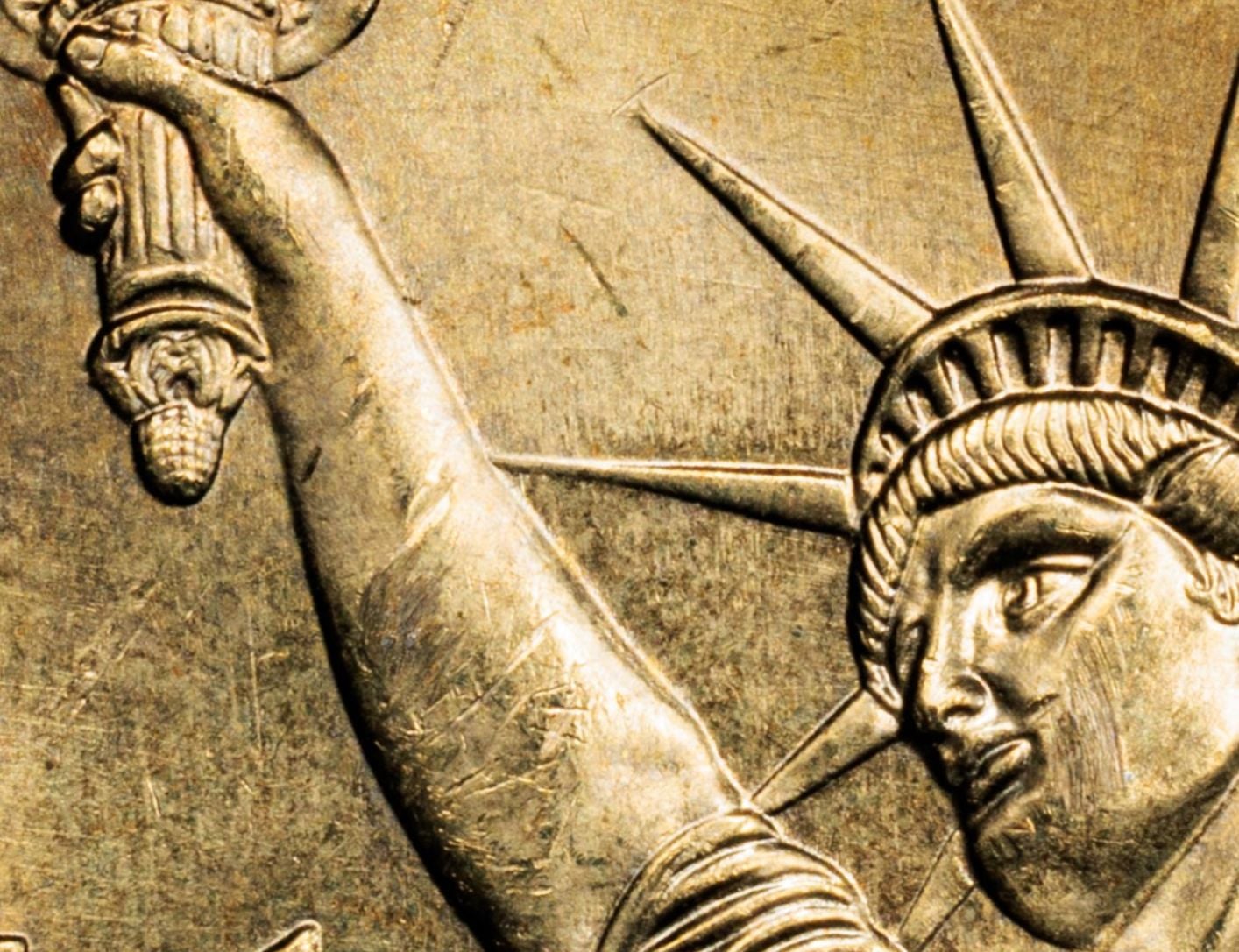
.

Getting to the point, my theory now is that it is a clashed die. The crease in Washington's mouth is a raised ridge on the die. That ridge impacted the reverse die in just the right way to extend the ray.
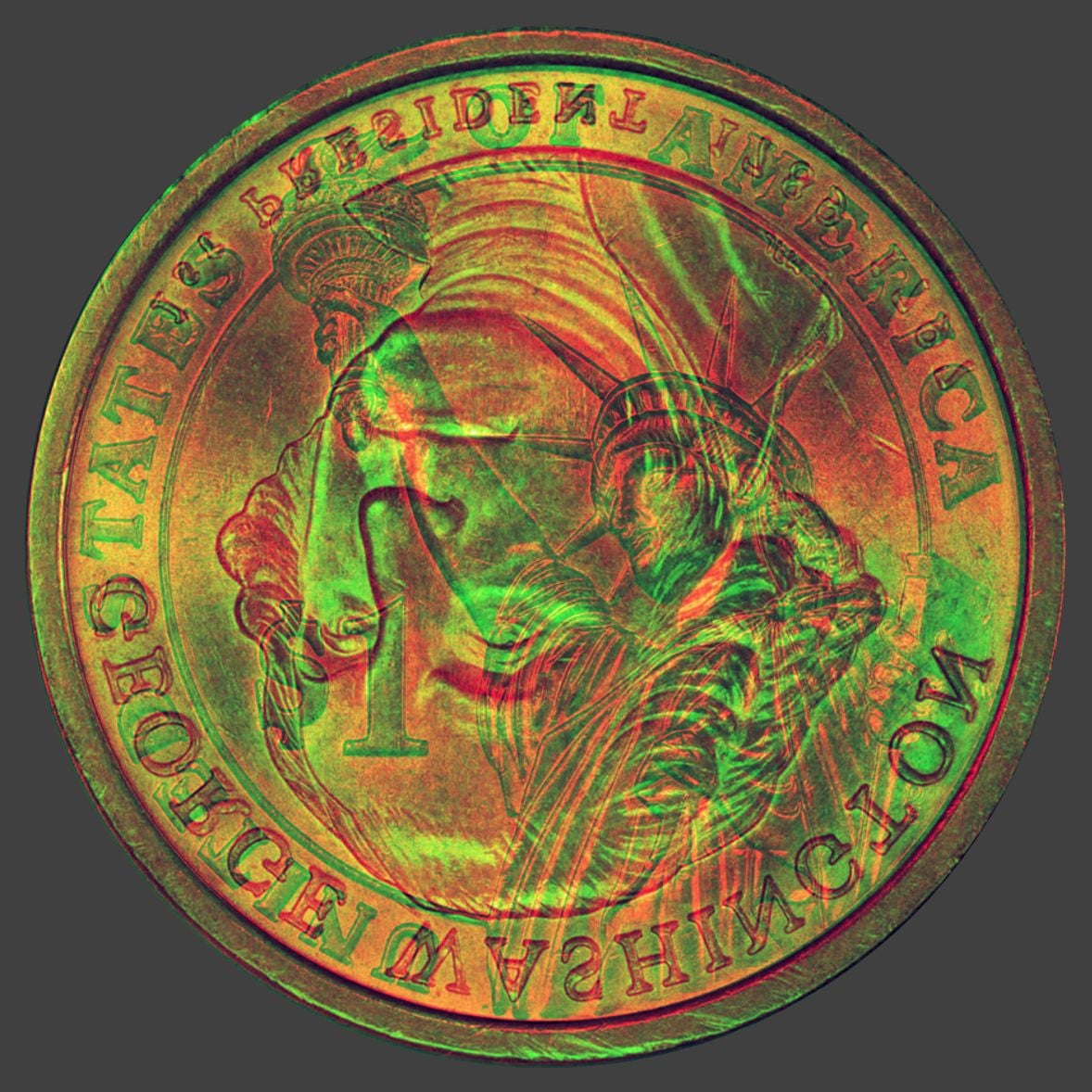
.

An obvious question arises. Why is there no visible evidence of other design elements from this clashing event ? Actually, there is evidence. Evidence that other clash marks were removed. The US Mint has frequently removed clash marks from many dies. The removal is typically performed by a general or localized lapping of the die face. The lapping can be performed by sanding and/or polishing. Sanding usually results in a scratchy texture to the die. Note that such sanding will affect the highest areas on the die face, which are the lowest areas of the struck coin (the fields). A die that was lapped extensively will exhibit a loss of delineation between the fields and devices. Think of the topography of Florida on a struck coin. Imagine what would happen to the apparent shape of Florida if sea levels rose drastically. Lapping a die is like raising the sea level on a coin.

When removing clash marks via sanding, there is some leeway with how the localized sanding is applied. Specific marks can be targeted by sanding that area until the offending mark is gone. If a specific clash mark happens to blend in with the existing design, it might be missed.

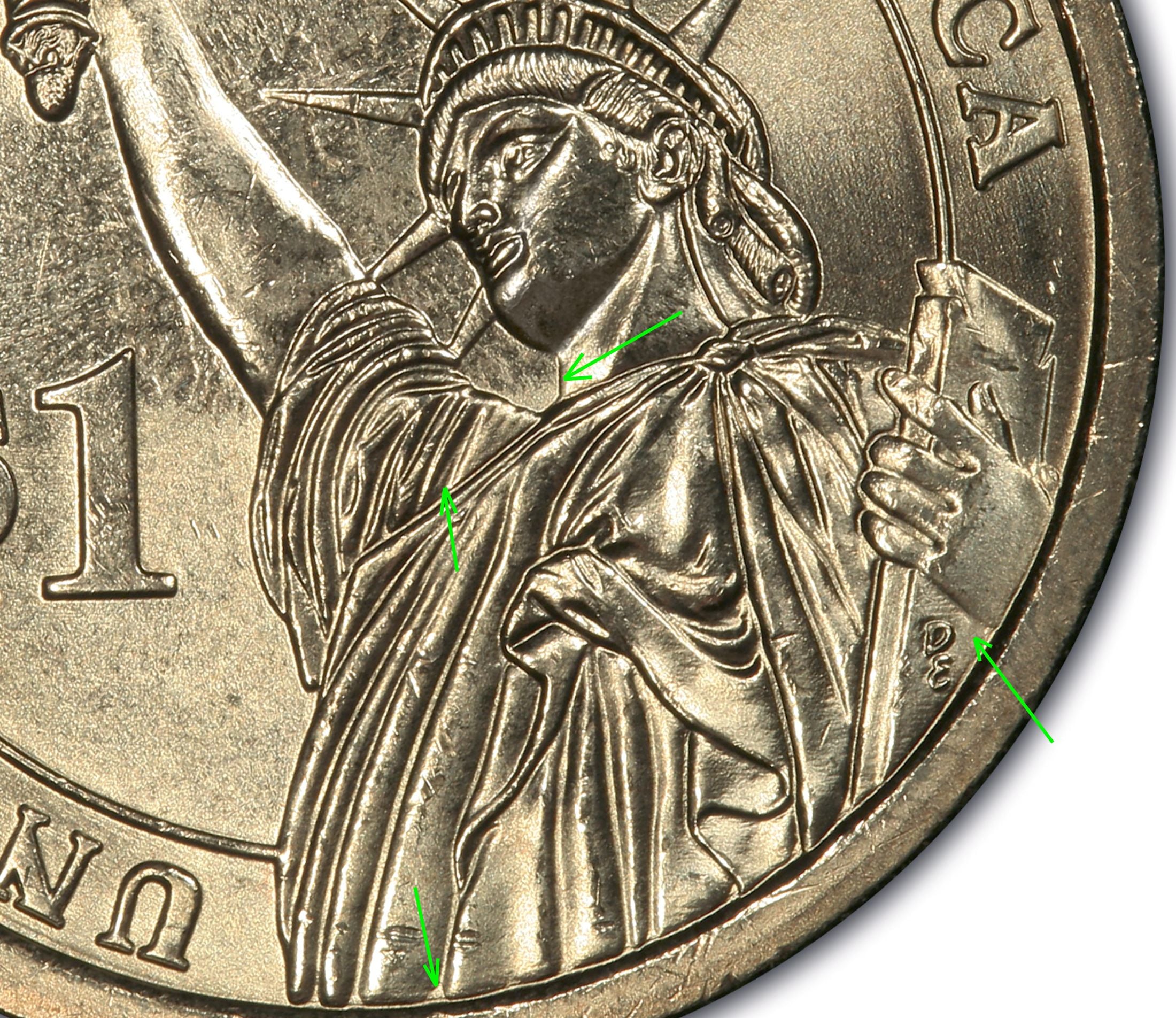
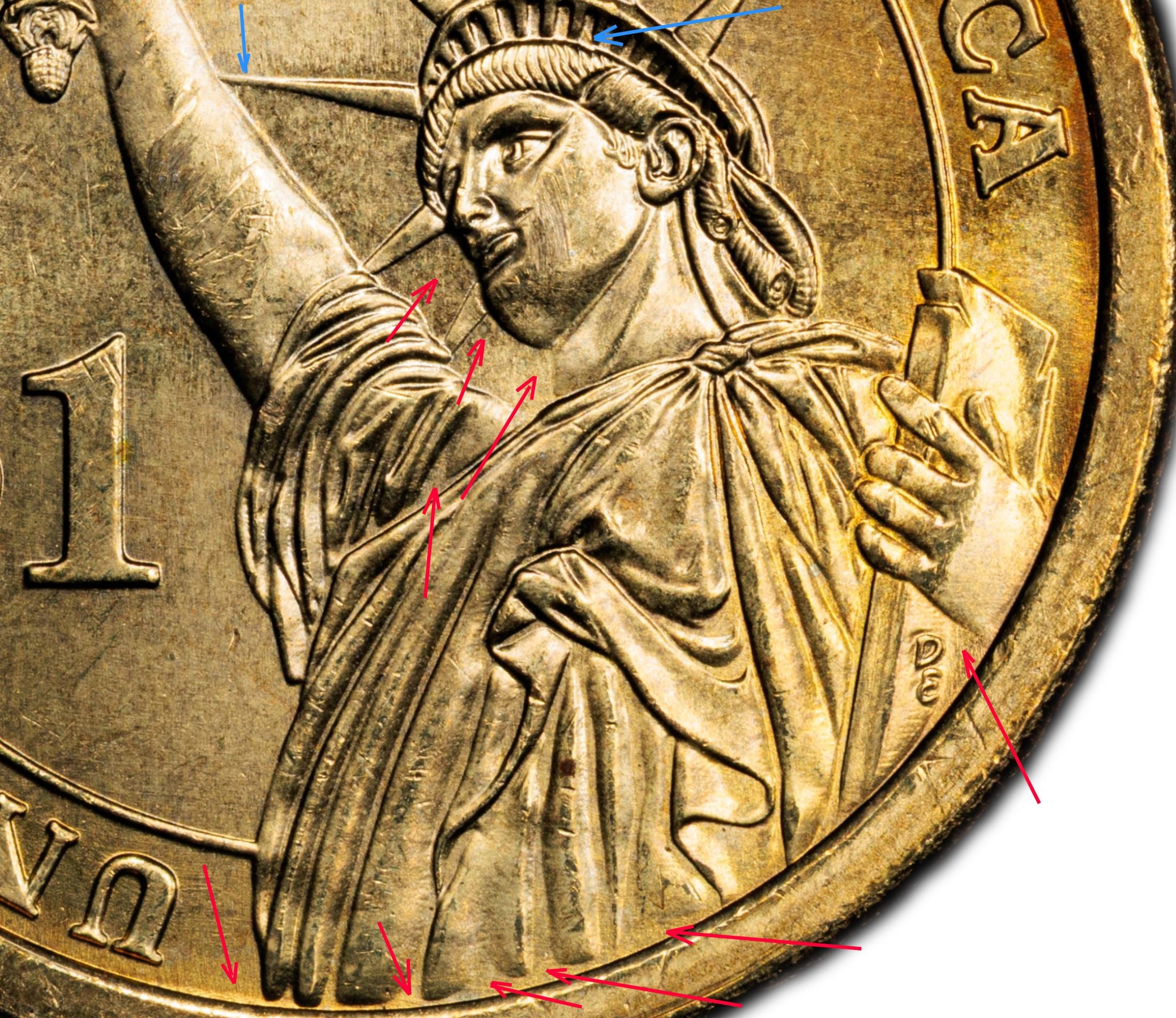
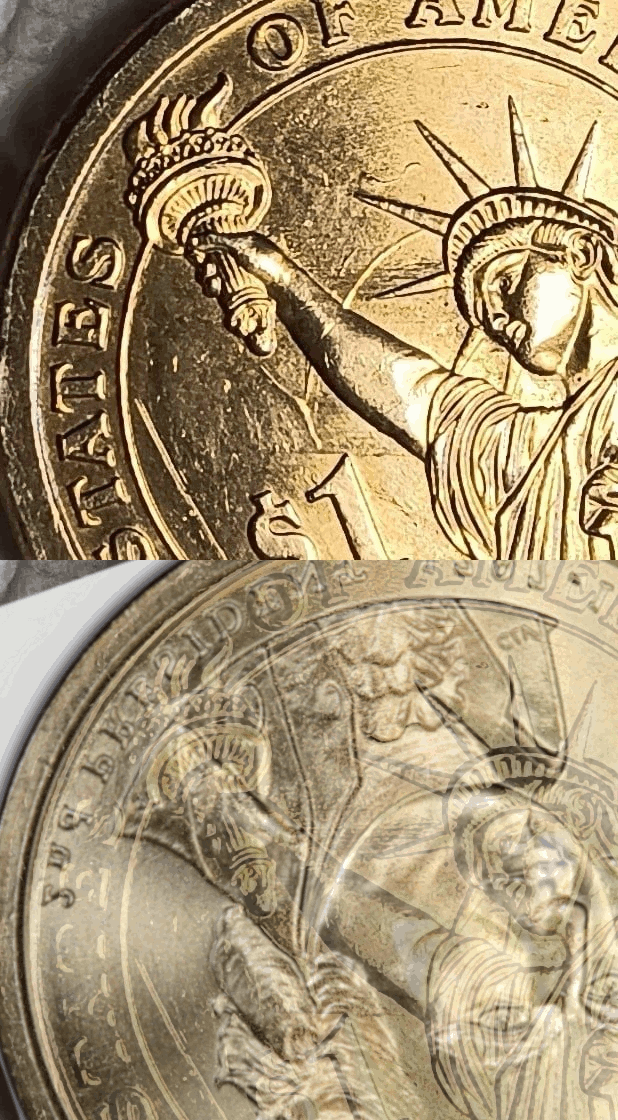
The following images illustrate points of interest. Compare the upper image (normal ray) to the lower image (elongated ray).

Blue arrows point to remaining (visible) clash marks.
Green arrows point to areas unaffected by die lapping.
Red arrows point to areas where significant die lapping is evident.
Comments

  • Options
    cameonut2011cameonut2011 Posts: 10,924 ✭✭✭✭✭

    " My initial thought was that it was perhaps a "track or "tracer" effect were die polishing compound happens to be concentrated and channeled across a narrow straight line on the die surface, causing a permanent groove."

    What are the odds that it would just happen to (1) run in the right orientation and direction, (2) be perfectly straight and continuous of the previous line, and (3) that it would be of a consistent thickness as to create a uniform depth so there was no irregularity of the ray's surface? My thought is the odds are pretty de minimis. Although I think it is wise to question the motivation, it remains the most likely option.

  • Options
    cameonut2011cameonut2011 Posts: 10,924 ✭✭✭✭✭

    And by thickness, I meant depth.

  • Options
    cameonut2011cameonut2011 Posts: 10,924 ✭✭✭✭✭

    The clash mark theory is interesting, but why would they ignore the ray? At a certain point, the die becomes more "trouble" than it is worth. I'm also not 100% convinced I see the clash, but it is an interesting thought.

  • Options
    CaptHenwayCaptHenway Posts: 34,178 ✭✭✭✭✭

    Sorry, but I do not see the clash mark theory as at all plausible. Washington's mouth line, which is proposed as the cause of the continuation of the long ray, is at the bottom of the broad hole in the obverse die that formed Washington's raised head on the struck coin. For the field of the reverse die to sink that deep into the hole in the obverse die, that field would have left massive clash marks elsewhere on the reverse die, such as Washington's mouth and jaw above and below Miss Liberty's torch, and I see no evidence there that the field of the reverse die was heavily ground down, a la the 1937-D 3-Legged Nickel and the 1922 "No D, Strong Reverse" Cent, Die Pair #2, DeLorey-2202.

    There are other dies of the era with unexplained tooling and/or punch marks added to working dies, such as but not limited to the Wisconsin "so-called Extra Leaves" Quarters. Mint shenanigans is the logical explanation for them.

    TD

    Professional Numismatist, Retired. 55 year member ANA. Former ANA Senior Authenticator. Winner of four ANA Heath Literary Awards; three Wayte and Olga Raymond Literary Awards; Numismatist of the Year Award 2009, and ANA Lifetime Achievement Award 2020. Winner of the PNG's 2026 Robert Friedberg Award for "The Enigmatic Lincoln Cents of 1922," Available now from Whitman or Amazon.
  • Options
    jmlanzafjmlanzaf Posts: 43,078 ✭✭✭✭✭

    @CaptHenway said:
    Sorry, but I do not see the clash mark theory as at all plausible. Washington's mouth line, which is proposed as the cause of the continuation of the long ray, is at the bottom of the broad hole in the obverse die that formed Washington's raised head on the struck coin. For the field of the reverse die to sink that deep into the hole in the obverse die, that field would have left massive clash marks elsewhere on the reverse die, such as Washington's mouth and jaw above and below Miss Liberty's torch, and I see no evidence there that the field of the reverse die was heavily ground down, a la the 1937-D 3-Legged Nickel and the 1922 "No D, Strong Reverse" Cent, Die Pair #2, DeLorey-2202.

    There are other dies of the era with unexplained tooling and/or punch marks added to working dies, such as but not limited to the Wisconsin "so-called Extra Leaves" Quarters. Mint shenanigans is the logical explanation for them.

    TD

    I agree. I do think it is an interesting proposal. But if one of the low points on the die made such a prominent clash, then the high points on the die should be more fully developed.

    All comments reflect the opinion of the author, even when irrefutably accurate.

  • Options
    USSID18USSID18 Posts: 657 ✭✭✭✭

    A very comprehensive synopsis and theory Dan. Thank you.

    However, your die clash theory still does not seem probable to me either. There doesn't seem to be evident or apparent converging parallel lines that could be associated with the mouth as a clash.

    These are three different long rays. Unless I'm missing it (and I'm not an expert), I see zero evidence of a clash or anything resembling a mouth with these convergent parallel lines at the end of the ray. The above and below lines of the ray just looks and seems much to perfect!

    My offer still stands. I would be willing to send you an example for an in-hand examination.

  • Options
    Steven59Steven59 Posts: 11,246 ✭✭✭✭✭

    Interesting theory.

    "When they can't find anything wrong with you, they create it!"

  • Options
    dcarrdcarr Posts: 10,266 ✭✭✭✭✭

    @CaptHenway said:
    Sorry, but I do not see the clash mark theory as at all plausible. Washington's mouth line, which is proposed as the cause of the continuation of the long ray, is at the bottom of the broad hole in the obverse die that formed Washington's raised head on the struck coin. For the field of the reverse die to sink that deep into the hole in the obverse die, that field would have left massive clash marks elsewhere on the reverse die, such as Washington's mouth and jaw above and below Miss Liberty's torch, and I see no evidence there that the field of the reverse die was heavily ground down, a la the 1937-D 3-Legged Nickel and the 1922 "No D, Strong Reverse" Cent, Die Pair #2, DeLorey-2202.

    There are other dies of the era with unexplained tooling and/or punch marks added to working dies, such as but not limited to the Wisconsin "so-called Extra Leaves" Quarters. Mint shenanigans is the logical explanation for them.

    TD

    .

    I do not find plausible the theory of an intentional act by some "expert engraver".
    An intent behind these die modifications (elongated ray and extra leaf) is not a logical conclusion.
    I already showed that the arcs on the "extra leaf" Wisconsin quarters was caused by the impact of a threaded bolt. An accident is likely.

    Accidental damage to dies happens all the time. I know because I work at a mint. I usually make about 50 to 100 dies per year. I have had accidental damage to dies. The US Mint deals with tens of thousands of dies per year. Most die damage is caught by inspectors. Any such damage that happens to look like it belongs there (is camouflaged by the design) has a chance of escaping the inspectors.

    Do you not see how extensively the Long Ray die was lapped in front of Liberty's neck, and around the perimeter (along with other areas) ?

    Clashing does not always work the way you expect it to.
    By your logic, the interior neck line of Adams could not clash onto the reverse. But it did.
    Look at this forum thread: https://forums.collectors.com/discussion/1110970
    Here is the key image from that thread:

    Notice how smooth and consistent the clashed arc is. If the neck line was straight, and aligned with a ray, we would have an Adams Elongated Ray variety.

    .

  • Options
    jmlanzafjmlanzaf Posts: 43,078 ✭✭✭✭✭

    @dcarr said:

    @CaptHenway said:
    Sorry, but I do not see the clash mark theory as at all plausible. Washington's mouth line, which is proposed as the cause of the continuation of the long ray, is at the bottom of the broad hole in the obverse die that formed Washington's raised head on the struck coin. For the field of the reverse die to sink that deep into the hole in the obverse die, that field would have left massive clash marks elsewhere on the reverse die, such as Washington's mouth and jaw above and below Miss Liberty's torch, and I see no evidence there that the field of the reverse die was heavily ground down, a la the 1937-D 3-Legged Nickel and the 1922 "No D, Strong Reverse" Cent, Die Pair #2, DeLorey-2202.

    There are other dies of the era with unexplained tooling and/or punch marks added to working dies, such as but not limited to the Wisconsin "so-called Extra Leaves" Quarters. Mint shenanigans is the logical explanation for them.

    TD

    .

    I do not find plausible the theory of an intentional act by some "expert engraver".
    An intent behind these die modifications (elongated ray and extra leaf) is not a logical conclusion.
    I already showed that the arcs on the "extra leaf" Wisconsin quarters was caused by the impact of a threaded bolt. An accident is likely.

    Accidental damage to dies happens all the time. I know because I work at a mint. I usually make about 50 to 100 dies per year. I have had accidental damage to dies. The US Mint deals with tens of thousands of dies per year. Most die damage is caught by inspectors. Any such damage that happens to look like it belongs there (is camouflaged by the design) has a chance of escaping the inspectors.

    Do you not see how extensively the Long Ray die was lapped in front of Liberty's neck, and around the perimeter (along with other areas) ?

    Clashing does not always work the way you expect it to.
    By your logic, the interior neck line of Adams could not clash onto the reverse. But it did.
    Look at this forum thread: https://forums.collectors.com/discussion/1110970
    Here is the key image from that thread:

    Notice how smooth and consistent the clashed arc is. If the neck line was straight, and aligned with a ray, we would have an Adams Elongated Ray variety.

    .

    But notice the outside neck line is also clashed, which is higher on the die. The point, I think, wasn't that the mouth couldn't clash. The point was that if the mouth, which is deep in the die, clashed then so should the outline of the bust which is much higher.

    All comments reflect the opinion of the author, even when irrefutably accurate.

  • Options
    cameonut2011cameonut2011 Posts: 10,924 ✭✭✭✭✭

    @jmlanzaf said:

    @dcarr said:

    @CaptHenway said:
    Sorry, but I do not see the clash mark theory as at all plausible. Washington's mouth line, which is proposed as the cause of the continuation of the long ray, is at the bottom of the broad hole in the obverse die that formed Washington's raised head on the struck coin. For the field of the reverse die to sink that deep into the hole in the obverse die, that field would have left massive clash marks elsewhere on the reverse die, such as Washington's mouth and jaw above and below Miss Liberty's torch, and I see no evidence there that the field of the reverse die was heavily ground down, a la the 1937-D 3-Legged Nickel and the 1922 "No D, Strong Reverse" Cent, Die Pair #2, DeLorey-2202.

    There are other dies of the era with unexplained tooling and/or punch marks added to working dies, such as but not limited to the Wisconsin "so-called Extra Leaves" Quarters. Mint shenanigans is the logical explanation for them.

    TD

    .

    I do not find plausible the theory of an intentional act by some "expert engraver".
    An intent behind these die modifications (elongated ray and extra leaf) is not a logical conclusion.
    I already showed that the arcs on the "extra leaf" Wisconsin quarters was caused by the impact of a threaded bolt. An accident is likely.

    Accidental damage to dies happens all the time. I know because I work at a mint. I usually make about 50 to 100 dies per year. I have had accidental damage to dies. The US Mint deals with tens of thousands of dies per year. Most die damage is caught by inspectors. Any such damage that happens to look like it belongs there (is camouflaged by the design) has a chance of escaping the inspectors.

    Do you not see how extensively the Long Ray die was lapped in front of Liberty's neck, and around the perimeter (along with other areas) ?

    Clashing does not always work the way you expect it to.
    By your logic, the interior neck line of Adams could not clash onto the reverse. But it did.
    Look at this forum thread: https://forums.collectors.com/discussion/1110970
    Here is the key image from that thread:

    Notice how smooth and consistent the clashed arc is. If the neck line was straight, and aligned with a ray, we would have an Adams Elongated Ray variety.

    .

    But notice the outside neck line is also clashed, which is higher on the die. The point, I think, wasn't that the mouth couldn't clash. The point was that if the mouth, which is deep in the die, clashed then so should the outline of the bust which is much higher.

    +1.

  • Options
    cameonut2011cameonut2011 Posts: 10,924 ✭✭✭✭✭

    I understand the skepticism about an intentional act, but it is the most plausible explanation. It could also just be a very odd and interesting die break, but for the same reason I am skeptical of the "track" effect theory I think this is less likely. What are the odds that it would align so perfectly and represent a continuous extension of the existing ray on the cap?

  • Options
    cameonut2011cameonut2011 Posts: 10,924 ✭✭✭✭✭

    Of course, we could test all of this experimentally. You could use a transfer process to make realistic obverse and reverse dies (modifying them appropriately under the HPA to avoid legal issues) and experiment to try to reproduce the effect by mimicking (1) track effect and (2) clashed dies theory.

  • Options
    dcarrdcarr Posts: 10,266 ✭✭✭✭✭

    @jmlanzaf said:

    @dcarr said:

    @CaptHenway said:
    Sorry, but I do not see the clash mark theory as at all plausible. Washington's mouth line, which is proposed as the cause of the continuation of the long ray, is at the bottom of the broad hole in the obverse die that formed Washington's raised head on the struck coin. For the field of the reverse die to sink that deep into the hole in the obverse die, that field would have left massive clash marks elsewhere on the reverse die, such as Washington's mouth and jaw above and below Miss Liberty's torch, and I see no evidence there that the field of the reverse die was heavily ground down, a la the 1937-D 3-Legged Nickel and the 1922 "No D, Strong Reverse" Cent, Die Pair #2, DeLorey-2202.

    There are other dies of the era with unexplained tooling and/or punch marks added to working dies, such as but not limited to the Wisconsin "so-called Extra Leaves" Quarters. Mint shenanigans is the logical explanation for them.

    TD

    .

    I do not find plausible the theory of an intentional act by some "expert engraver".
    An intent behind these die modifications (elongated ray and extra leaf) is not a logical conclusion.
    I already showed that the arcs on the "extra leaf" Wisconsin quarters was caused by the impact of a threaded bolt. An accident is likely.

    Accidental damage to dies happens all the time. I know because I work at a mint. I usually make about 50 to 100 dies per year. I have had accidental damage to dies. The US Mint deals with tens of thousands of dies per year. Most die damage is caught by inspectors. Any such damage that happens to look like it belongs there (is camouflaged by the design) has a chance of escaping the inspectors.

    Do you not see how extensively the Long Ray die was lapped in front of Liberty's neck, and around the perimeter (along with other areas) ?

    Clashing does not always work the way you expect it to.
    By your logic, the interior neck line of Adams could not clash onto the reverse. But it did.
    Look at this forum thread: https://forums.collectors.com/discussion/1110970
    Here is the key image from that thread:

    Notice how smooth and consistent the clashed arc is. If the neck line was straight, and aligned with a ray, we would have an Adams Elongated Ray variety.

    .

    But notice the outside neck line is also clashed, which is higher on the die. The point, I think, wasn't that the mouth couldn't clash. The point was that if the mouth, which is deep in the die, clashed then so should the outline of the bust which is much higher.

    .

    Put aside for a moment the question of how the Long Ray occurred.
    What are the odds that Washington's mouth line and the ray would line up perfectly ?
    It doesn't matter what the odds are. They just do.

    The neck line you mention IS NOT EXTERIOR TO THE PORTRAIT. IT IS INTERIOR TO THE PORTRAIT.
    Where are the clash marks from the perimeter of Adan's portrait, or from lettering ? THERE AREN'T ANY. And that die does not appear to have been lapped in any attempt to remove clash marks.

    If a coin has a generally dished profile on one or both sides, that results in clash marks that are more prevalent towards the center of the design, even if those areas are interior to a design element such as a portrait.

    .

  • Options
    jmlanzafjmlanzaf Posts: 43,078 ✭✭✭✭✭

    @dcarr said:

    @jmlanzaf said:

    @dcarr said:

    @CaptHenway said:
    Sorry, but I do not see the clash mark theory as at all plausible. Washington's mouth line, which is proposed as the cause of the continuation of the long ray, is at the bottom of the broad hole in the obverse die that formed Washington's raised head on the struck coin. For the field of the reverse die to sink that deep into the hole in the obverse die, that field would have left massive clash marks elsewhere on the reverse die, such as Washington's mouth and jaw above and below Miss Liberty's torch, and I see no evidence there that the field of the reverse die was heavily ground down, a la the 1937-D 3-Legged Nickel and the 1922 "No D, Strong Reverse" Cent, Die Pair #2, DeLorey-2202.

    There are other dies of the era with unexplained tooling and/or punch marks added to working dies, such as but not limited to the Wisconsin "so-called Extra Leaves" Quarters. Mint shenanigans is the logical explanation for them.

    TD

    .

    I do not find plausible the theory of an intentional act by some "expert engraver".
    An intent behind these die modifications (elongated ray and extra leaf) is not a logical conclusion.
    I already showed that the arcs on the "extra leaf" Wisconsin quarters was caused by the impact of a threaded bolt. An accident is likely.

    Accidental damage to dies happens all the time. I know because I work at a mint. I usually make about 50 to 100 dies per year. I have had accidental damage to dies. The US Mint deals with tens of thousands of dies per year. Most die damage is caught by inspectors. Any such damage that happens to look like it belongs there (is camouflaged by the design) has a chance of escaping the inspectors.

    Do you not see how extensively the Long Ray die was lapped in front of Liberty's neck, and around the perimeter (along with other areas) ?

    Clashing does not always work the way you expect it to.
    By your logic, the interior neck line of Adams could not clash onto the reverse. But it did.
    Look at this forum thread: https://forums.collectors.com/discussion/1110970
    Here is the key image from that thread:

    Notice how smooth and consistent the clashed arc is. If the neck line was straight, and aligned with a ray, we would have an Adams Elongated Ray variety.

    .

    But notice the outside neck line is also clashed, which is higher on the die. The point, I think, wasn't that the mouth couldn't clash. The point was that if the mouth, which is deep in the die, clashed then so should the outline of the bust which is much higher.

    .

    Put aside for a moment the question of how the Long Ray occurred.
    What are the odds that Washington's mouth line and the ray would line up perfectly ?
    It doesn't matter what the odds are. They just do.

    The neck line you mention IS NOT EXTERIOR TO THE PORTRAIT. IT IS INTERIOR TO THE PORTRAIT.
    Where are the clash marks from the perimeter of Adan's portrait, or from lettering ? THERE AREN'T ANY. And that die does not appear to have been lapped in any attempt to remove clash marks.

    If a coin has a generally dished profile on one or both sides, that results in clash marks that are more prevalent towards the center of the design, even if those areas are interior to a design element such as a portrait.

    .

    I'm not saying it's impossible. But it doesn't seem likely for the reasons mentioned.

    All comments reflect the opinion of the author, even when irrefutably accurate.

Leave a Comment

BoldItalicStrikethroughOrdered listUnordered list
Emoji
Image
Align leftAlign centerAlign rightToggle HTML viewToggle full pageToggle lights
Drop image/file