San Francisco Mexico Peso 1949 Restrikes for the Republic of China - New information
 WillieBoyd2
Posts: 5,418 ✭✭✭✭✭
WillieBoyd2
Posts: 5,418 ✭✭✭✭✭
During the summer of 1949 the San Francisco and Mexico City Mints struck 10,250,000 copies of the 1898 Mexico peso for the China Nationalist government to pay soldiers fighting the Communists.
In 2025 some new information on these unusual coins has appeared after the current owners of an El Paso, Texas house found some papers which belonged to previous owner, L. W. Hoffecker, a prominent Texas numismatist.

Mexico 1898 peso (1949 restrike)
Silver, 39 mm, 27.03 gm
Obverse: "Liberty Cap" and rays
Reverse: Eagle on cactus holding serpent in beak
In 1949 the American Numismatic Association (ANA) held it's annual convention in San Francisco from August 21 to 24, 1949.
During the convention some members were given tours of the San Francisco Mint where they watched coins being struck, including silver dollars.
The attendees, mostly being numismatists knowledgeable about United States coins, knew that the United States wasn't making silver dollars then. Some recognized the design on the coins of an eagle sitting on cactus holding a snake as the national emblem of Mexico.
Dr. Alberto Francisco Pradeau, an American top expert on Mexican numismatics, was on one of the tours and when he returned from the convention he started researched the pesos and the reasons for them being struck. He published an article on the coins titled "The San Francisco, California, Mexican Pesos of 1898", for the Azteca Numismatic Society's newsletter Plus Ultra in 1968.
New information:
Lyman William Hoffecker (1868-1955) also known as L. W. Hoffecker, was a prominent Texas numismatist who lived in El Paso, Texas. He joined the American Numismatic Association (ANA) and later served on the ANA board and as ANA president from 1939 to 1941. He is most well known for designing and promoting the Old Spanish Trail Commemorative Half Dollar minted in 1935.
In August of 1949 he attended the ANA convention in San Francisco and joined one of the tours of the San Francisco Mint. He watched the Mexican pesos being struck and met a mint official who showed him one.
Texas numismatist Jason Elwell published a series of articles about L. W. Hoffecker in the Texas Numismatic Association's TNA News starting in late 2025. The current owners of Hoffecker's house had found some of Hoffecker's papers and gave them to Mr. Elwell. The articles are titled "Go tell it on the Franklin Mountains - L. W. Hoffecker is Reborn!"
Texas Numismatic Association L. W. Hoffecker articles:
https://texasnumismatics.org/hoffecker
The Numismatic Bibliomania Society newsletter "E-Sylum" has several articles on L. W. Hoffecker including this one which mentions the Texas articles.
https://www.coinbooks.org/v29/esylum_v29n38.html
L. W. Hoffecker wrote an article about his visit to the San Francisco Mint and the Mexican pesos and sent it to the ANA for publication in their magazine The Numismatist.
He claimed that the San Francisco Mint's director showed him an Mexican coin dated 1898 and told him that Mexico had sent him dies for the 1897 eight reales coins.
A mint worker told him that people at the mint had modified the dies to change the date to 1898. He also claimed that a mint official told him that 6,000,000 coins were minted.
The ANA never published L. W. Hoffecker's article and he blamed fellow numismatist Dr. Pradeau for the ANA's rejection.
Jason Elwell speculates that possibly some of the San Francisco pesos left the mint quietly and cited a previous San Francisco Mint theft where a 1901 mint official walked off with 1,500 double eagles ($20 gold coins).

The Mysterious Egyptian Magic Coin
Coins in Movies
Coins on Television
Comments
Fascinating history. Are the restrikes identifiable?
Interesting information. I just read Elwell's articles and the Mexican data was a mess. I don't understand it any better after having read it.
According to what I always heard, it was easier to ship the coins from SF to Taiwan than from Mexico City to Taiwan, so the dies were shipped to SF and the coins struck there.
I have never heard anything about the changing of the date on 1897-dated 8R dies. The designs are quite different between the 1897 8R coins and the 1898 Peso coins.
I will use this opportunity to mention that I own a unique 1897-Mo Peso pattern with the revised dies. One day, it will head to PCGS.
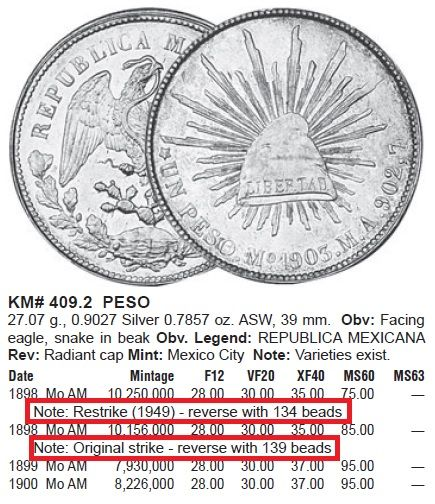
Restrikes are easily identifiable from the original 1898 strikes.
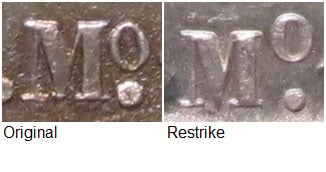
There is one easy tell which is the position of the "O" in Mo mint mark:
The 2nd tell is the number of the beads on the back.
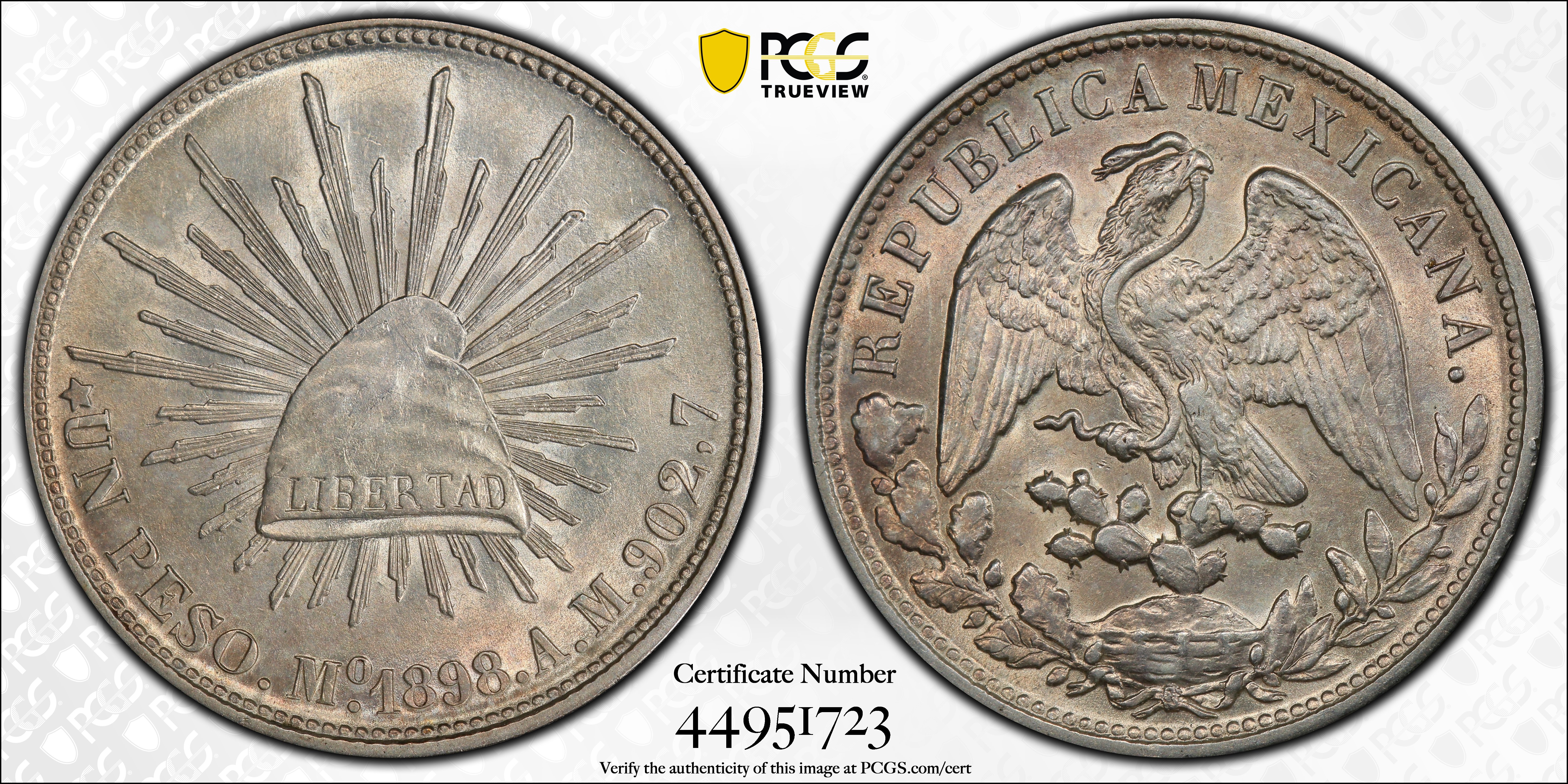
Here's my lovely example that only mustered MS61 but sure is a pleasant example:
Here are some more coins that were struck in US for Mexico:
1906 Gold 5 Pesos (1906-M)(KM-464) - 4,000,000 were minted at the United States Mint in Philadelphia and only 638,000 minted in Mexico. Likelihood is many are US minted coins in the wild. Mexican dies were used and there's no way to distinguish the mint.
1906 Gold 10 Pesos (1906-M)(KM-473) - 1,000,000 of these coins were minted by the United States Mint in Philadelphia. Mexican dies were used and there's no way to distinguish between 1,949,000 also minted in Mexico.
1906-1907 50 Centavos (KM-445) - Differences in dies exist. Difference in 9's and 7's
1907 20 Centavos (KM-435) - Same diagnostic as above for the 7's.
1935 50 Centavos (KM-448) - 10.8 million minted in Mexico City but 25 million in Philadelphia, 17,000,850 in Denver and 18 million in San Francisco. Mexican dies were used with no way to distinguish.
PCGS has a fun set to collect if above interests you! It's called World coins manufactured by mints of the United States: https://pcgs.com/setregistry/composite/7662
387 coin in the type set and there's a complete set by year that's even larger...
Hmmm, yeah, this is interesting, but as @pruebas says, doesn't really make sense. Only 8 Reales denominated-pieces were struck in 1897 - that was their last year. Pesos were only struck from 1898 forward, and indeed, the designs was notably different from the 8R.
Now pruebas is mentioning an 1897 Peso pattern (pruebas, are you well-versed on Mexican pattern coins???)... So I guess in theory, they could have sent an 1897 pattern die... but if that was case, a visible overdate should show. And honestly, that doesn't make a lot of sense... just send a regular 1898 peso die.
IDK, just quick thoughts... would have to read all of it in depth to make sense of the precise details.
One other thing, @Samets ... good info about the superscript positioning - I never heard that, just the pedantry, er, I mean stuff about the beads. You're certain that's a concrete consistent difference, no variants?
Correct.
How about pics of the 1897 pattern???
Doggedly collecting coins of the Central American Republic.
Visit the Society of US Pattern Collectors at USPatterns.com.
I'd like to see that also...
Meantime, behold an "1898" 8 Reales (a reasonably convincing fantasy date contemporary counterfeit). Interestingly, I've seen just one other well-worn example... and it has a few Asian chops.
The 1897 Peso pattern came from a set which included the Peso, 5c, 10c, and 20c all silver (and all in KM). All the coins are purportedly unique. I only saw the Peso, which I immediately bought. At the time, the minors were still in Mexico in a collection, and to this day I have not seen them.
Anyway, the coin was harshly cleaned before it got to me. Still a desirable coin nevertheless. I was trying to give it a bit of color so it would look better in the holder before sending it off the PCGS. I need to see how it has progressed.
Let me see if I can dig up a photo.