@CaptHenway said:
In my Branch Mint Proof thread @MrEureka mentions an unquestionable Proof 1904-O Half Dollar, ex-Pittman.
The part I left out in the other thread is that I bought that coin in partnership with another dealer. It was deeply toned, and that’s probably why PCGS couldn’t quite gather the courage to call it a proof. Instead, they put it in a Regency holder as (I think) 67PL, which didn’t work for us. My partner then dipped the coin, with my permission, and the coin came out deadish gray-white. We then got the coin in an NGC SP62 holder, consigned it to an ANR (?) auction, and netted about 4K on our 30K (?) investment. Not one of my finer moments. Oh, and it got worse when my partner’s financial troubles prevented him from giving me the 2K he owed me for my half of the proceeds. All I got was a pretty Italian coin worth maybe half of the 2K, and an apology. As I write this, a hear Willie Nelson in my head, singing “Mamas, don’t let your babies grow up to be coin dealers”. Yeah, he has a point. LOL
Andy Lustig
Doggedly collecting coins of the Central American Republic. Visit the Society of US Pattern Collectors at USPatterns.com.
@CaptHenway said:
We will have fun discussing the Proof status of the 1894-S Dimes when the time comes. This will not diminish any other piece here.
For whatever reason, it seems a little early in this thread to discuss the 1894-S dime, but seeing as Stacks is auctioning the Norweb example on Sep 1, it would be remiss to let that event pass without comment.
Admittedly, I haven’t studied this famous coin in much detail, so rather than opine on it as if I have, I’ll simply add links below to an article, the Stacks lot, and a photo and let others share their thoughts.
The auction listing includes a lengthy informative history and is worth a read. The current bid is $1,000,000.
I found this paragraph from the auction description to be particularly interesting, which I assume is what @CaptHenway was alluding to in his comment:
” Although all well preserved 1894-S dimes exhibit some qualities of traditional Proof coins - namely reflective surfaces and sharply struck design elements - there is no evidence that San Francisco Mint employees polished either the dies or planchets used to produce them. On the other hand, only a single die pair was used to strike all known examples, and the fresh state of those dies did impart a prooflike surface. In the end the facts speak for themselves: the reason that Acting Superintendent Robert Barnett gives for the production of these coins, and the eventual release of most examples into circulation, would not have required anything other than circulation strikes. Historically, however, the 1894-S has always been regarded as a Proof issue and, as confirmed below in our roster of known examples, PCGS and NGC certify all well preserved specimens as Proofs or Branch Mint Proofs.”
Superb collections are built more by omission than by addition.
Look at the inside edge of the obverse from, say, 5 o'clock to 6 o'clock. Not fully struck.
Professional Numismatist, Retired. 55 year member ANA. Former ANA Senior Authenticator. Winner of four ANA Heath Literary Awards; three Wayte and Olga Raymond Literary Awards; Numismatist of the Year Award 2009, and ANA Lifetime Achievement Award 2020. Winner of the PNG's 2026 Robert Friedberg Award for "The Enigmatic Lincoln Cents of 1922," Available now from Whitman or Amazon.
@CaptHenway Love the write up and the personal connection with the Benton Emory coins! I was very fortunate to acquire the Emory-Nichols-Duckor 1901-s half a while back from Joe O'Connor and it's one of the favorite Barbers I've ever owned. It's obvious that it was set aside and stored carefully all these years. Not a proof, but had to show it here. Beautiful detailed photo by @FlyingAl
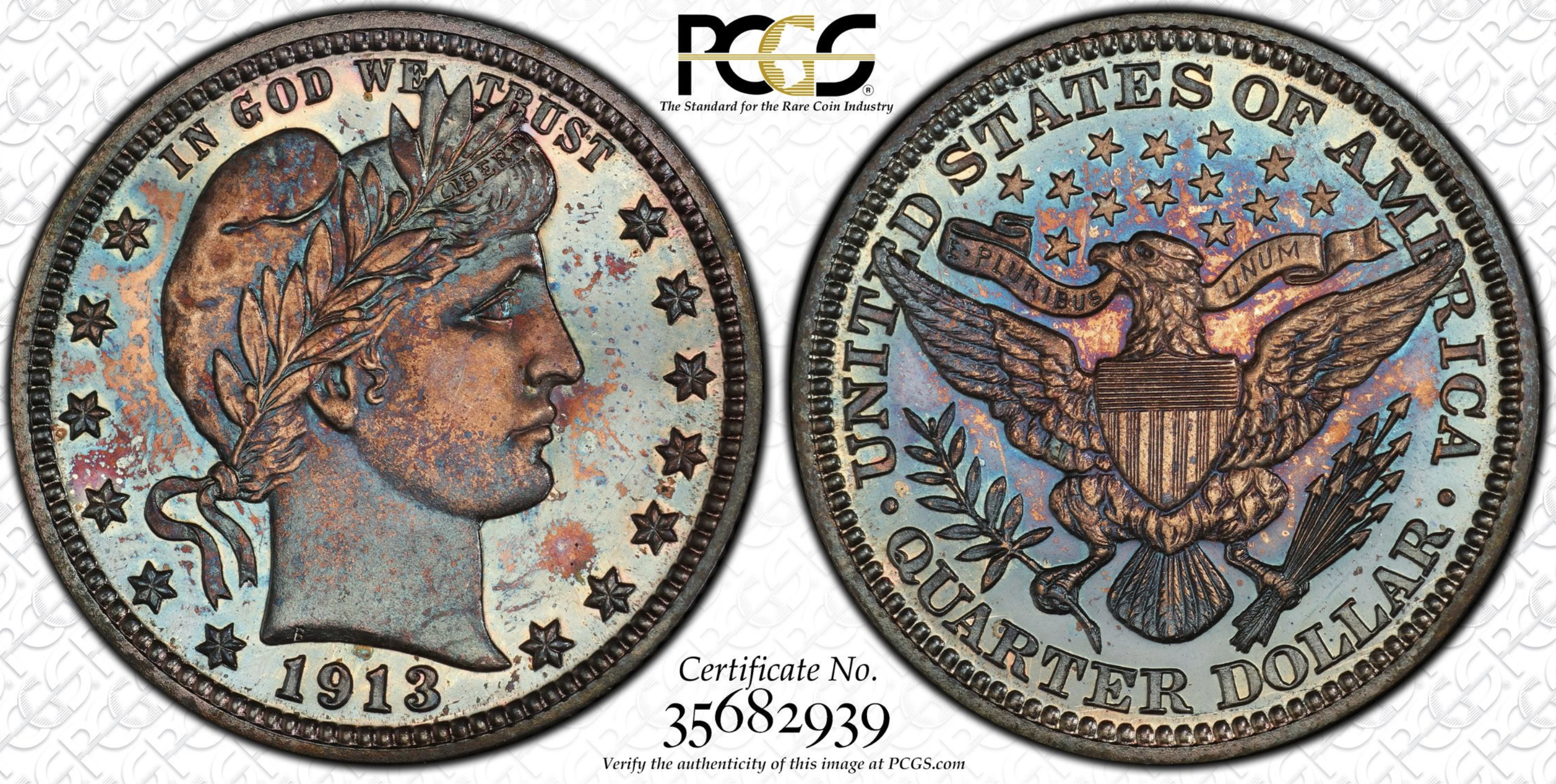
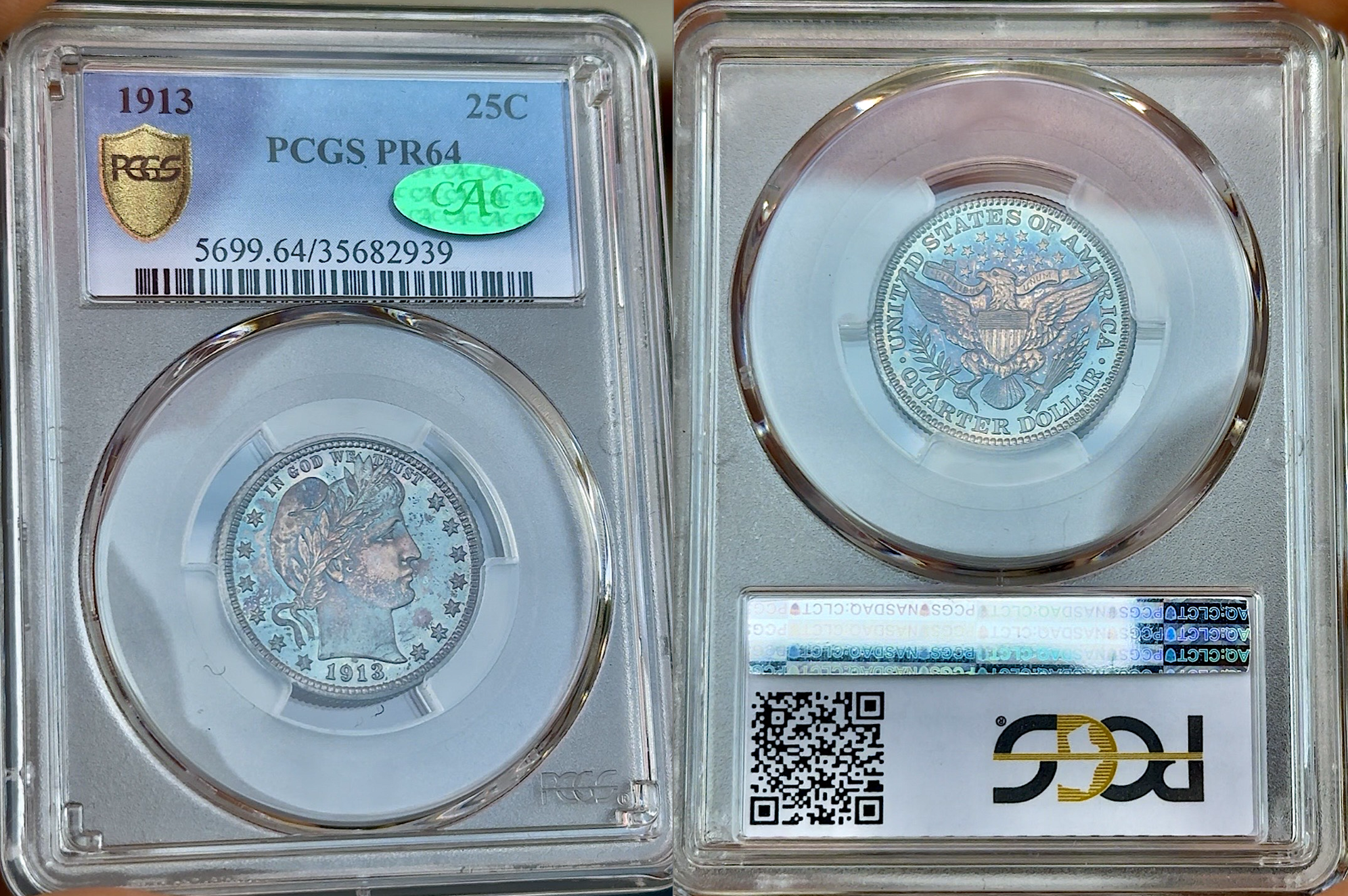
Here's a quarter I snapped up off eBay a few months ago. I sent it to CAC and earned a green sticker. The mirrors are on the higher end of flashy for a coin graded PR64; it's a pleasure to view this coin in-hand. Total proof mintage of 613 coins.
Superb collections are built more by omission than by addition.
@CaptHenway said:
We will have fun discussing the Proof status of the 1894-S Dimes when the time comes. This will not diminish any other piece here.
For whatever reason, it seems a little early in this thread to discuss the 1894-S dime, but seeing as Stacks is auctioning the Norweb example on Sep 1, it would be remiss to let that event pass without comment.
Admittedly, I haven’t studied this famous coin in much detail, so rather than opine on it as if I have, I’ll simply add links below to an article, the Stacks lot, and a photo and let others share their thoughts.
The auction listing includes a lengthy informative history and is worth a read. The current bid is $1,000,000.
I found this paragraph from the auction description to be particularly interesting, which I assume is what @CaptHenway was alluding to in his comment:
” Although all well preserved 1894-S dimes exhibit some qualities of traditional Proof coins - namely reflective surfaces and sharply struck design elements - there is no evidence that San Francisco Mint employees polished either the dies or planchets used to produce them. On the other hand, only a single die pair was used to strike all known examples, and the fresh state of those dies did impart a prooflike surface. In the end the facts speak for themselves: the reason that Acting Superintendent Robert Barnett gives for the production of these coins, and the eventual release of most examples into circulation, would not have required anything other than circulation strikes. Historically, however, the 1894-S has always been regarded as a Proof issue and, as confirmed below in our roster of known examples, PCGS and NGC certify all well preserved specimens as Proofs or Branch Mint Proofs.”
Sold yesterday at Stacks for $1.25m. The last 63 CAC in the PCGS auction records realized $1.32m back in 2019, so $1.25m seems like an underperformance given the coin market frenzy and inflation of the post-Covid era.
Superb collections are built more by omission than by addition.
Professional Numismatist, Retired. 55 year member ANA. Former ANA Senior Authenticator. Winner of four ANA Heath Literary Awards; three Wayte and Olga Raymond Literary Awards; Numismatist of the Year Award 2009, and ANA Lifetime Achievement Award 2020. Winner of the PNG's 2026 Robert Friedberg Award for "The Enigmatic Lincoln Cents of 1922," Available now from Whitman or Amazon.
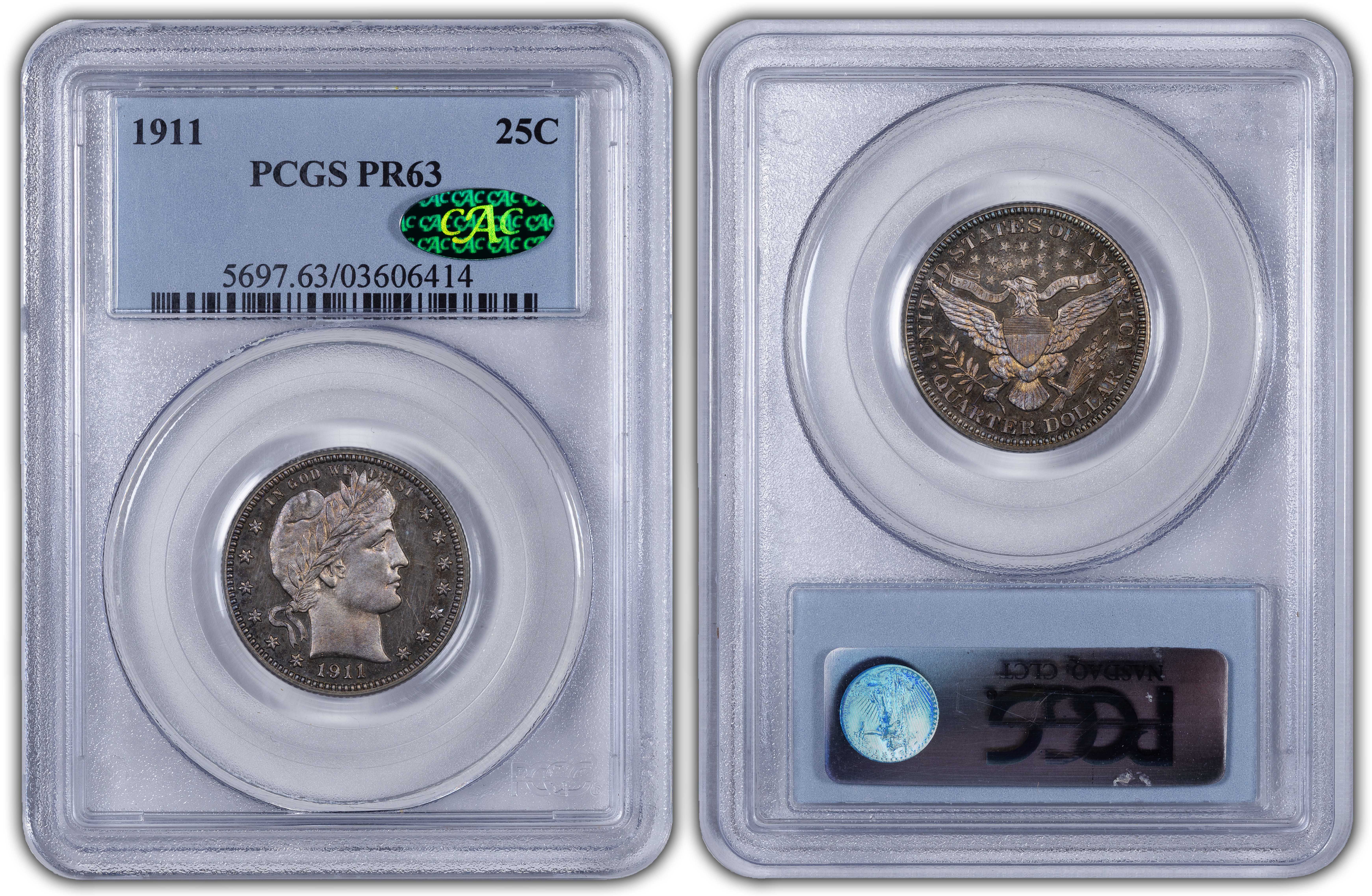
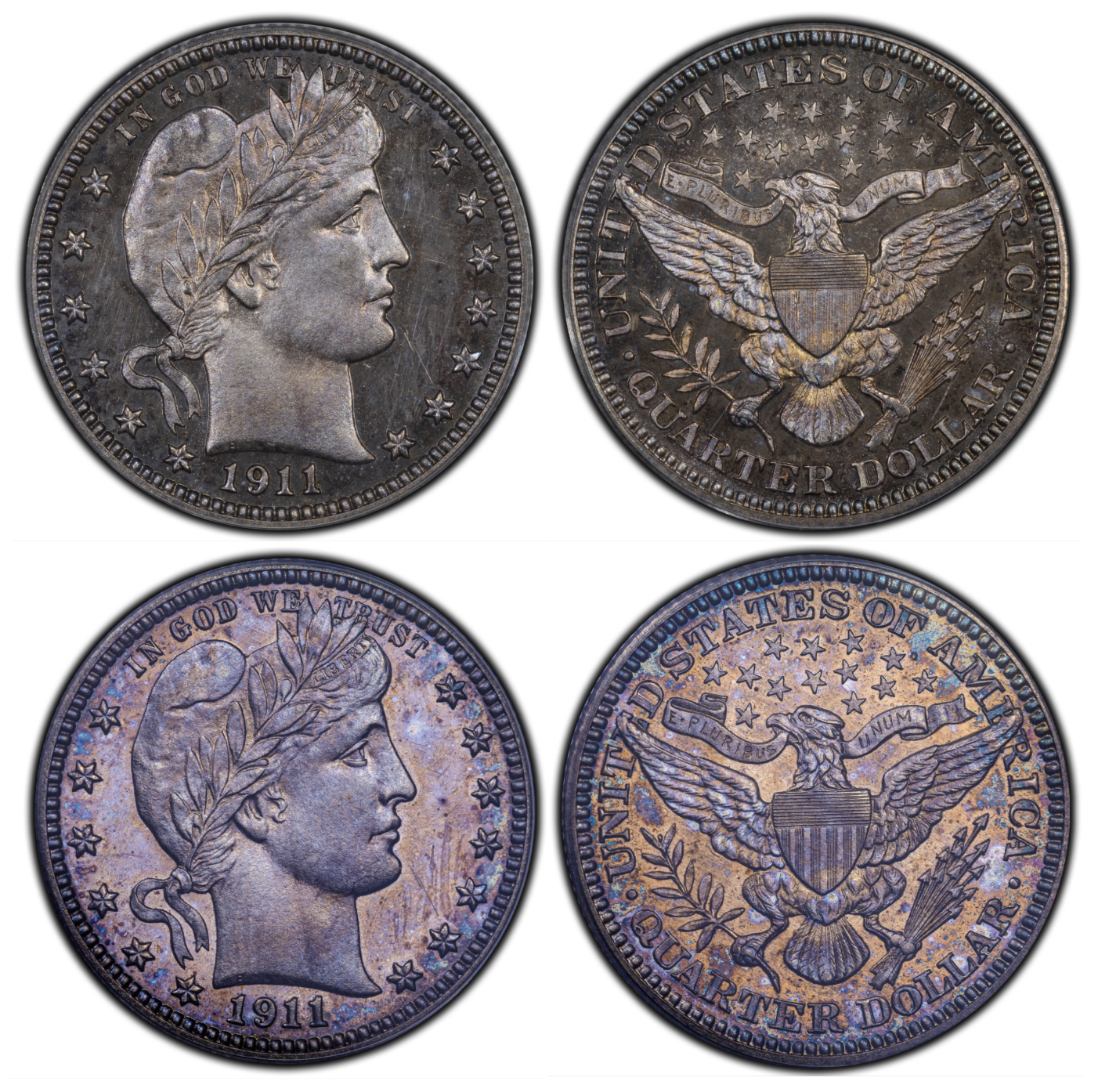
Here's a 1911 25c in PR63 CAC. This coin has the flash, pop and surfaces of 64 or 65. However, it was net graded down for the staple scratch in the obverse field near Liberty's chin. Evidently, CAC agreed that was a fair result. Color is really nice in-hand.
Superb collections are built more by omission than by addition.
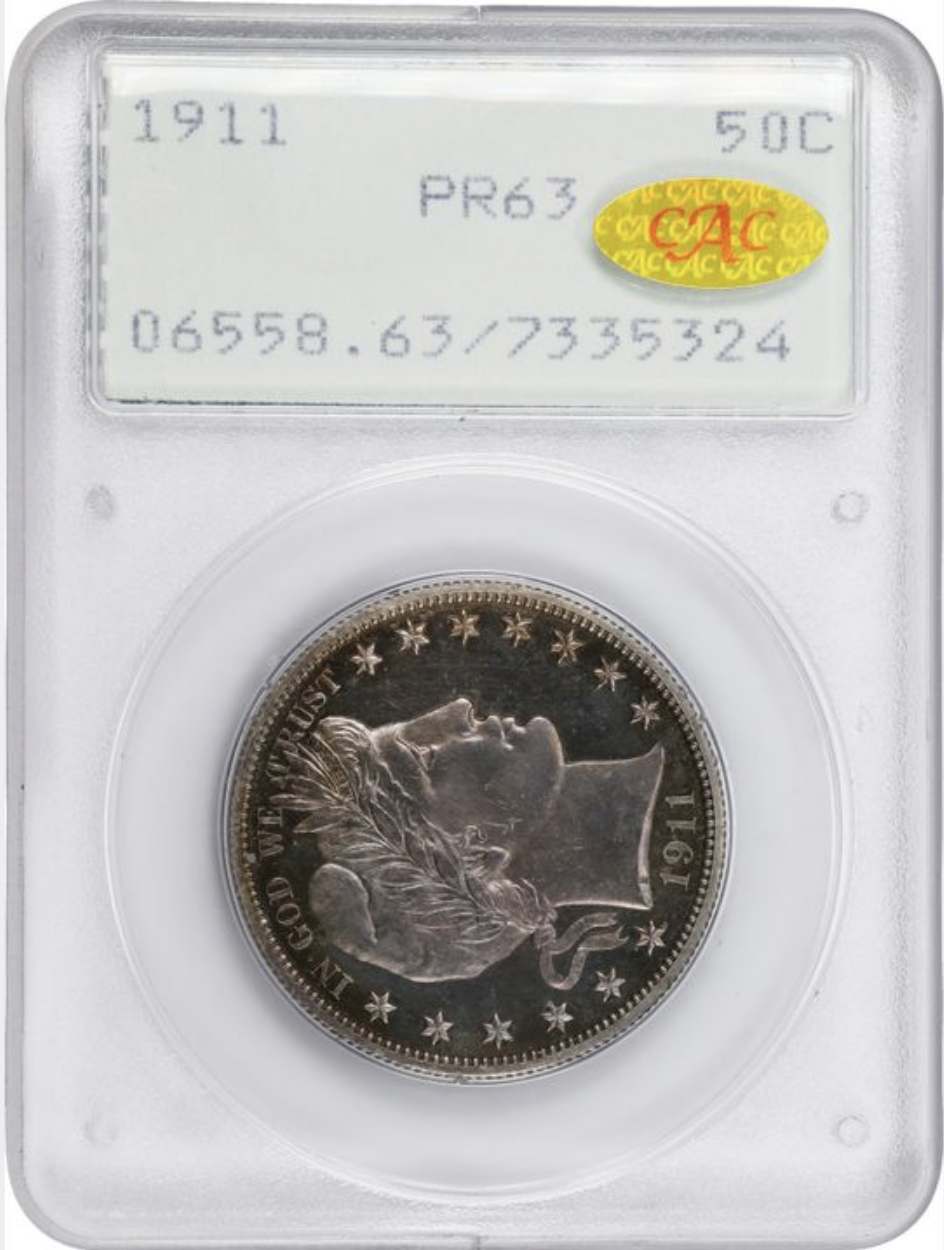
This 1911 Barber half in a PR63 rattler sold for $3900 last week at Stacks. It is just one of 11 gold CAC Barber half proofs. CAC CPG is $1400 in 63, $2100 in 64, and $2500 in 65.
I hope the new owner rattles it back to the proper orientation in the holder.
Superb collections are built more by omission than by addition.
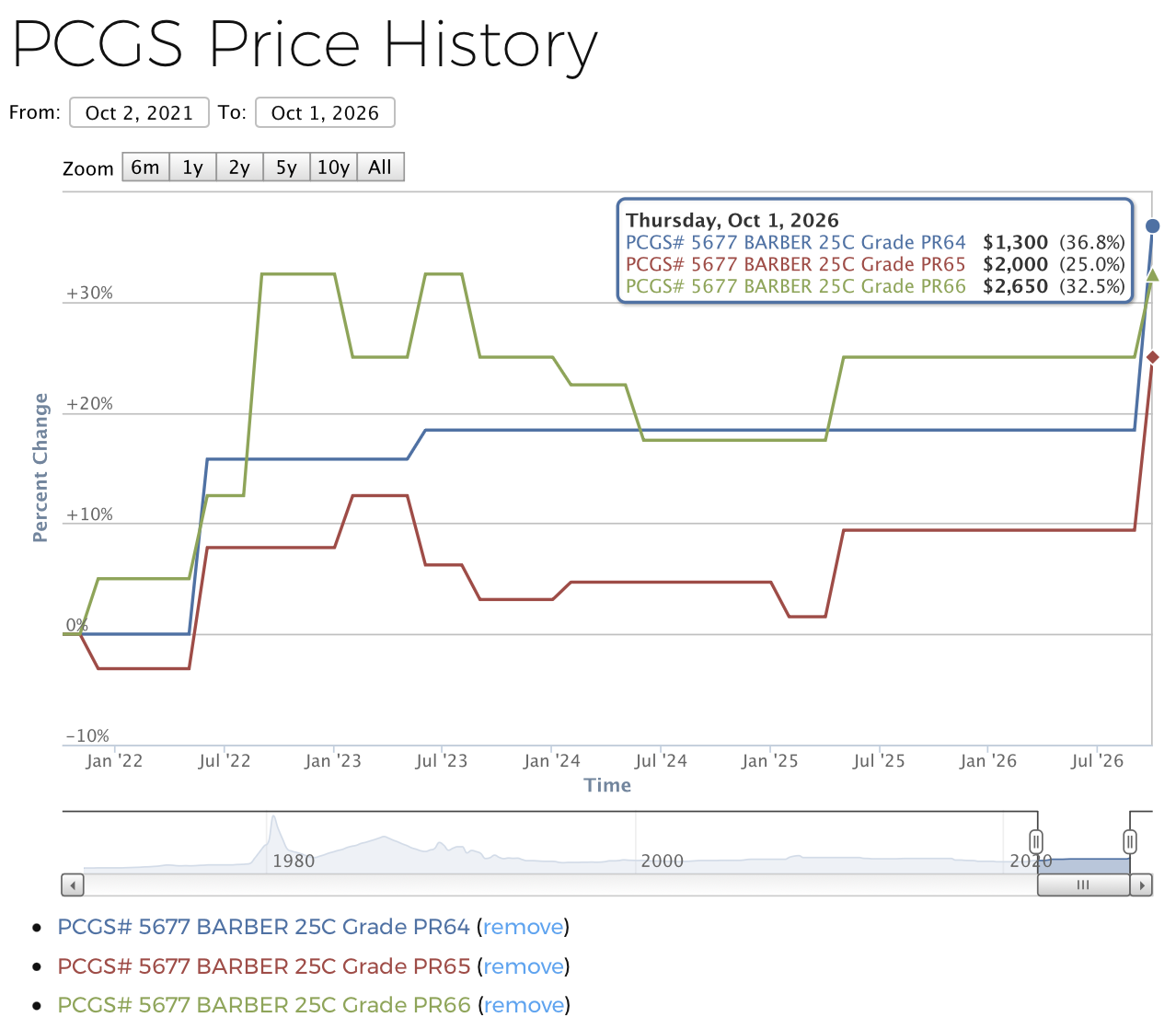
Proof Barber quarter prices are on the rise in the middle grades, with PR64 and PR65 seeing the biggest gains in an Oct 1st update to the PCGS Price Guide. PR64 $1125 --> $1300; PR65 $1750 --> $2000; PR66 $2500 --> $2650
Superb collections are built more by omission than by addition.
Holder and gold CAC mania continues. This 1898 BarberQ in a gold CAC'd Doily sold last weekend for $7,544 on GC. Greysheet on a PR67 CAC, 2 grades higher, is $3k and a PR68 CAC, 3 grades higher, is $8k.
Superb collections are built more by omission than by addition.
Comments
The part I left out in the other thread is that I bought that coin in partnership with another dealer. It was deeply toned, and that’s probably why PCGS couldn’t quite gather the courage to call it a proof. Instead, they put it in a Regency holder as (I think) 67PL, which didn’t work for us. My partner then dipped the coin, with my permission, and the coin came out deadish gray-white. We then got the coin in an NGC SP62 holder, consigned it to an ANR (?) auction, and netted about 4K on our 30K (?) investment. Not one of my finer moments. Oh, and it got worse when my partner’s financial troubles prevented him from giving me the 2K he owed me for my half of the proceeds. All I got was a pretty Italian coin worth maybe half of the 2K, and an apology. As I write this, a hear Willie Nelson in my head, singing “Mamas, don’t let your babies grow up to be coin dealers”. Yeah, he has a point. LOL
Doggedly collecting coins of the Central American Republic.
Visit the Society of US Pattern Collectors at USPatterns.com.
For whatever reason, it seems a little early in this thread to discuss the 1894-S dime, but seeing as Stacks is auctioning the Norweb example on Sep 1, it would be remiss to let that event pass without comment.
Admittedly, I haven’t studied this famous coin in much detail, so rather than opine on it as if I have, I’ll simply add links below to an article, the Stacks lot, and a photo and let others share their thoughts.
The auction listing includes a lengthy informative history and is worth a read. The current bid is $1,000,000.
https://stacksbowers.com/the-1894-s-dime-that-made-dave-bowers-a-legend/
https://auctions.stacksbowers.com/lots/view/3-1UQ81J/1894-s-barber-dime-jd-1-rarity-7-proof-63-pcgs-cac-cmq
I found this paragraph from the auction description to be particularly interesting, which I assume is what @CaptHenway was alluding to in his comment:
” Although all well preserved 1894-S dimes exhibit some qualities of traditional Proof coins - namely reflective surfaces and sharply struck design elements - there is no evidence that San Francisco Mint employees polished either the dies or planchets used to produce them. On the other hand, only a single die pair was used to strike all known examples, and the fresh state of those dies did impart a prooflike surface. In the end the facts speak for themselves: the reason that Acting Superintendent Robert Barnett gives for the production of these coins, and the eventual release of most examples into circulation, would not have required anything other than circulation strikes. Historically, however, the 1894-S has always been regarded as a Proof issue and, as confirmed below in our roster of known examples, PCGS and NGC certify all well preserved specimens as Proofs or Branch Mint Proofs.”
Superb collections are built more by omission than by addition.
Thank you for the links.
Look at the inside edge of the obverse from, say, 5 o'clock to 6 o'clock. Not fully struck.
@CaptHenway Love the write up and the personal connection with the Benton Emory coins! I was very fortunate to acquire the Emory-Nichols-Duckor 1901-s half a while back from Joe O'Connor and it's one of the favorite Barbers I've ever owned. It's obvious that it was set aside and stored carefully all these years. Not a proof, but had to show it here. Beautiful detailed photo by @FlyingAl
Here's a quarter I snapped up off eBay a few months ago. I sent it to CAC and earned a green sticker. The mirrors are on the higher end of flashy for a coin graded PR64; it's a pleasure to view this coin in-hand. Total proof mintage of 613 coins.
Superb collections are built more by omission than by addition.
Been slowly working on a proof dime set. Here is what I have so far.
@erwindoc Beautiful dimes buddy! That 1915, holy cow!
Sold yesterday at Stacks for $1.25m. The last 63 CAC in the PCGS auction records realized $1.32m back in 2019, so $1.25m seems like an underperformance given the coin market frenzy and inflation of the post-Covid era.
Superb collections are built more by omission than by addition.
Thank you for the followup.
Here's a 1911 25c in PR63 CAC. This coin has the flash, pop and surfaces of 64 or 65. However, it was net graded down for the staple scratch in the obverse field near Liberty's chin. Evidently, CAC agreed that was a fair result. Color is really nice in-hand.
Superb collections are built more by omission than by addition.
Auction Result
This 1911 Barber half in a PR63 rattler sold for $3900 last week at Stacks. It is just one of 11 gold CAC Barber half proofs. CAC CPG is $1400 in 63, $2100 in 64, and $2500 in 65.
I hope the new owner rattles it back to the proper orientation in the holder.
Superb collections are built more by omission than by addition.
I own one of those other gold CAC proof halves.
In honor of the memory of Cpl. Michael E. Thompson
Proof Barber quarter prices are on the rise in the middle grades, with PR64 and PR65 seeing the biggest gains in an Oct 1st update to the PCGS Price Guide. PR64 $1125 --> $1300; PR65 $1750 --> $2000; PR66 $2500 --> $2650
Superb collections are built more by omission than by addition.
You might want to take a look at this (It’s mine):
1902 Proof Barber 10C PR66 PCGS w/CAC - Blue Toning. Current Bid only $1,187. Only 10 out of 56 that merit a CAC sticker!
https://forums.collectors.com/discussion/1125820/fs-on-gc-1902-proof-barber-10c-pr66-pcgs-w-cac-blue-toning-current-bid-only-1-137-only-10-w-cac#latest
Thanks for looking!
Steve
My collecting “Pride & Joy” is my PCGS Registry Dansco 7070 Set! Winner of the 2026 PCGS Registry Award for “The Best U.S. Type Set”!
https://www.pcgs.com/setregistry/type-sets/design-type-sets/complete-dansco-7070-modified-type-set-1796-date/publishedset/213996
Holder and gold CAC mania continues. This 1898 BarberQ in a gold CAC'd Doily sold last weekend for $7,544 on GC. Greysheet on a PR67 CAC, 2 grades higher, is $3k and a PR68 CAC, 3 grades higher, is $8k.
Superb collections are built more by omission than by addition.