@dunkleosteus430 said:
I also did a toning experiment where I put some coins in one of those yellow/orange mailing envelopes for 2 or 3 years. I checked on it recently and found this -
My phone's camera doesn't capture the vibrancy of the colors well. The blue on the reverse is almost opaque.
Does this count as AT?
I would say “questionable color” or “ environmental damage”, or even “ improper storage “.
How about these ?
Never did an experiment.
They just do what they do.
Practice makes perfect & nobody is perfect. So, practice being nobody.
My sister is going to teach me how she makes these, but picture AT Lincoln’s or small bullion pieces with holes in them instead of the beads. That is what I plan to do soon
@Mr_Spud said:
It’s good for people to experiment and figure out how to detect AT. So bravo 🤩. Do continue to teach others, not how to AT coins, but how to tell that they are AT.
🔴
But if you start giving instructions con artists will learn how to rip people off. Also do continue to show pictures for educational purposes, or you will fall in love with your own work as you get better and you’ll end up a coin doctor and either rip newbies off and hurt the business, or you’ll end up with the FBI going after you for fraud.
🟨
I always stuck with pocket change, but recent experimented with some bullion to see if I could make target toned rainbows with at least a hint of emerald green.
🟧
Here’s my latest attempt after talking with @emeraldATV , he’s a genius. I’m not going to reveal how I did it, but pretty much I got bored one day at work in my lab and dreamt up a new technique. Note, I’m the head of R&D at a Pharmaceutical/Nutraceutical company and I have my own lab. An amateur will most likely hurt themselves going through the learning curve, but it’s a fun satisfying hobby if you are trained in how to do things safely. And yes, the nickels to the right are still looking great over 2 decades later, none of that flip them quick before they turn black coin doctor mentality. That set was displayed in an art gallery as an educational display when the artist, Jamie Frankie, first designed the modern buffalo nickels. I did it as an educational ATColor progression tool.
🟩
I’m not gonna sell any as coins, but I might make art projects where the coin has a hole drilled into it to make wire money tree sculptures or I might stamp AT on the coin reverse and blacken and burnish it. Not sure yet, but I’m not gonna become a conman and rip people off.
🟦
🏴🧩
🔴🟨🟧🟩🟦☦️
@Sr. Spud First of all, thank you so much to whoever mentioned you in this thread! You were already deeply immersed in this world long before I recently discovered it, so you definitely hold all the experience here. I truly believe we share a very similar mindset when it comes to curiosity and ingenuity.
As I mentioned, I have another plan that I will be carrying out in the coming days to try and improve the results, but it will always be strictly for fun and education, never with any intention to deceive anyone. Since I work in HVAC and refrigeration, my tool was a professional copper soldering blowtorch (the dragon). However, I didn’t just blast them with direct fire. To control the oxidation, I placed the coins on a heavy metal base. The metal base acts as a heat sink, absorbing the initial shock and distributing indirect heat evenly across the coin. This protects the reverse from getting fried while letting me flip and adjust the piece to get a more uniform tone.
Your joke about the FBI made me laugh, but don't worry! I actually share your exact ethical view on protecting the hobby. If I ever decided to sell these toned coins strictly as a decorative novelty or art piece—as someone mentioned in past comments about how lucrative this business can be at coin shows and fairs—I would want to put a permanent small mark or tiny stamp on them so they are clearly identified and can never be used to deceive a beginner. Thank you very much for your wisdom, and I wish you the best of luck with your future plans as you mentioned them.
@dunkleosteus430 said:
I also did a toning experiment where I put some coins in one of those yellow/orange mailing envelopes for 2 or 3 years. I checked on it recently and found this -
My phone's camera doesn't capture the vibrancy of the colors well. The blue on the reverse is almost opaque.
Does this count as AT?
I would say “questionable color” or “ environmental damage”, or even “ improper storage “.
How about these ?
Never did an experiment.
They just do what they do.
That specific coin looks beautiful to me. To be honest, there is absolutely no comparison between trying to tone a coin artificially and what is naturally produced by the passage of time over the years.
. @ricarf2386 said
“Your joke about the FBI made me laugh, but don't worry! I actually share your exact ethical view on protecting the hobby. If I ever decided to sell these toned coins strictly as a decorative novelty or art piece—as someone mentioned in past comments about how lucrative this business can be at coin shows and fairs—I would want to put a permanent small mark or tiny stamp on them so they are clearly identified and can never be used to deceive a beginner. Thank you very much for your wisdom, and I wish you the best of luck with your future plans as you mentioned them.”
You’re right, my bad, it’s not the FBI that can go after coin doctors toning coins, it’s the FTC
The following info is intended to help people from getting ripped off by paying too much for AT coins
Third-party grading services like PCGS and NGC examine several visual tells to spot artificially toned (AT) coins. Professional graders look for specific physical and chemical anomalies that occur when toning is rapidly accelerated rather than formed naturally over decades. [1, 2]
The primary visual tells used to identify artificial toning are categorized below:
🎨 The "Crayon Box" Effect & Color Progression
On a naturally toned coin, silver or copper oxidizes in a scientifically predictable sequence of light-wave interference. The colors transition smoothly in order of film thickness: Light Gold ➡️ Amber ➡️ Magenta ➡️ Cobalt Blue ➡️ Emerald Green. [3, 4]
The AT Tell: Artificial toning often violates this progression. You might see neon greens directly adjacent to harsh oranges without the intervening shades. The colors often look hyper-vibrant, electric, or pastel, resembling "crayon" colors rather than deep, metallic patinas. [3, 5, 6]
🔍 Floating Color vs. Embedded Luster
Natural toning is a thin layer of oxidation chemically bonded directly to the coin’s metal. When you tilt a naturally toned, uncirculated coin under a light source, the original mint luster will "cartwheel" underneath the color. [4, 6, 7]
The AT Tell: Artificial color applied via chemicals, gases, or high heat often behaves like paint. The color looks like it is floating on top of the surface, completely masking or killing the underlying mint bloom. The coin will look flat, dead, or greasy when rotated in the light. [6, 7, 8]
📐 Unnatural Geometry and Borders
Natural toning usually happens because of how a coin was stored. For example, coins kept in paper envelopes or cardboard albums tone inward from the edges (rim toning). Coins stored in canvas bags develop a crescent tone where another coin partially overlapped them. [1, 2, 7]
The AT Tell: Artificial toning often has abrupt, rigid, or highly jagged borders. You might find intense color pooled heavily in the deepest recesses of the coin while the open fields remain white. Alternatively, a coin doctor using heat might leave localized circular spots, or a dark, burnt-looking black mark right near the rim where tweezers held the coin over a flame. [2, 3, 8, 9]
🦺 Color Over Imperfections
Natural toning takes years or decades to form. Therefore, any scratches, wear, or cleaning hairlines that happened to the coin during circulation will tone right along with it.
The AT Tell: If a coin doctor takes a lightly circulated or harshly cleaned coin and artificially tones it to hide the damage, the new color will pool directly inside and over the hairline scratches. If you see bright blue or magenta color sitting directly inside an obvious scratch, the color was applied after the damage occurred. [5, 6, 8]
@Mr_Spud said:
The following info is intended to help people from getting ripped off by paying too much for AT coins
Third-party grading services like PCGS and NGC examine several visual tells to spot artificially toned (AT) coins. Professional graders look for specific physical and chemical anomalies that occur when toning is rapidly accelerated rather than formed naturally over decades. [1, 2]
The primary visual tells used to identify artificial toning are categorized below:
🎨 The "Crayon Box" Effect & Color Progression
On a naturally toned coin, silver or copper oxidizes in a scientifically predictable sequence of light-wave interference. The colors transition smoothly in order of film thickness: Light Gold ➡️ Amber ➡️ Magenta ➡️ Cobalt Blue ➡️ Emerald Green. [3, 4]
The AT Tell: Artificial toning often violates this progression. You might see neon greens directly adjacent to harsh oranges without the intervening shades. The colors often look hyper-vibrant, electric, or pastel, resembling "crayon" colors rather than deep, metallic patinas. [3, 5, 6]
🔍 Floating Color vs. Embedded Luster
Natural toning is a thin layer of oxidation chemically bonded directly to the coin’s metal. When you tilt a naturally toned, uncirculated coin under a light source, the original mint luster will "cartwheel" underneath the color. [4, 6, 7]
The AT Tell: Artificial color applied via chemicals, gases, or high heat often behaves like paint. The color looks like it is floating on top of the surface, completely masking or killing the underlying mint bloom. The coin will look flat, dead, or greasy when rotated in the light. [6, 7, 8]
📐 Unnatural Geometry and Borders
Natural toning usually happens because of how a coin was stored. For example, coins kept in paper envelopes or cardboard albums tone inward from the edges (rim toning). Coins stored in canvas bags develop a crescent tone where another coin partially overlapped them. [1, 2, 7]
The AT Tell: Artificial toning often has abrupt, rigid, or highly jagged borders. You might find intense color pooled heavily in the deepest recesses of the coin while the open fields remain white. Alternatively, a coin doctor using heat might leave localized circular spots, or a dark, burnt-looking black mark right near the rim where tweezers held the coin over a flame. [2, 3, 8, 9]
🦺 Color Over Imperfections
Natural toning takes years or decades to form. Therefore, any scratches, wear, or cleaning hairlines that happened to the coin during circulation will tone right along with it.
The AT Tell: If a coin doctor takes a lightly circulated or harshly cleaned coin and artificially tones it to hide the damage, the new color will pool directly inside and over the hairline scratches. If you see bright blue or magenta color sitting directly inside an obvious scratch, the color was applied after the damage occurred. [5, 6, 8]
Thanks for the legal and technical breakdown! To be honest, I wasn't trying to correct your point at all. I just found the whole FBI scenario a bit amusing from my perspective, even though I know you shared it from a strictly professional and serious standpoint. I truly appreciate you adding such a great level of technical detail to this thread; it definitely brings a lot of value to every single member of this forum.
@Mr_Spud said:
The following info is intended to help people from getting ripped off by paying too much for AT coins
Third-party grading services like PCGS and NGC examine several visual tells to spot artificially toned (AT) coins. Professional graders look for specific physical and chemical anomalies that occur when toning is rapidly accelerated rather than formed naturally over decades. [1, 2]
The primary visual tells used to identify artificial toning are categorized below:
🎨 The "Crayon Box" Effect & Color Progression
On a naturally toned coin, silver or copper oxidizes in a scientifically predictable sequence of light-wave interference. The colors transition smoothly in order of film thickness: Light Gold ➡️ Amber ➡️ Magenta ➡️ Cobalt Blue ➡️ Emerald Green. [3, 4]
The AT Tell: Artificial toning often violates this progression. You might see neon greens directly adjacent to harsh oranges without the intervening shades. The colors often look hyper-vibrant, electric, or pastel, resembling "crayon" colors rather than deep, metallic patinas. [3, 5, 6]
🔍 Floating Color vs. Embedded Luster
Natural toning is a thin layer of oxidation chemically bonded directly to the coin’s metal. When you tilt a naturally toned, uncirculated coin under a light source, the original mint luster will "cartwheel" underneath the color. [4, 6, 7]
The AT Tell: Artificial color applied via chemicals, gases, or high heat often behaves like paint. The color looks like it is floating on top of the surface, completely masking or killing the underlying mint bloom. The coin will look flat, dead, or greasy when rotated in the light. [6, 7, 8]
📐 Unnatural Geometry and Borders
Natural toning usually happens because of how a coin was stored. For example, coins kept in paper envelopes or cardboard albums tone inward from the edges (rim toning). Coins stored in canvas bags develop a crescent tone where another coin partially overlapped them. [1, 2, 7]
The AT Tell: Artificial toning often has abrupt, rigid, or highly jagged borders. You might find intense color pooled heavily in the deepest recesses of the coin while the open fields remain white. Alternatively, a coin doctor using heat might leave localized circular spots, or a dark, burnt-looking black mark right near the rim where tweezers held the coin over a flame. [2, 3, 8, 9]
🦺 Color Over Imperfections
Natural toning takes years or decades to form. Therefore, any scratches, wear, or cleaning hairlines that happened to the coin during circulation will tone right along with it.
The AT Tell: If a coin doctor takes a lightly circulated or harshly cleaned coin and artificially tones it to hide the damage, the new color will pool directly inside and over the hairline scratches. If you see bright blue or magenta color sitting directly inside an obvious scratch, the color was applied after the damage occurred. [5, 6, 8]
Thanks for the legal and technical breakdown! To be honest, I wasn't trying to correct your point at all—I was actually just enjoying your fine sense of humor alongside the FBI reference. I truly appreciate you adding such a great level of technical detail to this thread; it definitely makes things crystal clear and brings a lot of value to every single member of this forum.
One more warning and/or invitation if you will, if/when you dig deep enough to get one of these invitations
And if you accept the invitation and pick which hat you want to wear
Don’t be surprised if/when this cat shows up
Choose wisely which path you take afterwards.
If you were motivated enough to read this post, consider yourself warned
@ricarf2386 said:
Let's be honest, who doesn't love coins with colors? Vibrant, eye-catching colors on their coins, especially on the ones we like the most. It also brings a bit of envy when we see old books where, over the years, the coins have developed a truly beautiful toning with a variety of colors that make them stand out.
Sorry, but you will have to put me as well into the "don't like toned coins" camp. Perhaps it's my chemistry background, but I cannot look at an extremely toned coin and help but think "that's a seriously corroded coin". Because toning is, after all, just mild corrosion.
I should perhaps qualify it by saying that I appreciate older coins with "good honest toning" - that's part of the coin's history, and certainly don't want it removed since removal of toning almost always makes a coin look worse. However, a modern coin simply hasn't existed for long enough to acquire "good honest toning". To me, it's just "fake history".
@ricarf2386 said:
...Even though some earlier comments mentioned heat in general, you nailed the exact method. It was indirect heat using a torch primarily used in HVAC (Heating, Ventilation, and Air Conditioning), which happens to be my line of work.
Seeing the metal react to the heat firsthand triggered a lot of ideas in my head. I have conceptualized a new project that I’ve named "The Time Travel Chamber." I believe this new method could perfectly simulate 50 to 60 years of natural toning—replicating the exact conditions of a coin sitting inside an album under a specific controlled climate.
I think you will find that any attempt at "Accelerated aging" of a coin using heat alone isn't going to replicate the results of natural room-temperature toning, because natural toning is mostly about the environment. In short, the chemistry is different, and different chemistry inevitably will create different results.
For example, heating a base-metal (bronze, copper-plated or cupronickel) will add an oxide layer to the coin. "Natural toning" of copper is a combination of oxides and sulfides. Cupronickel, in particular, is not normally vulnerable to colorful toning at room temperature and a coloured cupronickel coin is almost always a sign of some nasty environmental effect taking place.
Now, it might eventually be possible to generate a similar-looking effect, because toning colours is actually a laws-of-physics byproduct, rather than a laws-of-chemistry byproduct. The colours in toning resemble the colours in a soap bubble, because they're caused by the exact same optical effect: thin film interference. Any kind of "thin layer" placed onto a coin (or thin corrosion layer chemcially created there) has a chance of generating "colours" - which is why laundry detergent and similar soaps and oils can superficially create such colours. But generating specific colours requires generating a film of specific thickness, and that's a trial and error process; if specific colours are being aimed for then a heat-based process will likely require split-second timing to get the heat "just right".
Waste no more time arguing what a good man should be. Be one. Roman emperor Marcus Aurelius, "Meditations"
AT coins like this end up on Ebay, at flea markets or in new dealers cases at shows and are sold as NT to unsuspecting collectors. When this happens, it is a black eye to the Numismatic community. Having owned a coin shop with a bid board for others to sell their coins, blatant AT coins were not allowed. This thread reminds me of the forum member who was gassing slabs to get toning, which I shouldn't bring up.
Thanksgiving 2026 National Battlefield Coin Show November 27 & 28, 2026 at the Eisenhower Hotel Ballroom, Gettysburg, PA. No Early Bird passes for this show. WWW.AmericasCoinShows.com
I don’t buy them at this time. Don’t have enough experience in that field nor want procure. Friend setup next to me at show sent in around 8 or 10 toners to CAC - none stickered. Free grading coupon.
@ricarf2386 said:
Let's be honest, who doesn't love coins with colors? Vibrant, eye-catching colors on their coins, especially on the ones we like the most. It also brings a bit of envy when we see old books where, over the years, the coins have developed a truly beautiful toning with a variety of colors that make them stand out.
Sorry, but you will have to put me as well into the "don't like toned coins" camp. Perhaps it's my chemistry background, but I cannot look at an extremely toned coin and help but think "that's a seriously corroded coin". Because toning is, after all, just mild corrosion.
I should perhaps qualify it by saying that I appreciate older coins with "good honest toning" - that's part of the coin's history, and certainly don't want it removed since removal of toning almost always makes a coin look worse. However, a modern coin simply hasn't existed for long enough to acquire "good honest toning". To me, it's just "fake history".
@ricarf2386 said:
...Even though some earlier comments mentioned heat in general, you nailed the exact method. It was indirect heat using a torch primarily used in HVAC (Heating, Ventilation, and Air Conditioning), which happens to be my line of work.
Seeing the metal react to the heat firsthand triggered a lot of ideas in my head. I have conceptualized a new project that I’ve named "The Time Travel Chamber." I believe this new method could perfectly simulate 50 to 60 years of natural toning—replicating the exact conditions of a coin sitting inside an album under a specific controlled climate.
I think you will find that any attempt at "Accelerated aging" of a coin using heat alone isn't going to replicate the results of natural room-temperature toning, because natural toning is mostly about the environment. In short, the chemistry is different, and different chemistry inevitably will create different results.
For example, heating a base-metal (bronze, copper-plated or cupronickel) will add an oxide layer to the coin. "Natural toning" of copper is a combination of oxides and sulfides. Cupronickel, in particular, is not normally vulnerable to colorful toning at room temperature and a coloured cupronickel coin is almost always a sign of some nasty environmental effect taking place.
Now, it might eventually be possible to generate a similar-looking effect, because toning colours is actually a laws-of-physics byproduct, rather than a laws-of-chemistry byproduct. The colours in toning resemble the colours in a soap bubble, because they're caused by the exact same optical effect: thin film interference. Any kind of "thin layer" placed onto a coin (or thin corrosion layer chemcially created there) has a chance of generating "colours" - which is why laundry detergent and similar soaps and oils can superficially create such colours. But generating specific colours requires generating a film of specific thickness, and that's a trial and error process; if specific colours are being aimed for then a heat-based process will likely require split-second timing to get the heat "just right".
Thank you very much for your contribution. I found it to be an excellent and highly technical explanation, and I truly value the time you took to break down my arguments.
Regarding what I mentioned about my "Time Travel Chamber" project, I wanted to clarify that I am still in a phase of trial and error. I am just experimenting with this matter for now, but in the not-too-distant future, I will be presenting here in full detail the final finish of the coins with this artificial toning.
Thank you again for your words and your valuable comment. Best regards!
@Cougar1978 said:
Is it real or AT (toner above) - Beats me. Like it though.
I don’t buy them at this time. Don’t have enough experience in that field. Friend setup next to me at show sent in around 8 or 10 toners to CAC - none stickered. Free grading coupon.
It’s your hobby, money.
Thank you for your comment and for sharing that experience. I appreciate your input!
@jmlanzaf said:
Respectfully, who cares the method? It's not a good method, because it won't fool anyone. (I know, you said that wasn't the point.) You can place them in a variety of sulfur-containing media at slightly elevated temperatures and get that to happen fairly quickly. I'm not sure what the point of the guessing game is.
This is like the posts from people asking how a damaged coin could come to be damaged. The specific mechanism is rarely that important, nor can it easily be pinpointed specifically because there are dozens of ways to scratch a coin. Similarly, BADLY artificially toning a coin is simple. Numerous foreign compounds will accelerate oxidation or sulfurization. Sometimes, just laundry detergent will do it with reactive metals.
Kill joy 😂
Lol. Sorry. But people say it constantly on the "Walmart coin" threads. Does anyone need to know that it was actually found at a Piggly Wiggly? Or that it actually was a belt sander.
Don't hate on the Piggly Wiggly (in my Thelma Harper voice).
I'd like to see a large scale, controlled experiment using multiple methods and compositions, varying the chemical mix, temperature, etc. Any doctors out there interested in sharing information (for learning/non-nefarious purposes), please DM me.
@Cougar1978 said:
Is it real or AT (toner above) - Beats me. Like it though.
I don’t buy them at this time. Don’t have enough experience in that field. Friend setup next to me at show sent in around 8 or 10 toners to CAC - none stickered. Free grading coupon.
It’s your hobby, money.
Thank you for your comment and for sharing that experience. I appreciate your input!
@Morgan13 said:
Real or AT?
I think its beautiful.
Wow, healthy envy right here! You have a truly beautiful coin.
Not my coin. I can only wish.
Oh, really? I honestly thought it was yours! Well, hopefully one day you can add one to your collection... Actually, hopefully both you and I can get one! 😂
@Morgan13 said:
Real or AT?
I think its beautiful.
I would be inclined to straight grade it. Is absolutely stunning.
Please excuse my personal point of view, but in my honest opinion, this coin is absolutely beautiful. To me, with such a majestic display of colors, it feels like the beginning of a sunrise, where the sun is just coming up and, as it rises, it illuminates all the different colors of the things around it.
I would suggest reading the coin preservation handbook. It discusses the very things which cause tarnish, etc. Reaction from the atmosphere, biological attack, salt air, heat, humidity, etc.
@Morgan13 said:
Real or AT?
I think its beautiful.
.
That is very pretty, regardless of AT or NT. Here is my favorite Oregon Trail.
"Questionable Color" due to, I presume, the predominant aqua color, but I don't care - still like it regardless:
Thank you very much for bringing that old thread back to the forum. The technical discussion it generated provided an excellent flow of data and information that I was lacking for the development of my experiment. Best regards!
Here are my experimental results: (Yes - a while back, I tried to see what would happen if I tried to clean some actually worthless clads that had some odd chemical spots on them.)
The interesting part is that, the process was soaking overnight. I washed them off and noticed that the chemical change to the nickel was pretty deep. That tarnish is not superficial.
What's wrong with ruining some pocket change before it loses its value altogether? I'm in agreement with the idea that experiments like this are interesting.
Side note story: I had a friend who ran an electroplating company who would chrome plate pennies for his friends. No FBI agents or Secret Service came looking for him. He also did all the local police department and state trooper badges, which were strictly monitored and accounted for.
“When you don't know what you're talking about, it's hard to know when you're finished.” - Tommy Smothers
Here are my experimental results: (Yes - a while back, I tried to see what would happen if I tried to clean some actually worthless clads that had some odd chemical spots on them.)
The interesting part is that, the process was soaking overnight. I washed them off and noticed that the chemical change to the nickel was pretty deep. That tarnish is not superficial.
What's wrong with ruining some pocket change before it loses its value altogether? I'm in agreement with the idea that experiments like this are interesting.
Side note story: I had a friend who ran an electroplating company who would chrome plate pennies for his friends. No FBI agents or Secret Service came looking for him. He also did all the local police department and state trooper badges, which were strictly monitored and accounted for.
Thanks for the shoutout, @rooksmith! I truly appreciate you taking my posts into consideration.
Reading your results makes me realize that opening this debate was completely worth it. It seems many of us had our own private experiments hidden away! I honestly believe that deep down, we all keep that inner child alive—the one who loves to experiment and see what happens when a crazy idea pops into our heads. That’s exactly what pushes us to learn, and I think it's awesome. May we stay curious like that forever!
By the way, that Lowell quarter looks absolutely beautiful. Even though the toning is heavily cranked up and intense, the colors and gradients flow so perfectly that it honestly looks like a piece of art painted by a master artist.
Thanks for sharing these wild results with the community!
Re the ATB quarters. I cant really show the shimmer that these coins have. Yes they are darker than the originals, but its a nice copper color with blue highlights.
I tried to shoot a video clip of the same coins with different lighting. (and on an angle) I dont know if this will work worked but heres the link to a google photo: GooglePhoto external link
“When you don't know what you're talking about, it's hard to know when you're finished.” - Tommy Smothers
@OKCC said:
What are the thoughts about this one? I bought it this way. PCGS didn't approve.
The fundamental cause of toning on coins is long-term storage, mostly inside vintage albums or folders, where the accumulation of sulfur combined with environmental factors helps it develop. However, this is a very long process. On your particular coin, we can see a highly developed toning on both sides. Since this piece is not that old, that alone gives strong reasons to believe it is artificial toning (AT). Unless you can share the story of how you acquired it, which might provide a different explanation.
The green obverse areas seem to be biological attack / impact heat and humidity. Over time coins can go bad in the holders / bad tarnish. I agree with PCGS on that one. When people bring tarnished stuff like that to my table ……no go for me. Reverse green areas / what’s your theory? Reminds me of some MRR projects….
However not to worry - shop it around the bourse….
@OKCC said:
What are the thoughts about this one? I bought it this way. PCGS didn't approve.
To be honest, your image got stuck in my head for quite a while, and my imagination just took off, hahaha! It truly served as a great inspiration. I hope you like it, and here is a quick mockup of a t-shirt I put together as a sample.
@jmlanzaf said:
Respectfully, who cares the method? It's not a good method, because it won't fool anyone. (I know, you said that wasn't the point.) You can place them in a variety of sulfur-containing media at slightly elevated temperatures and get that to happen fairly quickly. I'm not sure what the point of the guessing game is.
This is like the posts from people asking how a damaged coin could come to be damaged. The specific mechanism is rarely that important, nor can it easily be pinpointed specifically because there are dozens of ways to scratch a coin. Similarly, BADLY artificially toning a coin is simple. Numerous foreign compounds will accelerate oxidation or sulfurization. Sometimes, just laundry detergent will do it with reactive metals.
.
Your contention is FALSE that nobody cares what the method is. The method is important because :
to know what natural toning looks like, you have to know how artificial toning is implemented.
.
No. You don't. There is no good definition of AT vs NT. It's really MA. The only time such a mechanism might be helpful is if the AT looks similar to NT. Even then, the fact that it looks wrong is now important than how it got to look wrong. The only thing you need to know is what NT (MA) looks like.
I don't have to know how a counterfeit was made to know that my 1916-D dime has the wrong mintmark style. Or that my 1923-O Lincoln is fake.
As I specifically stated, the coins look so bad that it is irrelevant how they are made. This is not a case of then being close.
.
Ugly or not, plausible or not, all methods of artificial toning are a valid topic for discussion.
Maybe you could stop being so negative and such an obstructionist all the time, and let people discuss what they want to discuss on this forum ?
.
@dcarr Well said with more contempt than deserved!
The whole worlds off its rocker, buy Gold™.
BOOMIN!™
Wooooha! Did someone just say it's officially "TACO™" Tuesday????
Retiring at 55, what day is today?
Comments
I would say “questionable color” or “ environmental damage”, or even “ improper storage “.
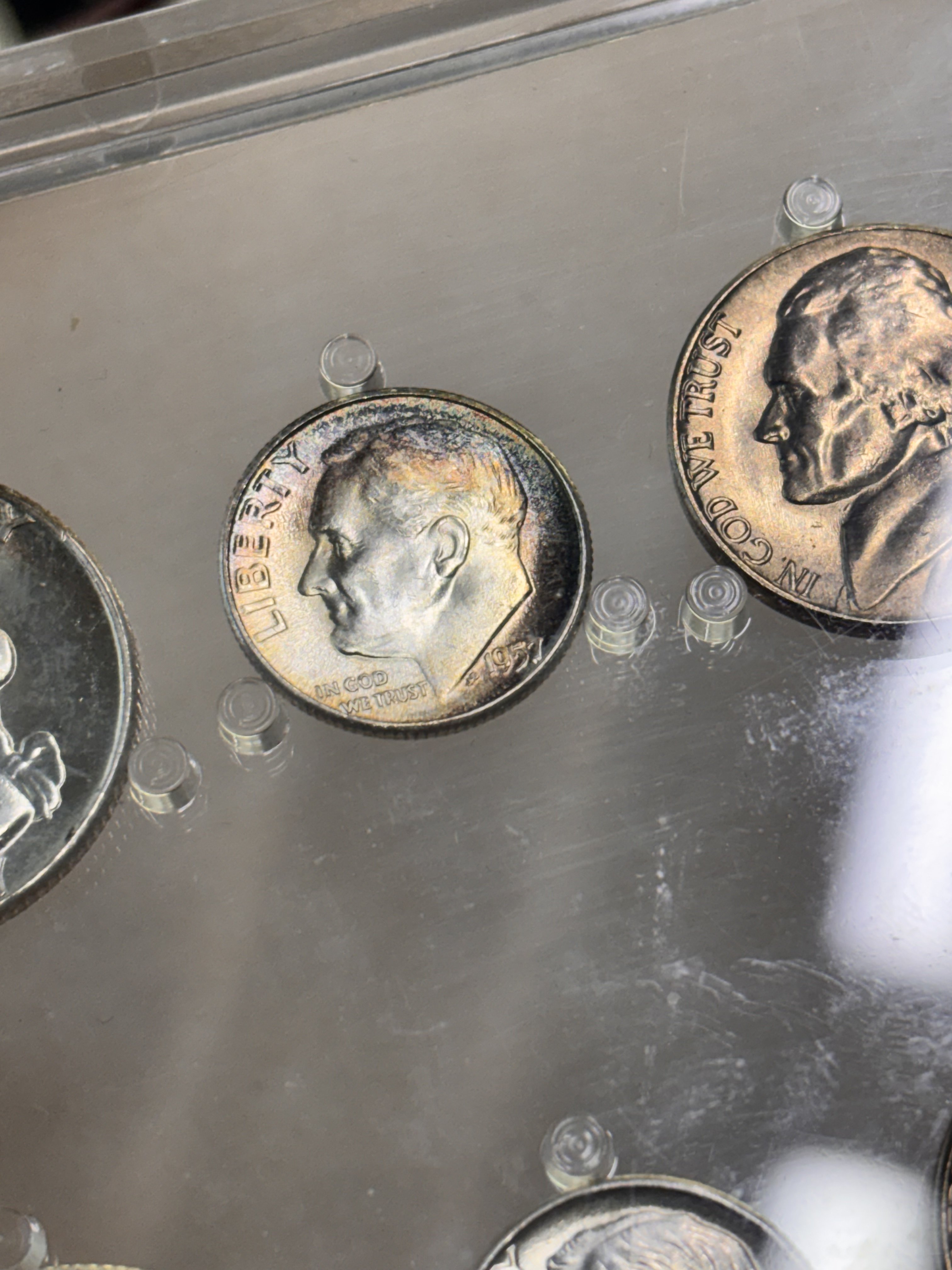
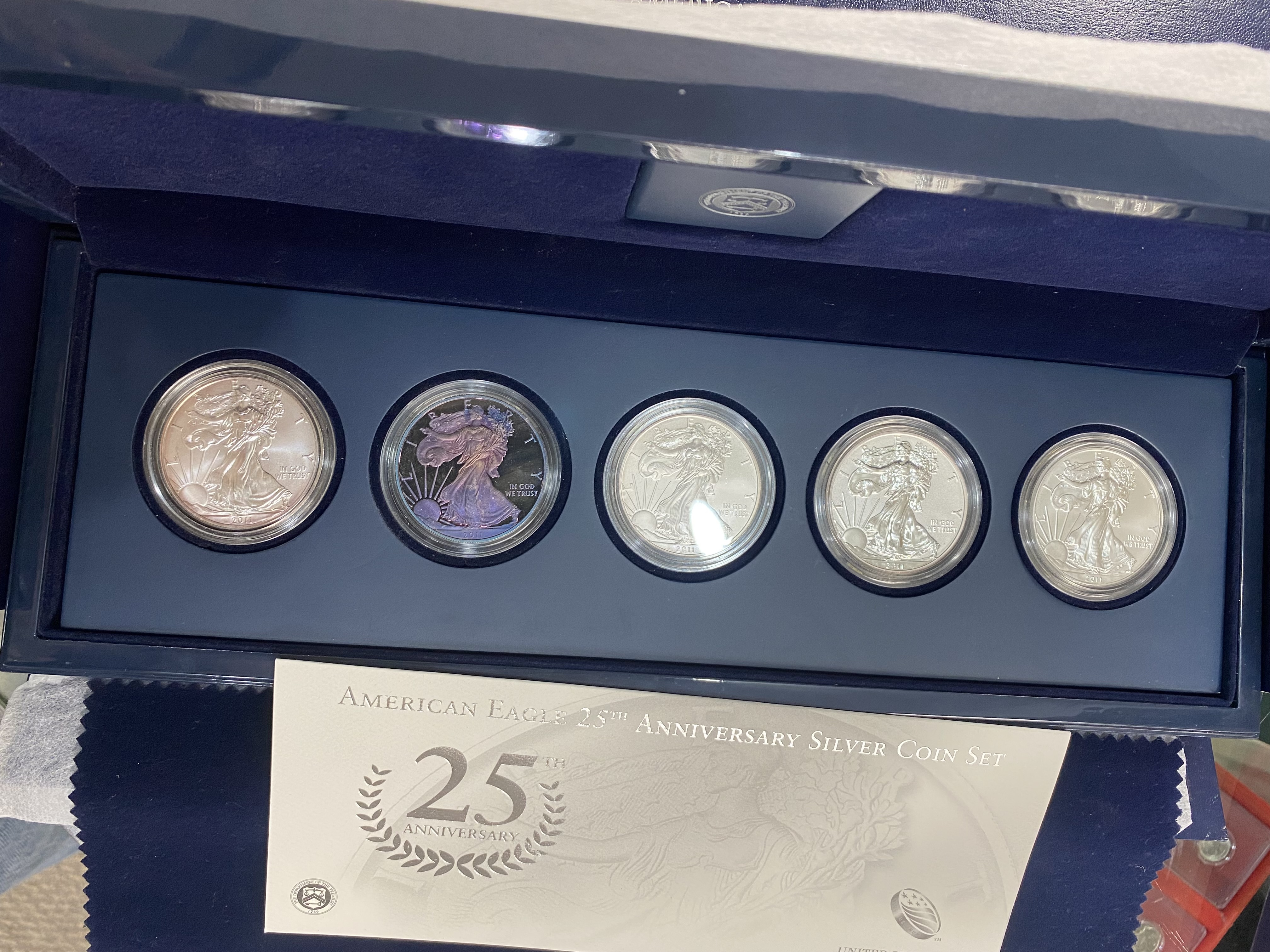
How about these ?
Never did an experiment.
They just do what they do.
Practice makes perfect & nobody is perfect. So, practice being nobody.
My sister is going to teach me how she makes these, but picture AT Lincoln’s or small bullion pieces with holes in them instead of the beads. That is what I plan to do soon
🔴 🔴
🔴
Mr_Spud
@Sr. Spud First of all, thank you so much to whoever mentioned you in this thread! You were already deeply immersed in this world long before I recently discovered it, so you definitely hold all the experience here. I truly believe we share a very similar mindset when it comes to curiosity and ingenuity.
As I mentioned, I have another plan that I will be carrying out in the coming days to try and improve the results, but it will always be strictly for fun and education, never with any intention to deceive anyone. Since I work in HVAC and refrigeration, my tool was a professional copper soldering blowtorch (the dragon). However, I didn’t just blast them with direct fire. To control the oxidation, I placed the coins on a heavy metal base. The metal base acts as a heat sink, absorbing the initial shock and distributing indirect heat evenly across the coin. This protects the reverse from getting fried while letting me flip and adjust the piece to get a more uniform tone.
Your joke about the FBI made me laugh, but don't worry! I actually share your exact ethical view on protecting the hobby. If I ever decided to sell these toned coins strictly as a decorative novelty or art piece—as someone mentioned in past comments about how lucrative this business can be at coin shows and fairs—I would want to put a permanent small mark or tiny stamp on them so they are clearly identified and can never be used to deceive a beginner. Thank you very much for your wisdom, and I wish you the best of luck with your future plans as you mentioned them.
In this case it hardly matters. Those would NEVER fool a TPG
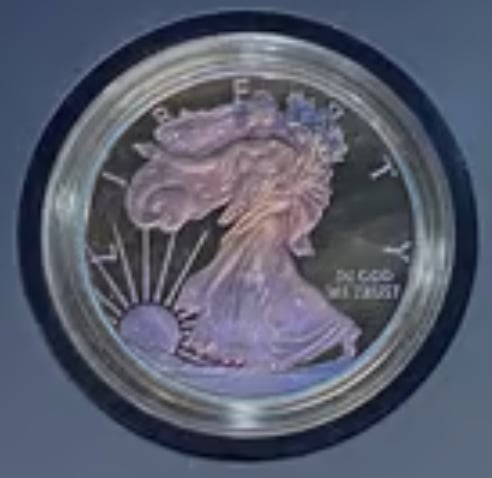
That specific coin looks beautiful to me. To be honest, there is absolutely no comparison between trying to tone a coin artificially and what is naturally produced by the passage of time over the years.
.
@ricarf2386 said
“Your joke about the FBI made me laugh, but don't worry! I actually share your exact ethical view on protecting the hobby. If I ever decided to sell these toned coins strictly as a decorative novelty or art piece—as someone mentioned in past comments about how lucrative this business can be at coin shows and fairs—I would want to put a permanent small mark or tiny stamp on them so they are clearly identified and can never be used to deceive a beginner. Thank you very much for your wisdom, and I wish you the best of luck with your future plans as you mentioned them.”
You’re right, my bad, it’s not the FBI that can go after coin doctors toning coins, it’s the FTC
Mr_Spud
The following info is intended to help people from getting ripped off by paying too much for AT coins
Third-party grading services like PCGS and NGC examine several visual tells to spot artificially toned (AT) coins. Professional graders look for specific physical and chemical anomalies that occur when toning is rapidly accelerated rather than formed naturally over decades. [1, 2]
The primary visual tells used to identify artificial toning are categorized below:
🎨 The "Crayon Box" Effect & Color Progression
On a naturally toned coin, silver or copper oxidizes in a scientifically predictable sequence of light-wave interference. The colors transition smoothly in order of film thickness: Light Gold ➡️ Amber ➡️ Magenta ➡️ Cobalt Blue ➡️ Emerald Green. [3, 4]
🔍 Floating Color vs. Embedded Luster
Natural toning is a thin layer of oxidation chemically bonded directly to the coin’s metal. When you tilt a naturally toned, uncirculated coin under a light source, the original mint luster will "cartwheel" underneath the color. [4, 6, 7]
📐 Unnatural Geometry and Borders
Natural toning usually happens because of how a coin was stored. For example, coins kept in paper envelopes or cardboard albums tone inward from the edges (rim toning). Coins stored in canvas bags develop a crescent tone where another coin partially overlapped them. [1, 2, 7]
🦺 Color Over Imperfections
Natural toning takes years or decades to form. Therefore, any scratches, wear, or cleaning hairlines that happened to the coin during circulation will tone right along with it.
💡 Quick Cheat Sheet
[1] https://uscoins.com
[2] https://bullionexchanges.com
[3] https://boards.ngccoin.com
[4] https://bullionexchanges.com
[5] https://learn.apmex.com
[6] https://www.pcgs.com
[7] https://bullionexchanges.com
[8] https://www.gainesvillecoins.com
[9] https://www.reddit.com
Mr_Spud
Some them look AT
Thanks for the legal and technical breakdown! To be honest, I wasn't trying to correct your point at all. I just found the whole FBI scenario a bit amusing from my perspective, even though I know you shared it from a strictly professional and serious standpoint. I truly appreciate you adding such a great level of technical detail to this thread; it definitely brings a lot of value to every single member of this forum.
Thanks ☺️
Mr_Spud
I shouldn't have mocked you for editing almost every single one of your posts.
Please. Go back to doing so.
One more warning and/or invitation if you will, if/when you dig deep enough to get one of these invitations
And if you accept the invitation and pick which hat you want to wear
Don’t be surprised if/when this cat shows up
Choose wisely which path you take afterwards.
If you were motivated enough to read this post, consider yourself warned
❄️🔥❄️🔥❄️
Mr_Spud
Sorry, but you will have to put me as well into the "don't like toned coins" camp. Perhaps it's my chemistry background, but I cannot look at an extremely toned coin and help but think "that's a seriously corroded coin". Because toning is, after all, just mild corrosion.
I should perhaps qualify it by saying that I appreciate older coins with "good honest toning" - that's part of the coin's history, and certainly don't want it removed since removal of toning almost always makes a coin look worse. However, a modern coin simply hasn't existed for long enough to acquire "good honest toning". To me, it's just "fake history".
I think you will find that any attempt at "Accelerated aging" of a coin using heat alone isn't going to replicate the results of natural room-temperature toning, because natural toning is mostly about the environment. In short, the chemistry is different, and different chemistry inevitably will create different results.
For example, heating a base-metal (bronze, copper-plated or cupronickel) will add an oxide layer to the coin. "Natural toning" of copper is a combination of oxides and sulfides. Cupronickel, in particular, is not normally vulnerable to colorful toning at room temperature and a coloured cupronickel coin is almost always a sign of some nasty environmental effect taking place.
Now, it might eventually be possible to generate a similar-looking effect, because toning colours is actually a laws-of-physics byproduct, rather than a laws-of-chemistry byproduct. The colours in toning resemble the colours in a soap bubble, because they're caused by the exact same optical effect: thin film interference. Any kind of "thin layer" placed onto a coin (or thin corrosion layer chemcially created there) has a chance of generating "colours" - which is why laundry detergent and similar soaps and oils can superficially create such colours. But generating specific colours requires generating a film of specific thickness, and that's a trial and error process; if specific colours are being aimed for then a heat-based process will likely require split-second timing to get the heat "just right".
Roman emperor Marcus Aurelius, "Meditations"
Apparently I have been awarded the DPOTD twice.
They look like carnival prizes.
Student of numismatics and collector of Morgan dollars
Successful BST transactions with: Namvet Justindan Mattniss RWW olah_in_MA
Dantheman984 Toyz4geo SurfinxHI greencopper RWW bigjpst bretsan MWallace logger7 JWP BruceS bigjpst
JWP PROMETHIUS88
AT coins like this end up on Ebay, at flea markets or in new dealers cases at shows and are sold as NT to unsuspecting collectors. When this happens, it is a black eye to the Numismatic community. Having owned a coin shop with a bid board for others to sell their coins, blatant AT coins were not allowed. This thread reminds me of the forum member who was gassing slabs to get toning, which I shouldn't bring up.
Real or AT?
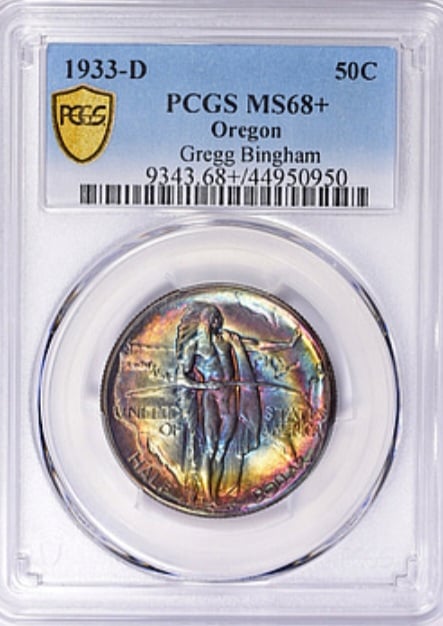
I think its beautiful.
Student of numismatics and collector of Morgan dollars
Successful BST transactions with: Namvet Justindan Mattniss RWW olah_in_MA
Dantheman984 Toyz4geo SurfinxHI greencopper RWW bigjpst bretsan MWallace logger7 JWP BruceS bigjpst
JWP PROMETHIUS88
Is it real or AT (toner above) - Beats me.
I don’t buy them at this time. Don’t have enough experience in that field nor want procure. Friend setup next to me at show sent in around 8 or 10 toners to CAC - none stickered. Free grading coupon.
It’s your hobby, money.
Dear @Sapyx,
Thank you very much for your contribution. I found it to be an excellent and highly technical explanation, and I truly value the time you took to break down my arguments.
Regarding what I mentioned about my "Time Travel Chamber" project, I wanted to clarify that I am still in a phase of trial and error. I am just experimenting with this matter for now, but in the not-too-distant future, I will be presenting here in full detail the final finish of the coins with this artificial toning.
Thank you again for your words and your valuable comment. Best regards!
Haha, good one! But be honest, if you won a "carnival prize" like this one, would you accept it?
Wow, healthy envy right here! You have a truly beautiful coin.
Thank you for your comment and for sharing that experience. I appreciate your input!
Not my coin. I can only wish.
Student of numismatics and collector of Morgan dollars
Successful BST transactions with: Namvet Justindan Mattniss RWW olah_in_MA
Dantheman984 Toyz4geo SurfinxHI greencopper RWW bigjpst bretsan MWallace logger7 JWP BruceS bigjpst
JWP PROMETHIUS88
Don't hate on the Piggly Wiggly (in my Thelma Harper voice).

I'd like to see a large scale, controlled experiment using multiple methods and compositions, varying the chemical mix, temperature, etc. Any doctors out there interested in sharing information (for learning/non-nefarious purposes), please DM me.
Thank you for your comment and for sharing that experience. I appreciate your input!
Oh, really? I honestly thought it was yours! Well, hopefully one day you can add one to your collection... Actually, hopefully both you and I can get one! 😂
I would be inclined to straight grade it. Is absolutely stunning.
Please excuse my personal point of view, but in my honest opinion, this coin is absolutely beautiful. To me, with such a majestic display of colors, it feels like the beginning of a sunrise, where the sun is just coming up and, as it rises, it illuminates all the different colors of the things around it.
I would suggest reading the coin preservation handbook. It discusses the very things which cause tarnish, etc. Reaction from the atmosphere, biological attack, salt air, heat, humidity, etc.
.
That is very pretty, regardless of AT or NT. Here is my favorite Oregon Trail.
"Questionable Color" due to, I presume, the predominant aqua color, but I don't care - still like it regardless:
This was sitting on my carpet for 2 years.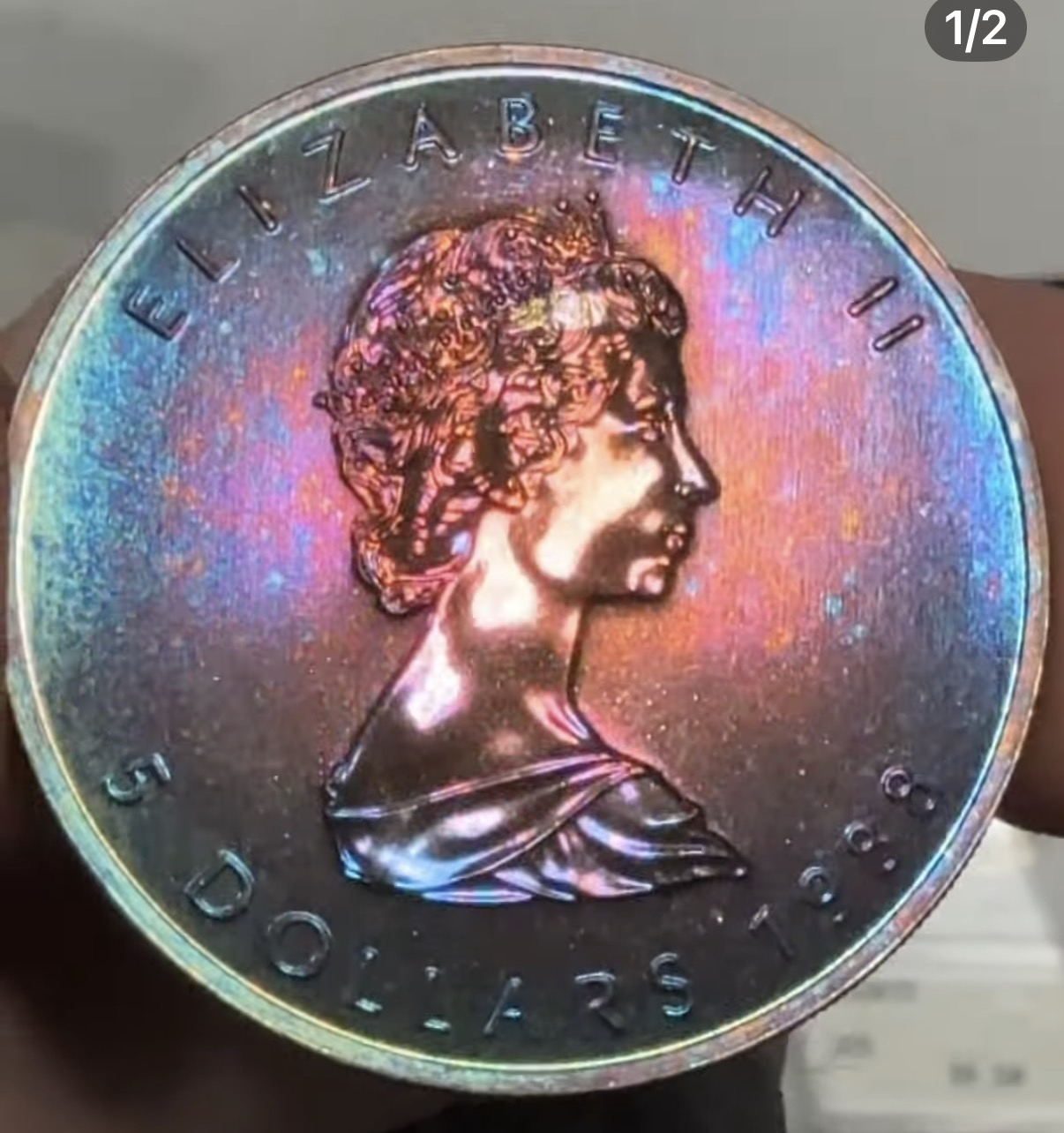
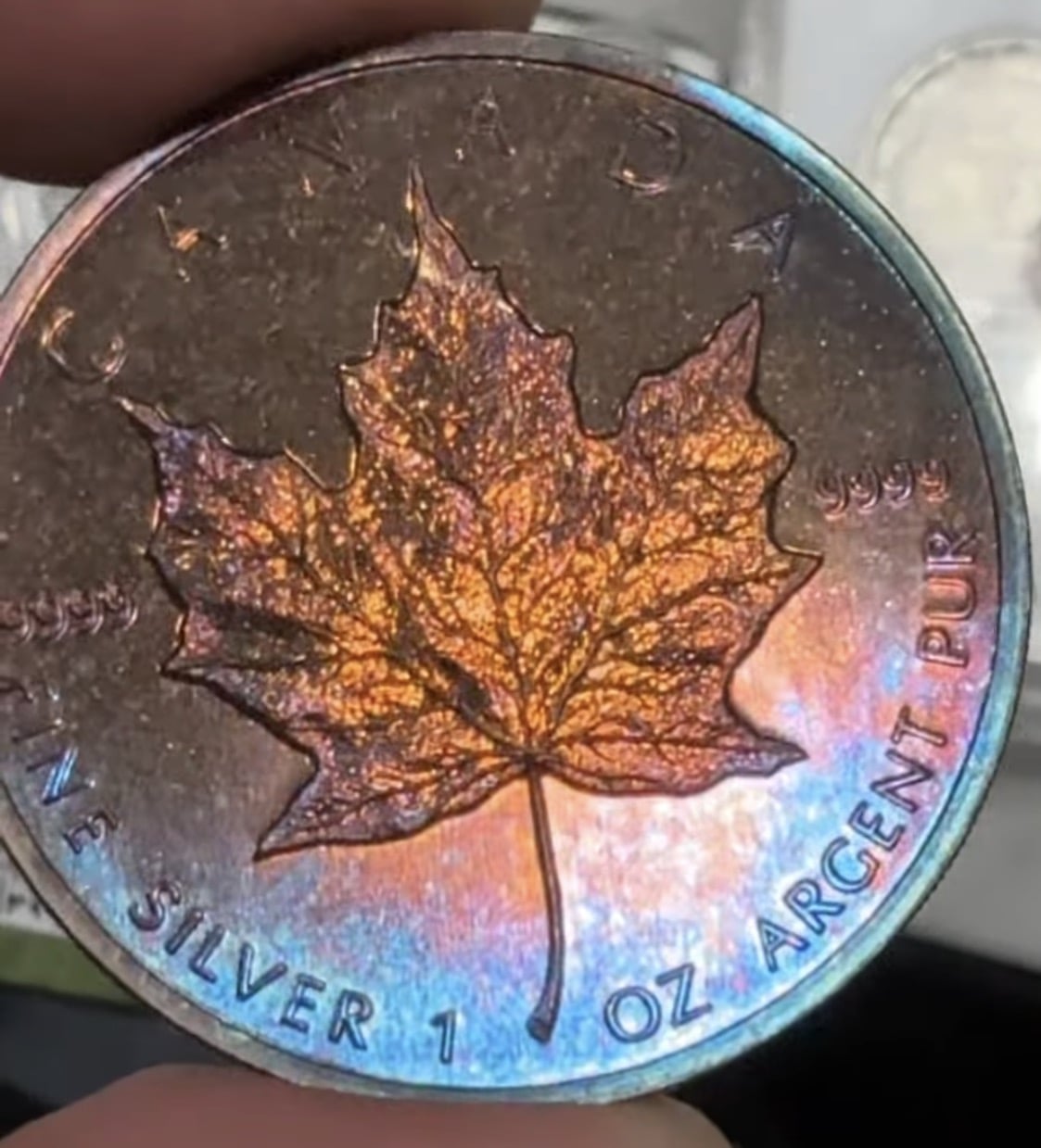
WD-40 and a BBQ?
AT
Air blown thru a plastic garden hose inside of a heated copper pipe directed at the coin?
Well the craze was once Taco Bell Napkins...
https://forums.collectors.com/discussion/527026/taco-bell-napkin-update/p1
Thank you very much for bringing that old thread back to the forum. The technical discussion it generated provided an excellent flow of data and information that I was lacking for the development of my experiment. Best regards!
Kudos to @Mr_Spud @ricarf2386 and @dunkleosteus430 for having the courage to post their "experiments"
Here are my experimental results: (Yes - a while back, I tried to see what would happen if I tried to clean some actually worthless clads that had some odd chemical spots on them.)
The interesting part is that, the process was soaking overnight. I washed them off and noticed that the chemical change to the nickel was pretty deep. That tarnish is not superficial.
What's wrong with ruining some pocket change before it loses its value altogether? I'm in agreement with the idea that experiments like this are interesting.
Side note story: I had a friend who ran an electroplating company who would chrome plate pennies for his friends. No FBI agents or Secret Service came looking for him. He also did all the local police department and state trooper badges, which were strictly monitored and accounted for.
Thanks for the shoutout, @rooksmith! I truly appreciate you taking my posts into consideration.
Reading your results makes me realize that opening this debate was completely worth it. It seems many of us had our own private experiments hidden away! I honestly believe that deep down, we all keep that inner child alive—the one who loves to experiment and see what happens when a crazy idea pops into our heads. That’s exactly what pushes us to learn, and I think it's awesome. May we stay curious like that forever!
By the way, that Lowell quarter looks absolutely beautiful. Even though the toning is heavily cranked up and intense, the colors and gradients flow so perfectly that it honestly looks like a piece of art painted by a master artist.
Thanks for sharing these wild results with the community!
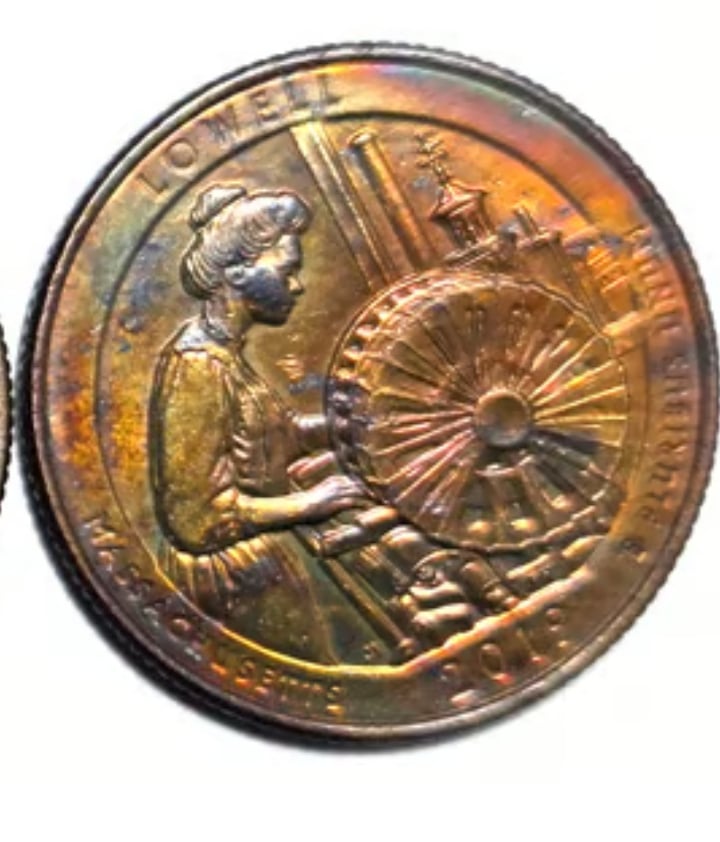
Re the ATB quarters. I cant really show the shimmer that these coins have. Yes they are darker than the originals, but its a nice copper color with blue highlights.
I tried to shoot a video clip of the same coins with different lighting. (and on an angle) I dont know if this will work worked but heres the link to a google photo: GooglePhoto external link
What are the thoughts about this one? I bought it this way. PCGS didn't approve.
The fundamental cause of toning on coins is long-term storage, mostly inside vintage albums or folders, where the accumulation of sulfur combined with environmental factors helps it develop. However, this is a very long process. On your particular coin, we can see a highly developed toning on both sides. Since this piece is not that old, that alone gives strong reasons to believe it is artificial toning (AT). Unless you can share the story of how you acquired it, which might provide a different explanation.
The green obverse areas seem to be biological attack / impact heat and humidity. Over time coins can go bad in the holders / bad tarnish. I agree with PCGS on that one. When people bring tarnished stuff like that to my table ……no go for me. Reverse green areas / what’s your theory? Reminds me of some MRR projects….
However not to worry - shop it around the bourse….
I bought the Peace Dollar from a forum member several years ago who said it had been left on a bookshelf somehow.
My opinion, AT, but if you like it, that's all that matters
To be honest, your image got stuck in my head for quite a while, and my imagination just took off, hahaha! It truly served as a great inspiration. I hope you like it, and here is a quick mockup of a t-shirt I put together as a sample.
I think I'll put the Toned Peace Dollar up on the BST for 310 shipped. I've had it long enough.
Too bad about your peace dollar.
@dcarr Well said with more contempt than deserved!
THKS!
The whole worlds off its rocker, buy Gold™.
BOOMIN!™
Wooooha! Did someone just say it's officially "TACO™" Tuesday????
Retiring at 55, what day is today?
Looks like a super toner bet it will sell.
Here’s what’s left of the rest of my old AT experiments from 20+ years ago. I still have them, most haven’t changed very much at all.
Mr_Spud
Hello Mr. Spud,
The nickel is the one that
caught my attention the most.
Looking at the quarters,
I notice that the toning
only happened on one side,
so I imagine only that side
was treated to achieve
the toning.
Thank you for sharing
the images and your experience.